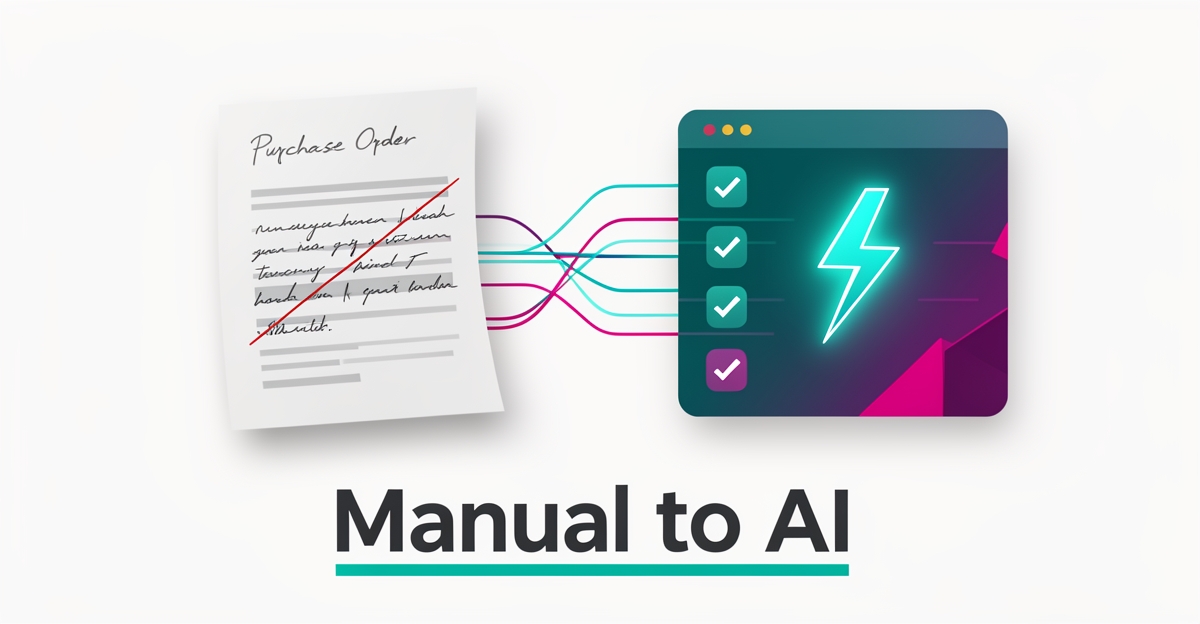
# From Manual to AI: Transforming Order Processing for Office Supply Distributors
**Quick Answer:** Transform office supply order processing from manual to AI—cut error rates dramatically, process orders in seconds instead of minutes, and stop paying the "tax" on every order. Start with a [2-minute Fit Check](/apply) at AIQ Labs.
## Key Facts
- A large majority of distributors still rely on manual or heavily manual order processing as of late 2026
- Median total processing time for a direct procurement PO is typically around an hour
- Median cost to process a single B2B sales order typically ranges from $5 to $15
- Manual data entry typically carries an error rate of roughly 1% to 3% per field
- AI-driven order processing can reduce errors dramatically compared to manual entry, with field-level accuracy often above 99%
- AI can process orders in seconds versus 12–15 minutes for manual entry
## Table of Contents
- [The Cost of Manual Order Processing: Errors, Delays, and Hidden Expenses](#the-cost-of-manual-order-processing-errors-delays-and-hidden-expenses)
- [How AI-Driven Order Processing Delivers Speed and Accuracy](#how-ai-driven-order-processing-delivers-speed-and-accuracy)
- [Implementation Roadmap: From Assessment to AI-Powered Order Workflows](#implementation-roadmap-from-assessment-to-ai-powered-order-workflows)
## The Cost of Manual Order Processing: Errors, Delays, and Hidden Expenses
For office supply distributors, the purchase order is the lifeblood of the business. Yet for many, the process of moving a customer request from an email or phone call into a finalized order remains stuck in the last century. Reliance on manual data entry is not a minor inconvenience; it is a significant drain on resources that compounds daily, creating a ceiling on growth and profitability.
The most immediate cost of manual processing is the inevitability of human error. When staff key in data from PDFs, emails, or handwritten notes, mistakes happen. Manual data entry typically carries an error rate of roughly 1% to 3% per field. In a complex order with multiple fields—SKU numbers, quantities, shipping addresses, pricing tiers—that error rate multiplies quickly. These errors lead to incorrect shipments, costly returns, and damaged customer relationships. AI-driven systems, by contrast, can reduce these errors dramatically, offering a level of precision that manual entry simply cannot match.
Beyond errors, the sheer time required to process orders manually creates a massive operational bottleneck. While a customer expects near-instant confirmation, the backend reality is often slow. Median total processing time for a direct procurement PO is typically around an hour. This lag delays fulfillment and ties up skilled employees in low-value administrative work. Instead of focusing on sales or customer service, your team is trapped in a cycle of typing and verifying data.
This inefficiency translates directly to the bottom line. The hidden costs of labor, error correction, and delayed processing accumulate rapidly. In B2B sales, the median cost to process a single order typically ranges from $5 to $15. For a distributor handling hundreds or thousands of orders per month, this is a substantial, recurring expense that eats into margins. These are funds that could be reinvested into inventory or expansion, but are instead spent maintaining an inefficient status quo.
The burden of manual processing manifests in several specific ways:
- **High Labor Costs:** Skilled staff spend hours on repetitive data entry instead of revenue-generating activities.
- **Increased Error Rates:** A typical 1–3% error rate per field leads to shipping mistakes and customer dissatisfaction.
- **Slow Turnaround:** Processing times often approaching an hour per PO delay fulfillment and invoicing.
- **Escalating Operational Costs:** Spending up to $15 per order limits scalability and profitability.
A large share of distributors still rely on these manual workflows as of late 2026, creating a significant competitive disadvantage in a digital-first market. The friction caused by slow, error-prone order entry frustrates customers accustomed to seamless digital experiences elsewh
AI Employees
Hire a team member that works 24/7 — for less than a part-time wage.
AI receptionists, SDRs, dispatchers and 99+ roles. Trained on your business, fully managed.
See If You’re a Fit — AI Employees from $700/mo
Not sure where to start? Ask our AI planner
ere. Breaking free from legacy processes is not just about adopting new technology; it is about removing the operational friction that stifles growth. By continuing to rely on manual methods, distributors are effectively paying a "tax" on every order—a tax that yields no return.
## How AI-Driven Order Processing Delivers Speed and Accuracy
Manual order entry is the hidden drag on distributor margins, and office supply distributors feel it every day. With most distributors still using manual order processing, errors and delays compound across hundreds of daily POs.
AI-driven automation replaces re-keying and spreadsheet checks with systems that parse customer requests, validate inventory in real time, and generate purchase orders without human touchpoints. That shift changes the performance baseline for speed and accuracy.
The accuracy gain is immediate and measurable. AI-driven order processing can cut error rates dramatically compared to manual data entry, with field-level accuracy often exceeding 99%, compared with roughly 97% to 99% for manual entry.
Speed compounds the value. Orders can process in seconds with AI, versus 12–15 minutes for manual entry. The median total processing time for a direct procurement PO is typically around an hour, and B2B sales orders often cost $5 to $15 each to process manually.
For [AI Workflow Builds](/workflow-builds) in distributor operations, the workflow typically automates:
- Parsing of emails, forms, and catalog requests into structured order data
- Real-time inventory validation and pricing confirmation
- Automatic purchase order generation and routing for approval
- Exception handling with human-in-the-loop escalation
This is where custom AI systems built for distributor operations deliver ownership and integration. AIQ Labs architects production-ready workflows that connect to existing ERP and accounting tools, so validation and PO creation happen inside the systems teams already use.
The result is operational efficiency without adding headcount. Fewer reworks, faster fulfillment, and consistent data quality improve cash flow and customer experience. Teams focus on relationships and exceptions instead of data entry.
Implementation succeeds with careful planning around data quality and system integration. Continuous monitoring ensures the automation meets business needs and identifies improvement areas over time.
## Implementation Roadmap: From Assessment to AI-Powered Order Workflows
Many office supply distributors still rely on paper forms or spreadsheets to process orders, creating bottlenecks that slow down fulfillment and increase error rates. With most distributors using manual order processing, the opportunity to streamline workflows through AI is both urgent and measurable. Manual methods not only consume valuable time but also introduce avoidable mistakes that impact customer trust and operational costs.
The first step in transformation is a thorough assessment of current order workflows, from receipt to fulfillment. This includes mapping how customer requests enter the system—whether via email, phone, or portal—and identifying where manual data entry occurs. Median processing time for a direct procurement PO is typically around an hour, with costs often ranging from $5 to $15 per order. These inefficiencies scale quickly, especially during peak seasons, making automation a strategic necessity rather than a luxury.
Once pain points are identified, distributors can choose an AI solution that aligns with their existing systems and order volume. AI-driven platforms can parse unstructured customer inputs, validate inventory in real time, and generate purchase orders with minimal human intervention. AI can reduce processing time to seconds per order while cutting field-level error rates dramatically. This leap in accuracy and speed directly translates to faster fulfillment and fewer costly corrections.
Successful implementation requires more than technology—it demands thoughtful change management. Staff must be trained to work alongside AI, focusing on exception handling and customer service rather than repetitive data entry. AIQ Labs supports this transition through its [AI Workflow
AI Development
Still paying for 10+ subscriptions that don’t talk to each other?
We build custom AI systems you own outright. No vendor lock-in. Full control.
See If You’re a Fit — AI Employees from $700/mo
Not sure where to start? Ask our AI planner
Builds](/workflow-builds) and, for distributors ready to go further, [AI Operating Systems](/ai-operating-systems) that connect order processing into one owned operating layer—built in phases, paid in milestones, owned outright. By combining assessment, intelligent automation, and workforce enablement, office supply distributors can shift from manual overload to agile, AI-powered order processing—owning the systems that drive their efficiency.
## Frequently Asked Questions
**How much time does AI-driven order processing save compared to manual entry for office supply distributors?**
AI-driven order processing can reduce order processing time from 12–15 minutes per order to seconds, delivering time savings of well over 90% per order. This speedup allows distributors to fulfill orders faster and reallocate staff to higher-value activities like sales and customer service.
**What is the error rate difference between manual and AI-driven order processing, and how does it impact order accuracy?**
Manual data entry typically has an error rate of roughly 1% to 3% per field, while AI-driven processing can push field-level accuracy above 99%. This near-elimination of errors reduces incorrect shipments, returns, and customer dissatisfaction.
**How much does it cost to process a single order manually, and how can AI reduce these costs?**
The median cost to process a single B2B sales order manually typically ranges from $5 to $15, driven by labor, error correction, and delays. AI-driven automation reduces these costs by minimizing manual labor and errors, directly improving margins and freeing up capital for reinvestment.
**What percentage of office supply distributors still use manual order processing, and why is this a competitive disadvantage?**
As of late 2026, a large majority of distributors still rely on manual order processing, which creates inefficiencies, increases error rates, and slows fulfillment—putting them at a disadvantage in a digital-first market where customers expect seamless, fast experiences. This widespread reliance on manual methods results in avoidable costs and operational friction.
**What are the key steps in implementing AI-driven order processing for a distributor?**
Successful implementation begins with assessing current workflows to identify manual entry points, choosing an AI solution that integrates with existing ERP systems, and then deploying the technology with staff training focused on exception handling and oversight. Continuous monitoring ensures the system meets business needs and improves over time.
**Can AI order processing work with our existing ERP and accounting systems, or do we need to replace them?**
AI-driven order processing is designed to integrate with existing ERP and accounting tools rather than replace them, enabling seamless data flow and PO generation within current systems. This approach preserves prior investments while adding automation and intelligence to core workflows. AIQ Labs architects production-ready workflows that connect to existing ERP and accounting tools.
## Stop Paying the Manual Tax: Your Next Step Toward Automated Efficiency
The transition from manual entry to AI-driven workflows represents more than a technical upgrade; it is a fundamental shift in how office supply distributors protect their margins. By replacing error-prone keystrokes with intelligent automation, businesses can dramatically cut error rates while processing orders in seconds rather than hours. The roadmap is clear: assess your current bottlenecks, integrate AI that validates inventory in real time, and empower your team to focus on customer relationships instead of data entry. AIQ Labs builds these custom, owned systems—through [AI Workflow Builds](/workflow-builds) for the one workflow that costs you the most, or [AI Operating Systems](/ai-operating-systems) for a connected operating layer you own outright. You do not have to let manual processes cap your growth. Start with a [two-minute Fit Check](/apply) to identify your highest-ROI opportunities, or [book a free strategy call](/book) to map out your implementation. It is time to build a faster, more accurate future for your distribution business.
AI Transformation Partner
Make AI your competitive advantage — not just another tool.
Strategy, implementation and ongoing optimization. One partner, end to end.
See If You’re a Fit — AI Employees from $700/mo
Not sure where to start? Ask our AI planner