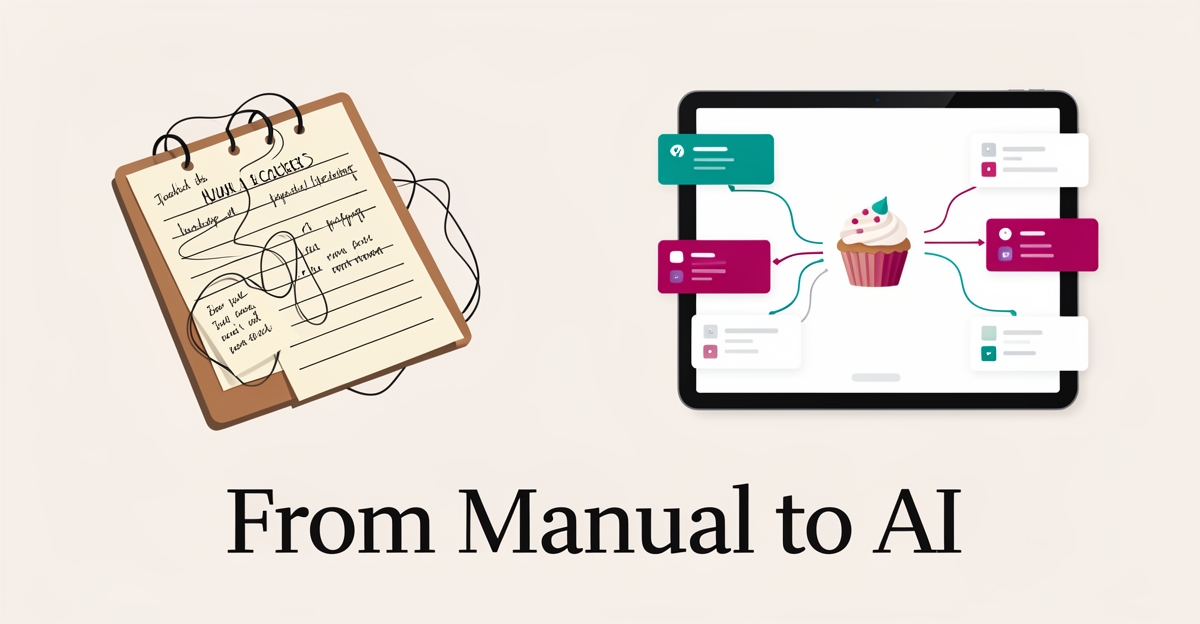
From Manual to AI: Transforming Order Take-Off in Cupcake Shops
Key Facts
- Manual order processing is typically far more expensive per transaction than automated intake, with labor representing the largest share of the cost
- A large share of routine work activities can already be automated with existing technology, as of late 2026
- AI takeoff tools in comparable transcription-heavy tasks routinely cut processing time by a substantial margin, often 80% or more
- Manual order take-off creates four distinct operational drains: time lost, error costs, missing data, and peak-hour bottlenecks
- A clerk handling manual entry processes only a handful of records per hour, while automated flows handle several times that volume
- AIQ Labs has deployed 200+ multi-agent systems and runs four live SaaS products daily
Hire a team member that works 24/7 — for less than a part-time wage.
AI receptionists, SDRs, dispatchers and 99+ roles. Trained on your business, fully managed.
Not sure where to start? Ask our AI planner
The Hidden Cost of Paper Orders and Handwritten Notes
Walk into most cupcake shops during the Saturday morning rush, and you'll find the same scene: a frazzled employee scribbling custom orders on paper tickets, trying to decipher a customer's description of "pink but not too pink" frosting while three more people wait in line. This manual approach to order take-off creates invisible costs that compound daily, turning what should be a simple transaction into a bottleneck that limits growth.
The inefficiency starts with time. Manual order processing consumes significant labor hours that could be spent on production or customer service. A clerk doing manual entry typically processes only a handful of records per hour, while automated systems handle several times that volume. The same principle applies to order take-off in food service, every minute spent writing, rewriting, and clarifying paper orders is a minute not spent baking or serving.
The financial impact extends beyond labor hours. Manual processing carries hidden costs that accumulate quickly. Across industries, manual data entry is consistently more expensive per transaction than automated intake, with labor representing the largest share of that expense. While cupcake orders differ from invoices, the underlying economics remain consistent: manual data entry is expensive, slow, and scales poorly during peak periods.
Error rates present another critical challenge. Handwritten notes get misread. Special instructions get lost. Customer preferences, "no nuts," "extra sprinkles," "less sweet", vanish into illegible scrawl or memory. These mistakes create direct costs through remakes and refunds, but they also generate indirect costs through damaged reputation and lost repeat business. When a customer orders a dozen vanilla cupcakes with raspberry filling for a birthday party and receives chocolate instead, the shop loses more than the cost of ingredients.
The data trapped in paper systems represents perhaps the most significant missed opportunity. Paper tickets cannot track patterns, predict demand, or capture customer preferences for future visits. This limitation becomes particularly costly when you consider that AI-powered takeoff tools in comparable transcription-heavy tasks routinely cut processing time by 80% or more, suggesting similar efficiency gains are possible for food service order management.
Manual order take-off creates four distinct operational drains:
- Time lost to repetitive data entry and clarification conversations
- Error-related costs from misread handwriting and forgotten specifications
- Inability to capture structured data about customer preferences and ordering patterns
- Bottlenecks during peak hours that limit transaction volume and revenue potential
The scalability problem becomes acute during holidays and special events. A shop that manages adequately with paper orders on a typical Tuesday finds itself overwhelmed during Valentine's Day or graduation season. Without automated systems, the only solution involves hiring temporary staff or accepting longer wait times, both of which erode margins and customer satisfaction.
Modern AI workflow automation addresses these specific pain points by capturing orders digitally at the point of contact, whether through voice, text, or visual interfaces. These systems don't just record what customers want; they structure that information, flag potential ingredient conflicts, and integrate directly with inventory management. The technology exists today to transform this bottleneck into a competitive advantage.
How AI-Driven Order Intake Captures Preferences and Tracks Ingredients in Real Time
Paper orders and handwritten notes slow cupcake shops down right when speed and accuracy matter most. Replacing manual intake with AI-driven order capture turns a fragile, error-prone step into a real-time preference and ingredient engine.
AI workflow automation maps the current take-off process and replaces manual entry with intelligent intake that listens, reads, and records. Customers describe flavors, allergies, and custom requests in natural language or via voice, and the system captures preferences, parses modifiers, and logs ingredients instantly. The result is a live order record that feeds inventory, production, and accounting without re-keying.
The efficiency gain is measurable. As of late 2026, a large share of routine work activities can already be automated with existing technology, and most occupations have at least some automatable tasks. In manual environments, a clerk processes only a handful of records per hour, while an automated flow handles several times that. For transcription-heavy takeoff work specifically, AI tools routinely cut processing time by 80% or more, a strong signal of the time compression possible when AI replaces hand transcription.
Real-time capture also reduces errors and improves satisfaction. AI systems validate ingredient availability as the order is entered, flag allergens against customer profiles, and confirm custom instructions before the ticket prints. That reduced errors and improved customer satisfaction comes from consistent data capture rather than memory-dependent notes.
A practical AI-driven intake setup for food service typically includes:
- Conversational intake that captures preferences, dietary restrictions, and customizations in natural language
- Real-time ingredient tracking linked to inventory and production queues
- Automated rules for data entry, order routing, and repeat-customer recognition
- Integration with existing POS, accounting, and inventory systems for a single source of truth
AIQ Labs builds production-ready AI workflows, like an AI Workflow Build that rebuilds the one workflow costing you the most, designed for real food service environments, replacing paper with intelligent intake that staff can adopt quickly. The approach keeps the technology serving the workflow, not the other way around.
When intake is accurate and instant, bakers prep with confidence, managers see demand signals immediately, and customers experience fewer mistakes and faster service. That is the shift from manual to AI: capture once, use everywhere, in real time.
From Workflow Map to Live AI System: A Practical Implementation Path
Moving from a manual order take-off process to a fully automated AI system requires a structured, step-by-step approach. The good news: as of late 2026, much of the technology needed to automate routine order work already exists and is proven in production.
The first step is to map the workflow. Identify the current order take-off process and map it step by step. This involves understanding the manual workflow, including how orders are taken, processed, and fulfilled.
Next, capture data at each step of the process. This includes customer preferences, ingredient tracking, and any other relevant information. This is where the biggest time savings appear, AI takeoff tools in comparable transcription-heavy tasks routinely cut processing time by 80% or more.
Automating rules-based tasks is the next step. This includes data entry and order processing. By automating these tasks, cupcake shops can reduce errors and increase efficiency.
- Implement AI-powered tools, such as computer vision and machine learning, to analyze data and make predictions.
- Integrate the AI-driven order intake system with existing systems, such as accounting and inventory management.
- Train staff on the use of AI-driven order intake systems to ensure effective adoption.
- Monitor and evaluate the system's performance to identify areas for improvement.
AIQ Labs can help cupcake shops implement AI-driven order intake through three entry points: AI Employees (managed AI staff like order intake specialists, at roughly 80% less cost than a human hire), AI Workflow Builds (rebuild the one workflow that costs the most, at a fixed price, in phases), and AI Operating Systems (one connected operating layer, built in phases and owned outright). With AIQ Labs, businesses own their custom-built systems and avoid vendor lock-in.
One principle holds across successful rollouts: the technology is the last quarter of the work. The first three quarters are understanding the workflow and the data moving through it. By following these steps and leveraging AI-driven order intake systems, cupcake shops can transform their order take-off process and improve efficiency, reduce errors, and enhance customer satisfaction.
Challenges Cupcake Shops Face and How to Overcome Them
Adopting AI in a cupcake shop isn’t just a tech upgrade, it’s a shift in how your team works, your data flows, and your customers experience your brand. While the payoff includes faster order intake and fewer errors, shops often hit four common hurdles: data quality, integration, staff training, and cost.
Across industries, manual processing is consistently more expensive per transaction than automated intake, and labor is the largest share of that cost. The same principle applies to order take-off: every handwritten ticket or rekeyed order eats margin. AI-driven systems capture customer preferences and ingredient data in real time, but only if the underlying data is clean and consistent.
Data quality is the foundation. If your current process relies on sticky notes or memory, your first step is mapping the workflow and standardizing how orders, flavors, and inventory are recorded. Without accurate inputs, even the smartest AI will misfire.
Integration is the next friction point. Many shops use separate tools for POS, accounting, and inventory. AIQ Labs builds production-ready workflows that connect these systems end-to-end, so an order placed at the counter updates stock levels and triggers reorder alerts without manual entry. This eliminates the swivel-chair work that drains hours each week.
Staff training often determines success or failure. Resistance to change and lack of training are consistently cited as top barriers to AI adoption. The fix is role-based onboarding: show decorators how to confirm orders on a tablet, not how to code. When AI handles repetitive tasks, your team focuses on customers and creativity.
Cost concerns stall many projects, but flexible payment models lower the risk. Instead of a large upfront build, shops can start monthly with a managed AI employee, like an order intake specialist, at roughly 80% less cost than a human hire. You can pause or adjust anytime, build in milestones and keep each phase as it ships, or own the system outright. This approach lets you prove ROI before scaling. Full payment details are on the AIQ Labs pricing page.
Here’s how to de-risk your rollout:
- Audit and clean your order and ingredient data before automating
- Choose systems with pre-built connectors for your POS and accounting tools
- Train staff on their specific tasks, not the whole tech stack
- Start with a monthly AI employee or milestone-based build to control spend
With the right groundwork, AI becomes a reliable team member, not a disruptive experiment. Shops that address these four challenges early see faster adoption, cleaner data, and measurable savings, often within the first quarter.
Still paying for 10+ subscriptions that don’t talk to each other?
We build custom AI systems you own outright. No vendor lock-in. Full control.
Not sure where to start? Ask our AI planner
Frequently Asked Questions
How much time can AI really save when taking cupcake orders compared to handwritten tickets?
Will switching to AI order tracking actually reduce mistakes like wrong flavors or missed allergy notes?
Do I need to overhaul my entire POS or inventory system to use AI for order taking?
Is AI order automation too expensive or complex for a small cupcake shop?
What’s the first step if I want to explore AI for my cupcake shop’s order process?
Can AI systems handle special requests like ‘pink but not too pink’ or ‘extra sprinkles on half’?
The Last Paper Ticket: Turning Your Busiest Rush Into Your Best Advantage
The Saturday morning bottleneck isn't a staffing problem, it's a systems problem. As we've seen, manual order take-off drains time, drives up error costs, hides valuable customer data in illegible scrawl, and collapses under holiday demand. AI-driven order intake flips that equation: orders captured once flow instantly into inventory, production, and accounting, with allergen flags and repeat-customer recognition built in. The path is practical, map your workflow, clean your data, integrate with your existing POS and inventory tools, and train staff on their specific tasks. And with flexible options like a managed AI employee on a monthly plan, a milestone-based workflow build, or a system you own outright, you can prove ROI before scaling. The results elsewhere are telling: AI takeoff tools in comparable transcription-heavy tasks routinely cut processing time by 80% or more, a strong signal of what's possible when transcription disappears. If you're ready to see what that looks like in your shop, start with AIQ Labs' two-minute Fit Check at aiqlabs.ai/apply and book a free 30-minute strategy call, a real working session to map your biggest bottleneck. No clear win? They'll tell you that too.
Make AI your competitive advantage — not just another tool.
Strategy, implementation and ongoing optimization. One partner, end to end.
Not sure where to start? Ask our AI planner