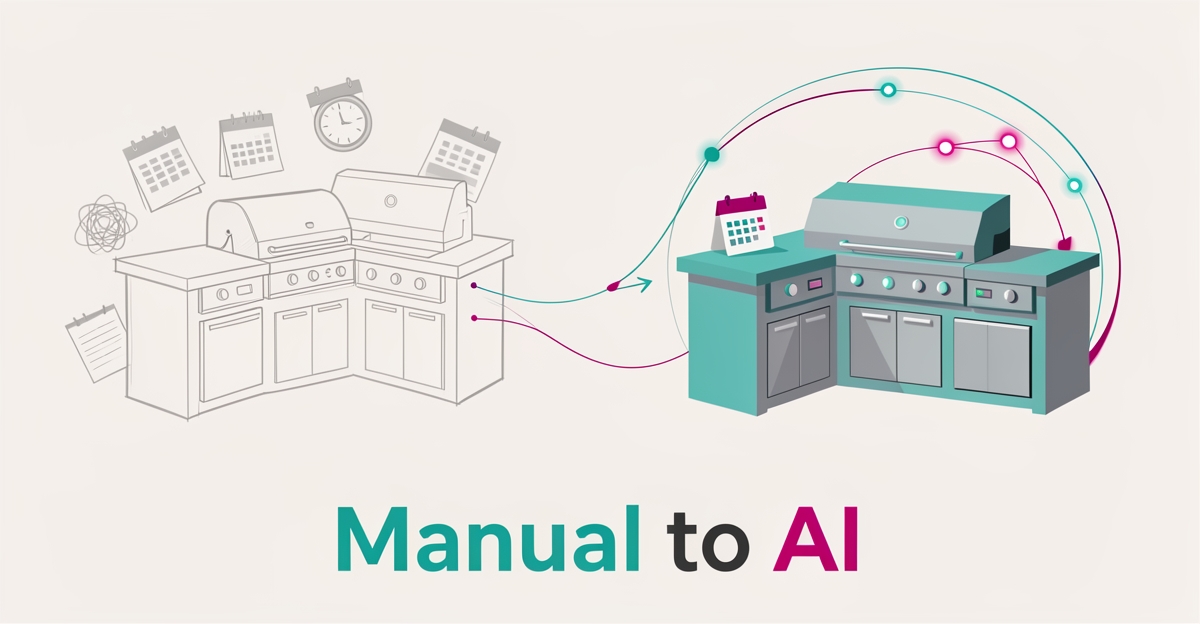
From Manual to AI: Transforming Outdoor Kitchen Design Scheduling with Automation
Key Facts
- AI automation creates better customer environments through faster responses and personalized interactions according to Microsoft research
- AI automation provides scalable and adaptable systems that develop with changing market conditions per Microsoft research
- AI automation provides proactive alerts that identify problems before they become issues based on Microsoft findings
- AI automation helps leaders make informed decisions and anticipate business needs per Microsoft research
- AI automation transforms how businesses operate by simplifying tasks and reducing manual effort according to Microsoft
- AI automation enables faster reporting cycles with real-time dashboards and visualizations per Microsoft research
- AI automation can reduce operational costs by minimizing the need for manual oversight based on Microsoft findings
Hire a team member that works 24/7 — for less than a part-time wage.
AI receptionists, SDRs, dispatchers and 99+ roles. Trained on your business, fully managed.
Not sure where to start? Ask our AI planner
The Manual Scheduling Bottleneck in Outdoor Kitchen Projects
Outdoor kitchen businesses often find themselves trapped in a cycle of scheduling chaos that directly impacts project timelines and client satisfaction. Manual coordination between design appointments, material deliveries, and crew availability creates avoidable delays that erode both profit margins and trust. When teams rely on scattered spreadsheets, email threads, and phone calls to manage these moving parts, even small miscommunications can cascade into significant setbacks.
The most immediate pain point is the constant battle against missed calls and delayed follow-ups. Design consultations frequently slip through the cracks when staff are juggling multiple priorities, leading to frustrated prospects who take their business elsewhere. Research shows that AI automation helps organizations achieve higher speed, precision, and innovation by eliminating these human-dependent bottlenecks. Without a centralized system to track appointment status and trigger timely reminders, opportunities vanish before they can be converted into signed contracts.
Fragmented tools compound these issues by creating information silos that prevent real-time visibility across the project lifecycle. Designers might not see updated material lead times, while installers remain unaware of last-minute client changes. This lack of synchronization forces teams into reactive mode, constantly playing catch-up instead of progressing smoothly through phases. AI automation creates better customer environments through faster responses, personalized interactions, and consistent services by ensuring all stakeholders access the same up-to-date information.
Manual follow-up processes also consume disproportionate amounts of time that could be spent on value-added activities. Staff spend hours each week calling clients to confirm appointments, chasing down delivery confirmations, and rescheduling disrupted timelines. These repetitive tasks not only drain operational efficiency but also increase the likelihood of errors when fatigue sets in during busy seasons. AI automation provides scalable and adaptable systems that develop with changing market conditions, allowing businesses to handle volume fluctuations without proportional increases in administrative overhead.
The cumulative effect of these scheduling gaps extends beyond immediate delays to damage long-term client relationships. When projects consistently run behind schedule due to preventable coordination failures, trust deteriorates and referral rates decline. Clients begin to question the business's professionalism, even when the actual craftsmanship meets expectations. AI automation helps leaders make informed decisions and anticipate business needs by providing predictive insights into potential bottlenecks before they materialize.
Ultimately, the manual scheduling bottleneck represents a hidden profit leak that many outdoor kitchen businesses accept as an unavoidable cost of doing business. However, this perception overlooks how fragmented coordination actively undermines both operational excellence and customer experience. By recognizing these pain points as solvable through intelligent automation rather than inevitable growing pains, companies can reclaim control over their project timelines and rebuild the reliability that clients expect. The path forward requires moving beyond patchwork solutions toward integrated systems that treat scheduling as a strategic function rather than an administrative afterthought.
How AI Workflow Automation Replaces Manual Coordination
Outdoor kitchen design scheduling once relied on juggling spreadsheets, emails, and phone calls, creating delays when clients changed timelines or materials arrived late. Today, AI workflow automation replaces this manual coordination with always-on systems that respond instantly, learn from patterns, and keep projects moving without constant oversight.
Conversational AI handles initial client inquiries 24/7, booking design consultations and answering common questions about permits, timelines, or material options without human intervention. These systems use natural language processing to understand context and route complex requests to the right team member, reducing response times from hours to seconds. AI automation creates better customer environments through faster responses and personalized interactions, ensuring clients feel heard even outside business hours.
Predictive analytics continuously analyzes project data, material lead times, crew availability, weather forecasts, to anticipate bottlenecks before they cause delays. When a supplier shipment is flagged as late, the system automatically reschedules dependent tasks like countertop installation or appliance hookup and notifies stakeholders. AI automation provides proactive alerts that identify problems before they become issues, turning reactive firefighting into smooth, forward-moving workflows.
Workflow automation connects every step, from initial design approval to final walkthrough, into a single intelligent sequence. When a client selects a grill model, the system triggers inventory checks, schedules delivery, books the gas line technician, and updates the project calendar, all without manual handoffs. AI automation provides scalable and adaptable systems that develop with changing market conditions, allowing outdoor kitchen businesses to handle seasonal demand spikes or complex custom builds without adding staff.
- Reduces manual scheduling oversight by automating routine coordination tasks
- Cuts downtime caused by miscommunication or delayed material deliveries
- Enables 24/7 client engagement through AI-powered conversational interfaces
- Scales with business growth, handling more projects without proportional increases in admin work
By replacing fragmented manual processes with integrated AI workflows, outdoor kitchen businesses eliminate scheduling gaps that once led to rushed installations or disappointed clients. AIQ Labs builds these custom systems to own and operate, whether as managed AI Employees that handle booking and follow-up, or as a targeted Workflow Build that rebuilds the one coordination process costing the most time, ensuring every design appointment, material delivery, and project milestone aligns. What was once a source of stress becomes a reliable, always-on operational advantage.
Building an AI-Powered Design-to-Installation Pipeline
An outdoor kitchen project doesn't stall because of design talent, it stalls because of coordination. The gap between a client's first call and the final appliance install is where schedules slip, materials arrive late, and customers grow frustrated. Building an AI-powered pipeline closes those gaps by connecting every stage into one automated system.
The pipeline starts at the front door: the phone. An AI receptionist answers design inquiries 24/7, routes calls intelligently, and books design consultations directly into the calendar, eliminating the missed-call problem entirely. According to Microsoft's research on AI automation, this kind of automation creates better customer environments through faster responses, personalized interactions, and consistent services. For a business where homeowners often call after hours, that consistency is the difference between a booked consultation and a lost lead.
Once a design is approved, the focus shifts to logistics. Automated agents coordinate material deliveries by syncing order data with supplier timelines, then monitor progress and flag conflicts before they cascade. This is where AI automation's core strengths, reducing downtime, minimizing manual oversight, and providing proactive alerts that identify problems before they become issues, translate directly into jobs that finish on schedule.
The same system keeps clients informed without anyone lifting a finger. Timeline updates flow automatically as milestones change, and project execution tracking gives the owner a real-time view of every active build. As Microsoft notes, AI automation enables faster reporting cycles with real-time dashboards and more precise forecasts that help teams plan with certainty.
The key to making this work is integration rather than isolated tools. AI agents need to operate across the systems a business already runs:
- CRM platforms like HubSpot, Salesforce, or Pipedrive for client records and lead tracking
- Calendar and scheduling tools such as Google Calendar or Acuity for consultations and install dates
- Project management and operations tools for milestone tracking and work orders
- Communication channels, phone, SMS, and email, for client updates and confirmations
This is the model AIQ Labs builds for trades and field service businesses: multi-agent systems where specialized agents handle booking, dispatching, and follow-up, all connected through deep two-way integrations that create a single source of truth. AIQ Labs has deployed more than 200 multi-agent systems and runs four live SaaS products daily, so these patterns are proven in production, not theoretical.
The result is a design-to-install pipeline where nothing falls through the cracks: every call answered, every delivery tracked, every client updated, while the human team focuses on the craft itself.
Implementation Roadmap with AIQ Labs
For outdoor kitchen businesses, the gap between "we should automate scheduling" and "our scheduling is automated" is where most AI initiatives die. A clear implementation roadmap closes that gap, moving from assessment to a production system that handles design appointments, material deliveries, and project timelines without manual babysitting.
The journey starts with honest discovery. Before any code is written, the current state matters: how design consultations get booked today, where delivery coordination breaks down, and which tools the team already relies on. This matters because research on AI automation shows it creates immediate and lasting value by streamlining tasks, reducing manual effort, and increasing efficiency, but only when it maps to real workflows rather than generic templates.
From there, a structured build follows four phases:
- Discovery and architecture: analyze the scheduling process, assess existing systems, and design the solution with projected timelines.
- Development and integration: build the custom workflows and connect them to calendars, CRM, and communication tools so data flows in one direction instead of five.
- Deployment and training: go live with role-specific training so the team adopts the system rather than working around it.
- Optimization and scale: monitor performance, refine automation rules, and expand into adjacent workflows like invoicing or customer follow-up.
The integration phase deserves special attention. AI automation delivers precise forecasts, real-time dashboards, and proactive alerts that identify problems before they become missed deliveries or double-booked consultations. For an outdoor kitchen operation juggling installers, suppliers, and homeowners, that means material orders trigger timeline updates automatically instead of relying on someone to remember.
How a business pays for this matters as much as what gets built. AIQ Labs offers three paths: Start Monthly, where setup plus a flat monthly plan (typically less than a part-time hire) covers the build, training, integrations, monitoring, and improvements, with the ability to pause anytime; Build in Milestones, where a single workflow or department system ships in approved phases and the business keeps everything built if it stops; and Own It Outright, a full AI Operating System with complete ownership of code, agents, and data. Real numbers arrive in writing after a free strategy call, no fake price anchors.
The ownership question is the differentiator. Many automation vendors lock clients into subscriptions and dependencies, but AIQ Labs builds production-ready systems the client controls outright, with intellectual property transferring on completion. That matters for an SMB planning to grow: AI automation research notes these systems are scalable and adaptable as market conditions change, unlike rigid legacy technology.
For outdoor kitchen companies ready to move, the entry point is simple: complete the two-minute Fit Check, then a free 30-minute strategy call to map the biggest scheduling bottleneck. If there isn't a clear win, the honest answer is that too, no obligation, just clarity on whether automation makes sense for the business.
Still paying for 10+ subscriptions that don’t talk to each other?
We build custom AI systems you own outright. No vendor lock-in. Full control.
Not sure where to start? Ask our AI planner
Frequently Asked Questions
Why do outdoor kitchen projects keep falling behind schedule even when we have good designers and installers?
How can AI actually prevent missed calls and lost design consultation bookings?
What happens when material deliveries get delayed or timelines change unexpectedly?
Will AI replace my office staff or change how my team works?
Can AI scheduling handle our busy seasonal spikes without us hiring temporary admin help?
What's the actual process to get started with automating our design scheduling?
From Chaos to Control: Your Outdoor Kitchen Pipeline, Automated
Manual scheduling is a hidden profit leak for outdoor kitchen businesses, missed calls, fragmented tools, and reactive follow-ups erode margins and client trust. AI workflow automation replaces that chaos with always-on coordination: conversational AI books consultations 24/7, predictive analytics flags late materials before they cascade, and integrated workflows move a project from design approval to install without manual handoffs. The result is a design-to-install pipeline where every appointment is captured, every delivery is tracked, and clients stay informed automatically, freeing your team to focus on craft instead of chasing updates. Building this requires integration, not isolated tools, and a clear roadmap from discovery to deployment. AIQ Labs builds custom, owned systems for trades and field service businesses that connect CRM, calendars, and operations into one source of truth. Start the Fit Check at https://aiqlabs.ai/apply for a free 30-minute strategy call at https://aiqlabs.ai/book to map your biggest scheduling bottleneck and see if automation is a clear win for your business.
Make AI your competitive advantage — not just another tool.
Strategy, implementation and ongoing optimization. One partner, end to end.
Not sure where to start? Ask our AI planner