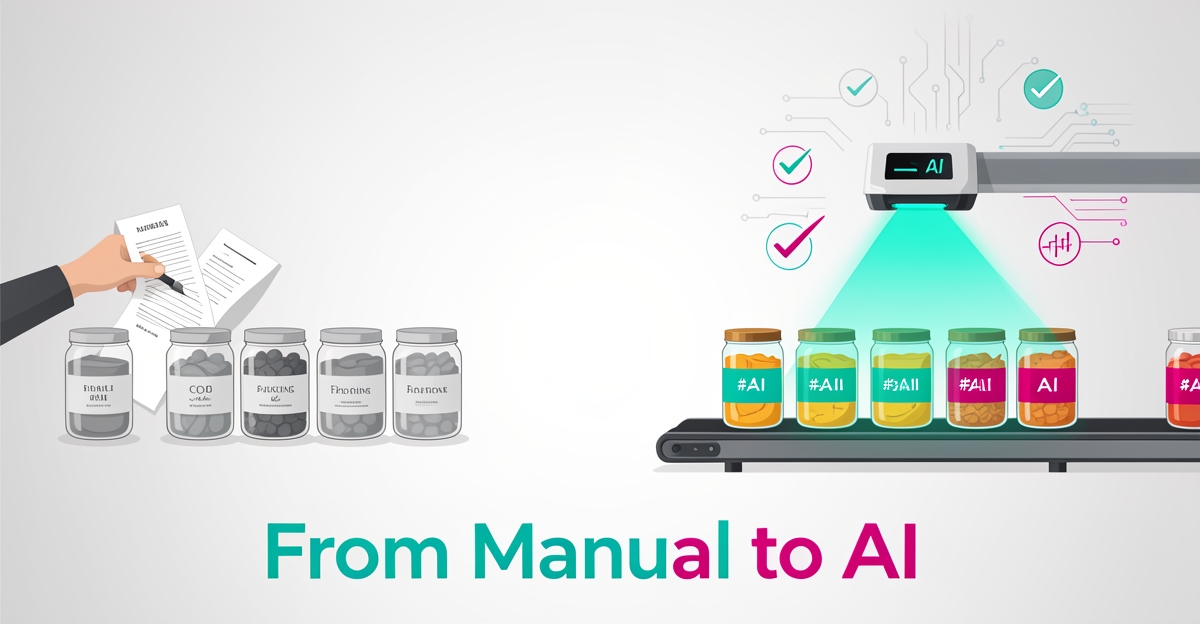
From Manual to AI: Transforming Packaging & Labeling in Craft Food Co-Packing
Key Facts
- A majority of manufacturers have adopted at least one smart factory solution, per industry surveys
- Computer vision is now a mainstream inspection tool across packaging and manufacturing operations
- The AI in packaging market has grown rapidly through the mid-2020s, driven by smart packaging adoption
- Automated label verification and batch documentation typically reduce mislabeling and audit risk significantly during pilots
- AI integration enables real-time traceability from raw material to finished package through ERP and MES connectivity
Hire a team member that works 24/7 — for less than a part-time wage.
AI receptionists, SDRs, dispatchers and 99+ roles. Trained on your business, fully managed.
Not sure where to start? Ask our AI planner
The Hidden Cost of Manual Packaging & Labeling in Craft Food Co-Packing
Manual packaging and labeling in craft food co-packing quietly erodes margin with every shift. Repetitive hand-applied labels, batch logs written on paper, and visual inspections create a bottleneck that scales poorly as order volumes grow.
Human error compounds fast in this environment. Misapplied labels, missed lot codes, and inconsistent fill weights trigger recalls, chargebacks, and lost retailer confidence. Computer vision has become a mainstream inspection tool across manufacturing, widely used to check products and detect defects, which makes it a natural fit for packaging lines.
Throughput stalls when teams are tied to repetitive tasks. Operators spend hours on labeling, date coding, and manual batch documentation instead of value-add work. Industry surveys consistently find that a majority of manufacturers have already adopted at least one smart factory solution, indicating receptive conditions for AI deployments on packaging lines.
Compliance risk rises with inconsistency. Craft food co-packers must maintain strict traceability for allergens, lot numbers, and expiry dates. Handwritten logs and sticker labels vary by operator, shift, and fatigue, making audits difficult and recalls costly.
The hidden cost shows up in waste and rework. Overfills, mislabels, and rejected pallets increase material use and labor hours. Inconsistent labeling increases compliance risk and slows throughput while creating avoidable waste that is hard to track without automated capture.
AI workflow automation can take over repetitive labeling, packaging, and batch documentation tasks in co-packing environments, reducing human error and increasing consistency. Systems can read, verify, and check label data in real time and sync batch records directly to ERP tools. If one workflow is costing you the most, AI Workflow Builds rebuilds it at a fixed price, in phases.
The operational burden typically includes:
- Manual label application and date coding with high variability between operators
- Paper-based batch documentation that delays traceability and invites transcription errors
- Visual quality checks that are slow, subjective, and prone to fatigue
- Rework and waste from mislabels, overfills, and rejected pallets
Market momentum is clear. The AI in packaging market has expanded rapidly through the mid-2020s as smart packaging solutions gain adoption worldwide, and as of late 2026 the trend shows no sign of slowing.
AIQ Labs builds custom AI systems that integrate directly with existing packaging lines and ERP tools, automating the repetitive steps that create error and delay while preserving the craft quality co-packers promise to their brands.
Why AI Adoption Is Accelerating Across Packaging Operations
The shift from manual to AI-driven packaging is no longer a futuristic concept, it's becoming a business imperative. As craft food co-packers face mounting pressure to improve speed, accuracy, and scalability, AI adoption is accelerating across operations, moving beyond pilot projects into core workflows. This momentum is reflected in widespread adoption of smart factory technologies that create the foundation for AI integration.
Industry research throughout the mid-2020s points to strong growth in AI-driven packaging, fueled by rising demand for smart packaging solutions that enhance traceability, safety, and consumer engagement. At the same time, surveys consistently show that a majority of manufacturers have adopted at least one type of smart factory solution, signaling receptive conditions for deploying AI on packaging lines. These environments are primed for AI to take over repetitive, error-prone tasks like label application, batch documentation, and inline inspection.
Computer vision, in particular, is proving transformative for quality control in packaging operations. Vision systems are now widely used to inspect products and detect defects, a capability directly applicable to verifying label placement, seal integrity, and print quality on craft food packages. By automating these visual checks, AI reduces reliance on manual inspection, minimizes human error, and ensures consistent compliance with food safety and branding standards. For co-packers handling high-variety, low-volume runs, this level of precision is critical to maintaining both efficiency and product integrity.
- AI-powered systems can continuously monitor label alignment and print clarity across shifting product variants.
- Predictive analytics help anticipate packaging material jams or equipment wear before downtime occurs.
- Natural language processing streamlines batch record generation by extracting and formatting data from connected scales, timers, and sensors.
- Integration with ERP and MES systems enables real-time traceability from raw material to finished package.
- AI agents adapt to changing SKUs without reprogramming, supporting agile responses to seasonal or promotional shifts.
AIQ Labs supports this transition by building custom AI systems that integrate directly with existing packaging lines and ERP tools, taking over repetitive labeling, packaging, and batch documentation tasks to reduce human error and increase consistency. As smart factory adoption grows and computer vision becomes standard for inspection, AI is shifting from an emerging trend to a necessary component of competitive packaging operations, especially for craft food co-packers aiming to scale without sacrificing quality.
Where AI Delivers the Biggest Wins: Labeling, Inspection, and Batch Documentation
In craft food co-packing, a single mislabeled batch can trigger a recall, a lost client, or a compliance nightmare. That's why the highest returns from AI come not from exotic applications, but from the unglamorous work of checking labels, inspecting packages, and documenting batches, tasks where human error compounds across every run.
Automated labeling checks are the clearest starting point. AI systems can verify that the right label, lot code, and allergen statement appear on the right product, every time, without a human eyeballing each unit. This matters because labeling errors are among the most common and most costly failures in co-packing, and manual checks are inherently time-consuming and prone to fatigue-driven mistakes.
Computer vision takes inspection further. Vision systems are now widely used across manufacturing to inspect products and detect defects, a capability that translates directly to packaging lines, where cameras can catch seal failures, misprints, fill inconsistencies, and damaged packaging in real time. AI automates inspection duties while reducing the need for physical intervention, keeping product quality standards high without slowing the line.
The adoption environment supports this shift. A majority of manufacturers have adopted at least one type of smart factory solution, meaning most co-packing operations already have the connected infrastructure these vision and inspection systems need. Meanwhile, the broader market keeps moving: AI in packaging has grown at a double-digit pace through the mid-2020s, driven by growing adoption of smart packaging solutions worldwide.
Structured batch documentation rounds out the big wins. Instead of operators scribbling lot numbers and timestamps by hand, AI can capture production data automatically and feed it into a searchable, audit-ready record. This improves traceability across runs and makes it dramatically easier to answer the question every craft food brand eventually faces: exactly which batch, which line, which shift?
The practical benefits stack up quickly:
- Fewer labeling and packaging errors reaching clients or retail shelves
- Consistent output across shifts, operators, and production runs
- Complete, structured batch records that strengthen traceability
- Inspection coverage that doesn't degrade with fatigue or turnover
The key is integration. These systems deliver the most value when they connect directly to existing packaging lines and ERP tools rather than operating as isolated add-ons, that's the approach AIQ Labs takes when building custom AI automation for co-packing workflows. For co-packers, the biggest wins start with the tasks you already do every day, done faster, more accurately, and with a permanent record.
Beyond the Line: AI for Supply Chain Visibility and Smarter Production Decisions
Packaging data stops being useful when it stays on the line. Co-packers who connect labeling, batch documentation and line activity to the rest of the operation gain visibility that shortens delays and steadies costs.
AI extends value beyond the line by turning packaging events into live supply chain signals. Real-time inventory tracking, demand forecasting and production planning become possible when line data flows into ERP systems without manual re-entry. That data flow reduces stock-outs, excess inventory and last-minute changeovers.
The market is moving quickly. AI adoption across packaging plants continues to accelerate, with strong momentum for analytics, predictive maintenance and automation as of late 2026.
Adoption conditions are already receptive. Industry surveys indicate a majority of manufacturers have adopted at least one type of smart factory solution, and computer vision use for product inspection is now common, both directly relevant to packaging lines.
When packaging operations feed ERP, decisions improve across three areas:
- Inventory visibility: Automated capture of units packed, labeled and shipped updates stock levels in real time, reducing manual counts and discrepancies.
- Demand forecasting: Historical pack runs, order patterns and seasonality inform smarter production planning and raw material ordering.
- Cost control: Fewer delays from mislabeled batches or missing documentation, and less overtime to recover schedule slips.
Repetitive labeling, packaging and batch documentation tasks are prime for automation. AI can take over these workflows while maintaining consistency and reducing human error, and custom systems can integrate directly with existing packaging lines and ERP tools. AIQ Labs builds custom AI systems that connect line operations to back-office platforms, creating a single source of truth for production and inventory. For co-packers ready to connect the whole operation, not just one workflow, an AI Operating System provides one connected layer, built in phases and owned outright.
Better data flow also supports compliance and traceability. Automated batch records and label verification create auditable trails without added admin time. Teams spend less time reconciling spreadsheets and more time responding to demand signals.
The result is a co-packing operation that is both faster and more predictable. Packaging stops being a bottleneck and becomes a source of reliable data for smarter, end-to-end decisions.
How to Implement AI in a Co-Packing Operation Without Disrupting Production
Craft food co-packers looking to adopt AI often worry about disrupting production during implementation. The key is starting small, identifying one repetitive workflow where AI can deliver immediate value without requiring line shutdowns or major retraining. Computer vision for product inspection is already common across manufacturing, making it a natural entry point for AI integration in labeling and packaging.
Begin by mapping your current workflow to pinpoint tasks that are rule-based, high-volume, and prone to human error, such as label alignment checks, batch code verification, or documentation entry. These are ideal candidates for AI-powered automation because they follow consistent patterns and generate measurable outcomes. AIQ Labs helps co-packers assess readiness through a structured discovery phase that evaluates data availability, equipment compatibility, and integration points with existing ERP or MES systems.
Next, pilot the AI solution in a single, isolated area, like a vision system for label defect detection on one packaging line, while keeping manual processes running in parallel. This approach minimizes risk and allows teams to validate accuracy, refine thresholds, and build confidence before scaling. Strong market growth in AI-driven packaging reflects momentum behind practical, scalable implementations like this.
Once the pilot demonstrates consistent performance, typically a meaningful drop in mislabeling errors and faster batch documentation, gradually expand to adjacent workflows, such as automated batch record generation or real-time inventory updates. Throughout this phase, AIQ Labs provides ongoing optimization and integration support, ensuring the system adapts to product changes, seasonal variations, and evolving compliance needs without disrupting daily operations.
- Start with one high-impact, repetitive task (e.g., label inspection or batch logging)
- Run AI in parallel with manual processes during a 2–4 week pilot
- Measure accuracy, speed, and error reduction before scaling
- Expand incrementally to labeling, packaging, and documentation workflows
- Maintain human oversight for exception handling and continuous improvement
Common barriers like legacy equipment concerns or data readiness are addressable through middleware integration and incremental data labeling, AI systems can often work with existing cameras, sensors, and PLCs without requiring costly replacements. By framing AI as a tool that augments rather than replaces human expertise, co-packers can foster team buy-in and smooth adoption. The result is a resilient, intelligent packaging operation that maintains craft quality while gaining the consistency and traceability of modern automation.
Still paying for 10+ subscriptions that don’t talk to each other?
We build custom AI systems you own outright. No vendor lock-in. Full control.
Not sure where to start? Ask our AI planner
Frequently Asked Questions
Will AI disrupt production when we switch from manual labeling?
Is our plant ready for AI on packaging lines?
What's the biggest win from AI in craft food co-packing?
Is computer vision actually used in packaging inspection?
How fast is AI adoption growing in packaging?
Can AI integrate with our existing lines and ERP?
Your First Automated Batch Record Starts Here
Manual packaging and labeling doesn't fail all at once, it erodes margin quietly through misapplied labels, handwritten batch logs, and inspections that degrade with fatigue. As this article has shown, the path forward doesn't require a line shutdown or a full retooling: start with one repetitive, error-prone workflow, pilot AI in parallel with your manual process, and scale from there. The real case is simple: fewer recalls, cleaner audits, and consistent output across every shift. AIQ Labs builds custom AI systems that integrate directly with your existing packaging lines and ERP tools, and you can start with a single workflow under a flat monthly plan or phased build. The next step costs nothing but two minutes: take the Fit Check and book a free 30-minute strategy call. If there's a clear win on your line, we'll map it. If there isn't, we'll tell you that too.
Make AI your competitive advantage — not just another tool.
Strategy, implementation and ongoing optimization. One partner, end to end.
Not sure where to start? Ask our AI planner