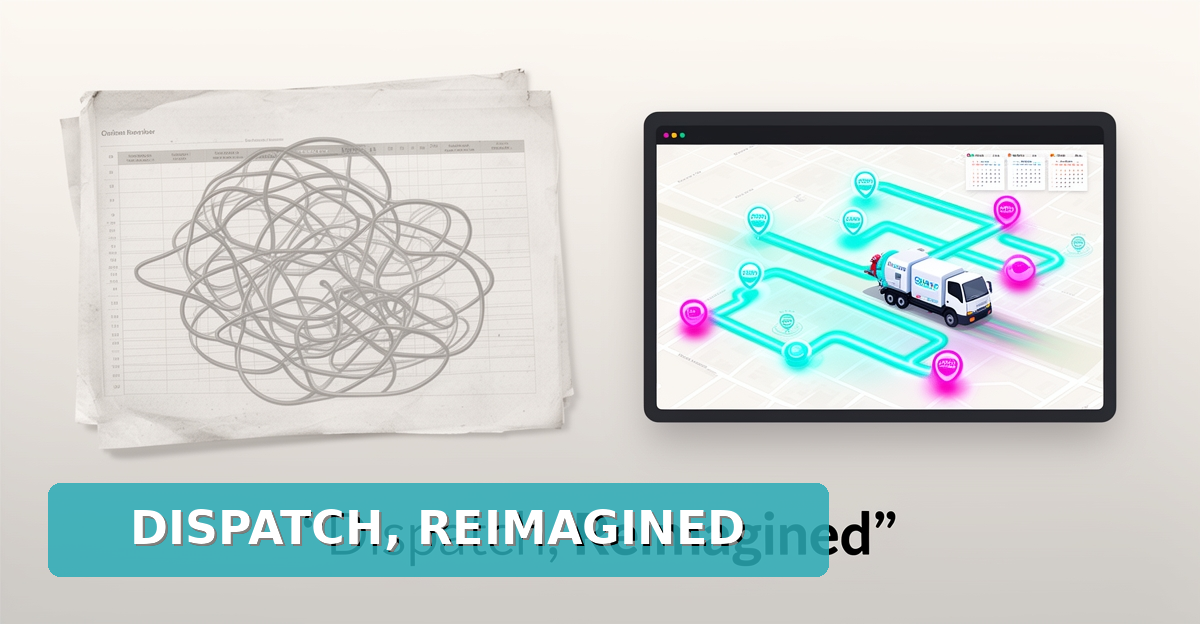
From Manual to AI: Transforming Septic System Job Scheduling and Dispatch
Key Facts
- AI-powered scheduling improves efficiency by reducing the time and resources needed to complete septic jobs
- AI reduces scheduling conflicts by matching technician skills to job requirements in real time
- Optimized routing cuts fuel costs and vehicle wear by minimizing unnecessary travel
- Customers receive accurate ETAs and proactive updates, reducing inquiry volume
- Poor data quality can lead to inaccurate or biased AI dispatch results, potentially deprioritizing certain neighborhoods or job types
- AIQ Labs builds dispatch automation with validation layers and human-in-the-loop controls so every AI decision can be reviewed
Hire a team member that works 24/7 — for less than a part-time wage.
AI receptionists, SDRs, dispatchers and 99+ roles. Trained on your business, fully managed.
Not sure where to start? Ask our AI planner
Manual Dispatch Bottlenecks in Septic Service
Septic service operations run on tight margins where every minute of technician idle time erodes profitability. Dispatchers juggling whiteboards, spreadsheets, and radio calls often lack real-time visibility into crew locations, tank access constraints, or job complexity, turning daily routing into a guessing game.
The industry is undergoing a significant transformation driven by the increasing adoption of AI and ML technologies to address these exact inefficiencies. Companies relying on manual coordination frequently face cascading delays: a pump-out runs long, the next crew arrives at a locked gate, and the afternoon schedule collapses. Customers experience wider arrival windows, missed appointments, and limited communication, factors that directly impact retention in a referral-driven market.
- Dispatchers cannot optimize routes dynamically when emergencies insert into the day
- Technicians waste hours driving between jobs instead of servicing systems
- Job complexity (tank depth, lid access, soil conditions) is discovered on-site, not planned for
- Customer updates rely on manual callbacks rather than automated notifications
These bottlenecks compound across weeks, creating a hidden labor cost that doesn't appear on invoices but shows up in overtime, fuel waste, and lost repeat business. AIQ Labs works with field service operators to replace this fragmentation with custom AI systems that analyze technician availability, vehicle locations, and job specifications in real time, assigning the right crew to the right job before the day begins and adjusting instantly when conditions change. For many operators, rebuilding the single workflow that costs the most, dispatch, is the fastest path to ROI, which is exactly what our AI Workflow Builds are designed for. The shift from reactive dispatch to predictive scheduling represents the single highest-ROI automation most septic companies can implement today.
How AI Improves Efficiency, Accuracy and Customer Experience
Septic companies are shifting from manual scheduling to AI-driven systems to solve persistent inefficiencies in job dispatch and technician routing. By analyzing real-time data on technician availability, vehicle locations, and job complexity, AI optimizes scheduling decisions that once relied on guesswork or static spreadsheets. This shift reduces idle time, minimizes travel distances, and ensures the right technician is assigned to each job based on skill and proximity. AIQ Labs builds custom AI systems that integrate directly with existing dispatch tools to automate these decisions without disrupting current workflows.
The benefits of this automation are measurable. AI-powered scheduling improves efficiency by reducing the time and resources needed to complete jobs, a benefit consistently reported across AI adoption in field services. Accuracy increases as AI minimizes human error in job assignment and routing, leading to fewer missed appointments and better resource utilization. These improvements directly enhance the customer experience through more reliable service windows, faster response times, and proactive communication, factors that drive satisfaction and loyalty in competitive local markets.
- AI reduces scheduling conflicts by matching technician skills to job requirements in real time
- Optimized routing cuts fuel costs and vehicle wear by minimizing unnecessary travel
- Dynamic rescheduling allows AI to adapt to delays or emergencies without manual intervention
- Customers receive accurate ETAs and proactive updates, reducing inquiry volume
- Dispatchers gain visibility into workload balance, preventing burnout and overtime
These outcomes are not theoretical, they reflect gains reported from AI implementation across home services and trades industries. As septic companies adopt these systems, they move beyond reactive dispatch to predictive, data-driven operations that scale with demand. The result is a more resilient, responsive, and customer-focused service model that turns scheduling from a cost center into a competitive advantage. For businesses ready to make this shift, AIQ Labs offers a clear path forward through custom AI development and managed AI employees designed specifically for field service workflows, including 24/7 intake, customer callbacks, and re-routing handled by AI staff at a fraction of the cost of an additional hire. Start the Fit Check at https://aiqlabs.ai/apply to explore how AI can transform your septic dispatch operations with a free 30-minute strategy call.
Data Quality and Model Explainability Challenges
An AI dispatch system is only as smart as the data feeding it, and only as trustworthy as its ability to explain itself. For septic companies moving toward automated scheduling, these two constraints deserve as much attention as the potential efficiency gains.
The first challenge is data quality. AI and ML models that assign jobs, predict technician availability, and optimize routes are trained on historical records, job durations, drive times, service types, and equipment needs. If that data is incomplete or inconsistent, the model's output suffers. As AI research literature consistently emphasizes, poor data quality can lead to inaccurate or biased results, and in a dispatch context that bias might mean certain neighborhoods, job types, or technicians are systematically deprioritized.
Septic businesses often have scattered records, paper tickets, spreadsheets, and disconnected software. Before deploying automated dispatch, companies should expect to invest in consolidating and cleaning this data. That groundwork is unglamorous, but it determines whether the AI assigns jobs efficiently or compounds existing errors.
The second challenge is the combination of model complexity and explainability. AI and ML models can be complex and difficult to interpret, making it challenging to understand how they make decisions. When a dispatcher asks why the system routed a technician to a tank inspection in one town over an urgent repair call in another, "the algorithm decided" is not an acceptable answer, especially when customer satisfaction and emergency response times are on the line.
Consider the trade-offs involved:
- AI offers improved efficiency, increased accuracy, and an enhanced customer experience for scheduling and dispatch.
- The same systems carry limitations around data quality, model complexity, and explainability.
- These limitations apply to both AI and ML approaches, so no single technology choice eliminates the risk.
The lesson from technology adoption history is that early skepticism often gives way to mainstream use once the tools mature and prove themselves in day-to-day operations. AI in field services appears to be following a similar arc as of late 2026, but the transition still demands diligence.
This is why AIQ Labs builds dispatch automation with validation layers, audit trails, and human-in-the-loop controls, so every AI assignment decision can be reviewed, and critical calls can be escalated to a person. Companies evaluating any automated dispatch platform should ask hard questions about where the training data comes from and whether the system can justify its recommendations.
Anticipating these risks before deployment is the difference between an AI system that quietly improves operations and one that erodes trust with your dispatchers and customers.
Implementation Roadmap for AI-Powered Dispatch
Manual whiteboards and phone tags create idle trucks and missed windows. Septic companies moving to AI-driven dispatch need a practical path that preserves field knowledge while adding automation.
The roadmap starts with mapping the current dispatch flow. Document how jobs are received, how technician availability and vehicle locations are assessed, and how job complexity is judged today. This baseline exposes manual bottlenecks and data gaps that will shape the AI design. AIQ Labs builds custom AI systems that ensure jobs are assigned efficiently, reducing idle time and improving customer satisfaction.
A custom build approach replaces subscription tools with owned assets. Engineering teams architect a workflow that ingests live availability, location, and job attributes, then assigns work with clear rules and learning loops. True ownership means the system belongs to the business, with no vendor lock-in and full control over future changes. Depending on your needs and budget, AIQ Labs offers three payment models: Start Monthly, Build in Milestones, or Own It Outright, see pricing for details.
Implementation follows a phased, low-risk sequence:
- Audit data quality for jobs, technicians, vehicles, and service history before any model training
- Design the dispatch logic with human-in-the-loop guardrails for complex or high-risk jobs
- Integrate with existing CRM, scheduling, and field tools for two-way data sync
- Pilot with one crew or region, measure idle time, on-time completion, and customer feedback
- Scale across teams and add managed AI employees for 24/7 intake and re-routing
Data quality is critical to effectiveness. Poor data quality can lead to inaccurate or biased results, and model complexity and explainability also remain challenges, making it important to keep dispatch decisions auditable for crews and customers.
The septic industry is undergoing a significant transformation driven by AI and ML adoption. The use of AI and ML is increasing rapidly with many companies adopting these technologies to improve job scheduling and dispatch systems. This adoption is being driven by the need for more efficient and effective systems, as well as the increasing availability of data and analytics.
Benefits reported in the sector include improved efficiency through optimized scheduling, increased accuracy that reduces errors, and an enhanced customer experience with more personalized and responsive service. These outcomes align with the broader technology shift seen across industries, where adoption curves accelerate once tools prove practical in the field.
For operators who want dispatch connected to intake, customer communication, and billing in one layer rather than a standalone tool, an AI Operating System approach builds that connected layer in phases, owned outright by the business. Start the Fit Check at https://aiqlabs.ai/apply to map your biggest dispatch bottleneck and identify high-ROI automation opportunities with a free 30-minute strategy call.
Still paying for 10+ subscriptions that don’t talk to each other?
We build custom AI systems you own outright. No vendor lock-in. Full control.
Not sure where to start? Ask our AI planner
Frequently Asked Questions
How does AI improve septic system job scheduling compared to manual methods?
What are the biggest challenges septic companies face when implementing AI for dispatch?
Can AI dispatch systems handle emergency job insertions or last-minute changes?
Will using AI for septic dispatch improve customer satisfaction?
Do I need to replace my current dispatch software to use AI from AIQ Labs?
What kind of ROI can septic companies expect from AI-powered dispatch automation?
Turning Dispatch Chaos into Your Competitive Edge
Septic service operations lose money every day to idle time, inefficient routing, and reactive dispatch, costs that don't show up on invoices but erode profitability through overtime, fuel waste, and lost repeat business. AI transforms this by analyzing real-time technician availability, vehicle locations, and job complexity to optimize scheduling, reduce travel, and improve customer experience with accurate ETAs and proactive communication. Success depends on clean data, explainable models, and human-in-the-loop controls to build trust and avoid bias. For septic companies ready to move beyond whiteboards and spreadsheets, the path forward starts with mapping your current dispatch flow and identifying where AI can deliver the highest ROI. Take the first step with a free, no-obligation strategy call to explore how custom AI systems can turn scheduling from a cost center into a scalable advantage, without vendor lock-in or disruption to your existing workflows.
Make AI your competitive advantage — not just another tool.
Strategy, implementation and ongoing optimization. One partner, end to end.
Not sure where to start? Ask our AI planner