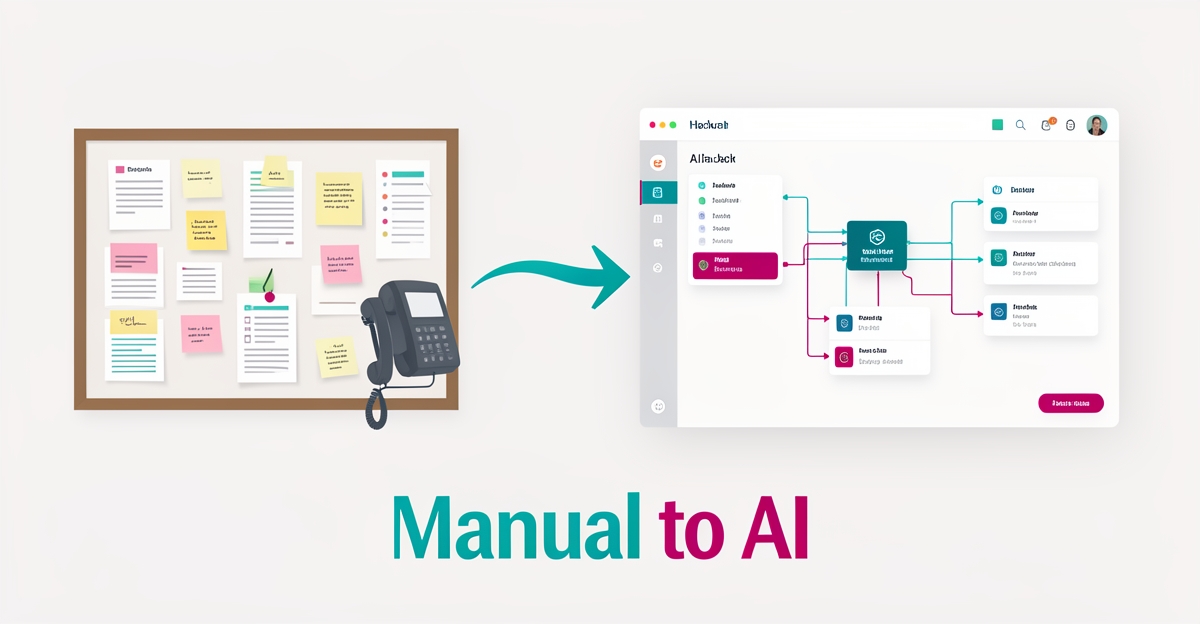
From Manual to AI: Transforming Service Requests in Handyman Operations
Key Facts
- Most large organizations now report regular AI use, yet only a minority have scaled it beyond pilot projects, per widely cited industry research such as Databricks' AI transformation analysis
- Organizations using AI to automate customer workflows commonly report meaningful reductions in response times, with some Freshworks benchmarks citing improvements of up to 83%
- Sales development reps typically spend 10 to 20 minutes per deal researching contacts and entering data manually according to workflow analysis
- In a reported sales workflow, AI automation cut research time per deal from 10–20 minutes to roughly 3–5 minutes per a LinkedIn case study
Hire a team member that works 24/7 — for less than a part-time wage.
AI receptionists, SDRs, dispatchers and 99+ roles. Trained on your business, fully managed.
Not sure where to start? Ask our AI planner
The Hidden Cost of Manual Service Request Handling
Every minute a dispatcher spends transcribing a voicemail or matching a technician to a job is a minute not spent solving a customer's problem. In handyman operations, these manual handoffs create a silent drain on revenue that compounds with every new request.
Comparable research-heavy roles show the pattern clearly: sales development reps typically spend 10 to 20 minutes per deal just researching contacts and entering data manually according to workflow analysis. For a field service business, that translates directly into delayed dispatches, double-booked crews, and jobs that slip through the cracks entirely. The only way to scale this model traditionally is adding headcount, a linear cost increase for a problem that demands speed.
- Transcribing calls and emails into a work order system consumes hours of administrative time daily
- Researching customer history, property details, and parts availability stalls dispatch decisions
- Manually checking technician skills, location, and availability creates assignment bottlenecks
- Re-entering data across disconnected tools introduces errors that require costly rework
These inefficiencies are not abstract. Organizations using AI to automate similar customer-facing workflows commonly report faster response times, with some industry benchmarks citing reductions of up to 83%. When an AI agent handles intake, research, and routing, the human team receives a complete, prioritized work order instantly, ready to execute, not to decipher.
AIQ Labs eliminates this friction by automating the entire intake-to-dispatch loop. The goal isn't to replace your coordinators; it's to remove the grunt work so they can focus on the complex scheduling exceptions and customer conversations that actually require human judgment.
How AI Agents Automate End-to-End Service Workflows
Manual intake creates a bottleneck that costs handyman operations jobs every day. Requests arrive by phone, text, and email, then sit while someone decodes the problem, finds history, and picks a technician.
AI agents change the workflow from reactive data entry to autonomous execution. An agent carries out steps in a workflow based on the goal provided, breaking the goal into subgoals and tasks, and then completing them. That means intake, context gathering, assignment, and tracking happen as one continuous process.
In practice, the agent first identifies the request from signals and transcribes the need, such as leaky faucet or drywall repair. It then researches context via web search or internal databases, pulling customer history, property details, and parts requirements. Next it assigns the job to the correct technician based on skills, location, and availability, and creates a detailed work order with priority and due date. Finally it tracks progress in real time and updates the customer automatically.
The efficiency gain is measurable. In a comparable sales workflow, an in-house AI scraper reportedly reduced research time per deal from 10–20 minutes to roughly 3–5 minutes, with compute costs of a few dollars per pair of deals per a LinkedIn case study. The rep opens their task and everything they need is already there.
This mirrors what handyman teams experience when dispatch is manual. Dispatchers manually check schedules and skills to assign work, and that manual matching kills velocity. With agents, the human role shifts to complex problem solving and quality assurance while the grunt work is handled.
What an end-to-end AI service workflow can automate today:
- Autonomous intake from calls, emails, and web forms with job type classification
- Instant context research from CRM, job history, and technician skill profiles
- Skill-based routing and work order creation with priority and due date
- Real-time progress tracking and customer updates without dispatcher intervention
The shift is augmentation, not replacement. As applied AI examples show, the goal is not replacing the person but making them dramatically faster on the part that was always grunt work. The same principle applies to dispatchers and field teams.
AIQ Labs builds custom AI systems that manage service workflows end-to-end, improving accuracy and response times. The approach aligns with how organizations are scaling AI: while most large organizations now report regular AI use, only a minority have successfully scaled it beyond pilot projects, and success requires redesigning how the business operates.
With AI adoption now mainstream across industries, the expectation for fast, reliable service keeps rising. AI agents deliver intake to dispatch in minutes, not hours, freeing teams to focus on the work only humans can do.
A Practical, Low-Risk Roadmap for AI Transformation in Field Services
Most handyman operations don't need more tools, they need a disciplined path from chaotic intake to predictable dispatch. Industry research is consistent: while most large organizations now report regular AI use, only a minority have successfully scaled it beyond pilot projects. The gap isn't technology; it's a missing roadmap.
A practical crawl-walk-run framework starts with the highest-friction, lowest-risk step: AI-powered intake. An intake agent captures requests 24/7, classifies job type, and creates a structured ticket instantly, eliminating the 10–20 minutes per request that manual triage typically consumes. In a parallel sales workflow, this shift reportedly cut research time to roughly 3–5 minutes per deal. For a handyman business, that means every lead arrives at dispatch already categorized, located, and enriched with customer history.
The "walk" phase connects that clean intake to workflow automation. An AI agent reads the ticket, checks technician skills and real-time availability, assigns the right pro, and generates a detailed work order with parts lists and priority. AI agents carry out steps in a workflow based on the goal provided, breaking it into subgoals and completing them autonomously. Dispatchers shift from data entry to exception handling and customer communication.
The "run" phase layers in real-time tracking, predictive scheduling, and closed-loop feedback, but none of it works without a data foundation. Data is the foundation of success; the most sophisticated models can't overcome poor data practices. Clean customer records, standardized job codes, and technician skill matrices must exist before the first agent goes live.
- Crawl: Deploy an intake agent that structures every inbound request into a standardized ticket.
- Walk: Add an AI dispatcher that matches tickets to technicians and auto-generates work orders.
- Run: Enable real-time job tracking, predictive parts ordering, and automated customer updates.
- Measure cycle time, first-time fix rate, and customer NPS at each stage, then iterate.
AIQ Labs applies this methodology through three entry points. AI Employees give you managed AI staff, receptionists, SDRs, dispatchers, and 99+ other roles, at roughly 80% less cost than a human hire. AI Workflow Builds rebuild the one workflow that costs you the most, at a fixed price and in phases. And AI Operating Systems connect everything into one operating layer you own outright. You can start monthly, build in milestones, or own it outright, no fake pricing, no invented numbers. The goal isn't automation for its own sake, it's giving your team the bandwidth to do the work only humans can do.
Still paying for 10+ subscriptions that don’t talk to each other?
We build custom AI systems you own outright. No vendor lock-in. Full control.
Not sure where to start? Ask our AI planner
Frequently Asked Questions
How much time can AI save in processing a service request compared to manual methods?
Will AI replace our dispatchers and coordinators, or just change their role?
What’s the first step we should take when implementing AI in our handyman business?
How much does it typically cost to run AI for service request automation?
What data do we need to have in place before using AI for technician assignment?
Can AI handle real-time updates and customer communication during a job?
From Bottleneck to Competitive Edge
Manual service request handling quietly erodes revenue in handyman operations, every minute spent transcribing voicemails, researching history, or matching technicians is a minute not spent serving customers. AI changes that equation by turning intake to dispatch into one autonomous loop: requests are captured and classified, context is pulled instantly, jobs are routed by skills and location, and customers are updated without dispatcher intervention. The result is faster response, fewer missed jobs, and teams freed to handle exceptions that need human judgment. A practical crawl-walk-run path makes this low risk: start with AI-powered intake, connect it to skill-based routing and auto-generated work orders, then layer real-time tracking and predictive scheduling once your data foundation is clean. Organizations using AI for similar customer-facing workflows commonly report faster response times, with some industry benchmarks citing reductions of up to 83%. If you want to map your highest-friction workflow to a buildable AI system, take the two-minute Fit Check at aiqlabs.ai/apply, you'll get a free 30-minute strategy call, no pitch, just clarity on where the win is.
Make AI your competitive advantage — not just another tool.
Strategy, implementation and ongoing optimization. One partner, end to end.
Not sure where to start? Ask our AI planner