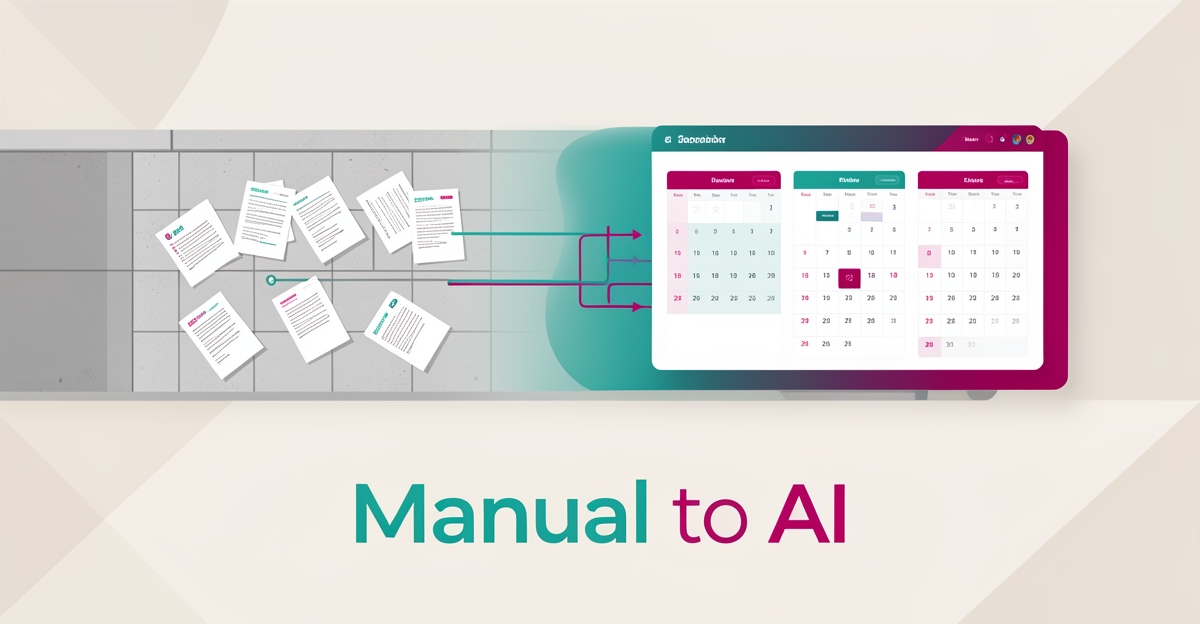
From Manual to AI: Transforming Sidewalk & Curb Job Scheduling with Automation
Key Facts
- AI doesn't fix chaos. It scales whatever system you already have, so redesign the workflow before automating it
- Moving from AI for tasks to AI to design how work gets done is the difference between incremental improvement and real change
- Curb management and smart-city AI adoption has grown steadily through 2026, driven by urbanization and resource-efficiency pressure
- AIQ Labs has deployed 200+ multi-agent systems and runs 4 live SaaS products daily
- Reliability in AI workflows comes from structured context and real system access, not from bigger prompts
Hire a team member that works 24/7 — for less than a part-time wage.
AI receptionists, SDRs, dispatchers and 99+ roles. Trained on your business, fully managed.
Not sure where to start? Ask our AI planner
The Manual Scheduling Trap: Why Traditional Methods Are Failing
Manual scheduling looks cheap until the costs pile up in missed jobs and wasted crew hours. Mid-sized sidewalk and curb contractors are hitting a ceiling where spreadsheets and phone calls can no longer keep pace with demand.
No-shows and last-minute changes cascade through the day. Dispatchers chase confirmations, crews sit idle between jobs, and customers receive conflicting updates. Reactive job management creates a loop where the team is always fixing yesterday instead of planning tomorrow.
The market signal is clear. Municipalities and property managers across North America have been investing in curb management and smart-city AI for years, and as of late 2026 that pressure keeps pushing contractors toward smarter, more responsive operations. Contractors who stay manual risk higher costs, lower service levels, and lost bids to more responsive competitors.
Manual processes hide costs in three ways:
- Misallocated resources from poor visibility into crew location and job readiness
- No-shows and rescheduling friction that erode job fulfillment rates
- Reactive management that burns dispatcher time on coordination instead of optimization
AI doesn't fix chaos. It scales whatever system you already have. When scheduling is built on manual handoffs, automation amplifies delays instead of removing them.
The shift from task automation to system redesign is the inflection point. Moving from using AI for tasks to using AI to design how work gets done separates incremental improvement from transformative change.
Mid-sized contractors need evaluation, system design, and deployment that rethinks the workflow, not just digitizes it. That means giving AI tools access to real data and systems, not just prompts, and redesigning processes to eliminate low-value manual tasks.
AIQ Labs works with SMBs on this exact transformation, replacing manual scheduling with AI-driven systems that increase job fulfillment and reduce no-shows, whether through AI Employees that handle dispatch and confirmations, or a full workflow rebuild.
The urgency is operational, not just technological. Every week of manual scheduling is another week of missed jobs, idle crews, and margin quietly leaking out of the business.
From Task Automation to Workflow Redesign: The AI Approach That Actually Works
Most teams don't fail at AI because the models are weak. They fail because they automate chaos instead of redesigning it.
Task automation speeds up what already exists. Workflow redesign eliminates low-value work entirely. Most people use AI for tasks, summarize, write, explain. That is level 1. Moving from using AI for tasks to using AI to design how work gets done is the difference between incremental improvement and transformative change. The pattern repeats across field operations: isolated task tools create pilot purgatory, while workflow redesign creates scale.
Successful implementation follows evaluation, system design, and deployment. It also shows that giving AI tools real data to work with beats prompting alone. AI doesn't fix chaos, it scales whatever system you already have. If the scheduling process is manual and fragmented, AI will scale the fragmentation.
A mid-sized contractor replacing manual scheduling with an AI-driven system illustrates the shift. The transformation isn't about a faster dispatcher. It's about rethinking job creation, resource allocation, and stakeholder communication as an integrated system. That approach mirrors how AIQ Labs structures production AI work, moving from point solutions to owned, integrated workflows.
Redesign starts with eliminating, not accelerating.
- Show up briefed with job priorities, crew skills, and success metrics
- Give AI tools connected to real data and systems, not just prompts
- Push back on weak inputs and redesign processes to leverage AI capabilities
- Build feedback loops for continuous improvement rather than one-off automation
This is why pilot projects stall. They automate isolated steps without changing the workflow. Production systems, by contrast, integrate CRM, scheduling, and field data so decisions happen automatically and exceptions surface early. Reliability in agentic systems comes from structured context and tool access, not from bigger prompts.
The outcome is not just faster scheduling. It's higher job fulfillment and reduced no-shows because the system redesigns how work flows from lead to completion. Tasks that once required manual coordination are removed, and human teams focus on exceptions and customer relationships.
Transformation requires treating AI as an operating system, not a feature.
The Three-Phase Transformation: Evaluation, Design, Deployment
The journey from manual scheduling chaos to AI-driven efficiency requires a structured approach that begins long before any code is written. For contractors managing sidewalk and curb jobs, the transformation hinges on three critical phases: evaluation, design, and deployment, each building on the last to ensure AI doesn't just automate tasks but fundamentally redesigns how work gets done.
The first phase starts with a rigorous assessment of current workflows and automation readiness. Contractors must identify which scheduling processes consume the most time and create the highest risk of errors, such as job assignment delays, resource misallocation, or communication gaps with crews and clients. This evaluation phase involves mapping existing systems, assessing data quality, and pinpointing high-ROI opportunities where AI can deliver immediate impact. Successful implementations begin by defining clear objectives: What specific problems are you solving? How will you measure success in terms of job fulfillment rates or no-show reduction? Without this clarity, AI risks scaling existing inefficiencies rather than eliminating them.
Once workflows are assessed, the design phase focuses on structuring AI interactions for optimal results. This means moving beyond simple prompts to giving AI real tools, connecting it to scheduling software, crew availability calendars, and client communication channels. Contractors should structure inputs using proven frameworks: showing up briefed with context about job priorities, crew skills, and location constraints; pushing back on weak inputs by validating address accuracy and job specifications before processing; and designing outputs that generate actionable dispatch instructions rather than just suggestions. Getting this architecture right is what separates a scalable system from a fragile demo.
Deployment follows with incremental implementation and measurable success tracking. Start with well-defined use cases like automated job creation from intake forms or intelligent crew assignment based on proximity and skill matching. Monitor key metrics such as reduction in scheduling time, improvement in job fulfillment rates, and decrease in no-shows through continuous feedback loops. AIQ Labs structures this as a milestone-based build: you approve each phase, see it working, and only then move to the next. The transformation culminates when AI becomes embedded in the operating model, turning scheduling from a reactive chore into a strategic advantage that scales with business growth. Ready to assess your automation readiness? Start the 2-minute Fit Check at https://aiqlabs.ai/apply, then book a free 30-minute strategy call at https://aiqlabs.ai/book to map your biggest bottleneck and identify high-ROI opportunities.
Real Implementation: What Changes When AI Takes Over Scheduling
When AI-driven scheduling goes live, the transformation is immediate and tangible. Contractors move from reactive firefighting to proactive optimization, with measurable improvements in job fulfillment and steady reductions in no-shows.
The shift begins with automated job creation. Instead of manually processing work orders, AI systems generate jobs automatically based on incoming requests, resource availability, and historical patterns. This eliminates the bottlenecks that plague manual scheduling, where a single missed call or delayed email can cascade into days of delays.
Resource allocation becomes predictive rather than reactive. AI systems analyze historical data, weather patterns, and crew availability to optimize assignments before problems arise. This proactive approach is what moving from task automation to system redesign actually delivers in practice.
The communication layer transforms completely. Stakeholders receive automated, personalized updates at every stage, confirmation texts when jobs are scheduled, reminders before appointments, and real-time updates if conditions change. Consistent, automated communication is one of the most reliable levers for cutting no-show rates.
Proactive risk detection represents the most significant operational shift. AI systems flag potential issues before they become problems:
- Weather delays that could impact concrete curing
- Resource conflicts between competing jobs
- Equipment maintenance schedules that might cause downtime
- Permit expiration dates that could halt work
This isn't theoretical, it's the practical reality of what happens when AI takes over scheduling. The system doesn't just automate existing processes; it redesigns them entirely, creating feedback loops that continuously improve performance. The most effective implementations move beyond using AI for tasks to using AI to design how work gets done.
For contractors ready to make this shift, the key is starting with a clear purpose and measurable outcomes, exactly the approach AIQ Labs takes in every AI transformation engagement.
Your Path Forward: From Assessment to Automation
Manual scheduling is costing sidewalk and curb contractors jobs, no-shows, and margin every week. Moving to AI is not about adding a chatbot; it is about redesigning how work gets done.
Start with a structured evaluation before any build begins. Map every scheduling touchpoint from job creation and assignment to resource allocation, stakeholder communication, and status reporting. Define clear objectives and success metrics such as job fulfillment rates, no-show reduction, and time saved. This assessment phase creates the business case and prevents pilots that stall before scaling.
Choose a partner that builds and operates, not just advises. Look for proven multi-agent architecture, deep two-way API integrations, and a true ownership model where you own the code, agents, and data. The right partner structures the evaluation, designs the system, and deploys it end-to-end under one accountable team, eliminating the complexity of managing multiple vendors.
A phased approach minimizes risk while proving ROI quickly. Depending on where you are, that can look like starting with an AI dispatcher or receptionist at a fraction of a human hire, rebuilding the one workflow that costs you the most at a fixed price, or building toward a full AI operating system in phases you own outright. Payment follows the same logic: start monthly, build in milestones, or own it outright, no fake prices, no invented numbers.
Successful implementation follows proven workflow transformation principles:
- Show up briefed with context on audience, objectives, and success metrics
- Give AI tools to work with real data and systems, not just prompts
- Push back on weak inputs and redesign processes to eliminate low-value manual tasks
- Start incremental with well-defined use cases, test, then scale
Moving from using AI for tasks to using AI to design how work gets done is the difference between incremental improvement and transformative change. AI does not fix chaos; it scales whatever system you already have.
AIQ Labs supports this path with 200+ multi-agent systems deployed and 4 live SaaS products the company runs daily. The approach aligns with how contractors can replace manual scheduling with an AI-driven system that increases job fulfillment and reduces no-shows, while keeping ownership and control in-house. Production-ready systems, not prototypes ensure the build is scalable and secure from day one.
With the right assessment, partner, and phased rollout, manual scheduling becomes a competitive advantage.
Still paying for 10+ subscriptions that don’t talk to each other?
We build custom AI systems you own outright. No vendor lock-in. Full control.
Not sure where to start? Ask our AI planner
Frequently Asked Questions
Will AI just automate the chaos in my sidewalk and curb scheduling?
What's the right way to move from manual scheduling to AI?
Can AI really reduce no-shows and improve job fulfillment?
Do I need perfect data before starting an AI scheduling project?
How do I know which AIQ Labs service fits my contracting business?
Turn Scheduling Into Your Next Competitive Advantage
Manual scheduling quietly erodes margin through missed jobs, idle crews and reactive dispatch. The shift isn't about faster spreadsheets, it's about redesigning how work flows from lead to completion with AI that's connected to real data and systems. Contractors who move from task automation to workflow redesign see higher job fulfillment and fewer no-shows because the system eliminates low-value coordination instead of scaling it. The operational risk is staying manual while competitors become more responsive. Start with a clear assessment of your scheduling touchpoints, define metrics like fulfillment and no-show reduction, and build incrementally with real integrations. AIQ Labs partners with SMBs on this exact transformation, from evaluation through design and deployment, with production-ready systems you own outright. Start the 2-minute Fit Check at https://aiqlabs.ai/apply, then book a free 30-minute strategy call at https://aiqlabs.ai/book to map your biggest bottleneck and identify high-ROI opportunities.
Make AI your competitive advantage — not just another tool.
Strategy, implementation and ongoing optimization. One partner, end to end.
Not sure where to start? Ask our AI planner