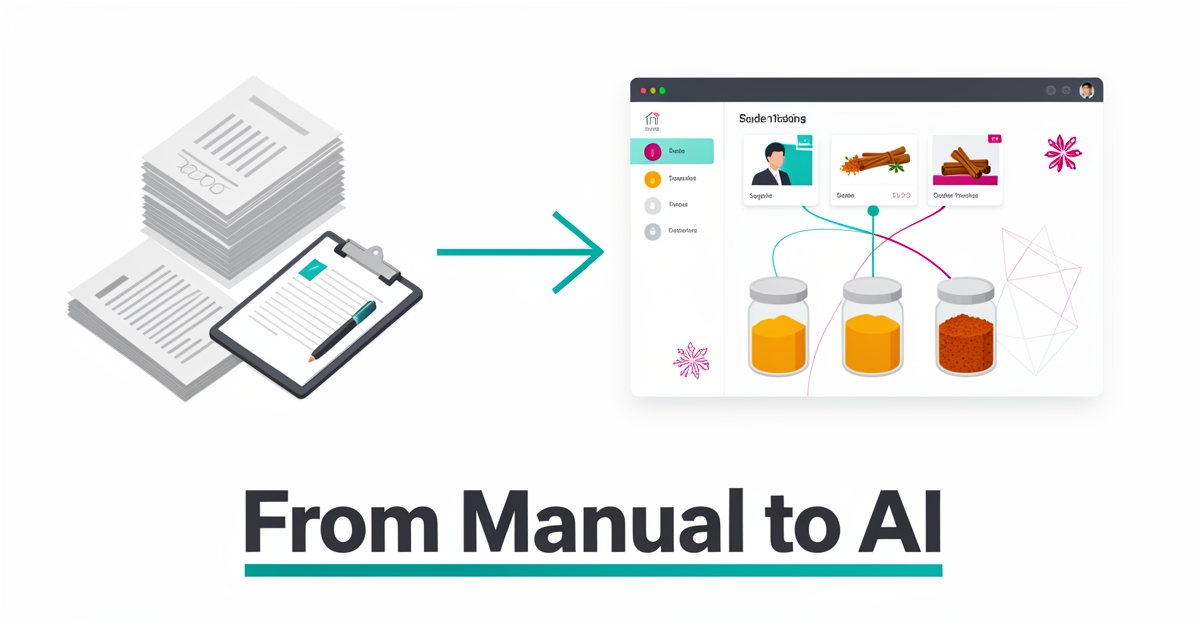
From Manual to AI: Transforming Spice Blend Sourcing & Procurement Workflows
Key Facts
- Organizations using AI workflow automation typically report reductions in processing times of well over half, with the largest gains in document-heavy tasks
- Finance teams in traditional ERP environments often spend 40-60% of their time on repetitive reconciliation and data validation
- Mid-market organizations using AI agents frequently report 50-70% reductions in operational overhead in ERP contexts
- AI workflow automation commonly delivers error reductions in the 70-95% range for repetitive data tasks
- Automated workflows let organizations absorb significant volume increases without proportional staff increases
- AI-native procurement layers typically deploy in 45-90 days, versus 6-12 months for legacy suite implementations
Hire a team member that works 24/7 — for less than a part-time wage.
AI receptionists, SDRs, dispatchers and 99+ roles. Trained on your business, fully managed.
Not sure where to start? Ask our AI planner
The Hidden Cost of Manual Spice Blend Procurement
Manual spice blend procurement quietly drains margin every week. Teams juggle PDFs, emails, and spreadsheets while suppliers wait for answers and orders slip through cracks.
The work is repetitive and high-friction. In traditional ERP environments, finance and procurement teams commonly spend 40-60% of their time on repetitive reconciliation tasks and data validation. That time is not strategic; it is copy-paste, re-keying, and chasing.
Unstructured documents create the first bottleneck. Certificates of analysis, pricing sheets, and compliance forms arrive as PDFs, a format first released in 1993 and standardized as ISO 32000. Extracting specs, allergens, and lot numbers by hand invites errors and delays. Organizations that automate these document-heavy workflows typically report large reductions in processing times and error rates, with the biggest gains on high-volume, repetitive tasks.
Supplier communication fragments next. Purchase orders are drafted manually, follow-ups go by email, and confirmations live in inboxes. Order tracking becomes reactive, with teams discovering delays only after production is impacted. Inconsistent communication erodes supplier reliability and increases maverick spend.
The cost shows up as operational overhead. Mid-market organizations using AI agents within existing ERP contexts frequently report 50-70% reductions in operational overhead. Automated workflows also absorb significant volume increases without proportional staff increases, yet manual spice procurement rarely scales.
Common pain points include:
- Manual data entry from PDFs for certificates of analysis, invoices, and contracts
- Inconsistent supplier communication with emails, spreadsheets, and phone calls
- Fragmented order tracking across portals, ERP, and manual logs
- Repetitive validation of pricing, compliance, and specifications
These tasks keep procurement tactical instead of strategic. Teams spend cycles verifying instead of negotiating, forecasting, or building supplier partnerships. AI shifts the focus from execution to oversight by automating supplier communication, order tracking, and procurement checks, whether through purpose-built [AI Workflow Builds](/workflow-builds) or managed [AI Employees](/ai-employees) that handle supplier follow-ups and order chasing around the clock.
At AIQ Labs, custom AI systems integrate with existing procurement tools to reduce manual effort and improve supplier reliability. The goal is not to replace teams but to remove the repetitive work that consumes much of their week.
How AI Automates Supplier Communication and Document Intelligence
Supplier communication and document processing have long consumed disproportionate time in spice blend procurement, with teams manually drafting emails and extracting data from unstructured PDFs like certificates of analysis and contracts. AI is now transforming these workflows through intelligent automation that handles routine interactions and data extraction with minimal human intervention.
Large Language Models (LLMs) are being adapted to draft and refine supplier emails, summarize key contract terms, and generate procurement reports with structured summaries, reducing the cognitive load on sourcing teams. Specialized platforms go further by enabling autonomous sourcing, tools like Keelvar use AI bots to run complex negotiations and e-auctions with limited human intervention, while platforms like Order.co deploy AI agents that place orders directly through vendor portals, executing procurement tasks rather than merely tracking them. These capabilities keep supplier communication consistent, compliant, and near real-time, freeing procurement professionals to focus on strategic relationship management.
Beyond communication, AI excels at extracting critical data from unstructured documents that traditionally required manual entry. Platforms such as Zycus Merlin AI use Natural Language Processing (NLP) to convert PDF invoices into structured data, enabling touchless Procure-to-Pay (P2P) workflows that eliminate repetitive data validation. Similar platforms automatically ingest and normalize data from contract repositories, removing the need for labor-intensive taxonomy projects. This Document Intelligence capability allows AI to pull specifications, pricing, and compliance details from PDFs regardless of format, and even analyze visual information for quality control in spice blend specifications.
The impact of these automations is measurable: vendors in this space report meaningful reductions in contract cycle time and bid review time, and teams using AI-assisted document processing consistently cut manual entry by the majority. By automating supplier communication and document intelligence, AI transforms procurement from a document-heavy, reactive function into a streamlined, insight-driven operation, laying the foundation for touchless workflows that accelerate sourcing decisions and improve supplier reliability in the spice blend industry.
Practical Implementation: From Pilot to AI-Native Procurement Layer
The gap between deciding to adopt AI and actually running it in procurement is where most initiatives stall. A structured implementation path, moving deliberately from assessment to pilot to scale, separates the programs that deliver measurable returns from the proofs-of-concept that quietly die.
The first step is an honest current-state assessment. Stakeholder interviews, process mining, and documentation review reveal which workflows are the best automation candidates, and the evidence favors starting with high-volume, low-risk tasks like invoice matching and data validation. Finance teams in traditional ERP environments often spend 40-60% of their time on repetitive reconciliation and data validation, which makes these processes both painful and ripe for quick wins.
Tool selection comes next, and it should follow a "layer, don't replace" philosophy. Rather than ripping out an existing ERP, an AI-native intelligence layer can sit on top of current systems, normalizing data from contract repositories automatically and eliminating manual taxonomy projects. This approach matters because of timing: legacy procurement suites typically take 6-12 months to implement, while AI-native platforms can deliver value in 45-90 days. Mid-market organizations using AI agents within their existing ERP security models frequently report 50-70% reductions in operational overhead, all while preserving custom code investments.
Before any deployment, establish governance. Organizations that define role-based access controls, escalation paths, and human-in-the-loop checkpoints before go-live tend to reach value faster than those that retrofit governance later. For spice blend procurement specifically, this means deciding upfront which decisions the AI can make autonomously, flagging an invoice variance, for example, and which require a human buyer.
A practical pilot sequence looks like this:
- Automate invoice validation and three-way matching against purchase orders, where volume is high and risk is low.
- Deploy document intelligence to extract data from PDF certificates of analysis and supplier contracts, regardless of format.
- Configure threshold-based rules, such as automatically flagging invoices above a set dollar amount for human review.
- Test everything in a sandbox environment before production deployment to build organizational confidence.
Once the pilot proves out, scale deliberately. Subsequent workflows consistently deploy faster than the first as team competency grows, and the compounding results are substantial: organizations implementing AI workflow automation commonly report major reductions in processing times and errors, alongside meaningfully lower operational costs.
This phased, milestones-based approach mirrors how custom AI systems are best built. AIQ Labs structures deployments so clients approve each phase as it ships, starting with a single broken workflow through a fixed-price [AI Workflow Build](/workflow-builds), proving value in weeks, then expanding into a full [AI Operating System](/ai-operating-systems) the business owns outright. The result is a procurement function that shifts from tactical data entry to strategic sourcing, with AI handling the routine work in the background.
Still paying for 10+ subscriptions that don’t talk to each other?
We build custom AI systems you own outright. No vendor lock-in. Full control.
Not sure where to start? Ask our AI planner
Frequently Asked Questions
How much time can AI actually save on manual spice blend procurement tasks?
Do I need to replace my existing ERP system to add AI procurement automation?
Can AI extract data from PDF certificates of analysis and supplier contracts?
What's the difference between AI agents and basic automation for supplier communication?
How do I maintain control over AI decisions in procurement workflows?
What ROI can mid-market spice companies expect from AI procurement automation?
From Bottlenecks to Breakthroughs: Your Path Forward
Manual spice blend procurement silently erodes margins through repetitive data entry, fragmented communication, and reactive order tracking, consuming 40-60% of teams' time on tasks that add no strategic value. AI transforms this reality by automating document intelligence, supplier communication, and order tracking, delivering dramatically faster processing, far fewer errors, and the ability to scale volume without proportional staff increases. The result isn't just efficiency, it's procurement shifting from tactical firefighting to strategic partnership building. To begin, assess your current workflows for high-volume, low-risk automation candidates like invoice matching or PDF data extraction. Then take the first step toward owning your AI advantage: complete the free [Fit Check](/apply) to map your biggest bottleneck and explore how AIQ Labs' AI Employees, Workflow Builds, or AI Operating Systems can deliver measurable ROI in weeks, not months.
Make AI your competitive advantage — not just another tool.
Strategy, implementation and ongoing optimization. One partner, end to end.
Not sure where to start? Ask our AI planner