From Manual to AI: Transforming Water Treatment Maintenance Schedules
Key Facts
- Global AI in water management market is projected to grow from $7.54 billion in 2024 to $53.85 billion by 2032 according to market analysis
- Government agencies deploying AI predictive maintenance see 50% fewer unplanned failures per engineering research
- Predictive maintenance can reduce maintenance costs by up to 40% and downtime by up to 50% in comparable infrastructure operations in comparable infrastructure operations
- AI-powered predictive maintenance cuts infrastructure failures by 73% and workplace safety incidents by up to 75% according to smart infrastructure data
- AI predictive maintenance delivers 30% longer asset lifespans for government agencies based on deployment results
- Reactive maintenance causes up to 50% more unplanned failures than predictive approaches
Hire a team member that works 24/7 — for less than a part-time wage.
AI receptionists, SDRs, dispatchers and 99+ roles. Trained on your business, fully managed.
Not sure where to start? Ask our AI planner
The Hidden Cost of Manual Maintenance in Water Treatment
Manual maintenance logs in water treatment facilities often lead to reactive scheduling, where repairs occur only after equipment fails. This approach creates inconsistent data entry, as handwritten or spreadsheet-based logs vary in detail and accuracy across shifts and personnel. Without standardized, real-time inputs, maintenance teams miss early warning signs of wear, increasing the likelihood of preventable breakdowns. These gaps in visibility directly contribute to unplanned downtime, disrupting treatment processes and risking regulatory non-compliance.
The financial and operational risks of relying on manual systems are substantial. Facilities using reactive maintenance experience up to 50% more unplanned failures compared to those adopting predictive approaches, according to industry analyses of urban infrastructure. Additionally, inconsistent logging accelerates asset degradation, shortening equipment lifespans by as much as 40% when compared to AI-optimized schedules that align maintenance with actual usage and environmental stressors. Such inefficiencies force facilities into costly emergency repairs and premature replacements, straining budgets and operational continuity.
AIQ Labs addresses these challenges by developing custom AI systems that transform maintenance from a guesswork-driven task into a precision workflow. By integrating sensor data, historical performance, and operational variables, these owned platforms generate dynamic schedules that prevent failures before they occur. This shift not only reduces downtime but also extends asset life, delivering measurable efficiency gains without ongoing subscription dependencies. Facilities gain full control over their maintenance intelligence, ensuring long-term resilience and compliance. For example, our [AI Operating Systems](/ai-operating-systems) offer a connected operating layer built in phases, owned outright.
How AI-Driven Scheduling Prevents Failures Before They Happen
A pump that fails at 2 a.m. during a storm surge doesn't care that it was serviced "on schedule" three weeks ago. Traditional maintenance logs treat every piece of equipment the same, while the equipment itself tells a far more nuanced story, one that AI systems are now built to hear.
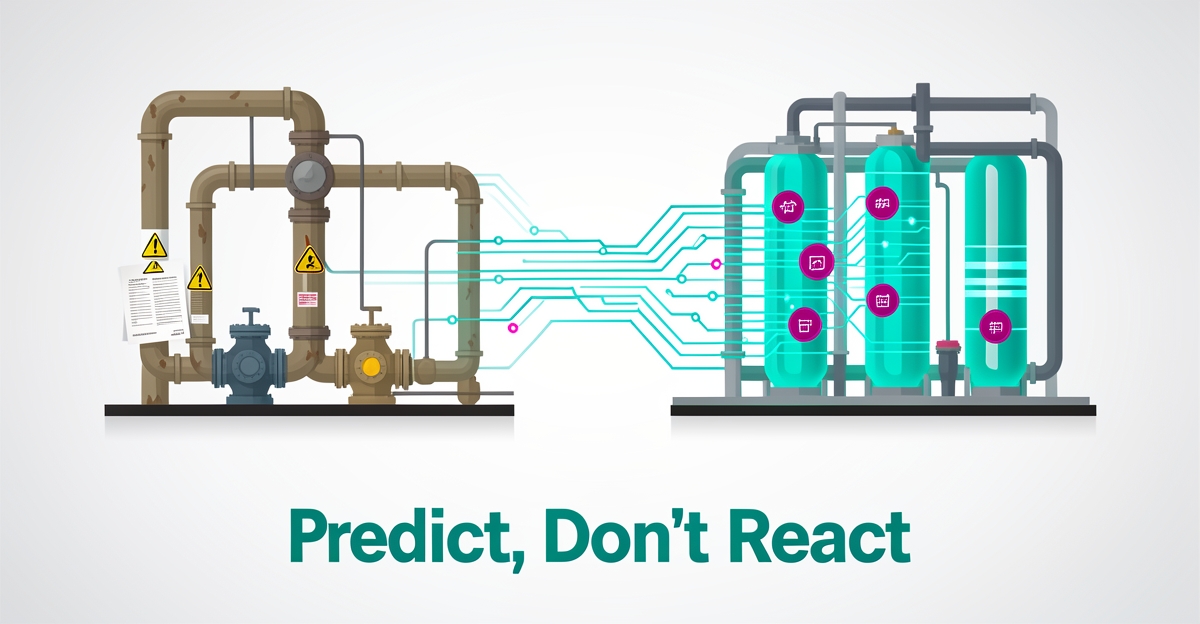
The core difference comes down to approach. Traditional maintenance scheduling is reactive: work happens when something breaks or when a calendar says so. AI-driven scheduling is proactive, relying on high-quality, real-time data and automated decision-making to intervene before failure occurs, rather than after.
Machine learning models make this possible by continuously analyzing three streams of information: equipment wear patterns, water usage data, and environmental conditions. By combining real-time sensor data with historical maintenance records, AI can predict when repairs are actually needed, flagging a valve showing abnormal vibration trends or a filter degrading faster than usual due to seasonal demand shifts.
The results from early adopters are striking. Government agencies deploying AI predictive maintenance are seeing 50% fewer unplanned failures and 30% longer asset lifespans, according to engineering research on smart infrastructure. The financial case is equally compelling: predictive maintenance can reduce maintenance costs by up to 40% and decrease downtime by up to 50% in comparable infrastructure operations.
Beyond cost and uptime, the safety implications matter for water treatment staff. AI-powered predictive maintenance reduces infrastructure failures by 73%, extends asset lifespans by 40%, and cuts workplace safety incidents by up to 75%, fewer emergency repairs means fewer technicians exposed to hazardous, high-pressure situations.
For facilities considering the shift, the market momentum is unmistakable. The global AI in water management market is projected to grow from $7.54 billion in 2024 to $53.85 billion by 2032, a 27.85% CAGR, per market analysis.
What does AI-driven scheduling actually monitor? In practice, these systems track signals that manual logs simply cannot capture at scale:
- Equipment wear indicators such as vibration, temperature, and runtime hours
- Water usage patterns that signal when pumps and filters are operating under abnormal load
- Environmental factors like seasonal demand spikes and source water quality changes
- Historical maintenance records that reveal which components fail and when
The transition does require foundations: high-quality data, integration across systems, and skilled personnel to implement and maintain the AI. As practitioners note, predictive maintenance is not just about predicting failures, it's about preventing them, and that depends as much on people and process as on technology.
This is where purpose-built automation changes the equation. AIQ Labs develops fully owned AI systems that automatically generate and update maintenance plans based on equipment wear, usage, and environmental data, shifting facilities from reacting to breakdowns to scheduling work weeks before a failure can occur. For instance, our [AI Employees](/ai-employees) can handle receptionist, SDR, dispatcher roles, and more, at about 80% less cost than a human hire.
Implementing AI Maintenance Systems: From Data to Action
The gap between wanting AI-driven maintenance and actually running it comes down to execution, and most facilities that attempt it get stuck at the pilot stage. A structured, phased approach prevents that stall.
Step 1: Audit your data foundation. AI predictions are only as good as the data feeding them, and high-quality data is essential for accurate AI decision-making. For a water treatment facility, that means equipment wear records, water usage logs, sensor readings, and environmental data, all in usable form. If your maintenance history lives in paper binders and scattered spreadsheets, digitizing it is the first real task.
Step 2: Build a data integration strategy. Sensors, SCADA systems, work order software, and historical maintenance records rarely speak the same language. Combining data from different sources and systems into a unified picture is what allows AI to correlate, say, pump vibration patterns with usage cycles and water chemistry. Without integration, you get siloed insights that never add up to a reliable schedule.
Step 3: Select and train the right models. Match the AI approach to the application, predictive maintenance models for equipment failure, anomaly detection for leaks, forecasting models for usage-driven scheduling. Then train and validate the system against your actual historical outcomes before trusting it with live decisions.
Step 4: Deploy with human oversight. The transition from manual to AI-driven scheduling works best when operators review AI-generated maintenance plans before they're executed. This human-in-the-loop approach builds trust, catches edge cases, and creates a feedback loop that improves the model over time.
Step 5: Monitor, refine, and expand. Implementation isn't a one-time event. Continuously update and refine the AI systems to improve performance and adapt to changing conditions, and once scheduling is stable, extend the same approach to leak detection and water quality management.
The payoff justifies the discipline. Government agencies deploying AI predictive maintenance report 50% fewer unplanned failures and 30% longer asset lifespans, and predictive maintenance can cut maintenance costs by up to 40% while decreasing downtime by up to 50%. It's no surprise the global AI in water management market is projected to grow from $7.54 billion in 2024 to $53.85 billion by 2032, according to DataM Intelligence.
The challenge for most small and mid-sized facilities is that steps one through five require both data engineering and AI development expertise, skills that are hard to hire and expensive to contract piecemeal. This is where an end-to-end partner changes the math. AIQ Labs builds fully owned AI systems that automatically generate and update maintenance plans from equipment wear, water usage, and environmental data, following a proven four-phase process: discovery and architecture, development and integration, deployment and training, then ongoing optimization and scale. Our [Workflow Builds](/workflow-builds) can help rebuild the one workflow that costs the most, fixed price, phased.
Because clients own the system outright, no vendor lock-in, no platform dependencies, the maintenance schedule AI becomes a lasting operational asset rather than another subscription. As the saying goes in the industry, predictive maintenance is not just about predicting failures, it's about preventing them, and that only happens when the system moves from data to daily action.
Still paying for 10+ subscriptions that don’t talk to each other?
We build custom AI systems you own outright. No vendor lock-in. Full control.
Not sure where to start? Ask our AI planner
Frequently Asked Questions
Will switching from manual logs to AI actually prevent equipment failures?
How much money and downtime can we realistically save?
What’s wrong with our current manual maintenance logs?
What data does an AI maintenance system actually monitor?
Do we need perfect data to start, or can we build up over time?
Will we be locked into a subscription platform?
Your Next Maintenance Schedule Shouldn't Be Written in Ink
The shift from manual logs to AI-driven scheduling isn't a distant vision, it's happening now, with facilities reporting 50% fewer unplanned failures and 30% longer asset lifespans, while predictive maintenance cuts maintenance costs by up to 40% and downtime by up to 50%. The path forward is clear: audit your data foundation, integrate your sensor and maintenance records, deploy with human oversight, and refine continuously. But execution is where most facilities stall, because building these systems requires both data engineering and AI development expertise. That's where AIQ Labs comes in, we build fully owned AI systems that automatically generate and update maintenance plans from your equipment wear, water usage, and environmental data, so the schedule becomes a lasting operational asset rather than another subscription. The market momentum is unmistakable: the global AI in water management market is projected to grow from $7.54 billion in 2024 to $53.85 billion by 2032, a 27.85% annual growth rate. Start with our two-minute [Fit Check](/apply), then book a free 30-minute strategy call, a real working session with an AI engineer to map your biggest maintenance bottleneck. If there isn't a clear win, we'll tell you that too. Prefer to explore first? Chat with our AI Transformation Agent at aiqlabs.ai/chat.
Make AI your competitive advantage — not just another tool.
Strategy, implementation and ongoing optimization. One partner, end to end.
Not sure where to start? Ask our AI planner