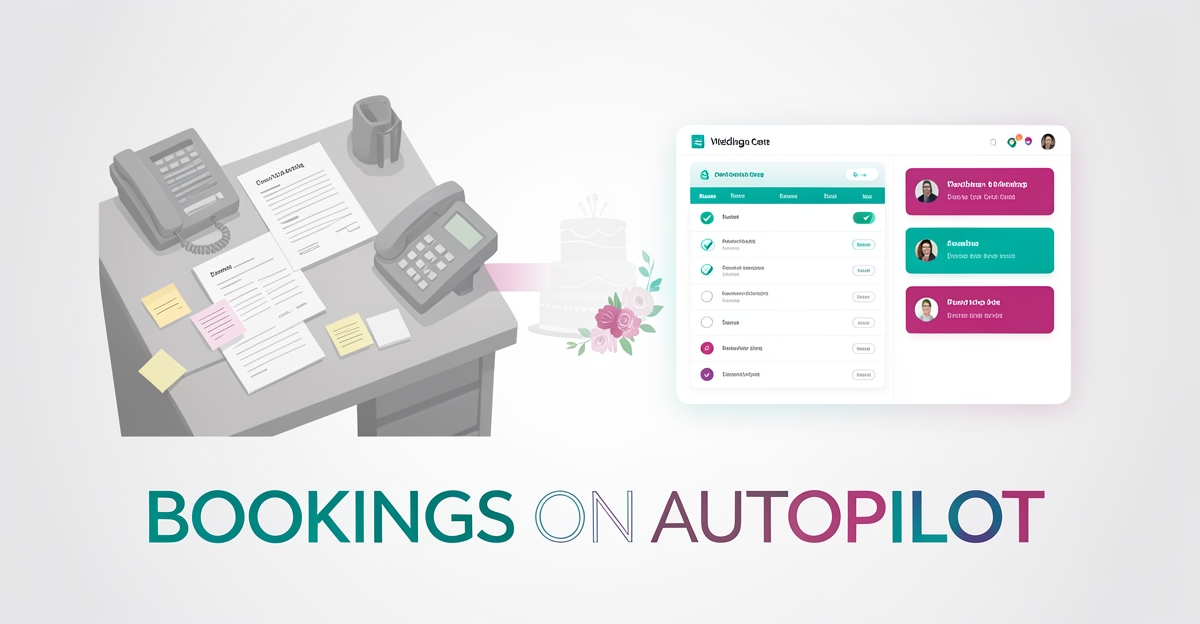
From Manual to AI: Transforming Wedding Catering Booking Workflows with Smart Automation
Key Facts
- Manual inquiry handling typically leaves couples waiting hours for a reply; automated systems respond in minutes, around the clock.
- Most booking losses happen in the gap between inquiry and first response, speed is the single biggest lever.
- Manual re-entry across disconnected tools is where most catering booking errors originate: dates, dietary restrictions, and deposit requests.
- Couples increasingly research vendors online and expect instant visibility and response, not a callback the next business day.
- AI adoption in the wedding industry has grown sharply since 2022, and businesses that automate communication and coordination report faster response times and lower admin workload.
- Only a minority of multi-platform operations achieve seamless AI integration, fragmented tool stacks are the most common reason automation projects stall.
- Fully integrated systems consistently outperform partial implementations on efficiency gains.
Hire a team member that works 24/7 — for less than a part-time wage.
AI receptionists, SDRs, dispatchers and 99+ roles. Trained on your business, fully managed.
Not sure where to start? Ask our AI planner
The Hidden Cost of Manual Booking Workflows
Manual inquiry handling looks manageable until peak season hits. Wedding caterers lose bookings, staff hours, and reputation in the gaps between an inquiry arriving and a human responding.
In manual workflows, standard client inquiries typically sit unanswered for hours, often most of a business day. That delay is a bottleneck at every stage. Inquiry qualification stalls, booking confirmations wait on email chains, and vendor coordination relies on spreadsheets and phone tag.
Manual processes also introduce error. Every time a date, dietary restriction, or deposit request is re-typed into another tool, there's a chance it gets lost or mistyped. A single misentered detail can cost a catering contract and damage the referral business that keeps wedding vendors alive.
Demand is shifting faster than manual teams can keep up. Most couples now research wedding vendors online, and many are more likely to contact a vendor when online booking is available. They expect instant visibility and response, not a voicemail callback tomorrow.
The hidden cost compounds across three pressure points:
- Inquiry handling: staff can only work one conversation at a time, while automated systems handle many in parallel, day and night
- Booking confirmation: email and phone confirmations create multi-hour gaps that increase ghosting and double-booking risk
- Vendor coordination: manual handoffs between caterers, florists, venues, and rental companies are where details most often fall through
These bottlenecks drive labor cost and client churn. Businesses that automate client communication consistently report faster inquiry response times and a meaningful reduction in administrative workload. The gap between expectation and delivery is where revenue leaks.
AIQ Labs rebuilds these workflows through AI Workflow Builds, a fixed-price, phased rebuild of the one workflow that costs you the most. The approach integrates with your existing CRM, scheduling, and accounting tools so booking confirmations, client onboarding, and vendor coordination run without manual re-entry. For wedding catering companies, that means fewer errors and faster, consistent follow-through during the highest-demand months.
The shift is already underway. By late 2026, a clear majority of wedding planning businesses have implemented at least one form of AI automation, with client communication leading the way. Manual workflows cannot sustain the volume or speed couples now expect.
How AI-Driven Automation Transforms Catering Operations
AI-driven automation is reshaping how wedding catering businesses manage their core operations, turning slow, error-prone processes into fast, reliable workflows. The industry is moving toward systems that handle everything from initial client inquiries to final event coordination. This shift isn't just about keeping up, it's about delivering a seamless experience that meets modern couples' expectations for speed and precision.
The most widespread application is client communication automation. AI systems handle initial inquiries, qualify leads, and schedule appointments without a human touching the first exchange. Response times compress from hours to minutes, ensuring no inquiry goes unanswered and potential clients stay engaged. The same pattern applies to vendor coordination: AI can sync with florists, venues, and rental companies automatically, reducing the miscommunications and scheduling conflicts that derail events.
The operational impact is immediate. Automated systems handle timeline updates, menu selections, and dietary requests with minimal human oversight, and they apply the same rules every time, no fatigue, no forgotten follow-up. That consistency translates into fewer booking errors, less back-and-forth, and faster inquiry handling than manual methods. For catering teams, this means less time on administrative tasks and more focus on crafting exceptional culinary experiences.
- Automated client onboarding that captures preferences and sends tailored proposals
- Real-time vendor synchronization for seamless menu and logistics planning
- Intelligent follow-up systems that nurture leads without manual tracking
- Dynamic calendar management that prevents double-booking and optimizes staff allocation
- Automated contract generation and payment reminders that reduce administrative delays
By integrating these capabilities, wedding catering businesses not only streamline internal workflows but also elevate the client journey from first contact to final event. AIQ Labs supports this transformation by building custom AI workflows that connect with your existing tools, eliminating manual data entry, cutting error rates substantially, and creating systems that scale with business growth. The result is a catering operation that's not just automated, but adaptive, ready to meet the demands of today's couples while laying the foundation for sustainable efficiency.
Three Core Workflows to Automate First
Wedding catering teams are drowning in repetitive back-and-forth that delays bookings and burns staff hours. Smart automation targets the three workflows that create the most friction and the fastest return.
Booking confirmations and inquiry qualification is the first high-impact target. Automated client communication systems handle many more interactions per month than a manual team can, because they work in parallel and never sleep. The system handles initial qualification, availability checks, and instant confirmation drafts, then routes hot leads to your sales staff immediately. Nothing waits in an inbox until someone has a spare hour.
Client onboarding and communication sequences remove the manual follow-up gap that loses couples. Automated onboarding delivers welcome packets, collects dietary restrictions and tasting preferences, and sends timeline updates without staff intervention. Response times for standard inquiries drop from hours to minutes, and every couple gets the same thorough, prompt experience whether they inquire in January or the middle of June.
Vendor coordination with real-time updates is the third core workflow. AI agents sync menus, delivery windows, and staffing changes across caterers, florists, and venues, then push status updates to clients automatically. This eliminates double-booking errors and last-minute phone tag.
These three workflows deliver measurable operational lift:
- Interaction capacity rises sharply, one system handles many conversations simultaneously
- Administrative labor costs drop as automated qualification and follow-up replace manual tracking
- Response time compresses from hours to minutes for standard inquiries
The shift is not about replacing staff, it is about freeing them for high-value tasting design and client experience work. AI-driven workflows integrate with existing CRMs and scheduling tools, so teams keep the systems they trust while cutting booking errors substantially. AIQ Labs designs production-ready systems that integrate with existing tools for wedding catering companies, focusing on booking confirmations, client onboarding, and vendor coordination as the first automation layer.
Avoiding the Integration Trap That Stalls Most AI Projects
Most wedding catering businesses don't fail at AI because the technology falls short, they fail because they try to layer automation on top of a fragmented mess of disconnected tools. Industry adoption data consistently shows that only a minority of businesses running multiple specialized platforms achieve seamless AI integration, and the resulting complexity can delay adoption by months.
This is the integration trap. A caterer might run one tool for inquiries, another for contracts, a spreadsheet for tastings, and email for vendor coordination, then wonder why their new AI assistant can't see the full picture. Each disconnected system becomes a silo, and AI is only as effective as the data it can access.
The payoff for getting this right is substantial. Businesses with fully integrated systems report far greater efficiency improvements than partial implementations. That's not a marginal gain, it's the difference between automation that transforms your booking workflow and automation that adds another layer of frustration.
Before automating anything, consolidate. A practical consolidation sequence looks like this:
- Map every tool currently touching your booking workflow, from inquiry to final payment
- Identify where the same client data gets entered twice or falls through the cracks
- Establish a single source of truth for client, event, and vendor information
- Connect remaining tools through deep, two-way integrations rather than surface-level syncs
- Only then layer AI workflows on top of the unified foundation
This is precisely why piecemeal tool stacks underperform unified, custom-built systems. When your booking confirmations, client onboarding, and vendor coordination all run through one integrated architecture, AI can act on complete information instead of fragments. Businesses that skip this step end up among the majority who never achieve seamless integration at all.
The stakes are rising as the industry digitizes. Couples increasingly research vendors online and expect instant, coordinated responses. A fragmented backend can't deliver that experience, no matter how sophisticated the AI layered on top.
Working with a partner like AIQ Labs, which builds production-ready systems with deep two-way integrations rather than stacking more subscriptions onto an already crowded stack, lets caterers consolidate first and automate second, the sequence the evidence clearly favors. With most wedding planning businesses already adopting some form of AI automation, the competitive risk isn't moving too fast. It's building on a foundation that can't support what you're trying to create.
Your Roadmap from Manual Chaos to Automated Bookings
The gap between manual chaos and automated bookings isn't crossed in one leap, it's crossed with a deliberate, phased roadmap. Wedding catering companies that rush into full-scale automation often stall, while those that start with a single high-friction workflow see results fast and build momentum from there.
Start with an honest audit of your current booking process. Map every step from initial inquiry to signed contract and note where inquiries sit unanswered, where details get re-entered by hand, and where errors slip through. The case for acting is simple: automated client communication systems cut response times from hours to minutes, and speed is what wins the couple.
Next, identify your single highest-friction bottleneck. For most caterers, that's booking confirmations and inquiry handling, the stage where slow responses cost you couples. With many couples more likely to contact a vendor when online booking is available, a slow or clunky confirmation process directly costs bookings.
Then choose your scope. You have two realistic paths:
- A targeted Workflow Build that rebuilds one broken process, such as automated booking confirmations, at a fixed price.
- An AI Operating System that connects your entire booking and onboarding operation as one integrated layer, built in phases and owned outright.
The right answer depends on your readiness, but the evidence favors starting narrow. Only a minority of multi-platform operations achieve seamless AI integration, and integration complexity can delay adoption by months. Fully integrated systems outperform partial implementations, which is why proving ROI on one workflow before scaling is the smarter play.
Deployment is where many caterers stumble, and it's where training matters most. Walk your staff through the new system role by role, document the processes, and monitor performance in the first weeks. This mirrors how AIQ Labs structures implementation: discovery and architecture first, then development and integration, then deployment with role-specific training, and finally ongoing optimization. The Build in Milestones payment model, where you approve and pay per phase and keep everything built, exists precisely so catering businesses can validate each step before committing to the next.
The payoff justifies the discipline. Beyond faster response times, AI automation delivers a real reduction in administrative labor costs and a noticeable improvement in client satisfaction, because couples get prompt, consistent communication at every step. And with most wedding planning businesses implementing at least one form of AI automation by 2026, the question is no longer whether to automate your booking workflow, it's whether you'll do it deliberately or fall behind competitors who already have.
If you're unsure where your biggest bottleneck lies, start with the two-minute Fit Check, then book a free 30-minute strategy call to map your workflow and identify the highest-ROI starting point, no obligation, just clarity.
Still paying for 10+ subscriptions that don’t talk to each other?
We build custom AI systems you own outright. No vendor lock-in. Full control.
Not sure where to start? Ask our AI planner
Frequently Asked Questions
How much faster do AI-powered systems respond to wedding catering inquiries compared to manual methods?
What parts of client communication can AI handle for a catering business?
Can AI automation really reduce administrative labor costs for catering businesses?
Why do many AI projects fail in wedding catering businesses, and how can this be avoided?
What measurable improvements do businesses see after successfully integrating AI across their booking workflows?
Is it better to start with a single workflow fix or go straight to full department automation when adopting AI for catering bookings?
From Bottlenecks to Bookings: Your Next Move
Manual workflows were built for a slower wedding season, not the instant expectations couples have today. Delays, re-entry errors, and fragmented tools cost caterers bookings, staff hours, and referrals, while AI-driven automation cuts inquiry response from hours to minutes, handles many conversations in parallel, and keeps qualification, onboarding, and vendor coordination consistent. The shift is already mainstream, with most wedding planning businesses implementing at least one form of AI automation by 2026. The practical path is to audit your current inquiry-to-contract flow, consolidate tools into a single source of truth, and automate first the three highest-friction workflows: booking confirmations, client onboarding, and vendor sync. AIQ Labs builds production-ready, owned systems that integrate with your existing CRM and scheduling tools, so teams focus on tastings and experience, not admin. Start the two-minute Fit Check at aiqlabs.ai/apply, then book a free 30-minute strategy call to map your bottleneck and identify the highest-ROI automation starting point.
Make AI your competitive advantage — not just another tool.
Strategy, implementation and ongoing optimization. One partner, end to end.
Not sure where to start? Ask our AI planner