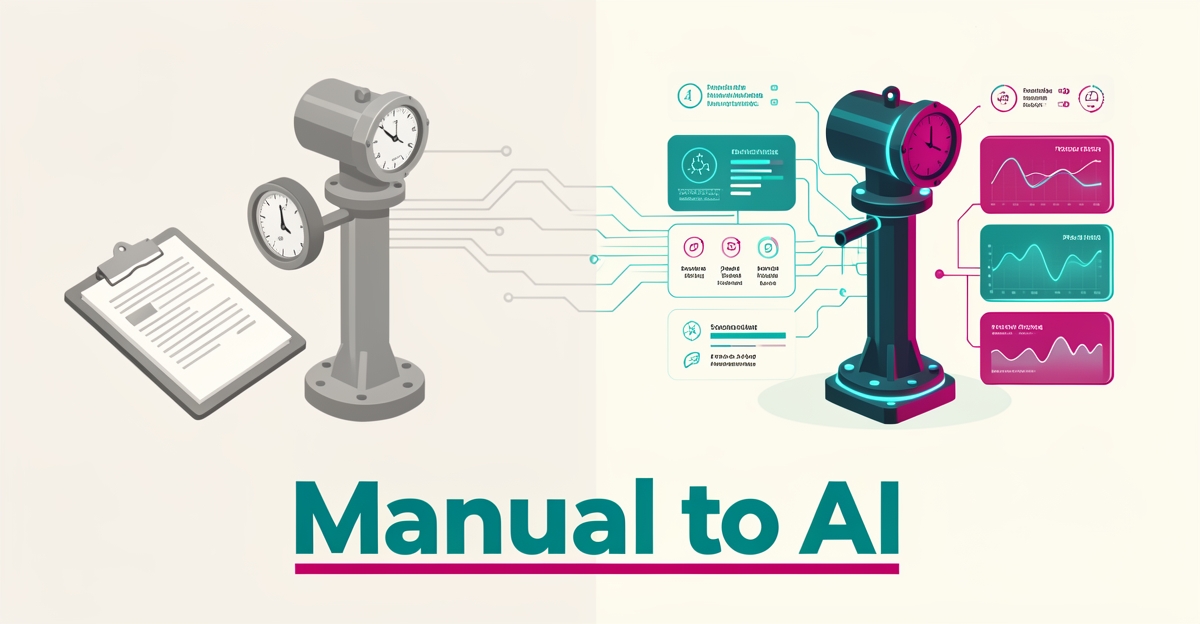
From Manual to AI: Transforming Well Pump Service Workflows
Key Facts
- Energy consumption, flow rates, and pressure levels are the three core signals for evaluating pump performance and efficiency
- AI-powered workflows can significantly reduce administrative processing time by automating work orders, scheduling, and invoicing
- Generative AI is well suited to lifting the dull, repetitive, and dangerous tasks off people's shoulders, freeing technicians for skilled work
- AI systems require high-quality data to function effectively, garbage sensor readings produce garbage diagnoses
- AIQ Labs has deployed 200+ multi-agent systems and runs 4 live SaaS products daily, so these patterns are proven in production, not theory
Hire a team member that works 24/7 — for less than a part-time wage.
AI receptionists, SDRs, dispatchers and 99+ roles. Trained on your business, fully managed.
Not sure where to start? Ask our AI planner
The Hidden Costs of Manual Well Pump Service Workflows
Manual well pump service still runs on phone calls, paper work orders, and technician memory, and the friction shows up in the customer experience. Delayed dispatches, inconsistent diagnostics, and reactive maintenance create hidden cost that erodes margins and retention.
Response times stretch when scheduling lives in spreadsheets and voicemail. Technicians arrive without complete history, repeat site visits to verify flow rates, and spend hours on manual data entry instead of repairs. That labor drag compounds with every service call.
Service quality varies because knowledge is tribal, not tracked. Without structured records for energy consumption, flow rates, and pressure levels, teams lack a consistent baseline to evaluate performance. Pump optimization guidance consistently emphasizes that energy consumption is critical in evaluating efficiency, flow rates are necessary to assess whether the pump is delivering its intended performance, and pressure levels are vital to evaluating overall system health.
Diagnostics remain slow and subjective. Technicians rely on experience rather than unified data, so root causes are missed and parts are replaced unnecessarily. The result is longer downtime for customers and higher cost per job for the business.
Manual data tracking creates a hidden tax on operations. Teams log readings on paper, retype them into invoices, and chase missing information before billing. This cycle increases errors, delays payments, and makes process improvement impossible because there's no reliable data to learn from.
The operational burden shows up in three persistent patterns:
- Delayed response times from fragmented scheduling and dispatch
- Inconsistent service quality due to undocumented diagnostics and tribal knowledge
- High labor costs from manual data entry, repeat visits, and reactive maintenance
Generative AI is, at its core, a tool in service of people, well suited to lifting the dull, repetitive, and dangerous tasks off their shoulders. In well pump service, that translates to automating routine capture, triage, and documentation so technicians focus on skilled work.
At AIQ Labs, the work starts by mapping these manual workflows to expose bottlenecks in intake, dispatch, and field reporting. Once current-state processes are visible, AI can redesign them for faster response times, better service quality, and increased customer retention. That's the core of AI Workflow Builds: rebuild the one workflow that costs you the most, at a fixed price, in phases.
How AI-Powered Workflows Diagnose and Optimize Pump Performance
A well pump rarely fails without warning, but most service businesses only find out when a customer calls with no water. AI-powered workflows change that equation by continuously analyzing the three signals that matter most: energy consumption, flow rates, and pressure levels. Instead of waiting for a breakdown, technicians get ahead of it.
Energy consumption is critical in evaluating pump efficiency, while flow rates are necessary to assess whether the pump is delivering its intended performance. Pressure levels complete the picture, giving a vital read on overall system health. When AI monitors these metrics in real time, it can spot the subtle drift, rising energy draw, falling flow, fluctuating pressure, that signals a pump working harder than it should.
That detection layer is only half the value. The other half is what AI does with the diagnosis. Rather than leaving technicians to manually interpret sensor readings, AI systems can automate the routine work that surrounds every service call.
- Continuously assess pump performance against baseline flow, pressure, and energy benchmarks to pinpoint optimization opportunities
- Flag inefficiencies early, such as a pump drawing excess energy to maintain pressure, before they become failures
- Automate routine tasks like work order creation, scheduling, and customer notifications when an issue is detected
- Identify workflow bottlenecks, from slow dispatch to delayed parts ordering, and recommend process redesigns
- Generate performance reports automatically, giving both technicians and customers a clear view of system health
The result is a service operation built around faster response times, better service quality, and increased customer retention. A customer whose pump issue was flagged, scheduled, and resolved before they noticed a problem is a customer who renews their service agreement. That's the difference between reactive repair and proactive care.
There's also a human dimension worth noting. The technology is built to lift the dull, repetitive, and difficult tasks off people's shoulders. For pump technicians, that means less time on manual data logging and paperwork, and more time on the skilled diagnostics and customer relationships that machines can't replicate. AI handles the monitoring grind; people handle the judgment.
None of this works without the right foundation. AI-powered workflows require high-quality data to function effectively, garbage sensor readings produce garbage diagnoses. They also demand seamless system integration with existing tools, and proper training so employees can actually use what's built. Teams that skip these steps end up with dashboards nobody checks.
That's why implementation matters as much as the technology itself. At AIQ Labs, the approach starts by mapping a business's current workflow, identifying where manual steps create delays, and rebuilding the process as an automated, AI-driven system the business owns outright, whether that's a single diagnostic workflow or an end-to-end service operation. For well pump companies ready to see where AI fits, a free strategy call at aiqlabs.ai/book maps the biggest bottleneck and the highest-ROI automation opportunity first.
Redesigning Service Delivery with AI: From Bottlenecks to Retention
AI-powered workflows are transforming how well pump service companies operate, turning fragmented, manual processes into streamlined, intelligent systems. By mapping existing workflows and pinpointing where delays occur, whether in dispatching, parts ordering, or customer follow-up, businesses gain clear visibility into inefficiencies that slow response times and frustrate customers. This diagnostic approach allows for targeted redesigns that eliminate redundant steps and align resources with actual service demands. As a result, teams spend less time on administrative tasks and more time resolving issues in the field, directly improving first-time fix rates and customer satisfaction.
AI-powered workflows can significantly enhance the efficiency, effectiveness, and customer satisfaction of well pump service operations by automating routine tasks and identifying bottlenecks before they escalate. These systems continuously analyze service patterns, such as response times and completion rates, to recommend process adjustments that reduce delays and improve consistency. For example, by monitoring energy consumption, flow rates, and pressure levels, key indicators of pump performance, AI can predict maintenance needs and schedule interventions proactively, turning reactive service into preventive care. This shift not only improves system reliability but also strengthens customer trust through fewer unexpected failures.
Redesigning service delivery with AI also involves rethinking how information flows between technicians, dispatchers, and customers. AI agents, like the managed AI Employees AIQ Labs deploys, from AI receptionists to AI dispatchers, can automatically generate work orders, update CRM systems in real time, and notify customers of technician arrival windows, all without manual input. This level of integration reduces errors, ensures data accuracy across platforms, and creates a seamless experience from call to completion. When customers receive timely updates and see consistent, professional service, their likelihood of returning increases, directly impacting retention.
To sustain these gains, companies must address foundational challenges like data quality, system integration, and staff training. AI systems rely on accurate, timely data to make effective decisions, so investing in clean data pipelines and compatible software integrations is essential. Equally important is preparing teams to work alongside AI tools, not as replacements, but as force multipliers that handle routine tasks while humans focus on complex diagnostics and customer relationships. With the right foundation, AI doesn't just optimize workflows; it redefines what's possible in field service delivery.
Ready to map your biggest service bottleneck and uncover high-ROI AI automation opportunities? Start with the free Fit Check at aiqlabs.ai/apply, then schedule a no-obligation 30-minute strategy call at aiqlabs.ai/book to see where AI can transform your well pump operations. If there isn't a clear win, we'll tell you straight, no pitch, just clarity.
Implementing AI in Well Pump Service: A Practical Roadmap
Transforming well pump service operations with AI requires a structured approach that addresses real-world constraints while building toward sustainable automation. The journey begins with understanding current workflows to identify where AI can deliver the highest impact, whether in dispatch optimization, predictive maintenance scheduling, or customer communication automation. AIQ Labs' implementation framework guides this transition in phases, ensuring each step delivers measurable value before progressing to the next.
The foundation of any successful AI implementation is data quality. Energy consumption, flow rates, and pressure levels are critical metrics for evaluating pump system performance, and these same data points become essential inputs for AI-driven optimization. Poor data quality, such as inconsistent meter readings, incomplete service logs, or fragmented customer histories, directly undermines AI effectiveness, leading to inaccurate predictions and unreliable automation. Before deploying any AI model, businesses must audit their data sources, standardize collection protocols, and establish validation routines to ensure the information feeding the system is accurate, timely, and relevant.
System integration presents another common hurdle, particularly for SMBs relying on legacy dispatch software or manual scheduling tools. AI-powered workflows require seamless connectivity with existing infrastructure to function effectively, whether that means connecting to CRM platforms for customer history, linking to accounting systems for invoicing, or integrating with IoT sensors on pump equipment for real-time monitoring. Without interoperability, automation remains siloed and limited in scope.
Employee training completes the triad of critical considerations. Even the most sophisticated AI system fails if technicians and dispatchers don't understand how to interact with it, interpret its recommendations, or override it when necessary. Training programs should focus on practical application, teaching staff how to use AI-generated insights for better decision-making rather than replacing their expertise. This human-in-the-loop approach ensures AI augments rather than displaces skilled workers, fostering adoption and long-term success.
For SMBs concerned about upfront investment and complexity, AIQ Labs offers three payment models aligned with each implementation phase. Start Monthly provides a low-risk entry point, covering build, training, integrations, monitoring, and ongoing improvements. Businesses can begin with a single workflow fix, such as automating service call triage or optimizing technician routing, and scale only after validating results. Build in Milestones lets you implement department-wide automation in phases, paying only for completed components while retaining all work done to date. And for companies that want no recurring fees at all, Own It Outright delivers the full system with complete ownership. This structure directly addresses the common challenge of stalled AI pilots by delivering tangible value at every stage. Full details are on the pricing page.
By following this roadmap, prioritizing data readiness, ensuring system compatibility, investing in team readiness, and leveraging adaptable engagement models, well pump service businesses can move beyond manual processes toward AI-enhanced operations that improve response times, service quality, and customer retention without disrupting core workflows. The transformation isn't about replacing human judgment with algorithms; it's about empowering teams with intelligent tools that handle routine complexity so they can focus on what they do best: solving problems and building customer trust.
Still paying for 10+ subscriptions that don’t talk to each other?
We build custom AI systems you own outright. No vendor lock-in. Full control.
Not sure where to start? Ask our AI planner
Frequently Asked Questions
How can AI actually help my well pump service business?
What pump metrics does AI monitor to predict failures?
Will AI replace my technicians?
What do I need before implementing AI in my service operations?
How much does it cost to get started with AI automation?
How do I know which workflow to automate first?
From Bottlenecks to Breakthroughs: Your AI-Powered Pump Service Future
Transforming well pump service from manual to AI-driven isn't just about technology, it's about reclaiming time, reducing hidden costs, and building customer trust through proactive care. By automating routine tasks like data entry and scheduling, continuously monitoring critical metrics such as energy consumption, flow rates, and pressure levels, and redesigning workflows around real-time insights, service teams can shift from reactive repairs to preventive maintenance. This leads to faster response times, higher first-time fix rates, and stronger customer retention, all while empowering technicians to focus on skilled diagnostics and relationships that machines can't replicate. The foundation of success lies in high-quality data, seamless system integration, and practical training, elements AIQ Labs addresses through its structured implementation roadmap. Ready to uncover your highest-ROI automation opportunity? Start with the free Fit Check at aiqlabs.ai/apply, then schedule a no-obligation 30-minute strategy call at aiqlabs.ai/book to see where AI can transform your operations, no pitch, just clarity.
Make AI your competitive advantage — not just another tool.
Strategy, implementation and ongoing optimization. One partner, end to end.
Not sure where to start? Ask our AI planner