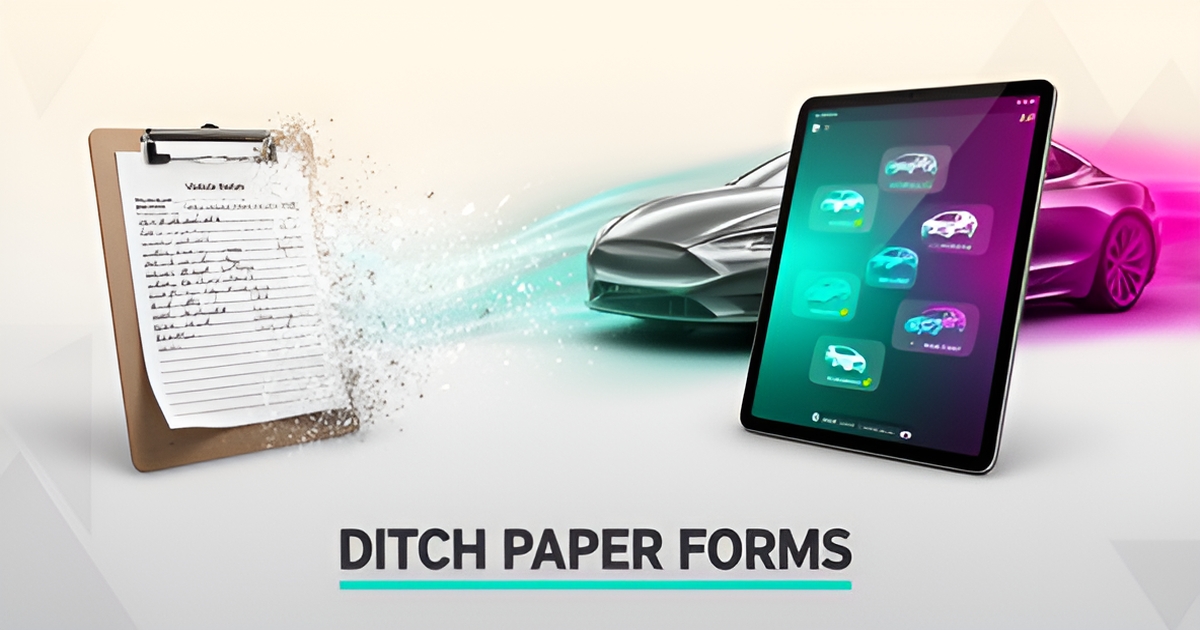
From Paper Forms to AI: Modernizing Your Oil Change Shop’s Customer Intake Process
Key Facts
- Industry research suggests knowledge workers spend a large share of their time—often cited around 40%—on manual data entry, with form processing a major contributor according to Artificio
- Administrative staff can average roughly 16 minutes per intake form on manual data entry in document-heavy settings per Artificio analysis
- As of late 2026, most large organizations report using AI in at least one business function, per widely cited adoption surveys such as McKinsey's State of AI research
- A majority of companies still struggle to show measurable AI results, often due to poor data quality and fragmented governance according to BCG cited by TechRadar
- The U.S. federal government maintains roughly 10,000 unique forms and processes over 100 billion pieces of paperwork annually per Cadmus Group
- Security reviews of AI-generated code have found significant rates of deficiencies, underscoring the need for human review per a 2025 Veracode study
Hire a team member that works 24/7 — for less than a part-time wage.
AI receptionists, SDRs, dispatchers and 99+ roles. Trained on your business, fully managed.
Not sure where to start? Ask our AI planner
The Hidden Cost of Paper Forms in Your Service Bay
The service bay doesn't start moving until the paperwork is done, and that's where the real delay begins. Manual intake forces technicians to wait while staff decipher handwriting, re-enter data, and hunt for missing details—turning a simple oil change into a drawn-out process. This isn't just inconvenient; it directly impacts how many cars you can service each day and how customers perceive your efficiency.
Industry research suggests knowledge workers spend a large share of their time—often cited around 40%—on manual data entry, with form processing a primary culprit. In service environments like oil change shops, this translates to minutes lost per vehicle—time that could be spent under the hood instead of at the desk. When administrative staff in document-heavy settings can average roughly 16 minutes per intake form, the parallel is clear: every paper form is a bottleneck waiting to happen.
These delays create a ripple effect. Errors in vehicle details or service history lead to incorrect parts being pulled or services missed, requiring rework that frustrates both staff and customers. Meanwhile, the technician stands idle, bay utilization drops, and the next customer in line sees a growing wait time. What feels like a small administrative task becomes a measurable drain on throughput and satisfaction.
- Illegible handwriting forces repeated clarification calls to customers
- Missing VIN or mileage data stalls service authorization
- Duplicate entry increases the risk of typos in critical vehicle specs
- Staff spend time filing and retrieving paper instead of engaging customers
- Paper forms create data silos that prevent quick history lookup
AIQ Labs helps shops replace this cycle with intelligent digital intake—built through AI Workflow Builds—that captures vehicle details, service history, and preferences accurately the first time, eliminating rework and getting cars into the bay faster. By connecting directly to scheduling and inventory systems, the intake process stops being a delay and starts enabling smoother, more predictable service flow from the moment the customer arrives.
How AI-Powered Form Digitization Transforms Customer Intake
AI-powered form digitization goes far beyond basic text extraction, using intelligent form recognition to understand context, structure, and relationships within documents. This approach transforms static paper intake forms into dynamic digital workflows that automatically capture vehicle details, service history, and customer preferences with high accuracy, even when dealing with imperfect scans, handwritten notes, or complex layouts. Research suggests that a large share of knowledge workers' time goes to manual data entry tasks, with form processing a major contributor—making this automation a significant opportunity for efficiency gains.
The process begins by uploading a scanned form, PDF, or even a smartphone photo, which the AI analyzes to identify form elements, understand field context (such as recognizing a "VIN" label as a vehicle identification number), and apply validation rules. Unlike traditional OCR that outputs unstructured text requiring manual cleanup, AI-powered digitization generates a fully functional digital form with smart validations, conditional logic, and integration-ready structure. Industry guides confirm that this output serves as a ready-made foundation that can be refined for usability, branding, and workflow-specific logic.
Once optimized, the digital form connects directly to business systems like CRM or scheduling software, enabling automatic data transfer and eliminating redundant manual entry. Analyses of document-heavy environments suggest administrative staff can spend an average of 16 minutes per intake form on manual data entry—a bottleneck AI can drastically reduce. For oil change shops, this means faster service starts, fewer data errors, and staff freed to focus on customer interactions rather than paperwork. AIQ Labs builds custom document processing systems that embody this intelligent approach, turning outdated intake processes into streamlined, accurate, and integrated digital workflows.
From Scan to Service: Implementing AI Intake in Your Shop
Paper forms still trap vehicle details, service history, and customer preferences in a format that slows every oil change. Modernizing intake means turning that friction into a fast, accurate digital workflow that staff can own without disruption.
The shift starts with upload. Shops scan or photograph existing intake sheets — PDFs, photocopies, or handwritten notes — and AI analyzes visual layout to extract text and understand context, structure, and relationships between fields. This goes beyond traditional OCR; the system distinguishes VIN fields from checkboxes, applies validation rules, and detects conditional sections. According to industry research, a large share of knowledge-worker time goes to manual data entry, with form processing a major contributor.
From analysis comes a functional digital framework. The AI generates editable forms that maintain original logic with smart validations and conditional logic ready for refinement. A recent guide to converting paper forms notes that digitizing isn't just about recreating a form online—it's about improving it. Refinement is where ownership matters: rename fields, improve layout, add branding, and add conditional logic so the form fits the shop's process, not the other way around.
Integration closes the loop. Connect the digital intake to scheduling or CRM tools so vehicle details flow directly into service records and appointments trigger automatically. This eliminates re-keying and speeds service starts. Form digitization analysis suggests administrative staff can spend 16 minutes per intake form on manual data entry alone—time that returns to customer-facing work once data moves automatically.
A practical implementation path looks like this:
- Upload existing paper forms and let AI generate a digital framework with fields, validation, and logic.
- Refine fields, layout, and conditional rules with shop staff to ensure accuracy and ease of use.
- Integrate with scheduling or CRM systems for automatic data transfer and workflow triggers.
- Continuously improve based on completion rates and front-desk feedback.
Governance keeps the system trustworthy. Widely cited adoption surveys, including McKinsey's State of AI research, report that while most organizations now use AI in at least one business function, a majority have yet to show measurable results due to poor data quality and fragmented governance. Human review, testing, and clear ownership prevent AI from scaling operational fragmentation.
AIQ Labs supports this modernization through custom document processing systems that reduce errors and speed up service starts. With the Start Monthly payment model, shops can pilot the change with low risk and no vendor lock-in—a flat monthly plan that includes build, training, tool integrations, monitoring, and improvements, with the ability to pause or adjust anytime. Shops ready to go further can graduate to Build in Milestones or Own It Outright. The result is a production-ready intake system the shop owns, minimal disruption, and data accuracy that improves with use.
Still paying for 10+ subscriptions that don’t talk to each other?
We build custom AI systems you own outright. No vendor lock-in. Full control.
Not sure where to start? Ask our AI planner
Frequently Asked Questions
How much time do oil change shops actually lose to paper intake forms?
Is AI form digitization just fancy OCR?
Do I have to redesign my forms from scratch to go digital?
Can AI handle messy forms with handwriting or poor-quality photocopies?
Will an AI intake system actually connect to my scheduling or CRM software?
What if the AI makes mistakes with customer or vehicle data?
Turn Your Intake Process Into a Competitive Edge
Modernizing your oil change shop's customer intake isn't just about ditching paper—it's about reclaiming time, reducing errors, and letting your team focus on what matters: servicing vehicles and delighting customers. By replacing manual forms with AI-powered digital workflows, you eliminate data entry delays, improve accuracy, and create a smoother flow from arrival to service bay. AIQ Labs helps shops make this shift with custom document processing systems—via AI Workflow Builds at a fixed price, in phases—that integrate directly with your scheduling and CRM tools, turning intake from a bottleneck into a streamlined, owned asset. Ready to see how much time and friction you could save? Take the 2-minute Fit Check and book a free 30-minute strategy call to map your biggest opportunity—no obligation, just clarity.
Make AI your competitive advantage — not just another tool.
Strategy, implementation and ongoing optimization. One partner, end to end.
Not sure where to start? Ask our AI planner