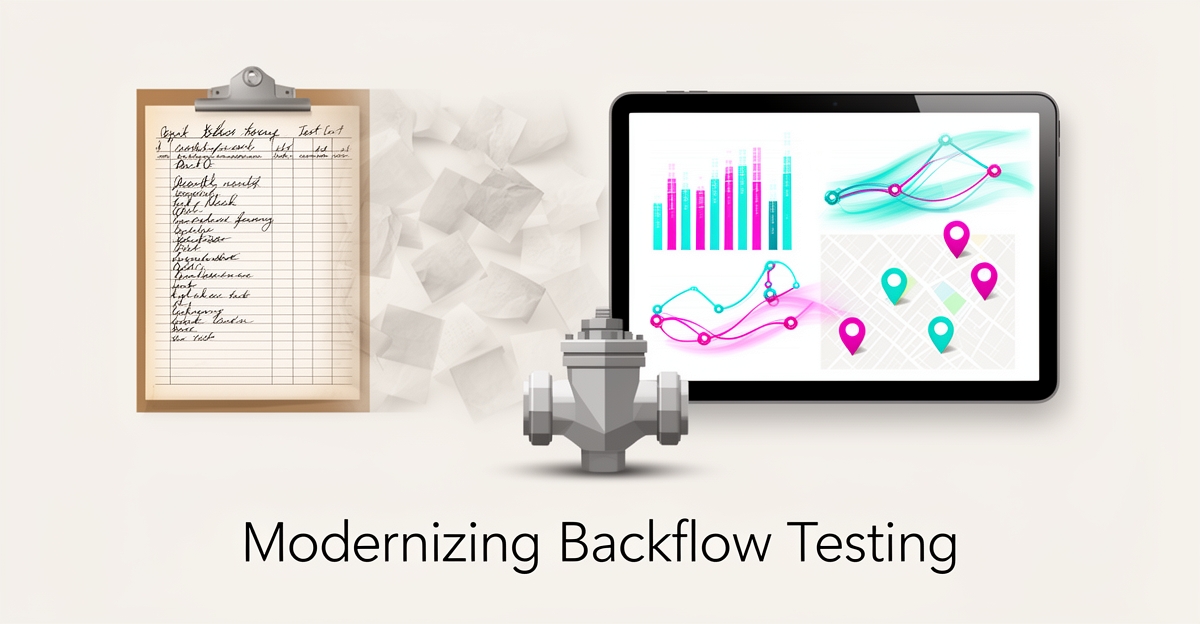
From Paper Logs to AI: How Backflow Testing Companies Are Modernizing Field Data Collection
Key Facts
- Paper-based workflows introduce significant operational limitations including manual transcription errors, limited searchability, difficult data sharing, and weak auditability
- AI document-processing tools in adjacent field-data industries typically convert large batches of legacy logs into structured formats (Excel, CSV, JSON) in a fraction of the time manual entry requires
- Specialized backflow testing platforms commonly offer per-assembly pricing, recurring annual reminders, and compliance documentation; entry-level plans in this category typically start in the tens of dollars per month as of late 2026
- Backflow testing businesses operate at the intersection of public health compliance and field service logistics, requiring software that handles per-assembly pricing, recurring annual reminders, compliance documentation, and route-dense schedules across dozens of daily stops
- Structured digital records can be automatically validated for inconsistencies, something paper logs simply cannot do
Hire a team member that works 24/7 — for less than a part-time wage.
AI receptionists, SDRs, dispatchers and 99+ roles. Trained on your business, fully managed.
Not sure where to start? Ask our AI planner
The Paper Log Problem Costing Backflow Testers Time and Compliance
Backflow testers still juggling paper logs and spreadsheets are fighting an uphill battle against time, errors, and compliance risk. Manual transcription from handwritten notes to digital systems introduces costly mistakes that can invalidate entire test reports, especially when dealing with per-assembly pricing and state-specific form requirements. Paper-based workflows create significant operational limitations including manual transcription errors, limited searchability, difficult data sharing, and weak auditability, each a direct threat to compliance in a field where annual recurring tests and jurisdictional form variations leave zero room for error.
For businesses managing route-dense schedules of a dozen or more daily stops, the inability to quickly search or filter historical test data turns every audit preparation into a scavenger hunt. Paper logs offer no instant access to past test results, device histories, or compliance trends, forcing testers to flip through physical binders or disorganized digital folders when time is critical. This lack of searchability not only slows down field operations but also undermines the ability to proactively manage customer assets or identify patterns that could prevent failures before they happen.
Beyond inefficiency, paper systems fail to provide the audit trails regulators demand. Without timestamped, user-tracked entries, it's nearly impossible to prove who conducted a test, when it was completed, or whether QA/QC checks were performed, opening the door to compliance challenges during inspections or liability claims. Structured digital systems enable automatic validation that flags inconsistencies like duplicate records or out-of-range readings, something paper logs simply cannot do. For backflow testers operating under tight annual cycles and strict public health obligations, relying on paper isn't just inefficient, it's a compliance liability waiting to happen.
How AI Digitizes Field Data and Enriches It With Location Intelligence
Every backflow testing company that has been in business more than a few years is sitting on a goldmine it can't use: boxes of paper test logs, handwritten field notes, and spreadsheets that only one retired technician fully understands. AI can now unlock that archive, and, more importantly, turn it into intelligence that drives better business decisions.
The first step is digitization. Modern AI document processing pipelines use an OCR-first approach combined with field-aware extraction and cross-validation to read legacy records, no matter how messy. Tools in adjacent field-data industries have demonstrated what's possible: batch-processing systems that convert thousands of pages across varied contractor templates into structured results in minutes per log, classifying pages automatically, merging tables that span multiple pages, and interpreting abbreviated field notes. The output isn't a scanned image, it's structured data in formats like Excel, CSV, and JSON, ready for analysis and integration.
This matters because paper workflows carry real operational costs. Paper-based systems suffer from manual transcription errors, limited searchability, and weak auditability, problems that compound when compliance documentation is on the line. Structured digital data, by contrast, can be automatically validated for inconsistencies, searched in seconds, and integrated with external platforms.
Once records are digitized, the second step begins: data enrichment with location intelligence. Structured records integrate effectively with GIS systems, mapping tools, and asset management platforms, meaning every historical test result can now be tied to a precise location, a device type, and a service history. For a backflow testing operation, that unlocks capabilities paper could never support:
- Route optimization for route-dense daily schedules spanning a dozen or more property stops
- Recurring scheduling built on annual test intervals tracked per customer and per device
- Per-assembly tiered pricing that accounts for different device types like RPZ, DCVA, and PVB assemblies
- Service pattern insights that reveal which neighborhoods, property types, or device categories drive the most revenue and retest volume
Backflow testing businesses operate at the intersection of public health compliance and field service logistics, requiring systems that handle per-assembly pricing, recurring annual reminders, and compliance documentation across dozens of daily stops. Generic spreadsheets can't deliver any of that. Enriched, structured data can.
The payoff of digitization is measurable. Where a junior staff member once budgeted weeks to digitize a project's worth of logs, AI-assisted extraction compresses that to an afternoon, with every extracted value traceable back to its source. That same compression of effort applies to a backflow company's decade of paper records.
This is precisely where custom data pipelines earn their keep. Rather than forcing a business into off-the-shelf software that treats every trade the same, AIQ Labs' AI Workflow Builds rebuild the one workflow that costs you the most, converting physical records into structured, location-enriched data the business owns outright, then connecting that data to scheduling, pricing, and planning workflows built around how backflow testing actually operates. The result is a single source of truth that turns a compliance obligation into a competitive advantage.
What Modern Field Service Platforms Deliver for Backflow Compliance
Specialized backflow testing platforms solve the compliance-and-logistics puzzle that generic CRMs miss. These businesses operate at the intersection of public health regulation and dense route schedules, requiring per-assembly pricing, annual recurring reminders, and inspection forms that mirror exact water authority submission requirements.
As of late 2026, several platforms serve this niche. All-in-one tools aimed at licensed contractors typically combine estimates, scheduling, invoicing, route optimization, and automated reminders in a single subscription, with entry plans generally starting in the tens of dollars per month. Other options target solo testers with per-report pricing or compliance-only tooling, so it's worth comparing current pricing directly with vendors before committing.
- Inspection forms matching RPZ, DCVA, and PVB test requirements for local authorities
- Recurring scheduling with annual test intervals per customer and device
- Route optimization for dense daily schedules across dozens of properties
- Per-assembly tiered pricing for different device types and repair kits
- Automated annual reminders and 24/7 virtual call handling
Mobile offline capture is non-negotiable, testers work in basements, mechanical rooms, and vaults where connectivity fails. The best apps require minimal taps to log a test, capture photos, and generate certificates before the tech leaves the site. City-specific form coverage and automatic submission via email, portal, or fax to the right authority are also key differentiators to look for.
This mirrors the broader shift AIQ Labs sees across field services: converting physical records into structured, searchable data unlocks planning and compliance intelligence that paper archives never could. The same AI document processing that transforms geological logs into modeling-ready datasets now powers backflow platforms that turn field notes into audit-ready submissions automatically.
Implementation Roadmap: From Paper Archive to Actionable Intelligence
Backflow testing companies are moving beyond paper logs to build field data systems that actually drive decisions. The journey starts with digitizing decades of handwritten notes and scanned forms, work that once took weeks now typically happens in hours using AI-powered extraction, turning illegible field notes into structured CSV, JSON, or Excel files ready for analysis. This isn't just about saving time, it's about creating a searchable, audit-ready foundation for compliance and planning.
Next, businesses need workflows that turn daily field activity into intelligent operations. Specialized backflow platforms handle scheduling, per-assembly pricing, and automated reminders for testers managing a dozen or more stops per day. AIQ Labs helps integrate these with existing tools, like QuickBooks or GPS systems, so data flows seamlessly from inspection to invoice without manual re-entry. The result is a unified system where every test, part used, and customer interaction feeds into real-time dashboards.
Finally, for companies that want the whole operation connected, AIQ Labs' AI Operating Systems service builds one connected operating layer, phased, owned outright, and free of vendor lock-in. By connecting field data to geolocation, service history, and failure patterns, companies can predict which assemblies are likely to fail next year or optimize routes based on seasonal demand. That turns archive boxes of paper into a living database that improves planning, reduces compliance risk, and supports smarter resource allocation.
Still paying for 10+ subscriptions that don’t talk to each other?
We build custom AI systems you own outright. No vendor lock-in. Full control.
Not sure where to start? Ask our AI planner
Frequently Asked Questions
How long does it actually take to digitize years of paper backflow test logs using AI?
What specific features do backflow testing platforms need that generic field service software doesn't provide?
What should I look for when comparing backflow testing software pricing?
Can AI really improve compliance and reduce rejected backflow test reports?
What happens to my data if I use an AI document processing service?
Do I need to replace my existing accounting or scheduling tools when modernizing with AI?
Key Takeaways
From Compliance Burden to Competitive Asset. The shift from paper logs to AI-enriched field data isn't just a technology upgrade, it's a fundamental change in how backflow testing businesses operate. Digitizing decades of handwritten records creates a searchable, audit-ready foundation; enriching that data with location and service history unlocks route optimization, predictive scheduling, and pricing intelligence that paper never could. Whether you start with a single workflow rebuild or a full connected operating layer, the companies that modernize their field data now will be the ones setting the pace on compliance and customer service. Ready to see what your paper archive is worth? Take the two-minute Fit Check and book a free 30-minute strategy call with AIQ Labs.
Make AI your competitive advantage — not just another tool.
Strategy, implementation and ongoing optimization. One partner, end to end.
Not sure where to start? Ask our AI planner