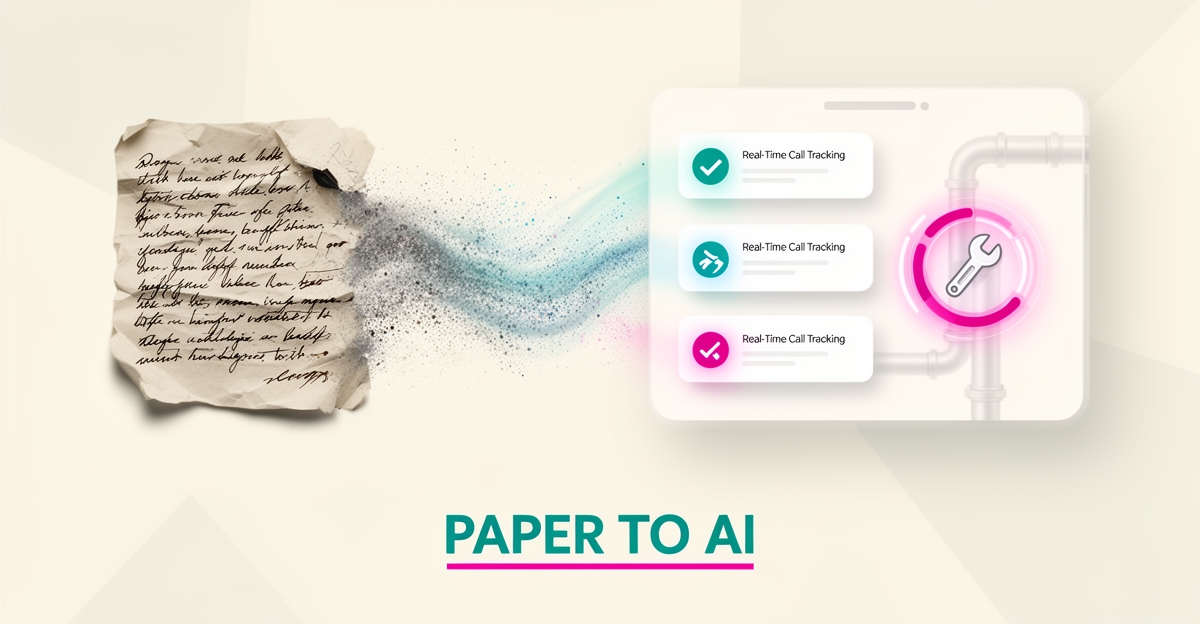
From Paper Logs to AI: How Emergency Plumbers Can Track Service Calls in Real Time
Key Facts
- 163% productivity growth on average for top fifth of AI-exposed companies according to PwC's 2026 AI Jobs Barometer
- 78% of global businesses use AI in at least one business function per industry research
- 42% faster wage growth in professionalized jobs since 2021 per PwC analysis
- 40% of UK employees receive 'work slop' from low-quality AI-generated content per industry analysis
- 62% to over 80% of workers lack confidence or training in AI systems per recent studies
- AI voice agents automatically record, categorize, and track service calls in real time as demonstrated in field applications
- AI-powered call tracking eliminates manual data entry and reduces response delays per plumbing service implementations
Hire a team member that works 24/7 — for less than a part-time wage.
AI receptionists, SDRs, dispatchers and 99+ roles. Trained on your business, fully managed.
Not sure where to start? Ask our AI planner
The Hidden Costs of Paper Logs in Emergency Plumbing
The hidden costs of paper logs in emergency plumbing go far beyond cluttered desks and lost receipts. When a pipe bursts at 2 a.m., technicians scribble notes on whatever's handy, creating gaps in accountability that ripple through follow-ups and customer trust. Manual logbooks offer no real-time visibility, leaving dispatchers guessing who's en route and managers unable to verify completed work until hours, or days, later. This delay isn't just inconvenient; it directly impacts response quality and customer satisfaction during critical moments.
Transcription errors compound the problem. A misread address or garbled service description can send a tech to the wrong location or trigger incorrect follow-up actions, wasting time and damaging credibility. These mistakes aren't rare, industry research shows that 40% of UK employees receive 'work slop' caused by low-quality, AI-generated content, highlighting how easily flawed data degrades operational quality per industry analysis. In emergency plumbing, where precision matters, such errors can mean the difference between a resolved issue and a flooded basement.
Without a digital trail, there's zero accountability for missed steps or delayed responses. If a customer calls back about a recurring leak, there's no way to verify what was done, what parts were used, or whether a follow-up was promised. This lack of traceability erodes trust and often costs jobs, negative reviews, and repeat business. AIQ Labs helps SMBs replace these fragile systems with AI workflow builds that automatically record, categorize, and track every service call, turning guesswork into verifiable action. By integrating with tools like Google Calendar or CRM platforms, these systems create a single source of truth that ensures no detail slips through the cracks, even during the busiest overnight shifts.
Why AI Adoption in the Trades Is Accelerating (and Paying Off)
AI adoption in the trades is no longer a distant possibility, it's already delivering measurable results across industries. According to industry research, 78% of global businesses are using AI in at least one business function, signaling a fundamental shift in operational norms. For emergency plumbers, this means AI call tracking is evolving from experimental tool to proven infrastructure.
The productivity gains are substantial. PwC's 2026 AI Jobs Barometer reveals that companies in the top fifth of AI exposure have achieved 163% productivity growth on average, while professionalized roles have seen 42% faster wage growth since 2021. These figures demonstrate that AI isn't just automating tasks, it's redefining efficiency and value creation in skilled trades.
For plumbing businesses specifically, AI voice agents are already qualifying leads, managing job scheduling, and syncing directly with FSM and CRM systems, eliminating manual data entry and reducing response delays. This integration turns every service call into a traceable, actionable data point, improving accountability and minimizing follow-up errors.
- Automatically records and categorizes incoming service calls in real time
- Routes urgent requests to the nearest available technician based on location and skill
- Logs job details, parts used, and completion status without manual input
- Flags unresolved issues or missed follow-ups before they escalate
- Generates audit-ready reports for insurance, compliance, and performance tracking
As AI moves from pilot projects to core operations, early adopters in home services are gaining a competitive edge through faster response times, higher first-time fix rates, and improved customer satisfaction. The data confirms that AI-powered call tracking isn't just about modernization, it's about building a more resilient, responsive, and profitable plumbing operation.
What an AI Call-Tracking System Actually Does on Every Job
Modern emergency plumbing operations face a critical accountability gap when relying on manual logbooks to track service calls. Paper systems create blind spots where calls get miscategorized, timestamps are inaccurate, and follow-ups fall through the cracks, directly contributing to the 40% of UK employees experiencing 'work slop' from low-quality, inefficient processes according to industry research. An AI call-tracking system eliminates this gap by creating a complete, auditable record of every customer interaction from first ring to job completion.
When a call comes in, an AI voice agent or dispatcher automatically captures and transcribes the conversation in real time, using natural language processing to categorize it as an emergency, quote request, or follow-up, mirroring how AI voice agents already transform plumbing services by qualifying leads and managing scheduling as demonstrated in field applications. The system then logs the transcribed call, timestamp, and category directly into the CRM with zero manual entry, creating an immutable audit trail that replaces the paper logbook entirely. Simultaneously, the AI books the job into Google Calendar based on technician availability and service urgency, ensuring no scheduling conflicts or missed appointments.
This end-to-end workflow establishes a clear accountability chain: every call is recorded at inception, accurately categorized by AI, timestamped in the CRM, and linked to a scheduled service event. For emergency plumbing businesses, this means no more disputed call times, no lost follow-ups on quotes, and complete visibility into how each service request moves through the pipeline. By automating these foundational tracking functions, companies reduce the administrative burden that fuels work slop, where 62% to over 80% of workers lack confidence or training in AI systems per recent studies, and instead focus human expertise on complex problem-solving and customer care. The result is a self-documenting service operation where accountability isn't hoped for; it's engineered into every interaction.
Avoiding 'Work Slop': Rolling Out AI Without Creating New Problems
Rolling out AI in emergency plumbing operations requires more than just installing new software, it demands a thoughtful approach to avoid creating what experts call "work slop." Research shows that 40% of UK employees already receive low-quality AI-generated output, which wastes time and erodes trust in the technology according to industry analysis. Even more concerning, between 62% and over 80% of workers lack the confidence or training to use AI effectively, increasing the risk of errors when systems are deployed without proper support as noted in recent studies. For dispatchers and technicians juggling urgent service calls, poorly implemented AI can add confusion rather than clarity.
To prevent these pitfalls, emergency plumbing businesses should start with targeted training for all team members who will interact with the AI system. Dispatchers need to understand how the technology categorizes incoming calls, while technicians benefit from knowing how work orders are generated and updated in real time. This foundational knowledge reduces reliance on guesswork and helps staff use AI as a tool rather than a black box. Equally important is maintaining a human review step, especially during early deployment, where a supervisor or experienced dispatcher verifies AI-categorized calls before they're assigned. This simple checkpoint catches misclassifications early and builds team confidence in the system's accuracy.
Clear operational rules are also essential. Define exactly when the AI should act autonomously (such as logging routine service requests) and when it must escalate to a human (like calls involving gas leaks or sewage backups). These boundaries prevent over-reliance on AI in high-stakes scenarios while still capturing efficiency gains in predictable workflows. Begin by applying the system to a single, well-defined process, such as automated call logging and categorization, before expanding to scheduling, invoicing, or customer follow-ups. This phased approach allows teams to adapt gradually, identify pain points early, and refine the system based on real-world feedback. By prioritizing training, oversight, and incremental scaling, emergency plumbers can harness AI's benefits without trading one set of problems for another.
Getting Started: From First Workflow to Full Dispatch Automation
The fastest way to modernize an emergency plumbing operation isn't to overhaul everything at once, it's to fix the one workflow that breaks most often. For most shops, that's call logging and follow-up: the moment a panicked customer phones in, details get scribbled on paper, and critical follow-ups slip through the cracks.
Start there. AI voice agents can already qualify new leads, answer service-specific questions, and manage complex job scheduling directly inside your existing FSM or CRM. That means your first automation doesn't require ripping out the tools your team already knows, it connects them. Your Google Calendar, your CRM, your phone line: one integrated system that records every call, categorizes the emergency, and schedules the follow-up automatically.
This targeted approach matters more than most owners realize. According to recent analysis of AI adoption, 62% to over 80% of workers lack confidence or training in AI tools, and 40% of employees report receiving low-quality, AI-generated "work slop" that wastes time instead of saving it. The antidote isn't avoiding AI; it's deploying it narrowly, with clear objectives and human review built in from day one.
A practical rollout looks like this:
- Pick one broken workflow, typically call intake and follow-up logging
- Integrate with existing tools like Google Calendar and your CRM rather than replacing them
- Train the AI on your specific service categories, pricing logic, and escalation rules
- Add a human review step for the first 30 days to catch edge cases
- Expand to full dispatch automation only after the first workflow runs clean
The payoff for getting this right is substantial. PwC's 2026 AI Jobs Barometer found that companies most exposed to AI are seeing 163% productivity growth on average, but that growth accrues to businesses that implement thoughtfully, not those that automate everything at once and hope for the best.
At AIQ Labs, we structure engagements around this exact progression. Some plumbing businesses start with an AI Employee, a managed AI dispatcher on a flat monthly plan that handles call answering, logging, and scheduling 24/7, at a fraction of the cost of a human hire, with the flexibility to pause or adjust anytime. Others prefer to build in milestones, fixing one workflow at a time at a fixed price, owning each phase as it ships. And for operations ready to replace their entire dispatch stack, we build a full AI Operating System the business owns outright, code, agents, and data included. You can compare all three paths on our pricing page.
The common thread is starting small enough to prove value in weeks, not months. If you're ready to map your first workflow, or just want an honest assessment of whether AI dispatch makes sense for your operation, start with the two-minute Fit Check, then book a free 30-minute strategy call. We'll identify your highest-ROI automation opportunity, and if there isn't a clear win, we'll tell you that too.
Still paying for 10+ subscriptions that don’t talk to each other?
We build custom AI systems you own outright. No vendor lock-in. Full control.
Not sure where to start? Ask our AI planner
Frequently Asked Questions
How does an AI call-tracking system improve accountability for emergency plumbing businesses?
What are the risks of using AI in emergency plumbing if not implemented properly?
Can AI voice agents really handle emergency plumbing calls without human intervention?
What productivity gains can emergency plumbers expect from adopting AI-powered call tracking?
Is it necessary to replace existing tools like Google Calendar or CRM when adopting AI for call tracking?
How can emergency plumbing businesses avoid creating new problems when rolling out AI?
Close the Accountability Gap Before Your Next 2 A.M. Call
Paper logs made sense when emergency plumbing was a one-truck operation. Today, they're a liability, creating blind spots where calls get lost, details get misread, and follow-ups vanish. The good news? AI call tracking isn't some distant future. With 78% of global businesses already using AI in at least one function, the technology has moved from experimental to essential. The key is starting small: automate call logging first, integrate with the tools you already use, and keep a human review step in place until the system proves itself. That's how you capture the productivity gains without falling into the work slop trap. At AIQ Labs, we help emergency plumbing businesses make this transition with AI Employees that record, categorize, and schedule every call, no rip-and-replace required. If you're ready to see what that looks like for your operation, start with the two-minute Fit Check and book a free 30-minute strategy call. We'll map your highest-ROI opportunity, or tell you honestly if there isn't one.
Make AI your competitive advantage — not just another tool.
Strategy, implementation and ongoing optimization. One partner, end to end.
Not sure where to start? Ask our AI planner