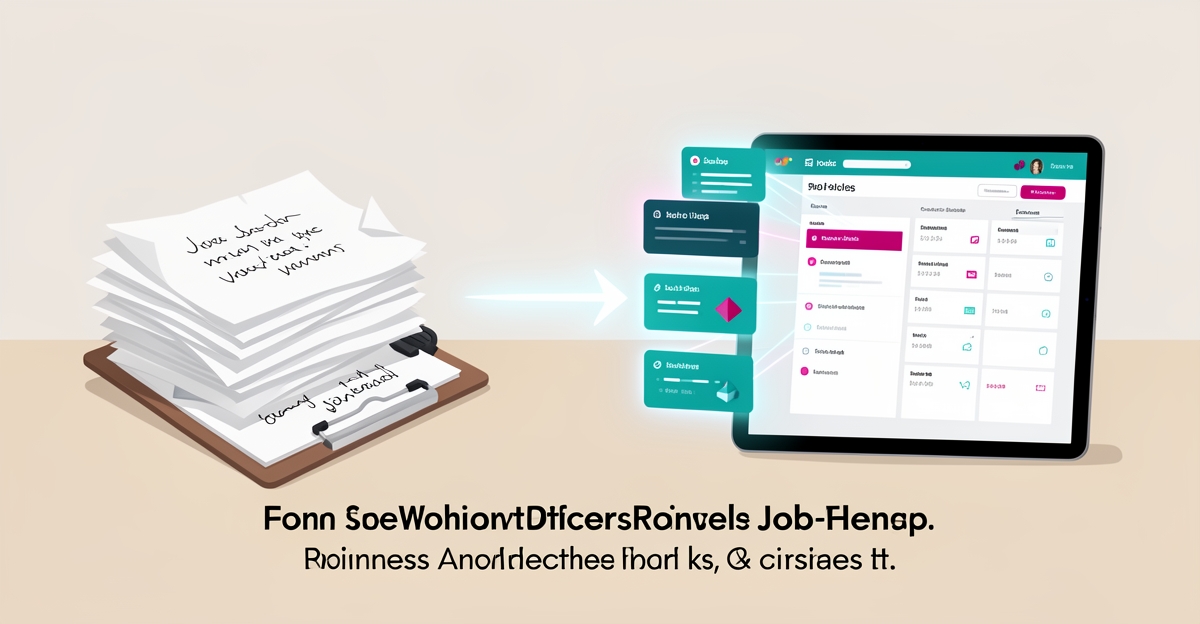
# From Paper Logs to AI: How Home Repair Shops Can Digitize Job Tracking
**Quick Answer:** Paper job logs slow down invoicing, complicate warranty claims, and bury your team's history in filing cabinets. AI document processing turns those logs into searchable digital records, captured automatically, verified by your team, and owned outright. Start with a [free Fit Check](/apply) to find your highest-impact workflow.
## Key Facts
- Paper-based job tracking creates three recurring costs: slow invoicing, weak warranty documentation, and hours lost to manual data entry.
- Modern OCR combined with language models can now interpret handwritten technician notes with enough accuracy for production use, with human review catching the rest.
- Digitized job records become searchable across job type, customer, and location, turning a filing cabinet into a queryable database.
- AIQ Labs has deployed 200+ multi-agent systems and runs 4 live SaaS products daily, so this isn't experimental tooling.
- The right first move is narrow: digitize the one document workflow that costs the most, prove it, then scale.
## Table of Contents
- [The Paper Problem: Why Home Repair Shops Are Drowning in Manual Job Logs](#the-paper-problem-why-home-repair-shops-are-drowning-in-manual-job-logs)
- [How AI Document Processing Turns Paper Chaos Into Searchable Records](#how-ai-document-processing-turns-paper-chaos-into-searchable-records)
- [From Filing Cabinets to Cloud: A Practical Implementation Roadmap](#from-filing-cabinets-to-cloud-a-practical-implementation-roadmap)
- [Real ROI: What Home Repair Shops Gain From AI Job Tracking](#real-roi-what-home-repair-shops-gain-from-ai-job-tracking)
## The Paper Problem: Why Home Repair Shops Are Drowning in Manual Job Logs
Home repair shops relying on paper job logs face daily operational friction that directly hits the bottom line. Lost invoices, illegible repair notes, and missing documentation for warranty claims create avoidable delays and errors. Technicians often duplicate work because job histories aren't easily accessible, while customer service teams spend hours manually searching through files instead of resolving issues. That manual data entry burden consumes time that should go to billable work or customer engagement.
The cost of inefficiency extends beyond lost hours. Delayed invoicing disrupts cash flow. Compliance gaps risk penalties. Customers receive inconsistent service because records are fragmented. These aren't minor inconveniences, they're systemic weaknesses that erode profitability and make it harder to scale.
The typical symptoms:
- Technicians recreating lost or unreadable job notes instead of doing billable work
- Warranty claims delayed or disputed because documentation is missing or illegible
- Invoicing that lags behind completed work because paperwork has to be chased, sorted, and rekeyed
AIQ Labs addresses this with [AI Workflow Builds](/workflow-builds): we rebuild the one document workflow that costs your shop the most, fixed price, delivered in phases. By transforming chaotic paper trails into searchable, secure digital records, shops eliminate manual data entry errors and get instant access to complete job histories. That foundation enables faster invoicing, accurate warranty support, and customer service teams that can actually answer questions on the first call.
## How AI Document Processing Turns Paper Chaos Into Searchable Records
The shift from paper job logs to digital records changes how a shop manages its operational knowledge. Paper chaos, scattered invoices, illegible technician notes, misplaced work orders, creates bottlenecks that slow service delivery and increase error rates. Modern AI document processing turns that disarray into structured, searchable data that flows across your business systems.
AI-powered document scanning starts the process by converting physical repair notes, invoices, and job logs into machine-readable formats. Optical character recognition, now enhanced with language models, can interpret handw
AI Employees
Hire a team member that works 24/7 — for less than a part-time wage.
AI receptionists, SDRs, dispatchers and 99+ roles. Trained on your business, fully managed.
See If You’re a Fit — AI Employees from $700/mo
Not sure where to start? Ask our AI planner
ritten technician notes far more reliably than earlier generations of the technology could. These systems extract critical fields, customer name, job date, parts used, labor hours, and flag missing or inconsistent information for human review before it affects billing or service follow-up.
Once extracted, the data is automatically categorized by job type, customer, or service location. That enables instant retrieval of historical records: pull up every HVAC maintenance job at a specific address, or spot recurring parts failures across a customer's equipment. The result is a living database that supports faster diagnostics, accurate quoting, and proactive customer outreach, while sharply cutting manual data entry.
AIQ Labs builds document processing systems that integrate directly with existing shop management software, so extracted data flows into scheduling, invoicing, and customer relationship platforms without rekeying. For shops that want to go further, an [AI Operating System](/ai-operating-systems) connects document intake with scheduling, dispatch, and invoicing in one layer, built in phases and owned outright, with no subscription sprawl or vendor lock-in.
## From Filing Cabinets to Cloud: A Practical Implementation Roadmap
The gap between "we should digitize" and "we actually did it" is where most home repair shops stall, usually because they try to digitize everything at once. The shops that succeed start narrow, prove value, then scale.
**Step one: map your highest-volume document workflows.** For most repair shops, that means invoices, work orders, and warranty claims, the paper trail that eats technician hours every week. Count how many of each document flows through the shop monthly and where they pile up. That's your starting point, not the filing cabinet in the back room.
**Step two: pilot AI document processing on one workflow.** Pick a single document type, say, work orders, and run AI-powered capture, categorization, and storage alongside your existing process for 30 days. The goal isn't perfection; it's a measurable baseline. You want your own numbers before committing shop-wide.
**Step three: address the real barriers before they stall you.** Most AI adoption slows down not because of technology, but because of organizational friction. Siloed systems, your invoicing tool that doesn't talk to your scheduling software, are the most common culprit. Compliance is the second: repair records, warranty documentation, and customer data need audit trails and controlled access. Modern AI document systems handle both, creating searchable records that make compliance easier, not harder, but only if you plan for it upfront.
**Step four: keep humans in the loop.** AI excels at scanning, extracting, and categorizing, but a technician should still verify that an invoice matches the work performed before it's archived. Your team's role shifts from data entry to review and judgment, not toward the exit.
- Audit document volume: identify which paperwork consumes the most hours weekly
- Pilot one workflow with clear success metrics before expanding
- Connect systems so AI can act across your whole operation, not one silo
- Build human review checkpoints into every automated step
**Build or buy?** Off-the-shelf tools work for standard needs, but shops with unusual workflows, custom warranty terms, multi-location parts tracking, often outgrow them quickly. Custom-built systems that the shop owns outright avoid subscription sprawl and vendor lock-in, and integrate directly with existing tools rather than forcing new ones. This is where AIQ Labs fits: our [AI Workflow Builds](/workflow-builds) rebuild the document workflow that costs you most, at a fixed price and in phases you approve.
For ongoing document management, an [AI Employee](/ai-employees), say, an Invoice Processor or Work Order Manager, can handle the daily flow around the clock at a fraction of the cost of a human hire, escalating exceptions to your team. The right move depends on your volume; a [free 30-minute strate
AI Development
Still paying for 10+ subscriptions that don’t talk to each other?
We build custom AI systems you own outright. No vendor lock-in. Full control.
See If You’re a Fit — AI Employees from $700/mo
Not sure where to start? Ask our AI planner
gy call](/book) can map which workflow delivers the fastest win.
## Real ROI: What Home Repair Shops Gain From AI Job Tracking
Paper logs and handwritten job sheets quietly drain margin from home repair shops every week. Digitizing that workflow with AI turns a cost center into a searchable, compliant asset.
Home repair teams gain speed where it matters most. AI-powered document processing scans, categorizes, and stores paper-based job logs, repair notes, and invoices automatically, creating searchable records for compliance and customer service. That shift reduces manual data entry and gives crews instant access to job histories without digging through file cabinets.
The financial impact compounds quickly. Faster capture means invoices leave the shop sooner, improving cash flow and reducing late payment exposure. Month-end close accelerates when records are structured and audit-ready, and searchable archives make warranty disputes easier to resolve with evidence at hand. **Compliance becomes continuous** rather than a scramble before an audit.
Real benefits show up across the operation:
- Instant job history retrieval for faster customer service and fewer repeat visits
- Audit trails and searchable records that support warranty claims and compliance reviews
- Automated document capture that cuts manual entry and frees administrative hours
- Structured data that feeds reporting, forecasting, and cash flow visibility
The trend is clear. Document automation is no longer experimental, it's a competitive advantage as AI adoption spreads through small and mid-sized operations. Shops that digitize job tracking now protect margin, improve service speed, and build a data foundation for future growth.
## Frequently Asked Questions
**How much time do technicians typically lose to paper job logs?**
It varies by shop, but the losses come from three places: recreating lost or unreadable notes, hunting for past job histories, and rekeying paperwork into invoicing systems. A 30-day pilot on one workflow will give you your own baseline.
**Can AI document processing accurately interpret handwritten technician notes?**
Modern OCR combined with language models handles handwritten notes far better than earlier generations of the technology, and anything ambiguous gets flagged for human review before it reaches billing.
**What is the recommended first step for a home repair shop looking to digitize job tracking with AI?**
Map your highest-volume document workflows, typically invoices, work orders, and warranty claims, to identify which paperwork consumes the most hours weekly, then pilot AI on that one workflow.
**Does implementing AI document processing require replacing existing shop management software?**
No. AIQ Labs builds document processing systems that integrate directly with existing shop management software, so extracted data flows into scheduling, invoicing, and customer relationship platforms without rekeying.
**Do I own the system, or am I locked into a subscription?**
With AIQ Labs, you own it outright. Systems are built in phases at a fixed price, no subscription sprawl, no vendor lock-in.
## Turn Paper Chaos Into Your Competitive Edge
Home repair shops drowning in paper logs are losing time, money, and customer trust, technicians waste hours recreating lost notes, warranty claims stall, and slow invoicing drags on cash flow. AI document processing flips this: scanning, categorizing, and storing job records automatically creates searchable, compliant data that speeds up service, reduces errors, and frees teams to focus on repairs, not paperwork. Start small, pilot one workflow like work orders, see measurable gains, then scale. The real win isn't just digitizing files; it's building a foundation for faster invoicing, stronger warranty support, and smarter customer service. Ready to find your biggest bottleneck? Take the [2-minute Fit Check](/apply), then book a [free 30-minute strategy call](/book) to map your highest-impact automation opportunity and get a clear path forward.
AI Transformation Partner
Make AI your competitive advantage — not just another tool.
Strategy, implementation and ongoing optimization. One partner, end to end.
See If You’re a Fit — AI Employees from $700/mo
Not sure where to start? Ask our AI planner