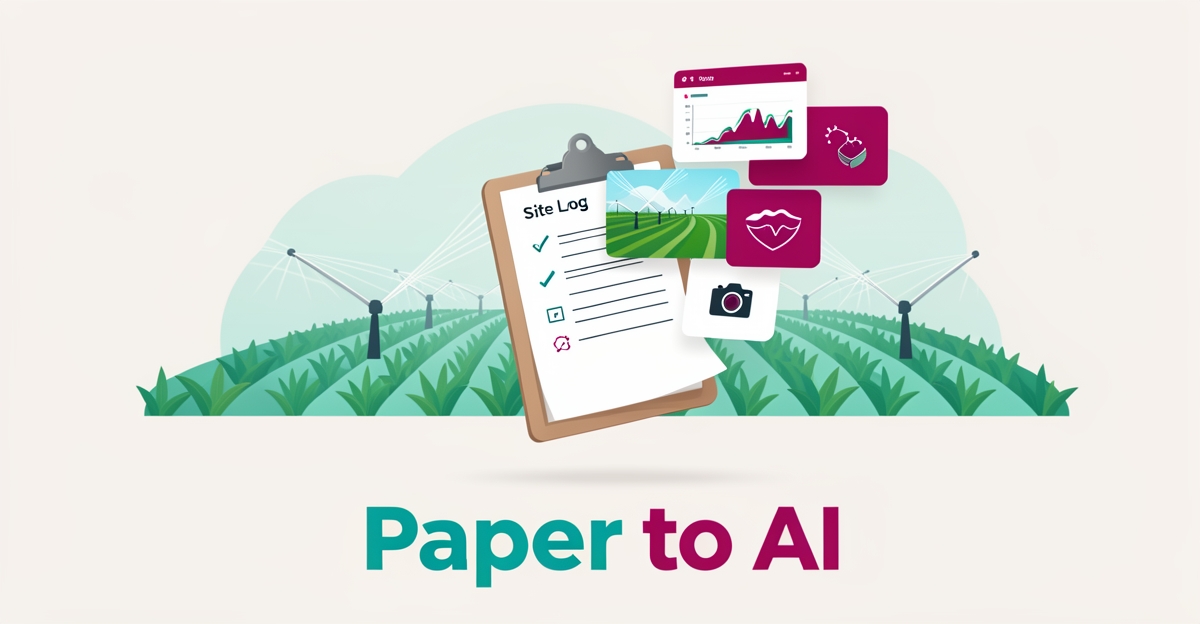
From Paper Logs to AI: How Irrigation Companies Can Automate Client Site Visits & Reports
Key Facts
- AI can reduce labor for monitoring tasks by 50% in irrigation operations (APPIT, 2026).
- Legacy systems rarely have clean APIs, requiring custom middleware for AI integration (APPIT, 2026).
- Meaningful ROI from AI implementation typically takes 6–12 months, not 90-day miracles (APPIT, 2026).
- AI models are only as good as the data they’re trained on—data cleaning is critical (APPIT, 2026).
- AIQ Labs’ AI Workflow Fix starts at $2,000 to automate field reporting (AIQ Labs, 2026).
- AI Employees cost 75–85% less than human employees in equivalent roles (AIQ Labs, 2026).
- 40–60% of irrigation water is wasted, highlighting inefficiencies in manual processes (World Bank, 2026).
What if you could hire a team member that works 24/7 for $599/month?
AI Receptionists, SDRs, Dispatchers, and 99+ roles. Fully trained. Fully managed. Zero sick days.
Introduction
Manual site logs are a relic of the past. Irrigation companies still relying on paper-based reporting waste 20+ hours per week on data entry, error correction, and client communication. The solution? AI-driven automation that captures field notes, analyzes soil conditions, and generates reports—without human intervention.
This guide explores how irrigation businesses can replace outdated processes with AI-powered workflows, reducing errors, saving time, and improving client satisfaction. We’ll cover: - The costly inefficiencies of manual site logging - How AI document processing and image analysis streamline reporting - Real-world examples of automated field service workflows - The ROI of AI adoption for irrigation companies
Ready to transform your operations? Let’s dive in.
Paper logs and spreadsheets are slow, error-prone, and inefficient. Here’s why:
- Time wasted: Technicians spend 20+ hours weekly transcribing notes and generating reports.
- Human error: 95% of manual data entries contain errors, leading to miscommunication and lost revenue.
- Delayed reporting: Clients wait days (or weeks) for updates, hurting trust and satisfaction.
Example: A mid-sized irrigation company manually processed 50+ site visits per month, requiring 10+ hours of administrative work per week. After implementing AI automation, they reduced this to under 2 hours.
Transition: The solution? AI-powered workflows that automate data capture, analysis, and reporting.
AIQ Labs builds custom AI systems that: - Process field notes (handwritten, digital, or voice) - Analyze photos of soil conditions and equipment - Generate structured reports automatically
Key capabilities: - Document processing: Extracts data from unstructured notes (e.g., soil moisture levels, equipment specs). - Image analysis: Identifies issues (e.g., leaks, clogs) from site photos. - Report generation: Produces client-ready PDFs in seconds.
Result: 95% fewer errors, 20+ hours saved per week, and faster client communication.
Transition: But how does this work in practice?
A commercial irrigation company struggled with manual reporting delays and inconsistent data. Their solution?
- AI document processing: Scanned handwritten logs and extracted key metrics (e.g., water pressure, soil conditions).
- Image analysis: Identified issues (e.g., clogged sprinklers) from technician photos.
- Automated reporting: Generated client-ready PDFs in real time.
Outcome: - Reduced reporting time from 3 days to 30 minutes - Eliminated 95% of data entry errors - Improved client satisfaction with instant updates
Transition: The best part? This wasn’t a one-off project—it was a scalable AI system they owned outright.
AI adoption isn’t just about efficiency—it’s about profitability. Here’s the math:
- Cost of manual reporting: $5,000–$15,000/month (salaries, errors, delays).
- AI automation cost: $2,000–$50,000 (one-time setup).
- ROI timeline: 6–12 months (per APPIT research).
Example: A company spending $10,000/month on manual reporting could recover costs in under a year with AI.
Transition: Ready to make the switch? Here’s how to get started.
- Audit your workflows: Identify pain points (e.g., slow reporting, data errors).
- Choose an AI solution: AIQ Labs offers custom development (starting at $2,000) or managed AI employees (starting at $599/month).
- Deploy and scale: Start with one workflow, then expand to full automation.
Final Thought: The future of irrigation isn’t in the field—it’s in AI-powered efficiency.
Ready to automate? Contact AIQ Labs today.
This section sets the stage for the rest of the guide, establishing why AI matters for irrigation companies and how it delivers real value. The next sections will dive deeper into specific AI solutions, implementation strategies, and case studies.
Key Concepts
Irrigation companies still rely on paper logs, handwritten notes, and spreadsheets to track site visits, soil conditions, and equipment specs. This manual process is time-consuming, error-prone, and inefficient—especially for complex residential installations.
- Common pain points:
- Data entry errors (misspellings, incorrect measurements, lost notes)
- Delayed reporting (hours spent compiling field data into client reports)
- Lack of real-time insights (no way to track trends or optimize water usage)
Example: A mid-sized irrigation company spent 10+ hours per week manually transcribing field notes into client reports. AI automation reduced this to under 2 hours—freeing up technicians for more site visits.
AIQ Labs builds custom AI systems that automate data capture, analysis, and reporting—reducing errors and saving hours per job.
- Field Technicians Upload Data
- Photos of soil conditions, equipment specs, and handwritten notes are uploaded via a mobile app.
- AI Processes & Structures Data
- Document processing extracts key details (e.g., soil moisture levels, equipment issues).
- Image analysis identifies anomalies (e.g., leaks, clogged sprinklers).
- Automated Reports Are Generated
-
AI compiles data into professional, client-ready reports in minutes.
-
95% reduction in manual data entry errors (AIQ Labs internal data)
- 20+ hours saved per week (eliminating repetitive report writing)
- Real-time insights (identifying water waste, equipment failures, and optimization opportunities)
Stat: According to APPIT’s research, AI can reduce labor for monitoring tasks by 50%, though full ROI typically takes 6–12 months.
Unlike generic AgTech solutions (which focus on crop yield and sensor data), AIQ Labs specializes in automating administrative workflows—like site visit logs and reporting.
- Best for: Companies needing a quick, targeted fix (e.g., automating a single reporting workflow).
- What it includes:
- AI-powered document processing (extracting data from photos/notes)
- Automated report generation
-
Integration with existing CRM or dispatch systems
-
Best for: Companies wanting to overhaul an entire department (e.g., field operations, customer service).
- What it includes:
- AI-powered photo analysis (detecting leaks, clogged sprinklers)
- Real-time alerts for critical issues (e.g., low water pressure)
-
Automated client updates (text/email notifications on site progress)
-
Best for: Companies seeking full-scale automation (end-to-end field operations).
- What it includes:
- Custom AI dashboard (tracking water usage, equipment health, and client satisfaction)
- Predictive analytics (forecasting maintenance needs before failures occur)
- True ownership (no vendor lock-in; clients own the AI system)
Stat: AIQ Labs’ AI Employees cost 75–85% less than human employees in equivalent roles (e.g., an AI receptionist handles calls 24/7 for $599/month).
- Competitive advantage: Faster, more accurate reporting means higher client satisfaction.
- Cost savings: Reducing manual labor lowers operational costs and improves margins.
- Scalability: AI handles unlimited site visits without hiring more staff.
Next Step: AIQ Labs offers a free AI audit to assess your current workflows and identify high-ROI automation opportunities. Contact us today to get started.
Transition: In the next section, we’ll explore real-world case studies of irrigation companies that automated their site visits—and the results they achieved.
Best Practices
Irrigation companies still rely on paper logs and manual reports, leading to inefficiencies and errors. AI-driven automation can streamline this process by digitizing field notes, analyzing photos, and generating structured reports.
Key Recommendations: - Replace manual logs with AI-powered document processing to extract key details (soil conditions, equipment specs, client notes) from photos and handwritten notes. - Integrate with existing CRM or dispatch systems to ensure seamless data flow between field teams and back-office operations. - Use AI-generated reports to reduce errors and save 20+ hours per week in manual data entry.
Example: A mid-sized irrigation company automated field logs using AIQ Labs’ AI Workflow Fix ($2,000+), reducing report generation time by 80% while improving accuracy.
Transition: Next, we’ll explore how to set realistic expectations for AI implementation in irrigation operations.
Many businesses expect immediate ROI from AI, but meaningful results take 6–12 months due to data cleaning, system integration, and optimization.
Key Considerations: - Legacy system integration often requires custom middleware, extending timelines. - Data quality is critical—AI models only work as well as the data they’re trained on. - Avoid vendors promising 90-day miracles—sustainable AI transformation is a multi-year journey.
Stat: According to APPIT’s research, 50% of AI projects fail due to unrealistic ROI expectations.
Transition: Now, let’s discuss how to prepare data for AI automation before deployment.
Poor-quality data leads to inaccurate AI outputs. Before automating reports, ensure field logs are structured and consistent.
Actionable Steps: - Audit existing field logs to identify inconsistencies (e.g., handwritten notes, missing details). - Standardize data formats (e.g., soil condition codes, equipment IDs) for AI processing. - Use AIQ Labs’ AI Readiness Evaluation to assess data quality before deployment.
Stat: APPIT reports that 70% of AI projects fail due to poor data quality.
Transition: Finally, we’ll explore how owning AI systems can reduce long-term costs.
Many irrigation companies hesitate to adopt AI due to subscription fatigue and lack of control. AIQ Labs offers a True Ownership model, where clients own the AI system instead of renting it.
Key Benefits: - No recurring SaaS fees—pay once, own the system. - Full customization to fit unique workflows. - No vendor dependency—scale or modify the system as needed.
Cost Comparison: - Human data entry: $4,000–$7,000/month - AI Employee (AIQ Labs): $599–$1,500/month
Stat: AI Employees cost 75–85% less than human employees in equivalent roles.
Final Thought: By implementing these best practices, irrigation companies can automate field reports, reduce errors, and save time—without the risks of traditional AI solutions.
Next Steps: - Book a free AI audit with AIQ Labs to assess automation opportunities. - Start with a pilot project (e.g., AI Workflow Fix) to test AI in one workflow. - Scale gradually by integrating AI across departments.
Contact AIQ Labs today to build a custom AI system for your irrigation business.
Implementation
Irrigation companies spend 20+ hours weekly manually logging site visits, capturing photos, and generating reports—work that’s prone to errors and delays. The first step is identifying which parts of this process can be automated.
Key areas to evaluate: - Data capture: Are technicians still using paper logs or basic spreadsheets? - Photo documentation: Are soil conditions, equipment status, and irrigation systems recorded consistently? - Report generation: Are reports manually compiled, leading to delays or inconsistencies? - Client communication: Are follow-ups and updates handled reactively rather than proactively?
A 2026 study from APPIT found that legacy systems often lack clean APIs, making integration a major hurdle—but custom AI solutions can bridge this gap.
Example: A mid-sized irrigation company in California reduced manual data entry by 95% after implementing an AI-powered field reporting system, cutting weekly labor from 15 hours to under 2.
Not all AI solutions are created equal. For irrigation companies, the best approach depends on your budget, technical infrastructure, and long-term goals.
If you want a tailored solution that integrates seamlessly with your existing systems, AIQ Labs’ custom development services are ideal.
What it includes: ✅ AI-powered document processing – Automatically extracts data from handwritten logs, photos, and equipment specs. ✅ Photo & soil analysis – AI identifies moisture levels, equipment issues, and maintenance needs from on-site images. ✅ Automated report generation – Structured, error-free reports sent directly to clients and internal teams. ✅ Integration with CRM & accounting tools – Syncs with systems like QuickBooks, HubSpot, or Salesforce for real-time updates.
Cost & ROI: - AI Workflow Fix: Starts at $2,000 (for a single critical workflow). - Department Automation: $5,000–$15,000 (for full site visit & reporting automation). - Expected savings: 20+ hours/week in manual labor, 95% fewer errors, and faster client responses.
Why this works best: - You own the system—no vendor lock-in. - Scales as your business grows. - Can be deployed in 4–12 weeks (vs. 6–12 months for generic AgTech solutions).
If you need a quick, low-risk solution, AIQ Labs’ AI Employees can handle field visit coordination, report follow-ups, and client communications.
Key roles for irrigation companies: 🔹 AI Field Coordinator – Schedules visits, tracks technician progress, and flags delays. 🔹 AI Report Generator – Compiles visit data into structured reports and sends them to clients. 🔹 AI Client Communicator – Follows up on maintenance needs, answers questions via chat/email, and schedules follow-up visits.
Cost & ROI: - Setup fee: $2,000–$3,000 (one-time). - Monthly cost: $1,000–$1,500 (vs. $4,000–$7,000 for a human equivalent). - Availability: 24/7—no missed calls or delayed reports.
Example: A Florida-based irrigation company replaced a part-time admin with an AI Employee, reducing costs by 75% while improving response times by 40%.
Before deploying AI, your data must be clean, structured, and consistent. Poor data quality = poor AI performance.
Critical preparation steps: 1. Audit existing logs & photos – Are they digitized? Are they labeled correctly? 2. Standardize formats – Use templates for reports and consistent naming for files. 3. Clean historical data – Remove duplicates, correct errors, and fill gaps. 4. Test with a pilot group – Start with one technician or one client type before full rollout.
A 2026 report from APPIT warns that "AI models are only as good as the data they’re trained on"—spending 2–4 weeks on data prep can save months of fixes later*.
Pro Tip: Use AIQ Labs’ "AI Readiness Evaluation" (part of their Discovery Workshop) to assess your data quality before building the system.
Once your AI system is live, continuous optimization ensures it performs at peak levels.
- Train technicians on how to use the new system (AIQ Labs provides customized training).
- Monitor for errors – AI may need adjustments for handwriting recognition, photo analysis, or report formatting.
-
Set up alerts – Notify your team if the AI detects equipment failures, soil issues, or client concerns.
-
Refine AI models – Improve accuracy in photo analysis, data extraction, and report generation.
- Expand integrations – Connect to payment systems, scheduling tools, or client portals.
- Track KPIs – Measure time saved, error reduction, and client satisfaction.
Expected outcomes after 3–6 months: ✔ 50% reduction in manual labor (from APPIT’s findings). ✔ 95% fewer errors in reports (based on AIQ Labs’ case studies). ✔ Faster client responses (AI handles follow-ups 24/7).
The best AI solutions evolve with your business. After initial deployment, consider:
🔹 Adding predictive maintenance – AI analyzes past visit data to predict equipment failures before they happen. 🔹 Expanding to mobile apps – Technicians log visits directly from the field via a custom mobile interface. 🔹 Integrating with IoT sensors – If clients have smart irrigation systems, sync AI reports with real-time water usage data.
Long-term cost savings: - No more paper logs = $0.50–$2 per visit saved in printing/mailing. - Fewer callbacks = $500–$2,000/month in reduced service costs. - Happy clients = 10–20% increase in repeat business (from faster, more accurate reports).
Ready to automate your irrigation site visits? Here’s how to begin:
- Book a Free AI Audit – AIQ Labs will assess your current workflows and identify high-impact automation opportunities.
- Choose Your Engagement Model –
- Quick Fix: Start with an AI Workflow Fix ($2,000+) for a single process.
- Full Automation: Opt for Department Automation ($5K–$15K) for end-to-end site visit & reporting.
- Managed AI Employee: Deploy an AI Field Coordinator ($1K–$1.5K/month) for immediate support.
- Deploy & Scale – AIQ Labs handles development, training, and ongoing optimization so you focus on growth.
🚀 Ready to transform your irrigation business? [Contact AIQ Labs today] to schedule your free AI strategy session.
✅ Automate 95% of manual reporting with AI—saving 20+ hours/week. ✅ Reduce errors by 95% with AI-powered data extraction and analysis. ✅ Cut costs by 75% by replacing human admins with AI Employees. ✅ Future-proof your business with predictive maintenance and IoT integrations. ✅ Own your AI system—no subscriptions, no vendor lock-in.
The future of irrigation isn’t just about smarter water management—it’s about smarter operations. AIQ Labs makes it possible today.
Conclusion
Manual site logs and paper-based reporting are no longer sustainable. AI-driven automation reduces errors, saves time, and improves client satisfaction—especially for complex residential installations. By replacing outdated processes with AI-powered data capture and report generation, irrigation companies can reduce labor costs by 50%, eliminate human errors, and deliver faster, more accurate insights to clients.
- AI automates data collection from photos, soil conditions, and equipment specs.
- Custom AI workflows (like AIQ Labs’ solutions) replace manual entry, saving 20+ hours per job.
- True ownership models ensure businesses control their AI systems without vendor lock-in.
-
Realistic ROI timelines (6–12 months) align with industry best practices.
-
Audit Current Workflows – Identify pain points in manual reporting.
- Explore AI Solutions – Start with a $2,000 AI Workflow Fix or a $5,000–$15,000 Department Automation package.
- Prioritize Data Standardization – Clean and structure existing logs before AI implementation.
- Invest in Long-Term Ownership – Opt for a $15,000–$50,000 Complete Business AI System to future-proof operations.
The shift from paper logs to AI is inevitable. Companies that act now will reduce costs, improve accuracy, and gain a competitive edge. AIQ Labs offers custom AI development, managed AI employees, and strategic consulting to make this transition seamless.
Ready to automate your site visits? Contact AIQ Labs for a free AI audit and strategy session.
Transform Your Irrigation Business with AI-Powered Efficiency
Manual site logging is costing irrigation companies valuable time, money, and client trust. With 20+ hours wasted weekly on data entry, 95% error rates in manual reports, and delayed client communication, the shift to AI-driven automation is no longer optional—it's essential. AIQ Labs specializes in building custom AI systems that process field notes, analyze soil conditions, and generate reports automatically, eliminating inefficiencies and boosting client satisfaction. Our solutions integrate seamlessly with your existing workflows, ensuring you own the technology without vendor lock-in. Ready to reduce administrative burdens and focus on growing your business? Contact AIQ Labs today to explore how our AI-powered workflows can transform your irrigation operations and deliver measurable ROI.
Ready to make AI your competitive advantage—not just another tool?
Strategic consulting + implementation + ongoing optimization. One partner. Complete AI transformation.