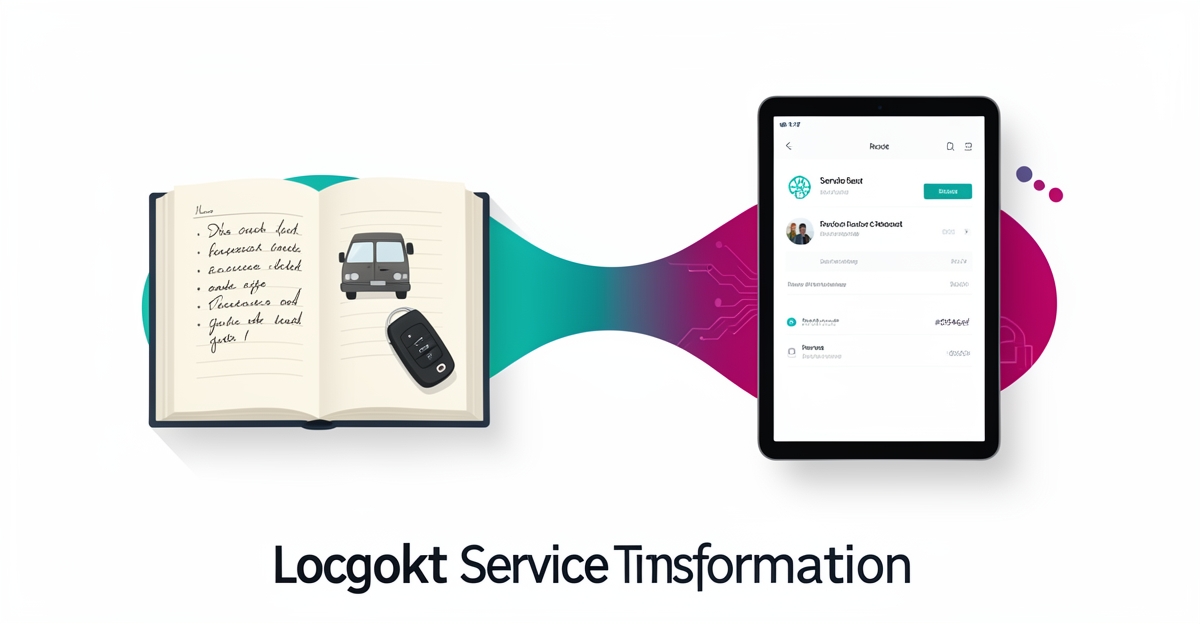
From Paper Logs to AI: How Locksmiths Can Automate Service Records
Key Facts
- Industry analyses of field service businesses suggest manual documentation can consume a substantial share of a shop's week in data entry and follow-up, often the equivalent of a part-time admin role for a multi-tech shop.
- Generic field service platforms typically start in the tens of dollars per month, while enterprise AI add-ons can run hundreds of dollars per technician per month, out of reach for most 3–5 person locksmith shops.
- AI-driven document processing captures work orders, handwritten notes, and voice updates at the job site and converts them into structured records without changing how technicians work.
- Automating scheduling, invoicing, and data entry removes the bottlenecks that consume technician time without generating revenue.
- AIQ Labs AI Employees typically cost around 80% less than an equivalent human hire while working 24/7 with no missed calls.
Hire a team member that works 24/7 — for less than a part-time wage.
AI receptionists, SDRs, dispatchers and 99+ roles. Trained on your business, fully managed.
Not sure where to start? Ask our AI planner
The Hidden Cost of Paper Logbooks
Every misplaced job ticket, illegible technician note, and forgotten parts entry carries a price tag most locksmith shop owners never calculate. The true cost of paper logbooks isn't the notebook itself, it's the compounding hours of administrative drag that quietly eat your profit margins week after week.
Consider a locksmith firm with eight mobile technicians relying on manual documentation. Between transferring handwritten notes into spreadsheets, chasing down missing job details, and reconciling incomplete service records, the admin burden can easily reach the equivalent of a part-time employee, hours you're already paying for but not getting back in billable work.
The financial bleed extends beyond labor hours. Paper-based operations carry ongoing overhead tied directly to manual document processing, storage, retrieval time, error correction, and the inevitable re-dispatch of technicians to gather information that should have been captured the first time.
For locksmiths operating on tight margins, these aren't abstract inefficiencies. They're the difference between a profitable quarter and a break-even one.
The compliance risks compound the problem further. When service records live in fragmented paper logs, proving what work was performed, which parts were installed, and what the customer authorized becomes a forensic exercise. Incomplete documentation creates exposure in several critical areas:
- Warranty disputes where you can't prove what parts were installed or when
- Insurance claims requiring detailed service histories you can't fully reconstruct
- Customer disputes over authorization, pricing, or scope of work performed
- Regulatory audits where missing documentation triggers penalties or lost contracts
The pattern is consistent across field service businesses: manual record-keeping doesn't just slow you down today. It creates a growing archive of incomplete, unsearchable, legally vulnerable documentation that becomes harder to fix the longer you wait.
AIQ Labs works with locksmiths and field service businesses to replace this paper-based drag with automated digital records that capture service history, parts used, and customer notes in real time, without requiring your team to learn new software or migrate to unfamiliar cloud platforms. The goal isn't adding technology for its own sake. It's reclaiming the admin hours your business is already paying for but not getting.
Why Generic Field Service Software Falls Short for Locksmiths
Generic field service software is built for plumbers, electricians, and HVAC companies. Locksmiths need something different. While platforms like Jobber and Housecall Pro handle basic scheduling and invoicing, they lack the specialized features that make locksmith operations run smoothly.
Locksmith work involves tracking key codes, managing master key systems, and documenting hardware specifications. A generic platform treats every job the same way. It doesn't understand that a commercial rekey job requires different documentation than an emergency lockout. It can't track which technician has access to which master key system or maintain the detailed hardware specs needed for compliance.
Pricing tells a similar story. As of late 2026, generic platforms typically start in the range of $39–$59 per month, with AI receptionist features often sold as add-ons. Vertical-specific tools aimed at locksmiths advertise lower entry pricing with AI estimating and 24/7 call answering built in, while enterprise suites with AI add-ons can run hundreds of dollars per technician per month, pricing built for companies with 20+ technicians, not the typical three-to-five-person locksmith shop.
Here's where vertical-specific AI delivers measurable value:
- Key code tracking that links every service call to specific key systems
- Master system management that maps hierarchical access across commercial properties
- Hardware specification logging that captures lock models, security ratings, and compliance requirements
- Regulatory documentation that maintains audit trails for licensed locksmith work
Generic platforms can't deliver those results because they don't understand locksmith workflows. AIQ Labs builds custom systems that capture the specific data locksmiths need. Instead of forcing your business into a generic template, the system learns your workflows, your compliance requirements, and your documentation standards. You get automated service records that actually reflect how locksmith work happens in the field.
How AI Document Processing Captures Complete Service Records
Paper logs, crumpled work orders and voice memos in the truck are still the default for many locksmiths. That manual trail creates gaps in service history, parts tracking and customer preferences that cost time every week.
AI document processing changes the capture point without changing how techs work in the field. Work orders photographed on site, handwritten notes, and quick voice updates are ingested automatically and converted into structured service records. The system extracts parts used, key codes, job type, technician observations and customer preferences in real time.
Extraction covers the full service record, not just text. AI models identify:
- Parts and key codes from invoices and photos
- Customer preferences and access notes from voice memos
- Technician observations and warranty details from work orders
- Service timestamps and location data for compliance and retrieval
Because processing happens on images and audio as they are created, staff do not need retraining or a cloud migration to adopt it. The workflow stays familiar: snap a photo, dictate a note, submit the ticket. The AI layer structures the data behind the scenes and writes it to the existing job management system.
For locksmiths moving from paper logs to automated digital records, accuracy and easy retrieval matter more than dashboards. AIQ Labs builds custom systems that ensure service history, parts used and customer notes are captured consistently, with compliance-ready audit trails and no vendor lock-in.
The impact compounds over time. Smarter records enable faster repeat service, fewer callbacks, and data-driven decisions about inventory and dispatch. It also supports the broader automation goals locksmiths are pursuing, from smarter customer communication, such as an AI receptionist or dispatcher that never misses a call, to automated workflow and admin.
The market is moving the same direction: all-in-one platforms now bundle 24/7 AI call answering at entry-level pricing, while enterprise options target larger fleets. The core principle remains the same: capture complete service records at the point of work, automatically.
Implementation Roadmap: From Pilot to Full Deployment
Implementing AI-driven service records requires a phased approach that builds confidence and delivers measurable results quickly. Starting with a high-volume workflow, such as rekey jobs or master key systems, allows locksmiths to test the system under real conditions while minimizing disruption. AIQ Labs recommends beginning with a pilot focused on one core service type to establish baselines for accuracy and processing time before scaling. That's exactly how AI Workflow Builds work: rebuild the one workflow that costs you the most, at a fixed price, in phases.
During the pilot phase, teams typically see meaningful improvements in both speed and precision. Automating administrative tasks like service logging frees hours of data entry each week for multi-tech teams, directly translating to more time spent on billable work. These gains come from prioritizing one workflow at a time and measuring results before expanding.
To ensure success, the implementation should follow a clear sequence: first, map the current rekey or master key workflow to identify pain points; second, configure the AI system to capture service history, parts used, and customer notes automatically; third, run the pilot for 2–4 weeks while tracking error rates and processing speed. Once the pilot hits your performance targets, expand to other service types like lockouts, safe work, or security installations, rolling out incrementally with each phase building on lessons learned.
- Begin with one high-frequency service type to limit complexity
- Measure error reduction and time savings weekly during the pilot
- Use pilot results to refine AI rules and integrations before scaling
- Expand to adjacent workflows only after hitting performance targets
- Maintain human oversight for exceptions while automating routine entries
This structured rollout ensures that automation enhances, not disrupts, daily operations. By proving value in a contained area first, locksmiths gain the data and confidence needed to invest in broader transformation. AIQ Labs supports this journey from initial pilot to full deployment, with payment structured in milestones so you're never asked to bet the whole shop up front. The result is a resilient, self-sustaining digital record-keeping process that scales with the business, without requiring retraining or cloud migration.
Own Your System: The Custom Build Alternative
Paper logs end up lost in truck seats, and service history disappears with the technician who wrote it. Locksmiths who move to owned automation stop paying per-tech subscriptions and keep their data in-house instead of renting it from a vendor.
A custom build gives you full data control, offline capability for jobs without signal, and direct integration into existing dispatch and invoicing tools. You avoid the ongoing per-tech subscription model that scales with headcount and locks records inside a third-party platform.
With an owned system, service notes, parts used, and customer history are captured once at the job site and sync automatically when connectivity returns. The system is built around your workflows, not forced into a generic template, and it remains yours to modify as your shop grows.
True ownership means no vendor lock-in and no forced cloud migration. AIQ Labs architects custom systems, up to a full AI Operating System that connects your whole shop in phases, that ensure accuracy, compliance, and easy retrieval without requiring staff retraining. The build is delivered as a production-ready asset you own outright.
A purpose-built record automation system can include:
- Mobile-first intake that logs service history, parts used, and customer notes with voice or photo capture
- Offline-first operation with automatic sync to dispatch and invoicing tools when back online
- AI extraction from handwritten notes and photos to structured records without manual retyping
- Role-based access and audit trails for compliance and easy retrieval
Market pricing for off-the-shelf AI modules starts low but adds up fast, and enterprise field-service suites charge per technician monthly. Owning the system converts that variable cost into a fixed asset. You keep the data, control updates, and integrate with the tools you already use. That is the practical path from paper logs to automated digital records that work for locksmiths, not the other way around.
Still paying for 10+ subscriptions that don’t talk to each other?
We build custom AI systems you own outright. No vendor lock-in. Full control.
Not sure where to start? Ask our AI planner
Frequently Asked Questions
How much time and money do paper logbooks actually cost a locksmith shop?
Will generic field service software like Jobber or Housecall Pro work for locksmiths?
Do technicians have to learn new software or migrate to the cloud to use AI document processing?
Can AI really capture handwritten notes and voice memos accurately in the field?
What compliance risks come with keeping service records on paper?
How do we start automating without disrupting the whole shop?
Reclaim the Hours Paper Logs Are Stealing
Paper logbooks quietly cost locksmiths more than notebooks, they cost admin hours every week, ongoing overhead, and a growing archive of incomplete, hard-to-retrieve records that expose you in warranty, insurance and compliance situations. Generic field service platforms can schedule jobs, but they don't understand key codes, master key hierarchies or locksmith-specific audit trails, which is why vertical-specific automation matters. AI document processing changes the capture point without changing how techs work: photos of work orders, handwritten notes and voice updates are ingested on site and structured into service history, parts used and customer notes in real time. Starting with one high-frequency workflow, measuring error reduction and processing speed, then scaling lets you prove value before expanding. If you're ready to move from manual logs to automated, owned records, start with the two-minute Fit Check at https://aiqlabs.ai/apply, then book a free 30-minute strategy call at https://aiqlabs.ai/book to map your biggest bottleneck and identify high-ROI automation opportunities. You can also reach the team directly at [email protected].
Make AI your competitive advantage — not just another tool.
Strategy, implementation and ongoing optimization. One partner, end to end.
Not sure where to start? Ask our AI planner