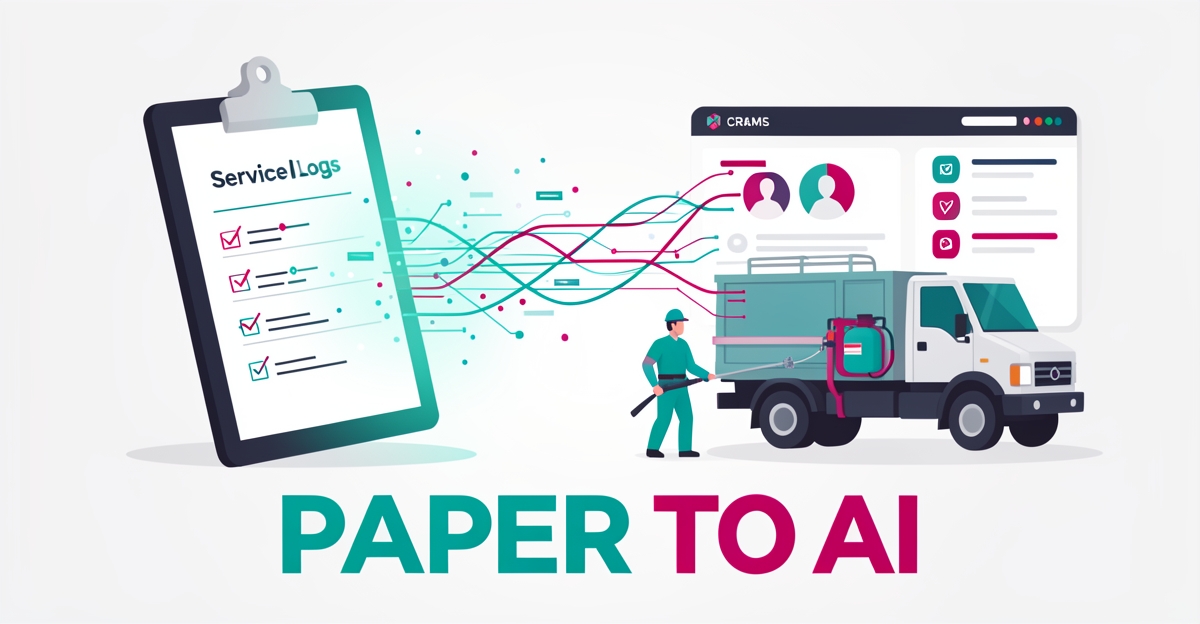
From Paper Logs to AI: How Mosquito Control Companies Can Automate Field Service Records
Key Facts
- Paper logs create delayed reporting, transcription errors and broken audit trails, no timestamp integrity and no easy property-history retrieval during outbreak investigations
- AI document capture reads handwritten notes, stamps and checkboxes from a smartphone photo and auto-fills CRM records without re-keying
- Cloud-based mosquito control platforms for mapping, collecting and reporting field data are already established in the sector, showing digital capture is the direction of travel
- Custom document processing models learn local pest patterns, routes and treatment protocols, keeping extraction consistent across technicians
- AIQ Labs has deployed 200+ multi-agent systems and runs 4 live SaaS products daily, field record automation is a proven build pattern, not an experiment
- Compliance inspectors and public health agencies expect verifiable proof of surveillance, inspection, treatment and education activities
Hire a team member that works 24/7 — for less than a part-time wage.
AI receptionists, SDRs, dispatchers and 99+ roles. Trained on your business, fully managed.
Not sure where to start? Ask our AI planner
The Paper Log Problem in Mosquito Control Operations
Field crews still finish the day with muddy notebooks, damp service reports and spreadsheets that never quite match. That paper trail moves slowly from truck to office, and by the time it is entered, the moment for fast decisions has passed.
Manual logbooks create a bottleneck between what happens in the field and what leadership sees. Handwritten notes smudge, treatment locations get misread, and service dates slip between pages. Fragmented capture undermines real-time response and program consistency, and the longer data sits on paper, the harder it is to act on.
Spreadsheets compound the problem. Teams duplicate entries across devices, reconcile conflicting versions, and spend hours chasing missing signatures. Errors propagate into reporting, making it hard to prove coverage or justify budgets to municipalities. The result is delayed data, repeated site visits, and compliance exposure.
Compliance risk rises when records are incomplete. Inspectors and public health agencies expect verifiable proof of surveillance, inspection, treatment and education activities. Paper logs offer no audit trail, no timestamp integrity, and no easy way to retrieve a specific property history during an outbreak investigation.
The sector is already moving toward integrated digital capture. Cloud-based platforms for mapping, collecting and reporting mosquito control data have become standard for larger programs, because manual methods cannot keep pace with program scale. The gap most teams still have is the paperwork itself, service reports, treatment logs and technician notes that never make it into those systems without manual re-entry.
Paper-based field service typically creates:
- Delayed reporting as crews wait for office entry
- Transcription errors in locations, treatments and timestamps
- Lost or damaged logs that break audit trails
- Inconsistent data that hinders trend analysis and targeting
AIQ Labs builds custom AI document processing that scans service reports, extracts key details like locations and treatments, and auto-fills CRM records. Instead of retroactive data entry, teams get structured, searchable records the same day work is completed. If paperwork is the single most expensive workflow in your operation, that is exactly what AI Workflow Builds are designed to fix.
How AI Document Capture Replaces Field Paperwork
Paper logs in the truck mean delayed billing, missed treatments, and CRM records that are always behind. AI document capture closes that gap by turning field reports into structured data the moment a technician returns.
A smartphone photo or scanned service sheet is processed with computer vision and machine learning to read handwritten notes, stamps, and checkboxes. The system extracts locations, treatment types, timestamps, and technician notes, then auto-fills CRM records without re-keying. This is the same class of computer vision and machine learning already used in AI-powered mosquito surveillance and targeting research.
Field teams already move toward cloud-based data collection for mapping and reporting. AI capture extends that principle from mapping to paperwork, ensuring service reports become live operational data rather than a backlog of forms waiting for entry.
The workflow replaces manual transcription with automated extraction and validation:
- Scan or photo service report at end of route
- AI reads location, treatment product, dosage, and time stamps
- Technician notes are parsed and tagged to the correct property record
- CRM, scheduling, and compliance logs update automatically
Accuracy improves because the model learns local pest patterns and service standards over time. That learning mirrors how researchers build mosquito detection models: develop a model that can identify mosquitoes and distinguish them from other insects, then train it on a large dataset of images. The same principle applies to forms, custom models trained on your actual service reports outperform generic ones.
For mosquito control companies, the benefit is consistent, auditable records without adding admin headcount. Service history, regulatory reporting, and follow-up scheduling stay synchronized because the AI document processing layer normalizes inputs from different technicians and forms.
AIQ Labs builds custom AI systems that learn your local pest patterns and service standards to ensure accuracy and consistency, turning paper logs into a searchable, actionable record set. The result is faster invoicing, fewer missed callbacks, and a CRM that reflects what actually happened in the field.
From Capture to Actionable Intelligence
The transition from handwritten logs to digital systems is just the first step in modernizing mosquito control operations. Raw field data, whether from paper forms or spreadsheets, holds little value until it consistently feeds into actionable intelligence. AI-powered capture transforms this unstructured information into standardized records by automatically identifying and categorizing key details like treatment locations, species observed, and products applied. This ensures every technician follows the same service protocols, eliminating variability that can compromise program effectiveness. By anchoring data entry in real-time field observations, companies establish a reliable foundation for mapping, reporting, and continuous improvement.
Once captured, AI systems go beyond simple transcription to learn local patterns unique to each service area. These models analyze historical treatment outcomes, environmental conditions, and mosquito activity trends to refine future recommendations. For example, they might recognize that certain neighborhoods require larviciding every 10 days after rainfall, while nearby commercial zones respond better to adulticide applications at dusk. This localized intelligence turns generic checklists into adaptive service standards that evolve with changing conditions. The result is not just consistency, but precision, where resources are directed exactly where and when they're needed most.
Cloud-based mapping and reporting platforms exemplify how this intelligence becomes operational. AI-generated data feeds directly into systems that visualize treatment coverage, track product usage over time, and highlight gaps in surveillance. Managers gain instant access to compliance metrics, treatment efficacy, and resource allocation, all without manual compilation. For mosquito control teams, this means less time spent on paperwork and more time focused on protecting public health. When capture, CRM, scheduling and reporting all run on one connected layer, you are effectively operating on an AI Operating System, built in phases, owned outright.
Implementing AI Field Records with AIQ Labs
Paper logs get wet, lost, and slow crews down. Mosquito control teams are moving from clipboards to AI-powered document capture that turns service reports into structured CRM records in minutes.
Implementation starts with workflow mapping. Crews document surveillance, inspection, treatment, and education visits, often with handwritten notes and photos. AI scans those service reports, extracts key details like locations and treatments, and auto-fills CRM records. Cloud-based mosquito control platforms for mapping and reporting show how digital capture is already used in the sector, AI document processing extends it to the paperwork itself.
Model training is localized for accuracy. Generic models struggle with local pest patterns and service standards. Custom AI systems learn your routes, species, and treatment protocols so extraction stays consistent. This mirrors how researchers build detection models: a model is developed to identify mosquitoes and distinguish them from other insects, then trained on a large dataset of images. Your service reports work the same way, the model learns from your forms, not a generic template.
Integration connects field capture to dispatch and CRM. Extracted data flows into existing tools without manual re-entry, creating a single source of truth for operations. AIQ Labs builds custom AI systems that learn your local pest patterns and service standards to ensure accuracy and consistency, with clients owning the code and agents they deploy.
A practical rollout follows these steps:
- Map current paper and spreadsheet workflows for surveillance, treatment, and reporting
- Collect sample service reports and photos to train a custom document processing model
- Connect the AI extractor to CRM and dispatch tools via two-way API integration
- Pilot with one crew, validate extraction accuracy, then scale across teams
Ownership matters for long-term control. Unlike subscription widgets, custom-built systems businesses own avoid vendor lock-in and allow continuous refinement as service standards evolve. AIQ Labs' Own It Outright payment model exists for exactly this reason: you keep the system, the code and the agents.
Results compound over time. Automated capture reduces manual data entry, improves reporting speed, and supports on-demand and seasonal surge support models. With AI handling document intake, teams focus on field work instead of admin.
Still paying for 10+ subscriptions that don’t talk to each other?
We build custom AI systems you own outright. No vendor lock-in. Full control.
Not sure where to start? Ask our AI planner
Frequently Asked Questions
Why are paper logs still a problem for mosquito control crews?
How does AI document capture replace field paperwork?
What software are mosquito teams already using for digital capture?
Can AI really improve productivity in field operations?
Do I need to buy new hardware for AI field records?
What's the difference between a generic AI model and a custom one for mosquito control?
From Field Notes to Field Intelligence
The shift from paper logs to AI-powered document capture represents more than digitization, it's a fundamental upgrade in how mosquito control programs operate. Manual entry creates delays, errors, and compliance gaps that compound across surveillance, treatment, and reporting. AI capture closes that loop by turning handwritten field reports into structured, searchable CRM records the same day work is completed. The result is faster invoicing, auditable service histories, and operational data that actually reflects what happened in the field. AIQ Labs builds custom document processing systems that learn your local pest patterns and service standards, ensuring extraction accuracy improves over time, without vendor lock-in, since clients own the code and agents outright. With 200+ multi-agent systems deployed and 4 live SaaS products run daily, this is a proven build pattern. Implementation starts with a workflow map and a pilot crew, then scales as validation confirms results. If your team is still reconciling spreadsheets or chasing missing signatures, the next step is a conversation about where automation delivers the clearest ROI. Start the 2-minute Fit Check at aiqlabs.ai/apply for a free 30-minute strategy call, no obligation, just a practical look at your highest-impact opportunity.
Make AI your competitive advantage — not just another tool.
Strategy, implementation and ongoing optimization. One partner, end to end.
Not sure where to start? Ask our AI planner