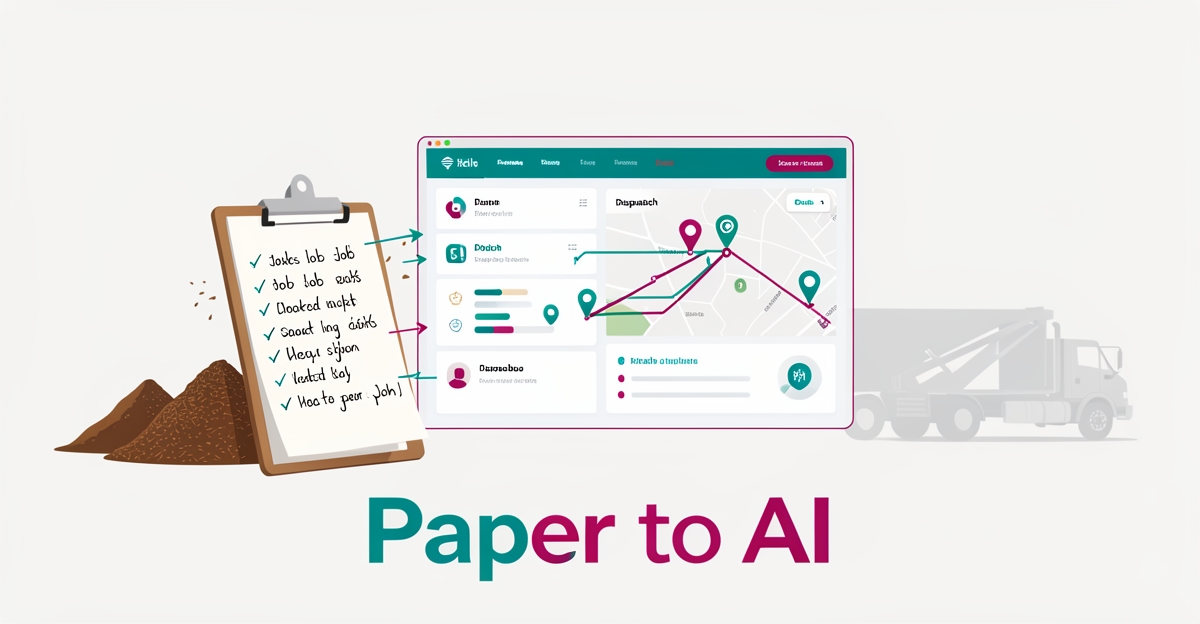
From Paper Logs to AI: How Mulching Services Can Automate Job Tracking and Dispatch
Key Facts
- AI workflow automation can reduce manual data entry substantially in field service operations, according to industry case studies
- Most AI failures at scale stem from capacity limits like rate limits and quotas rather than model accuracy, per industry analyses per recent infrastructure reporting
- Most customers now expect service within 24 hours, with a significant share demanding same-day response as noted in field service benchmarks
- Field service industries face ongoing skilled-labor shortages, intensifying the need to maximize every crew member's productivity according to workforce data
- Businesses typically outgrow spreadsheets and paper trackers around the fifth truck or when job details start slipping per field service guidance
- Operational excellence is AI's real competitive edge, requiring visibility, controls, utilization optimization, and efficient application design as emphasized by AI operations leaders
Hire a team member that works 24/7 — for less than a part-time wage.
AI receptionists, SDRs, dispatchers and 99+ roles. Trained on your business, fully managed.
Not sure where to start? Ask our AI planner
The Hidden Cost of Paper Logs in Mulching Services
The hidden cost of paper logs in mulching services extends far beyond the price of notebooks and pens. Manual data entry creates delays that ripple through operations, with crews often waiting hours or days for job details to reach the office. This lag prevents real-time visibility into crew activities, making it impossible to reroute teams when urgent jobs arise or to confirm completion times accurately. Field service management guidance shows that paper-based systems tend to fail once companies exceed a few technicians, leading to missed appointments, billing disputes, and eroded customer trust.
These challenges collide directly with rising customer expectations and a shrinking skilled workforce. Most customers now expect service within 24 hours, with a significant share demanding same-day response, standards nearly impossible to meet when job tracking relies on handwritten notes passed between office and field. Field service industries also face ongoing skilled-labor shortages, intensifying the need to maximize every crew member's productivity. Paper logs force dispatchers to rely on memory or outdated sheets, increasing the likelihood of scheduling conflicts and inefficient routing that waste both time and fuel.
Without digital visibility, mulching services operate in a reactive mode, unable to prove accountability or optimize performance. Manual logs are prone to transcription errors, illegible handwriting, and lost pages, issues that compound when scaling beyond a single crew. This lack of precision makes it difficult to identify profitable jobs, track equipment usage, or resolve customer complaints with verifiable data. As one field service expert notes, "You cannot operate what you cannot see, and AI is no exception," highlighting how blind spots in tracking directly undermine operational reliability. Even basic digital tracking eliminates the human errors that paper logs guarantee, creating a foundation for smarter automation.
AIQ Labs helps mulching businesses replace these fragile systems through AI Workflow Builds that auto-log job start and end times, track crew locations in real time, and trigger dispatch updates without manual input. By eliminating the guesswork and delays inherent in paper logs, companies gain the visibility needed to meet same-day service demands while reducing the administrative burden on office staff. This shift doesn't just improve accuracy, it transforms job tracking from a liability into a scalable asset that supports growth without adding headcount.
Why AI-Driven Dispatch Systems Outperform Traditional Methods
AI-powered dispatch systems transform how mulching services manage operations by eliminating manual bottlenecks and delivering real-time visibility into every job. Unlike paper logs that require constant human verification and are prone to delays, AI-driven platforms automatically log job start and completion times, track crew locations, and optimize dispatch based on live conditions. This shift from reactive to proactive management ensures crews are always assigned to the right job at the right time, reducing idle time and improving response rates.
Industry case studies indicate that AI workflow automation can cut manual data entry dramatically, freeing office staff from repetitive logging tasks and minimizing errors that lead to billing disputes or scheduling conflicts. With real-time job status visible to both dispatchers and field technicians, miscommunication drops significantly, and emergency reassignments happen instantly rather than after delays caused by lost or outdated paper slips. This level of control is essential for meeting customer expectations, most of whom expect service within 24 hours, with many demanding same-day response as noted in field service benchmarks.
Operational excellence remains the foundation of AI success, requiring visibility into resource usage, enforceable guardrails on agent behavior, and workflows designed for efficiency before scaling as emphasized by AI operations leaders. Without these disciplines, even advanced AI systems can fail under capacity limits, most failures at scale stem from unmanaged quotas or concurrency caps rather than model flaws per recent infrastructure analyses. For mulching businesses, this means investing not just in automation, but in the operational discipline that makes it sustainable. AIQ Labs helps build this foundation by designing custom workflows that integrate with existing tools, ensuring AI systems operate reliably within real-world constraints.
Implementing AI Job Tracking: A Phased Approach for Mulching Businesses
Paper logs create blind spots the moment a mulching crew leaves the yard. Without real-time visibility, dispatch becomes reactive, jobs slip, and accountability disappears.
A phased rollout protects operations while building the operational discipline AI requires at scale. According to industry analyses, most AI failures at scale stem from capacity limits rather than model accuracy. That risk is lower when implementation starts small and controlled.
Start by assessing the current operational state. Map where paper logs move, where handoffs fail between office and field, and when job details start slipping. Field service guidance shows businesses typically outgrow spreadsheets around the fifth truck. Document core requirements now: mobile access for offline sites, route optimization, drag-and-drop scheduling, photo capture, and on-site invoicing.
Define success metrics before building. Visibility and attribution are essential operational disciplines for AI success, meaning you must see how usage maps to latency, error rates, and user impact. Establish guardrails early for rate limits, budget caps, and agent behavior to prevent unbounded retries.
Integration should work alongside existing tools, not replace them. AI systems that accelerate work alongside ERP, scheduling, and accounting platforms reduce disruption and adoption friction. A phased approach lets you connect CRM, payment processing, and suppliers incrementally while preserving a single source of truth.
Pilot with one crew first. A limited rollout surfaces workflow problems early and builds internal champions before company-wide deployment.
A practical phased plan includes:
- Assess workflows and define core requirements like mobile access and route optimization
- Integrate with existing scheduling, accounting, and communication tools
- Pilot with a single crew to validate job auto-logging and real-time dispatch
- Expand department-wide with training, guardrails, and performance monitoring
Customer expectations raise the stakes for responsive dispatch. Field service analysis finds most customers expect a repair within 24 hours when service fails, with many wanting same-day service. Automated arrival windows and real-time updates directly address that pressure.
AIQ Labs supports this transition through AI Workflow Builds that integrate with your existing tools, eliminating manual errors and improving accountability. With the Build in Milestones payment model, you split the build into phases, approve and pay per phase, and keep everything built so far. If you'd rather start with managed AI staff, an AI dispatcher or receptionist handling calls and scheduling, the AI Employees option runs on a flat monthly plan that includes build, training, integrations, monitoring, and improvements.
Operational excellence is the real competitive edge. Teams that design for efficiency at the application layer, optimize utilization before scaling supply, and enforce controls avoid the technical debt that stalls most pilots.
Still paying for 10+ subscriptions that don’t talk to each other?
We build custom AI systems you own outright. No vendor lock-in. Full control.
Not sure where to start? Ask our AI planner
Frequently Asked Questions
How do I know if my mulching business has outgrown paper logs?
Can AI dispatch really handle same-day service demands?
What's the actual risk of AI systems failing during busy periods?
How much manual data entry can AI automation actually eliminate?
Do I need to replace my current scheduling and accounting software to use AI?
How does AI job tracking help with the labor shortage in field services?
Turn Visibility Into Growth Without Adding Headcount
Moving from paper logs to AI-driven job tracking isn't about chasing technology, it's about removing the blind spots that cost mulching services time, fuel, and trust. Real-time auto-logging, crew location tracking, and proactive dispatch replace delayed handoffs and transcription errors with the visibility needed to meet same-day expectations and prove accountability to customers. The businesses that win will be those that build operational discipline first, clear metrics, guardrails, and phased integration with the tools they already use, so automation scales reliably instead of creating new friction. AIQ Labs helps mulching teams make that shift with custom AI workflows that integrate with existing scheduling, accounting, and communication systems, turning job tracking from a liability into a scalable asset. Start with a focused assessment of your current handoffs, pilot with one crew, and expand with training and monitoring in place. Ready to map your highest-ROI automation opportunity? Take the 2-minute Fit Check at https://aiqlabs.ai/apply, then book a free 30-minute strategy call to see if there's a clear win for your operation. With most customers expecting service within 24 hours and many demanding same-day response, the cost of waiting is already showing up in your schedule.
Make AI your competitive advantage — not just another tool.
Strategy, implementation and ongoing optimization. One partner, end to end.
Not sure where to start? Ask our AI planner