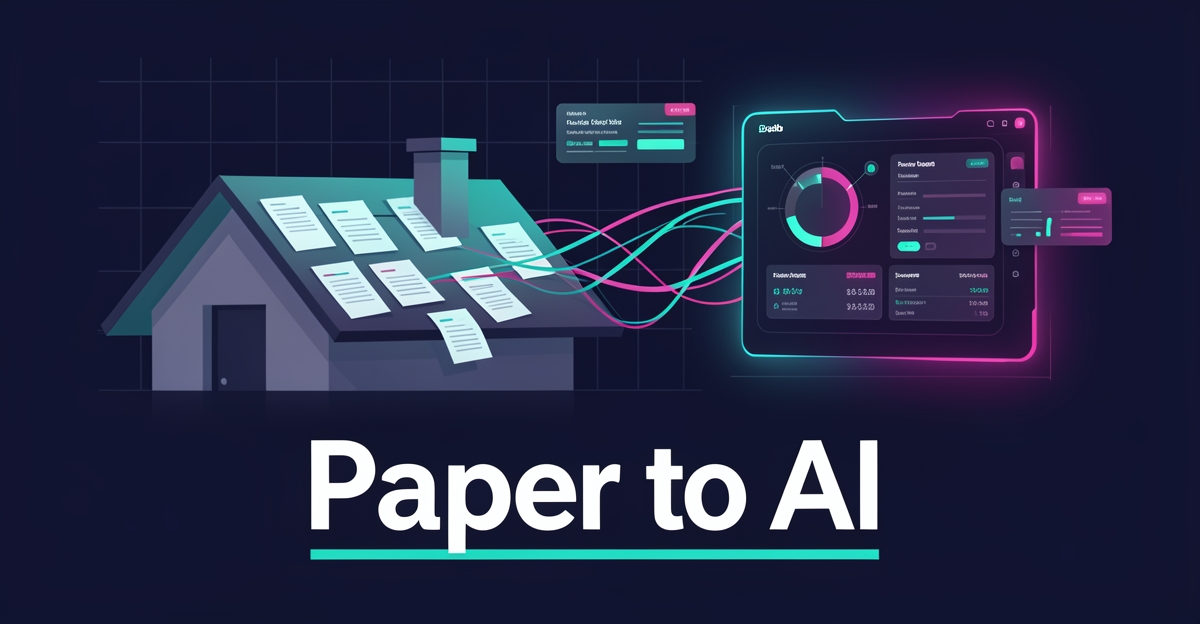
From Paper Logs to AI: How One Halifax Roofing Company Automated Its Job Tracking System
Key Takeaways
- Paper logs and spreadsheets record what already happened; agentic AI systems act, updating job status, dispatching crews, and notifying clients automatically
- A phased, milestone-based build lets you test each stage in parallel with your manual process before cutover
- Owning the code, agents, and data outright means no subscription lock-in and full governance over your AI tools
- Security guardrails, validated actions, audit trails, and human-in-the-loop escalation, should be built in from day one
Hire a team member that works 24/7 — for less than a part-time wage.
AI receptionists, SDRs, dispatchers and 99+ roles. Trained on your business, fully managed.
Not sure where to start? Ask our AI planner
The Paper Log Penalty Facing Trades Businesses
Every day, trades businesses lose time and revenue to outdated manual processes. Paper logs, scattered client notes, and handwritten field assignments create bottlenecks that slow operations and increase errors. The businesses that get real value from AI and automation are typically the ones that treat it as an operational system, not an experiment, most others are still stuck with the inefficiencies.
For service-based trades like roofing, plumbing, and electrical work, manual tracking means delayed invoicing, miscommunication between field teams, and lost job details. Automation delivers its clearest benefits exactly where paper hurts most: billing cycles, dispatch, and client communication. Yet many trades businesses still rely on paper logs, missing out on those gains.
The cost of staying manual adds up quickly:
- Delayed invoicing, Paper logs slow down billing cycles, delaying cash flow.
- Lost job details, Handwritten notes get misplaced or misinterpreted, leading to rework.
- Inefficient dispatching, Field technicians waste time waiting for assignments or clarifying instructions.
- Poor customer experience, Clients expect real-time updates, which manual systems can't provide.
The shift to AI-powered job tracking isn't just about efficiency, it's about staying competitive. Businesses running connected systems consistently report fewer errors, faster job completion, and happier clients than those still juggling notebooks.
AIQ Labs helps trades businesses transition from manual logs to fully automated systems. Whether that means rebuilding the one workflow that costs you the most through [AI Workflow Builds](/workflow-builds) or connecting your entire operation, the question isn't whether to automate, it's how quickly you can start seeing results.
Why Agentic AI Is Replacing Spreadsheets in Field Operations
For years, the roofing contractor in Halifax tracked every job in a paper logbook, crews, materials, client calls, all scribbled by hand. Today, an AI system handles that work automatically. What happened at this one company is part of a much larger shift in how service businesses operate.
Agentic AI adoption has grown sharply across service industries as of late 2026, and these aren't experiments anymore, they're operational systems handling real workflows: dispatch, scheduling, client updates, and follow-ups.
The distinction matters. Spreadsheets and logbooks record what already happened. Agentic AI systems act: they update job status when a technician marks a roof inspection complete, dispatch the next available crew, and send the client a status update without anyone touching a keyboard. It's the difference between a filing cabinet and a dispatcher who never sleeps.
The Halifax case maps directly onto the use cases where AI agents are already proving themselves in field service:
- Job status tracking, every stage of a roofing project logged and visible in real time, replacing the paper trail entirely
- Technician dispatch, assignments routed automatically based on crew availability and job requirements
- Client communication automation, status updates, scheduling confirmations, and follow-ups sent without manual effort
- Administrative follow-up, the callbacks, confirmations, and data entry that eat office hours every week
The payoff timeline matters for a small trade business. Because these systems automate work that's already happening manually, the savings show up quickly, often within the first weeks of a phased rollout, as invoicing speeds up and dispatch friction disappears. That's what makes the investment decision straightforward.
But speed without security is a liability. As AI agents move from reading to acting, connecting to your CRM, scheduling tools, and invoicing systems through integration protocols, they become part of your attack surface. Industry security guidance is consistent: treat every connected tool as part of the supply chain, review tool and integration changes with the same rigor as system prompt changes, and apply least-agency principles so agents can only do what they need to do.
This is why the Halifax build was engineered with guardrails: validated actions, audit trails, and human-in-the-loop escalation for anything high-impact. It's the approach AIQ Labs applies across its field service deployments, production systems the business owns outright, not prototypes left to drift. The lesson from this roofing company is simple: the technology to replace the logbook already works. The businesses winning with it are the ones that deploy it deliberately, with security built in rather than bolted on.
How AIQ Labs Built an Owned AI Job Tracking System for Roofers
When a Halifax roofing company decided to replace its paper logbooks with an automated system, AIQ Labs began with a discovery phase focused on mapping the business's actual workflows. We analyzed how jobs were tracked from initial client contact through material ordering, crew dispatch, and final invoicing, identifying the critical pain points: delayed status updates, missed follow-ups, and duplicated data entry across spreadsheets and notebooks.
Using our Build in Milestones payment model, we developed the system in approved phases: first, a custom job intake interface that replaced paper forms with digital entry; second, automated crew assignment logic that matched technician availability and skill sets to job requirements; third, real-time client communication triggers that sent status updates via SMS and email at key job milestones. Each phase was tested in parallel with the existing manual system before full cutover, ensuring zero disruption to ongoing projects. The solution integrated directly with the company's existing scheduling software and accounting platform using secure API connections, eliminating the need for duplicate data entry.
Throughout development, we applied our True Ownership Model, delivering production-ready code built on multi-agent workflows, not a licensed platform. The roofing team received full access to the source code, agent configurations, and data structures upon completion of each milestone, allowing them to modify or expand the system independently. This approach directly addresses supply chain security concerns: when uncontrolled tool modifications can lead to unintended agent behavior, owning the entire stack means the business maintains complete governance over its AI tools, ensuring long-term control and adaptability as their operations scale.
Implementation Playbook for Trades Teams
Paper logbooks don't fail loudly. They fail slowly, with missed callbacks, duplicate entries, and crews chasing outdated job sheets. A practical playbook keeps the rollout measurable and avoids vendor lock-in from day one.
Start by mapping the current paper workflow before any automation is designed. Document every handoff between office, dispatcher, and field tech, including where client communication is logged and how assignments change mid-day. This inventory becomes the requirements baseline for a custom-owned system and prevents automating broken steps.
Securing the AI supply chain is non-negotiable for trades teams handling customer data and job details. As agents gain the ability to act, calling tools, writing to systems, sending communications, unreviewed tool changes can redirect agent behavior without any credential compromise. Treat every integration as part of your supply chain.
A safe rollout follows proven controls:
- Govern the supply chain with an allowlist of approved integrations and tools, and review metadata changes with the same rigor as system prompts
- Disable unrestricted access and enable only the specific tools the agent needs for dispatch, CRM, and job tracking
- Implement runtime protection and data loss prevention to inspect tool call parameters and block sensitive data in outbound payloads
- Configure human-in-the-loop approval for high-impact actions like reassigning jobs or changing pricing
Integration should connect existing CRM and dispatch tools rather than replace them. For a roofing team, that means the AI job tracker syncs bid data from the CRM, work orders from dispatch, and technician updates from mobile check-ins into a single source of truth the business owns.
Human oversight preserves trust and compliance. Configurable escalation ensures a dispatcher can take over when a job requires judgment, a weather delay, a pricing exception, an unhappy client. The system handles the routine; people handle the exceptions.
AIQ Labs builds these workflows as custom-owned systems, so trades businesses retain full control over code, agents, and data. The result is measurable automation without subscription dependency, with clear metrics on job status accuracy, response time, and field utilization from the first 30 days. If you want to see what this would look like for your operation, [start with a free Fit Check](/apply) and a 30-minute strategy call.
Still paying for 10+ subscriptions that don’t talk to each other?
We build custom AI systems you own outright. No vendor lock-in. Full control.
Not sure where to start? Ask our AI planner
Frequently Asked Questions
Will automating job tracking actually pay off for a small roofing or trades business?
How is agentic AI different from just using spreadsheets or a logbook?
Is my paper log system really costing me money?
How long does it take to replace paper logs with an AI job tracking system?
Is it safe to let AI agents connect to my CRM and scheduling software?
Do I lose control if I automate with AI?
Turning Paper Logs into Profit: Your Next Step Forward
The Halifax roofing company's shift from manual logs to AI-powered job tracking isn't just a tech upgrade, it's a blueprint for any trades business ready to stop losing time to paperwork and start capturing real operational gains. By automating status updates, dispatching, and client communication, they eliminated delays, reduced errors, and positioned themselves for faster invoicing and happier customers, all while maintaining full ownership and control of their system. For trades teams still relying on spreadsheets and notebooks, the path forward is clear, start by mapping your current workflow, then explore how a custom-owned AI system can turn your biggest bottleneck into your next competitive advantage. Take the first step with a [free Fit Check](/apply) and a free 30-minute strategy call to see where AI can deliver measurable results for your business.
Make AI your competitive advantage — not just another tool.
Strategy, implementation and ongoing optimization. One partner, end to end.
Not sure where to start? Ask our AI planner