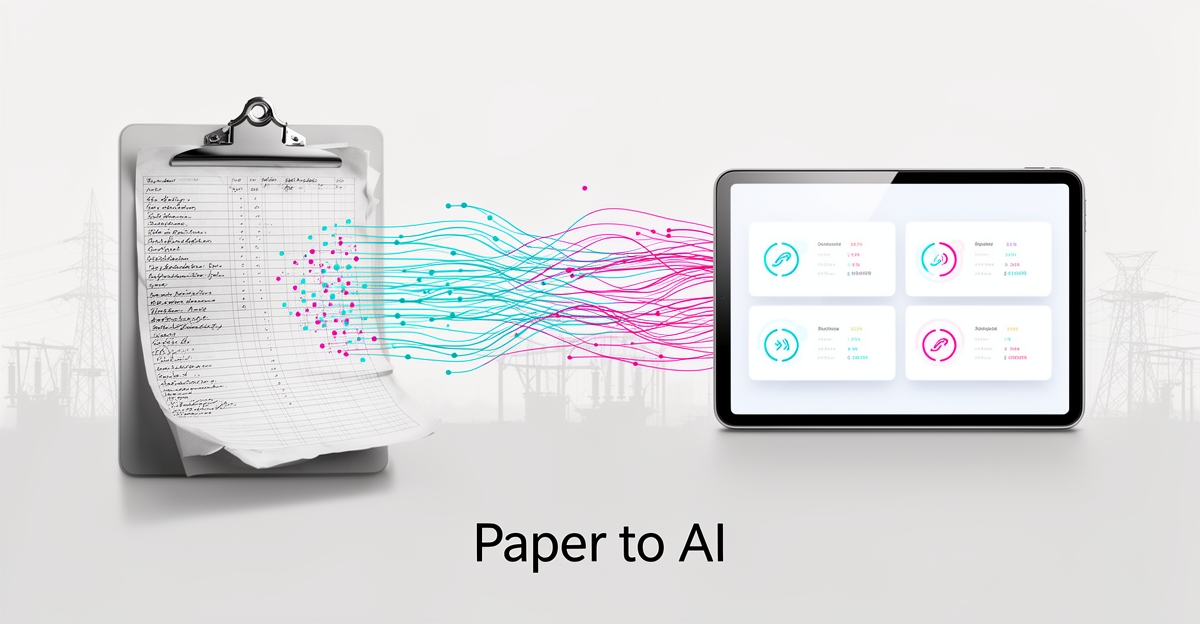
From Paper Logs to AI: How to Modernize Utility Field Data Collection
Key Facts
- Field technicians commonly spend a significant portion of each shift completing and submitting paper logs.
- Paper-based reporting routinely loses data to illegible handwriting, misplaced forms, or delayed submission.
- Paper-based systems add administrative overhead for utility contractors through duplicate data entry and error correction.
- As of late 2026, AI tools are widely treated as essential infrastructure rather than optional tooling.
- AI-powered data pipelines enable real-time visibility into work orders and asset conditions.
- Automated work order synchronization creates continuous, auditable records from field to office.
- End-to-end automation eliminates disconnected handoffs where data dies in paper-based workflows.
Hire a team member that works 24/7 — for less than a part-time wage.
AI receptionists, SDRs, dispatchers and 99+ roles. Trained on your business, fully managed.
Not sure where to start? Ask our AI planner
The Hidden Cost of Paper Logs in Utility Field Operations
The transition from paper logs to digital systems reveals significant operational blind spots in utility field operations. Manual processes create delays that disrupt workflow coordination between field crews and dispatch centers, often resulting in missed or delayed work order updates. These gaps in communication can lead to duplicated efforts, scheduling conflicts, and reduced responsiveness during critical service events. Organizations relying on paper-based reporting routinely lose field data to illegible handwriting, misplaced forms, or delayed submission, losses that directly impact decision-making accuracy and compliance reporting timelines.
Field technicians commonly spend a meaningful share of every shift completing and submitting paper logs, time that could otherwise go to value-added tasks like equipment inspection or customer engagement. The physical handling of paper introduces additional risks, including damage from weather exposure, loss during transit, or misfiling at central offices. These inefficiencies compound when multiple crews operate across dispersed service territories, making real-time visibility into work progress nearly impossible. Paper-based systems also add administrative overhead for utility contractors, primarily through duplicate data entry and error correction cycles.
Compliance risks are further amplified by the lack of audit trails in paper-based processes. Regulatory bodies increasingly require timestamped, verifiable records of field activities, especially for safety-critical infrastructure work, which paper logs struggle to provide consistently. Without automated synchronization between field inputs and dispatch systems, utilities face challenges demonstrating adherence to maintenance schedules, outage response protocols, and environmental reporting standards. The absence of real-time data flow also hinders predictive maintenance, as potential equipment issues identified in the field may not reach analysis teams in time to prevent failures. AIQ Labs addresses these challenges through AI Workflow Builds that capture field notes digitally, track work order status in real time, and integrate with existing dispatch and compliance systems. This approach minimizes data loss, reduces administrative delays, and strengthens operational accountability across the field-to-office workflow.
Why AI-Powered Data Pipelines Are Now Essential for Utilities
Paper logs were acceptable when field crews worked in isolation. Today they create blind spots that regulators, customers, and operations teams can no longer tolerate.
The industry consensus has shifted from experimentation to expectation. As of late 2026, AI tools are widely described as no longer "nice to have" but essential for modern operations. That inflection is visible in regulated utilities, where real-time visibility is a compliance requirement, not a convenience.
Field data collection sits at the intersection of operational risk, sustainability reporting, and financial exposure. AI-powered tools can simplify sustainability reporting, analyze risk exposure, and support informed decision-making about economic and environmental challenges, capabilities that map directly onto utility obligations.
For utilities, that translates into three non-negotiable pressures:
- Real-time visibility into work orders and asset conditions instead of delayed paper handoffs
- Audit-ready sustainability and emissions reporting for regulators and stakeholders
- Proactive risk analysis for weather events, grid stress, and compliance exposure
Paper-based logs drive data loss and delays that compound across dispatch, billing, and reporting. An end-to-end data pipeline approach digitizes field notes, tracks work orders, and syncs with dispatch systems, ensuring real-time visibility and compliance. That shift turns field data from a historical record into an operational signal.
The change is also cultural. The working principle in the field is that AI amplifies skill rather than replacing it, and utilities that internalize that principle adopt faster. AI-driven automation is increasingly required for utilities to meet benchmarks for speed, accuracy, and transparency.
AIQ Labs addresses this through pipeline automation that maps directly to utility workflows. Field notes are captured, structured, and pushed into existing dispatch and work management systems without manual re-entry. The result is continuous data flow rather than batch updates, which is the foundation for real-time visibility and risk analysis.
Utilities that delay modernization face growing cost and compliance risk. Those that move now treat AI-powered data pipelines as essential infrastructure, not optional tooling.
End-to-End Automation: Digitizing Notes, Tracking Orders, Syncing Dispatch
Every disconnected handoff in a paper-based workflow is a point where data dies. A modern field data pipeline eliminates those handoffs entirely, and the architecture is more straightforward than most utility contractors expect.
The pipeline begins at the point of capture. Field crews record notes by voice or photo on a mobile device, and AI-powered ingestion converts speech and handwriting into structured, searchable data automatically. There is no clipboard to lose, no end-of-day transcription backlog, and no illegible handwriting to decipher. Field data capture is exactly where the shift toward essential AI tooling delivers immediate returns.
From there, the pipeline moves into automated work order synchronization. Each captured data point routes directly into the work order system, updating job status, flagging exceptions, and timestamping every action. This creates a continuous, auditable record from the field to the office, the kind of documentation that regulators and clients increasingly demand. AI-powered tools also simplify compliance reporting and support informed decision-making about operational risk.
The final layer is dispatch integration. When field data, work orders, and dispatch systems share a single automated pipeline, schedulers gain real-time visibility into crew locations, job completion status, and emerging delays. AIQ Labs builds this kind of end-to-end automation as a system the client owns outright, no vendor lock-in, no manual data re-entry between systems.
A fully automated pipeline typically includes:
- Mobile capture with OCR and voice-to-text ingestion at the point of work
- Automatic work order creation, status updates, and exception flagging
- Two-way sync with dispatch and scheduling systems for real-time visibility
- Complete audit trails with timestamped records for compliance
- Human-in-the-loop checkpoints for decisions that require judgment
The result is a single source of truth that spans the entire operation. Field crews stop acting as data couriers, dispatchers stop chasing status updates by phone, and compliance documentation builds itself as a byproduct of normal work. AI amplifies skill rather than replacing it, and nowhere is that more evident than in a pipeline that lets skilled field workers focus on the work instead of the paperwork.
Implementation Roadmap: From Pilot to Full Deployment in 5 Steps
Most utility contractors know their data collection needs to change, the hard part is knowing where to start without disrupting crews already stretched thin in the field. A phased rollout keeps risk low while proving value at every stage.
Step 1: Assess your current field workflows. Before selecting any technology, map exactly how data moves from a technician's clipboard to your back office. Document where paper logs get lost, where work order details arrive late, and where compliance gaps appear. AI delivers returns only when matched to real bottlenecks.
Step 2: Select an integrated AI solution, not a point tool. The goal is end-to-end data pipeline automation that digitizes field notes, tracks work orders, and syncs with dispatch systems in real time. Point solutions create new silos; a unified pipeline eliminates them.
Step 3: Connect to your existing CRM and dispatch systems. Integration determines whether your investment compounds or stalls. Your rollout plan should include:
- Two-way API connections to dispatch and scheduling platforms
- Automated work order status updates flowing to the back office
- A single source of truth replacing duplicate data entry
- Compliance audit trails generated automatically
Step 4: Train crews on mobile interfaces. Adoption lives or dies in the field. Keep interfaces simple, run hands-on sessions with actual work orders, and pair early adopters with skeptical veterans. The principle holds that AI amplifies skill rather than replacing it, crews who see the tool making their day easier become your strongest advocates.
Step 5: Monitor data quality and adoption metrics continuously. Track completion rates, data accuracy, time-to-dispatch-sync, and crew usage patterns weekly. Ongoing evaluation is what separates successful deployments from stalled pilots.
This phased approach mirrors how AIQ Labs structures engagements, with milestone-based builds, you approve and pay for each phase as it ships, so a pilot expands to full deployment only after proving measurable results. Organizations that follow this sequence typically see real-time visibility and compliance replace the delays and data loss that defined paper-based operations.
Overcoming Adoption Barriers: Privacy, Training, and Ethical AI in the Field
Paper logs create a gap between the field and the office, and that gap shows up as lost data, delayed work orders, and compliance risk. Modernizing utility field data collection means closing that gap with governance, not just technology.
Data security in regulated sectors is the first adoption barrier. Field notes often contain customer locations, asset identifiers, and safety observations that must be protected. Teams need assurance that digitization does not increase exposure. Practical governance starts with data minimization and audit trails for every field entry, role-based access for crew and dispatch, and encryption in transit and at rest. With AI tools now treated as essential infrastructure as of late 2026, the stakes for responsible deployment in regulated utilities are higher than ever.
Crew resistance to digital tools is common when solutions feel like extra work. Adoption improves when the tool mirrors existing workflows and reduces manual re-entry. Framing field capture as faster reporting and fewer callbacks helps crews see personal benefit, not just management oversight.
Responsible AI use in the field requires human-in-the-loop controls and clear boundaries. AI can digitize field notes, track work orders, and sync with dispatch systems for real-time visibility and compliance, but critical decisions stay with people. Human review of exceptions, override paths for safety events, and transparent logging build trust.
Effective governance frameworks for utility field AI typically include:
- Privacy by design with data classification for PII and asset data
- Role-based access and immutable audit trails for every capture and sync
- Human-in-the-loop escalation for safety, compliance, and customer-impact decisions
- Training and support tied to specific crew roles and daily tasks
Training and support determine whether a pilot scales. Best practices for implementing AI solutions emphasize identifying specific challenges, choosing a solution that addresses those needs, ensuring integration with existing systems, and providing training and support to employees to ensure successful adoption. Short, field-based sessions with hands-on devices beat generic e-learning.
AIQ Labs approaches adoption through pipeline automation that digitizes field notes and connects them to work orders and dispatch, with governance built in from the start. The focus is on practical controls that protect data, respect crew expertise, and keep humans accountable for decisions that matter. For utilities ready to go beyond a single workflow, an AI Operating System can connect field data, dispatch, and compliance into one layer you own outright.
Still paying for 10+ subscriptions that don’t talk to each other?
We build custom AI systems you own outright. No vendor lock-in. Full control.
Not sure where to start? Ask our AI planner
Frequently Asked Questions
How much data do utilities actually lose with paper-based field logs?
What does an AI-powered field data pipeline actually include?
Why is 2026 considered a turning point for modernizing utility field data collection?
Will AI replace our field technicians or dispatchers?
How do we get field crews to actually adopt digital data collection tools?
How can AI help with utility compliance and sustainability reporting?
From Paper to Pipeline: Turning Field Data Into Your Competitive Edge
Modernizing utility field data collection isn’t just about replacing paper, it’s about unlocking real-time visibility, compliance confidence, and operational agility. By digitizing field notes, automating work order sync, and integrating with dispatch systems, utilities eliminate data loss, cut administrative overhead, and empower crews to focus on value-driven work instead of paperwork. The shift transforms field data from a historical record into a live operational signal, enabling proactive risk analysis, audit-ready reporting, and faster response to service events. For contractors ready to move beyond pilots, the path forward is clear: assess workflows, choose an end-to-end AI pipeline that integrates with existing systems, and scale with measurable milestones. Start with the 2-minute Fit Check to see where your biggest bottleneck sits, then book your free 30-minute strategy call to map a data pipeline you own outright, no vendor lock-in, just real results.
Make AI your competitive advantage — not just another tool.
Strategy, implementation and ongoing optimization. One partner, end to end.
Not sure where to start? Ask our AI planner