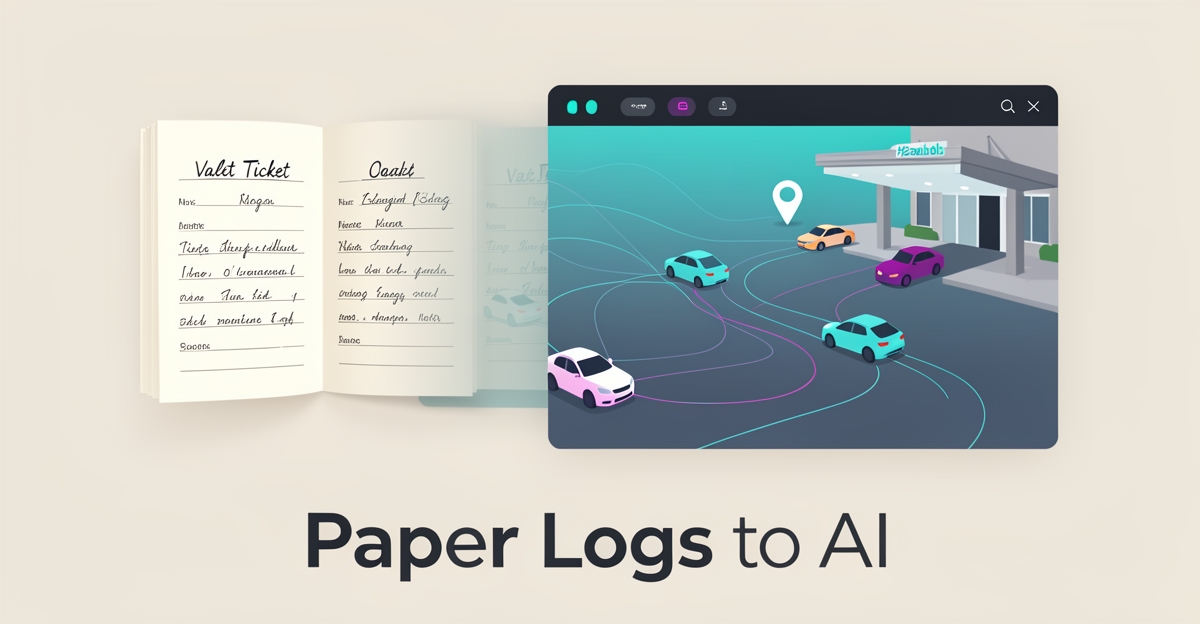
From Paper Logs to AI: How Valet Businesses Can Automate Vehicle Tracking
Hire a team member that works 24/7 — for less than a part-time wage.
AI receptionists, SDRs, dispatchers and 99+ roles. Trained on your business, fully managed.
Not sure where to start? Ask our AI planner
The Hidden Costs of Paper-Based Valet Operations
Most valet operations still run on a ticket book, a clipboard, and someone's memory. It works, until it doesn't. A smudged ticket number, a misspelled guest name, a car parked in the wrong row: each one is a small failure that shows up as a long wait, an apologetic phone call, or a guest who doesn't come back.
The costs are easy to underestimate because they don't show up on an invoice:
- Lost vehicles and slow retrievals. When the log is the only record, finding a car depends on whoever wrote the entry. During a rush, that means minutes of searching while the guest stands at the curb.
- No visibility for management. Paper gives you no real-time picture of how many cars are in, how long the average turnaround is, or which shift is falling behind. You find out about problems when a guest complains.
- Liability exposure. Damage claims, disputes over keys, and missing ticket numbers are far harder to resolve without a timestamped digital record.
- Staffing you can't right-size. Without data on peak drop-off windows, you're guessing how many attendants to schedule, and paying for either idle time or long lines.
None of these are dramatic on their own. Together they quietly cap how many cars a location can handle and how often guests return.
How AI-Powered Vehicle Tracking Eliminates Manual Errors
AI-driven tracking replaces the clipboard with a system that captures, stores, and acts on every vehicle event in real time. The core pieces:
- Digital check-in and check-out. Attendants log plate, make, color, and guest name once, on a phone or tablet. The system timestamps every drop-off and pickup automatically, no transcription, no lost tickets.
- Automated guest notifications. When a guest requests their car by SMS or a simple link, the request goes straight to the lot. The car is staged before the guest reaches the door, which is where most of the wait-time savings come from.
- Real-time dashboards. Managers see cars in, cars out, average retrieval time, and staffing load as they happen, so you fix bottlenecks the day they appear, not at the end of the month.
- AI agents handling the routine work. Guest requests, status updates, and payment follow-ups can be handled by AI employees that work around the clock, so your human staff focus on driving and hospitality. If you're curious how that works in practice, see AIQ Labs' AI Employees.
The result isn't just fewer errors. It's a system that gets faster the longer it runs, because every logged event becomes data you can use to schedule, price, and staff smarter.
Implementing AI Valet Systems: From Pilot to Full Automation
You don't automate a valet operation in one weekend. The businesses that succeed start with the single workflow that hurts most, usually the drop-off and retrieval log, and expand from there.
- Map the workflow that costs the most. For most valet operations, that's vehicle intake and retrieval: it touches every guest, every shift, and every dispute. A focused rebuild of that one workflow, at a fixed price and in phases, is the fastest way to prove value. AIQ Labs' AI Workflow Builds are built exactly for this.
- Pilot at one location. Run digital check-in alongside paper for a few weeks. Compare retrieval times, error rates, and guest feedback before you roll out everywhere.
- Connect the pieces. Once the core tracking works, link it to payments, SMS, reporting, and scheduling so the whole operation runs on one connected layer rather than a patchwork of apps. That's what an AI Operating System is: a single layer you own outright, built in phases.
- Pay in a way that matches the risk. Start monthly to test, build in milestones as you scale, and own the system outright once it's proven. You can see the full breakdown on the pricing page.
If you're not sure where to start, the two-minute Fit Check will tell you quickly whether your operation is a good fit, and if it is, a free 30-minute strategy call will map out the first phase.
Still paying for 10+ subscriptions that don’t talk to each other?
We build custom AI systems you own outright. No vendor lock-in. Full control.
Not sure where to start? Ask our AI planner
Frequently Asked Questions
How accurate is AI in tracking vehicles for valet services?
Can AI valet systems really reduce wait times for guests?
Do AI valet systems improve guest retention?
Are AI valet systems secure, and do they protect guest data?
Do AI valet systems still accept cash payments, or are they fully digital?
How does AI valet technology compare to traditional paper logs in terms of efficiency?
Make AI your competitive advantage — not just another tool.
Strategy, implementation and ongoing optimization. One partner, end to end.
Not sure where to start? Ask our AI planner