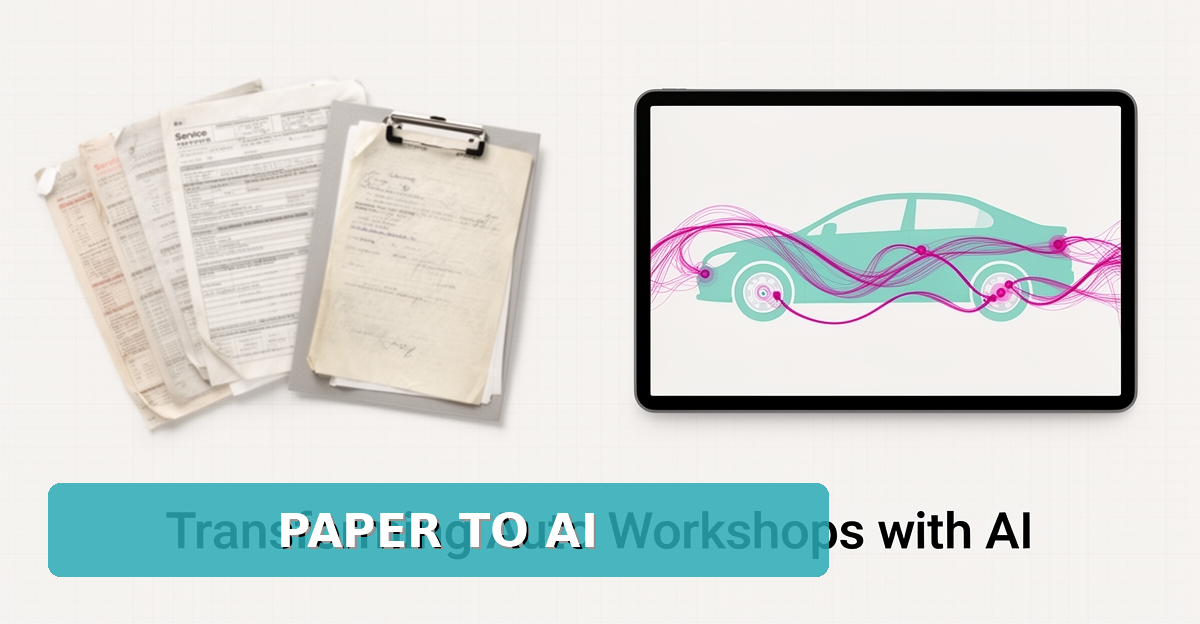
From Paper Logs to AI: Modernizing Service History Tracking in European Auto Workshops
Key Facts
- AI adoption is now widespread across business functions, but results depend heavily on proper integration and planning.
- Manual data entry is one of the largest recurring administrative costs in workshop operations—often many hours per week.
- AI systems can classify unstructured records (technician notes, invoices, OBD-II reports) into standardized, searchable formats.
- GDPR-compliant audit trails, role-based access, and encryption are essential for workshops handling customer and vehicle data.
- AIQ Labs has deployed 200+ multi-agent systems and runs 4 live SaaS products daily.
Hire a team member that works 24/7 — for less than a part-time wage.
AI receptionists, SDRs, dispatchers and 99+ roles. Trained on your business, fully managed.
Not sure where to start? Ask our AI planner
The Hidden Cost of Paper: Why Manual Service Logs Are Failing European Workshops
European auto workshops still relying on paper service logs face mounting inefficiencies that directly impact their bottom line and customer relationships. Manual data entry is not only time-consuming but highly susceptible to human error. These errors often go unnoticed until they lead to misdiagnoses, unnecessary repairs, or customer disputes, eroding trust over time.
Beyond inaccuracies, paper logs create significant operational delays due to poor searchability and accessibility. Technicians waste valuable time manually sifting through physical files to locate a vehicle's service history, slowing down diagnostics and increasing labor costs per job. This inefficiency is compounded when multiple workshops or service centers are involved, as paper records cannot be easily shared or integrated across systems. The result is a fragmented view of vehicle health that hinders proactive maintenance and informed decision-making.
These limitations translate into measurable costs for workshops, including extended vehicle downtime, repeat visits due to unresolved issues, and diminished customer satisfaction. When clients cannot easily access or verify their service history, confidence in the workshop's expertise declines, affecting retention and referral rates. AIQ Labs addresses these challenges by enabling secure, searchable digital service records that auto-capture and classify data from diagnostic tools and service interactions, ensuring accuracy and accessibility. By replacing error-prone paper logs with intelligent document processing, workshops can reduce administrative overhead, improve diagnostic speed, and rebuild customer trust through transparent, reliable vehicle histories.
How AI Transforms Service History: Automated Capture, Classification, and Compliance
AI-powered systems are reshaping how European auto workshops capture and manage service history by automating data collection from diagnostic tools, service records, and customer interactions. These platforms eliminate manual entry bottlenecks, reduce human error, and create a centralized, searchable repository that supports faster diagnostics and stronger customer trust. AI adoption is now widespread across industries—including automotive service—but the workshops seeing real results are the ones that integrate AI into their actual workflows rather than bolting on generic tools.
AI excels at classifying unstructured data—such as technician notes, invoice details, and OBD-II reports—into standardized, actionable formats with high accuracy. Multi-agent AI systems can cross-reference data from multiple sources to ensure consistency and flag discrepancies before they impact service decisions. This same principle applies to service history systems, where AI continuously learns from new inputs to improve classification precision over time.
Beyond capture and classification, AI-powered platforms maintain secure, compliant records that are instantly accessible to authorized staff. These systems support audit trails, role-based access, and encryption to meet data protection standards such as GDPR, which is critical for workshops handling sensitive vehicle and customer information. Many businesses that adopt AI without proper integration and governance struggle to see measurable results—which is why partnering with an experienced provider matters. AIQ Labs builds systems designed for true ownership and seamless integration with existing workshop tools, enabling auto shops to transition from paper logs to intelligent, self-improving service histories without vendor lock-in. The result is a more efficient, accurate, and transparent service history process that empowers technicians, builds customer confidence, and supports data-driven decision-making across the workshop.
From Pilot to Practice: Implementing AI Service History with AIQ Labs
Transitioning from paper logs to AI-powered service history tracking requires more than just technology—it demands a structured path from pilot to practice. Many workshops begin with limited trials but struggle to scale due to unclear workflows or integration gaps. AIQ Labs offers three entry points depending on where a workshop is in its journey: AI Employees for managed AI staff that handle intake, scheduling, and customer follow-up; AI Workflow Builds to rebuild the one workflow that costs the most, at a fixed price and in phases; and AI Operating Systems for a fully connected operating layer built in phases and owned outright.
The process starts with a thorough assessment of current service history practices, data sources, and pain points. This includes evaluating existing tools like scheduling software, diagnostic systems, and customer communication channels to identify where AI can deliver immediate value. Workshops that skip this foundational step risk investing in tools that don't integrate with their operations or meet compliance needs like GDPR. The easiest way to start is the two-minute Fit Check at /apply, followed by a free 30-minute strategy call.
Next, custom development builds a purpose-built AI system designed around the workshop's specific workflows. Rather than forcing processes into rigid off-the-shelf platforms, AIQ Labs engineers solutions that auto-capture service entries from diagnostic tools, classify repairs using natural language processing, and update digital histories in real time. These systems are built for ownership—clients retain full control of code, data, and future updates—eliminating dependency on third-party vendors. The approach is proven at scale: AIQ Labs has deployed 200+ multi-agent systems and runs 4 live SaaS products daily, demonstrating the reliability of its multi-agent architectures in production environments.
Finally, integration connects the AI system to core workshop tools such as CRM, inventory management, and invoicing platforms via secure APIs. This creates a unified operational hub where service history data flows seamlessly between departments, reducing manual entry and errors. Workshops that automate service history capture typically reclaim many hours of administrative work each week and see materially fewer data-entry errors—directly improving diagnostic accuracy and customer trust. Integrated systems are also far more accessible than paper logs, enabling instant keyword-based search and remote access—key advantages for multi-location workshops or mobile technicians.
By following this structured path—assess, build, integrate—European auto workshops can move beyond pilots to deploy AI service history systems that are compliant, owned, and designed for long-term value. Flexible payment models—Start Monthly, Build in Milestones, or Own It Outright—mean you can begin without a large upfront commitment. The result is not just digitized records, but a smarter, more responsive service operation that supports faster repairs, clearer customer communication, and data-driven decision-making—all without sacrificing control or inviting vendor lock-in.
Still paying for 10+ subscriptions that don’t talk to each other?
We build custom AI systems you own outright. No vendor lock-in. Full control.
Not sure where to start? Ask our AI planner
Frequently Asked Questions
Why are paper service logs causing problems for European auto workshops?
How does AI improve service history tracking in auto workshops?
Can AI-powered service history systems help workshops comply with data protection regulations like GDPR?
What are the risks of implementing AI in service history without proper planning?
How does AIQ Labs help workshops transition from paper logs to AI service history systems?
Your Service History Is Either an Asset or a Liability—Choose Now
The gap between paper logs and AI-powered service history tracking comes down to three things: accuracy, speed, and trust. Manual records cost European workshops hours of wasted technician time, invite diagnostic errors, and quietly erode the customer confidence that drives retention. AI systems flip that equation—automatically capturing, classifying, and securing every service entry while making a vehicle's entire history searchable in seconds. But technology alone isn't enough: results come from proper assessment and integration, which is why AIQ Labs follows a structured path—assess, build, integrate—and why every system we deliver is one you own outright, with no vendor lock-in. Your next step is simple: start with a two-minute Fit Check at /apply, then take the free 30-minute strategy call to map your biggest workflow bottleneck with a real AI engineer. If there's a clear win, you'll see it on paper. If there isn't, we'll tell you that too—no obligation, just clarity.
Make AI your competitive advantage — not just another tool.
Strategy, implementation and ongoing optimization. One partner, end to end.
Not sure where to start? Ask our AI planner