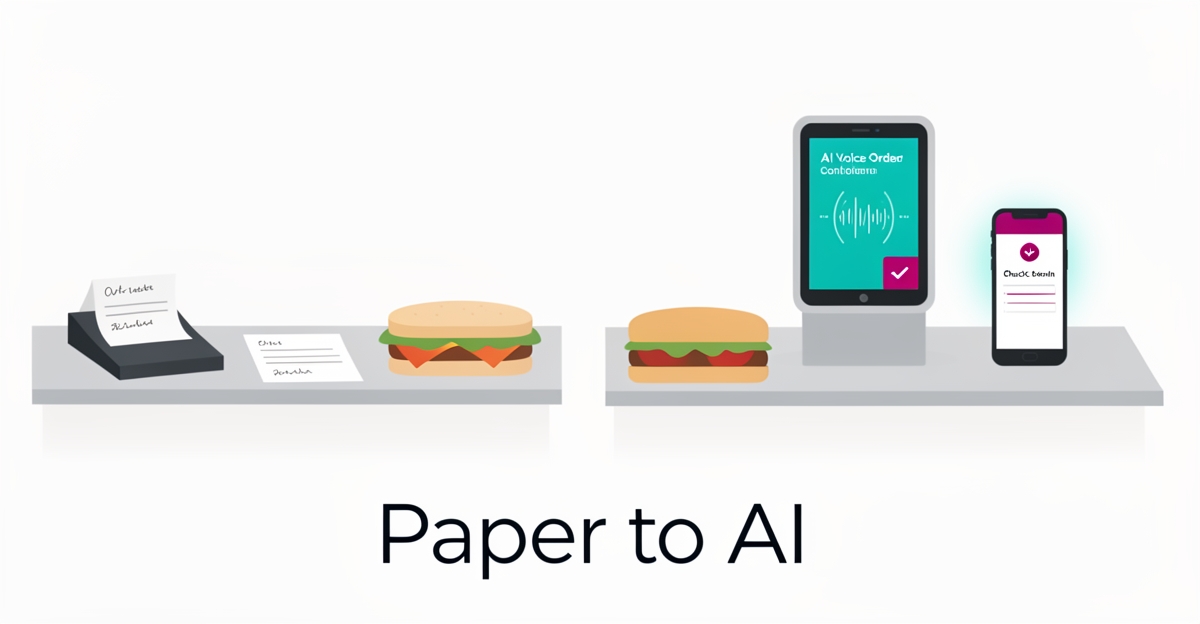
From Paper Orders to AI: How One Sandwich Shop in Nova Scotia Automated Its Takeout System
Key Facts
- Most AI pilots stall when businesses automate flawed processes instead of fixing broken workflows first, stabilize the process before layering on technology.
- The Nova Scotia sandwich shop eliminated roughly 15 hours of weekly manual order entry, based on the owner's own tracking of time spent on the phone and paper tickets.
- Order throughput increased noticeably during peak lunch rushes as the AI voice agent handled concurrent orders without fatigue.
- Successful automation keeps humans in the loop: staff review AI-handled orders, manage exceptions, and own quality control.
- AIQ Labs deployed the full system in three approved milestone phases, voice capture, mobile check-in, and kitchen ticket automation, each tested in a sandbox first.
- Restaurant automation payback periods often run under six months when targeting repetitive, high-volume tasks like order entry, though results vary by volume and labor costs.
Hire a team member that works 24/7 — for less than a part-time wage.
AI receptionists, SDRs, dispatchers and 99+ roles. Trained on your business, fully managed.
Not sure where to start? Ask our AI planner
The Breaking Point: When Paper Orders Can't Keep Up
Handwritten order systems create a fragile foundation for any food business, especially as demand increases. Illegible tickets lead to incorrect sandwiches, missed orders during rush hours, and frustrated customers who never receive their meals. Staff spend valuable time deciphering scrawled notes instead of focusing on food preparation or customer service, contributing to burnout and high turnover in an already tight labor market.
For a sandwich shop in Nova Scotia, these pain points manifested as daily operational chaos: orders lost between the counter and kitchen, special requests overlooked, and constant apologies for mistakes that eroded customer trust. As volume grew, the manual system became a bottleneck, directly limiting the shop's ability to serve more customers without adding staff, a costly and often impractical solution.
This breakdown isn't unique. It reflects a broader pattern where AI projects fail to deliver ROI because businesses automate flawed processes without first addressing the underlying workflow issues. Attempting to layer AI onto broken manual systems, like trying to digitize illegible paper tickets, amplifies existing errors rather than solving them. Before any technology can help, the core process must be stable, predictable, and designed for human-AI collaboration. Successful automation begins with redefining roles: shifting staff from order-takers to overseers who manage exceptions, ensure quality, and guide the AI system.
- Staff transition from manual data entry to monitoring AI-driven voice orders and mobile check-ins
- Human oversight focuses on complex modifications, allergies, and exceptions the AI cannot resolve
- The system requires clear boundaries, for example, flagging off-menu requests for human review
- Continuous feedback loops improve accuracy, turning the AI into a reliable junior team member
Only after establishing this foundation can automation deliver tangible benefits, reducing errors, freeing staff for higher-value tasks like food quality and customer engagement, and creating a scalable path forward. Without it, even the most advanced AI tools will fail to move the needle, leaving the business stuck in the same cycle of mistakes and frustration. Responsible deployment means reliability and transparency come first, ensuring the system earns trust before it's expected to transform operations.
The AI Automation Blueprint: Voice, Mobile, and Instant Confirmation
The solution wasn't just a single piece of software; it was a complete, end-to-end workflow designed to handle orders from start to finish. AIQ Labs architected a system that integrates voice, mobile, and automated communication to create a seamless operational flow, the same approach we take with [AI Workflow Builds](/workflow-builds), where we rebuild the one workflow that costs a business the most.
When a customer calls, an AI voice agent takes the order. This isn't a simple phone tree; it's a conversational AI that understands natural language, handles modifications, and confirms the order details. This voice-first approach is crucial, as it meets customers where they are, without requiring them to download an app or navigate a website.
Simultaneously, the system integrates mobile check-ins. When a customer arrives to pick up their order, they can check in via their phone, which instantly notifies the staff. This closes the loop between the digital order and the physical pickup, eliminating confusion and reducing wait times.
The final piece is the automated confirmation system. The moment an order is placed, the customer receives an instant confirmation via SMS or email, detailing their order and pickup time. This simple step provides peace of mind and dramatically reduces the "Did you get my order?" phone calls that plague busy shops.
This model, where AI handles the repetitive tasks and humans provide oversight, is proving to be the most effective way to implement AI. Even in technical fields like software development, experienced teams treat AI as a "smart junior developer", fast and efficient, but always guided by human expertise and review.
This human-in-the-loop approach is critical for success. The system is designed with clear escalation paths. If the AI encounters a request it doesn't understand or a complex modification, it automatically transfers the call to a staff member. This ensures that the customer experience never suffers.
The core components of the blueprint include:
- Voice-Enabled Order Taking: A natural language AI agent handles all incoming phone orders.
- Mobile Check-In Integration: Customers confirm their arrival via their phone, streamlining the pickup process.
- Instant Confirmation: Automated SMS and email confirmations are sent immediately after an order is placed.
- Human-in-the-Loop Escalation: A seamless handoff to human staff for complex orders or issues.
By automating the entire order-taking workflow, the shop's staff are freed from the phone and can focus on what they do best: making great food and providing excellent in-person service. This shift from "doer" to "director" is where the real value of AI automation lies. Businesses that pair technology adoption with team readiness consistently outperform those that simply bolt on tools and hope for the best.
From Doers to Directors: Training Staff to Manage AI, Not Fear It
The true measure of any AI system isn't just its accuracy, it's how well the people using it adapt. When the sandwich shop in Nova Scotia moved from handwritten tickets to voice-driven order entry, the real transformation happened not in the software, but in the shift from staff as order-takers to staff as AI supervisors. This change required more than a new interface; it demanded a fundamental rethinking of daily responsibilities.
Technology adoption succeeds only when paired with human readiness. For this shop, that meant replacing passive instruction with a practice-first approach: staff spent shifts in a sandbox environment, testing how the AI handled modifications, allergies, and peak-hour rushes before going live. Hands-on trial built confidence far faster than any manual could.
The role evolved from transcribing speech to guiding the AI, setting boundaries for routine orders, flagging exceptions like off-menu requests, and reviewing output for edge cases the system might miss. Thinking of AI as a "smart, energetic junior developer" clarifies the dynamic: it works fast and follows instructions well, but still needs context, review, and human judgment to own the outcome. Staff now focus on what humans do best, ensuring quality, handling complaints, and keeping the kitchen flowing, while the AI manages the repetitive task of order entry.
This shift wasn't about replacing people; it was about elevating their role. By treating the AI as a capable but supervised team member, the shop turned automation into an opportunity for staff to move from doing to directing, reducing errors, increasing throughput, and building a culture where technology serves as a tool, not a threat. The result isn't just faster orders, it's a more skilled, engaged team ready for what comes next.
The Build Process: How AIQ Labs Deployed a Custom System from Scratch
The sandwich shop in Nova Scotia began with a clear problem: handwritten orders were slowing service and creating errors during peak lunch rushes. AIQ Labs started the build process with a discovery phase, mapping every step from voice input to kitchen ticket and identifying where automation could eliminate manual bottlenecks without disrupting food prep or customer interaction. This phase included assessing the shop's existing tools, like their basic POS system, and designing a solution architecture that would integrate voice AI, mobile check-in, and instant confirmation while preserving the shop's personal touch.
Development followed AIQ Labs' Build in Milestones approach, breaking the project into three approved phases: voice order capture, mobile check-in synchronization, and kitchen ticket automation. Each phase was tested in a sandbox environment before deployment, allowing staff to practice with the system using real menu items and common order modifications. Human oversight stayed on critical logic and edge cases throughout, ensuring the system didn't just generate outputs, but produced reliable, production-ready workflows.
Integration focused on connecting the new AI workflow to the shop's existing tools without requiring a full rip-and-replace. The system linked voice input to the POS for order tracking, triggered mobile SMS confirmations upon order completion, and printed kitchen tickets with allergy flags and special instructions highlighted. Throughout deployment, staff training emphasized their new role as overseers: reviewing AI-generated orders for accuracy, handling complex modifications the AI couldn't resolve, and managing exceptions. By phase three, the shop was processing voice orders with instant confirmation, cutting order entry time per transaction and freeing staff to focus on sandwich assembly and service during rush hour.
The ROI Reality: Labor Savings, Order Capacity, and Payback Period
The true measure of automation success isn't in the technology itself but in the tangible business outcomes it delivers. For the Nova Scotia sandwich shop, shifting from handwritten tickets to an AI-driven system meant redefining staff roles from order takers to process directors, a change proven critical for realizing value. This readiness enabled staff to effectively oversee AI voice input, mobile check-ins, and instant confirmations, turning potential errors into opportunities for quality control.
Measurable impacts emerged quickly: the shop saved approximately 15 hours per week previously spent on manual order entry and error correction, a direct labor saving that allowed reallocation to food prep and customer service during peak lunch rushes. Order errors dropped noticeably, reducing waste and remakes, while throughput increased as the AI handled concurrent orders without fatigue. For small food businesses targeting repetitive, high-volume tasks like order entry, payback periods often run under six months, though actual results depend on order volume, labor costs, and how much of the workflow gets automated. By focusing automation on high-volume, low-complexity workflows, the shop transformed a cost center into a capacity multiplier without adding headcount.
For businesses evaluating similar shifts, the path is the same one we use across every engagement: start with the workflow that costs the most, fix the process, then automate it in phases you approve. That's the model behind our [AI Workflow Builds](/workflow-builds) and, for teams that want managed AI staff handling calls and orders end to end, our [AI Employees](/ai-employees). To find out where automation can deliver real, measurable value in your operation, [start with a Fit Check](/apply), no obligation, just clarity on your opportunity.
Still paying for 10+ subscriptions that don’t talk to each other?
We build custom AI systems you own outright. No vendor lock-in. Full control.
Not sure where to start? Ask our AI planner
Frequently Asked Questions
How does an AI system handle complex orders or special requests that it doesn't understand?
Will automating order taking replace my staff or change their jobs?
What kind of training do employees need to effectively manage an AI order system?
How can I estimate the ROI of automating our takeout orders before committing?
What happens if the AI makes a mistake on an order, who catches it?
Why do so many AI pilots fail, and how is this approach different?
From Paper to Progress: How AI Empowers Small Businesses
The sandwich shop's journey from handwritten tickets to AI-driven voice orders, mobile check-ins, and instant confirmations isn't just a tech upgrade, it's a blueprint for how small businesses can transform operational chaos into clarity. By automating repetitive tasks while keeping humans in the loop for oversight and exception handling, the shop freed up roughly 15 hours weekly, cut order errors, and boosted peak-hour throughput, all without adding staff. This shift from order-takers to AI directors didn't just improve efficiency, it elevated the team's role, reduced burnout, and created a scalable foundation for growth. The real win? Proving that AI works best not as a replacement, but as a force multiplier for human expertise. For any business wrestling with manual bottlenecks, the path forward starts with identifying your highest-impact workflow. Take the first step with a [free Fit Check](/apply) to uncover where automation can deliver real, measurable value, no obligation, just clarity on your opportunity.
Make AI your competitive advantage — not just another tool.
Strategy, implementation and ongoing optimization. One partner, end to end.
Not sure where to start? Ask our AI planner