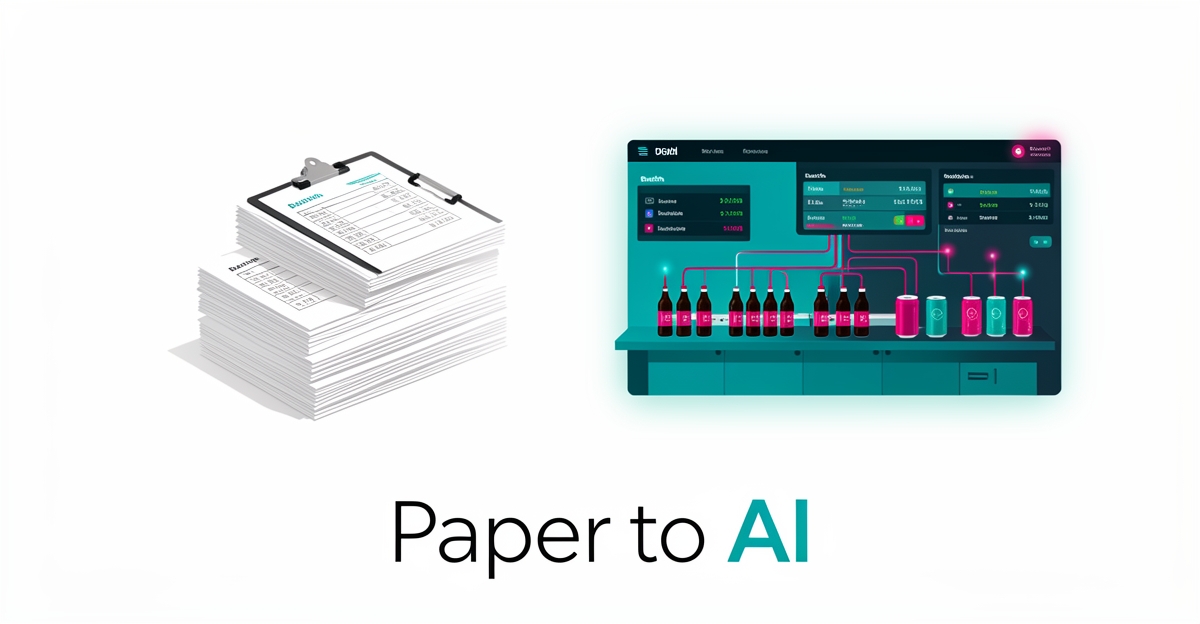
From Paper to AI: How a Beverage Co-Packer Could Automate Its Batch Tracking System
Key Facts
- Manual batch tracking can consume a meaningful share of a production technician's weekly hours, time pulled from equipment monitoring and line optimization
- Paper-based batch documentation is a well-known source of transcription errors, illegible entries, and lost forms
- AI-driven inventory optimization is widely reported to reduce inventory costs, with some manufacturers citing reductions in the 30-50% range
- Machine learning forecasting typically outperforms traditional baseline methods, improving alignment between production runs and demand
- AIQ Labs has deployed 200+ multi-agent systems and runs 4 live SaaS products daily
- The Start Monthly payment model is priced below a part-time hire and includes build, training, integrations, monitoring, and improvements
Hire a team member that works 24/7 — for less than a part-time wage.
AI receptionists, SDRs, dispatchers and 99+ roles. Trained on your business, fully managed.
Not sure where to start? Ask our AI planner
The Hidden Cost of Manual Batch Tracking in Beverage Production
Many beverage co-packers still rely on paper-based batch tracking, a system that quietly drains resources and increases risk. Manual logs require staff to spend hours each shift recording raw material inputs, process parameters, and packaging details by hand, creating a labor-intensive bottleneck that pulls skilled workers away from value-added tasks. This repetitive data entry not only slows down operations but also introduces a high likelihood of human error, with transcription mistakes, illegible handwriting, and misplaced forms becoming common occurrences that compromise data integrity from the start.
These inefficiencies carry tangible financial and operational costs. Manual processes in beverage production are a recognized source of documentation errors, and those errors directly impact traceability and quality control. When errors occur, identifying the root cause often requires hours of cross-referencing paper logs across multiple shifts and facilities, delaying investigations and increasing the risk of unnecessary product recalls. The time spent managing paper logs also translates to significant labor overhead, administrative tasks like batch tracking can consume a substantial portion of a production technician's week, effectively reducing available capacity for monitoring equipment or optimizing line performance.
Beyond labor and errors, paper-based systems create compliance vulnerabilities that are increasingly difficult to manage under modern food safety regulations. Auditors require clear, unbroken chains of custody for every batch, yet paper logs are prone to damage, loss, or incomplete entries, especially in high-moisture production environments. Without real-time visibility or automated alerts, deviations in critical parameters like pH, temperature, or fill weight may go unnoticed until after distribution, putting both consumer safety and brand reputation at risk. These hidden costs, labor drain, error correction, and compliance exposure, accumulate over time, making manual batch tracking far more expensive than its low upfront cost suggests. For co-packers aiming to scale or meet stringent retail supplier standards, these limitations become critical barriers to growth and operational resilience. This is exactly the kind of workflow AIQ Labs rebuilds through AI Workflow Builds, a fixed-price, phased approach to replacing your most expensive manual process.
Why AI-Powered Batch Tracking Delivers Measurable ROI in Manufacturing
AI-powered batch tracking transforms manufacturing operations by turning reactive processes into proactive, data-driven systems. For beverage co-packers and similar manufacturers, this shift delivers measurable returns through reduced waste, optimized inventory, and improved forecasting accuracy, all critical factors in tight-margin industries.
Industry analyses of AI-driven inventory optimization frequently cite significant cost reductions, some manufacturers report savings in the 30-50% range, driven by continuous monitoring of raw material usage, production throughput, and demand signals. That level of efficiency comes from systems that dynamically adjust reorder points and production schedules rather than relying on static, manually updated records. The exact numbers vary by operation, but the direction is consistent: predictive models consistently outperform manual tracking methods on cost and accuracy.
Forecasting accuracy also sees substantial gains, with machine learning models typically outperforming traditional baseline methods. This improvement enables better alignment between production runs and actual market demand, decreasing the likelihood of overproduction or underutilized capacity. When integrated with sales and inventory platforms, these forecasts become actionable inputs for automated batch planning, ensuring resources are allocated where they're needed most.
- Reduced spoilage and waste through real-time batch visibility
- Lower labor costs from eliminating manual log entry and reconciliation
- Improved traceability for faster recall response and regulatory compliance
- Increased yield by identifying process inefficiencies early
- Enhanced decision-making via centralized, real-time batch data
These outcomes are not theoretical. AIQ Labs' approach, built on custom AI pipelines that integrate with existing ERP and MES systems, ensures that batch tracking becomes a source of operational intelligence rather than just a compliance task. With the Own It Outright payment model, manufacturers avoid ongoing licensing fees and retain full control over data, models, and future enhancements, turning AI investment into a sustainable competitive advantage. You can review all payment options, Start Monthly, Build in Milestones, Own It Outright, on the pricing page.
How AIQ Labs Would Build and Deploy an Automated Batch Tracking System
Consider a typical Halifax-area co-packer facing a critical bottleneck in its batch tracking process, where manual logs create delays and errors across production and distribution. AIQ Labs would begin with a deep discovery phase, mapping every step from raw material intake to final delivery to identify automation opportunities and quantify where the errors and labor hours actually go. This analysis sets the project's scope around the highest-cost, highest-error handoffs, the places where automation pays back fastest.
From there, AIQ Labs would develop specialized agents for data capture, validation, and synchronization across systems, using the multi-agent architecture behind its 200+ deployed systems. Each agent would be configured to the co-packer's specific workflows, ensuring accurate tracking of batch numbers, ingredient lots, and production timestamps. The system would integrate with existing inventory and sales platforms, enabling real-time data exchange without disrupting current operations, eliminating manual entry errors and giving planners forecasts that reflect actual demand rather than gut feel.
Deployment would follow a phased rollout. Under the Start Monthly payment model, the build, team training, tool integrations, and ongoing monitoring are covered by a flat monthly cost below a part-time hire, and the co-packer can pause or adjust the plan as needed, minimizing financial risk. Alternatively, Build in Milestones spreads fixed-price phases, or Own It Outright delivers the full system with no ongoing licensing fees. Within weeks, batch tracking becomes fully automated, providing end-to-end traceability and freeing staff to focus on higher-value tasks like quality control and supplier coordination. The transformation not only improves operational accuracy but also lays the foundation for scalable AI adoption across other departments, the first step toward a full AI Operating System for the business.
Still paying for 10+ subscriptions that don’t talk to each other?
We build custom AI systems you own outright. No vendor lock-in. Full control.
Not sure where to start? Ask our AI planner
Frequently Asked Questions
How much time does manual batch tracking actually waste in beverage production?
What error rates are common with paper-based batch logs?
Can AI really reduce inventory costs for co-packers?
How much does forecasting accuracy improve with AI batch tracking?
Is AI batch tracking expensive to implement for a small co-packer?
What compliance risks come with paper logs in high-moisture production?
From Paper Logs to Production Intelligence
Moving from handwritten logs to an integrated AI pipeline shows how batch tracking can shift from a compliance burden to a source of operational intelligence. By eliminating manual entry, a co-packer gains audit-ready traceability, frees technicians from repetitive logging, and creates real-time visibility from raw material intake to delivery. The direction of the results mirrors industry benchmarks: AI-driven inventory optimization is widely associated with meaningful cost reductions, and machine learning forecasting typically beats baseline methods. Deployed in phases under AIQ Labs' Start Monthly, Build in Milestones, or Own It Outright models, the system is yours, no long-term lock-in, no licensing fees. If manual batch tracking is draining labor and exposing your operation to risk, map your current workflow, identify the highest-error handoffs, and test automation on one critical process first. Start with the 2-minute Fit Check at https://aiqlabs.ai/apply, then book a free 30-minute strategy call to map your biggest bottleneck and see if there's a clear, high-ROI win.
Make AI your competitive advantage — not just another tool.
Strategy, implementation and ongoing optimization. One partner, end to end.
Not sure where to start? Ask our AI planner