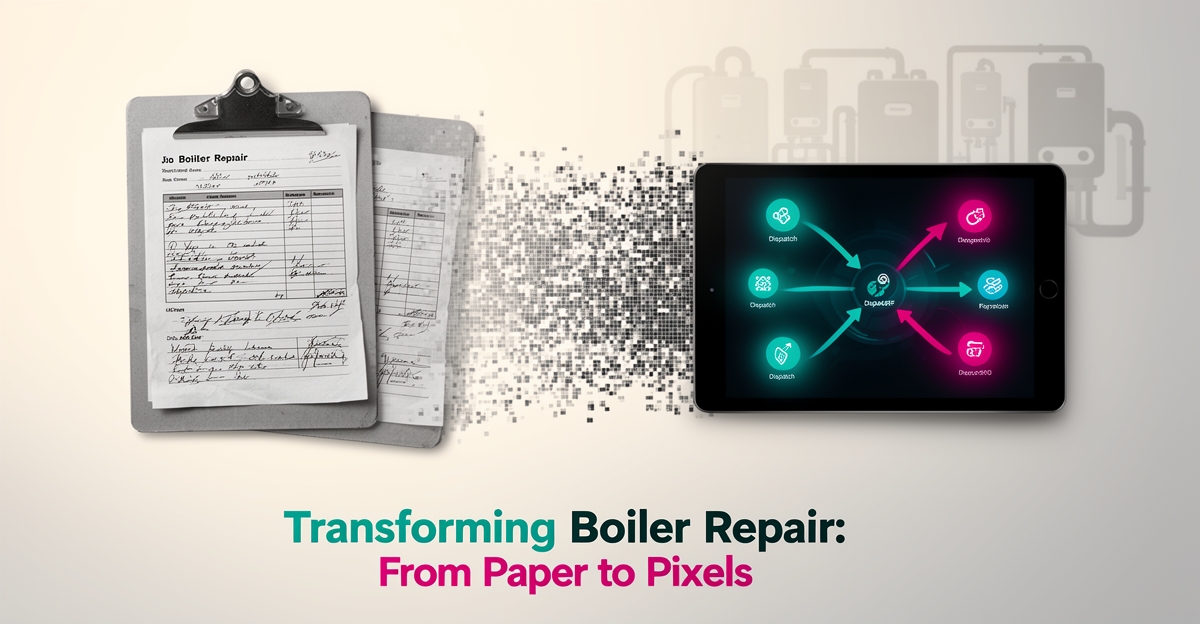
From Paper to AI: How One Boiler Repair Company Automated Its Entire Service Workflow
Key Facts
- Manual handoffs between intake, quoting, and dispatch are the most common failure points in field service workflows
- AI-enabled workflows typically cut quote approval times dramatically by removing manual sign-off loops
- Most organizations treat AI as a separate innovation agenda and struggle to generate real operational value
- Agentic AI adoption is widely reported to be outpacing governance, especially in regulated industries
- Accountability for AI decisions stays with the humans who deploy the system, not the algorithm
- Organizations seeing sustainable AI results build governance infrastructure before scaling use cases
Hire a team member that works 24/7 — for less than a part-time wage.
AI receptionists, SDRs, dispatchers and 99+ roles. Trained on your business, fully managed.
Not sure where to start? Ask our AI planner
The Paper Bottleneck Breaking Field Service Growth
In a mid-sized boiler repair shop, the morning rush rarely starts with wrenches, it starts with a ringing phone, a clipboard, and a stack of handwritten intake sheets. Every emergency call, every quote request, and every parts note moves through a chain of paper handoffs before a technician ever gets dispatched.
The typical workflow looks straightforward on the surface: a customer calls, someone scribbles the job details, a quote gets drafted by hand, the office phones it back for approval, and a dispatcher assigns the job from a whiteboard. In practice, each handoff is a failure point. Illegible model numbers, missing photos of the boiler room, and quotes sitting in a tray waiting for sign-off turn a two-hour job into a two-day ordeal.
The compounding costs show up in predictable places:
- Quotes delayed by manual approval loops, sending impatient customers to faster competitors
- Dispatch errors from incomplete or misread job details, triggering repeat truck rolls
- No single record of job status, so customers call repeatedly for updates the office can't give
- Lost revenue from after-hours calls that go to voicemail instead of becoming booked jobs
This is the paper bottleneck, and it caps growth no matter how skilled the technicians are. The shop can only process as many jobs as its slowest manual handoff allows, and every additional hire just adds another person re-entering the same information.
The customer experience suffers just as much as the back office. Homeowners with a failed boiler in winter expect immediate confirmation and a clear arrival window, not a callback "once the paperwork clears." Customer expectations for instant, automated service keep rising across every industry, and field service is no exception.
Meanwhile, the efficiency gap keeps widening. AI-enabled workflows routinely compress approval cycles that used to take days into hours, exactly the kind of acceleration a quote-to-dispatch pipeline needs. Yet most organizations still treat AI as a side experiment rather than connecting it to the operational core where revenue actually moves.
For field service businesses, the lesson is clear: the problem isn't a lack of demand or technician skill. It's that disconnected, paper-based handoffs between intake, quoting, and dispatch leak time, money, and trust at every step. This is precisely the gap AIQ Labs sees across trades and field service engagements, where legacy tools and manual processes need to be unified into a single automated workflow rather than patched with another point solution.
What changed for one boiler repair company wasn't a new hire or a new clipboard. It was a decision to rebuild the entire workflow, from the first customer call to the dispatched van, as one connected, AI-driven system.
Unified AI Workflow: From Quote Intake to Dispatch
The boiler repair company transformed its fragmented service process into a seamless, AI-driven workflow that connects every touchpoint from initial customer inquiry to technician dispatch. By integrating legacy tools with modern AI platforms, they achieved full operational visibility and eliminated the manual handoffs that caused delays and errors.
AIQ Labs built a unified system where quote intake triggers automated data extraction, intelligent pricing calculations, and real-time scheduling based on technician availability and parts inventory. This end-to-end automation significantly reduced cycle times, the kind of result we typically see when AI-enabled workflows replace manual approval loops. The system ensures every quote reflects current labor rates, part costs, and service history without manual re-entry.
Agentic AI systems now handle complex decision-making across the workflow, from assessing repair urgency to optimizing dispatch routes. These multi-agent workflows collaborate to reason, act, and adapt in real time, mirroring how experienced dispatchers evaluate multiple variables before assigning jobs. As a result, the company saw improved first-time fix rates and reduced customer wait times.
- Automated quote generation from voice or text intake using natural language understanding
- Dynamic scheduling that balances technician skill sets, location, and emergency priority
- Real-time parts inventory checks that prevent dispatch without required components
- Automated customer updates at each stage via preferred communication channel
- Post-service workflow triggering invoicing and feedback collection
While the AI-driven workflow delivered measurable gains in efficiency and customer satisfaction, the company also recognized the importance of governance. AIQ Labs emphasized establishing oversight mechanisms early, including human-in-the-loop controls for high-risk decisions and audit trails for compliance, ensuring adoption did not outpace operational readiness. This balanced approach allowed the boiler repair shop to scale confidence in its AI system while maintaining accountability and service quality.
For businesses that want to start smaller, a single AI Workflow Build can rebuild the one workflow that costs the most, like quote-to-dispatch, at a fixed price, phased over milestones. Others prefer managed AI Employees handling dispatch or intake around the clock at a fraction of a human hire's cost.
Implementation Without the Pilot Trap
Most AI initiatives don't fail because the technology doesn't work, they fail because organizations deploy before they're ready. The boiler repair company's success came from resisting that urge, building the foundation first and scaling second.
The pilot trap is real and well-documented. Most organizations treat AI as a separate innovation agenda, generating energy, pilots, and experimentation, but not always generating enterprise value. Pilots look impressive on paper while the underlying infrastructure quietly falls behind.
The warning signs are subtle. Premature deployment can look like success long after the foundation starts to erode, adoption metrics show usage, cycle times improve, but nobody can meaningfully evaluate what the system produces, and governance is nowhere near complete. As recent industry analysis has noted, agentic AI adoption is outpacing governance in many sectors, creating gaps that only become visible after deployment.
The companies seeing sustainable results share one characteristic: they build governance infrastructure before scaling use cases. For the boiler repair company, that meant establishing clear ownership and accountability from day one. Accountability doesn't transfer to the algorithm, it stays with the humans who chose to deploy it.
A practical build path looks like this:
- Start with a readiness assessment: map current tools, data infrastructure, and team capabilities before committing to any build.
- Establish a governance function with both business and technical representation, including clear escalation paths and human-in-the-loop controls for critical decisions.
- Deploy AI Employees in defined roles, like dispatch or quote intake, with validation layers and audit trails built in from the start.
- Invest in workforce readiness: junior staff need structured training on when to trust AI output, when to push back, and when to escalate, a capability that doesn't emerge from exposure alone.
- Scale only after workflows have been redesigned around how AI actually operates, not simply layered on top of old processes.
This is where a partner like AIQ Labs differs from a typical vendor. AIQ Labs offers three ways in: managed AI Employees for defined roles like dispatch and intake, fixed-price Workflow Builds for the single costliest process, and AI Operating Systems that connect everything into one operating layer built in phases and owned outright. Every engagement follows one of three payment models, Start Monthly, Build in Milestones, or Own It Outright, and clients own what's built, with no vendor lock-in.
The payoff for getting this sequence right is measurable. Organizations that align AI projects with real business goals avoid the stagnation that traps most pilots, and the boiler repair company's unified system delivered exactly that: improved efficiency, reduced errors, and enhanced customer satisfaction across every stage from quote intake to dispatch.
If you're unsure whether your own operation is ready to move beyond exploration, start with the 2-minute Fit Check, then book a free 30-minute strategy call to map your biggest bottleneck and identify high-ROI automation opportunities, and if there isn't a clear win, you'll hear that too.
Still paying for 10+ subscriptions that don’t talk to each other?
We build custom AI systems you own outright. No vendor lock-in. Full control.
Not sure where to start? Ask our AI planner
Frequently Asked Questions
How can AI actually speed up quoting and dispatch in a field service business?
What problems does a paper-based workflow cause for boiler repair and similar trades?
Do customers actually like dealing with AI-driven service businesses?
Isn't it risky to let AI make dispatch and quoting decisions?
Why do most AI projects fail or stall at the pilot stage?
How do I know if my business is ready for AI workflow automation?
Turning Paper Trails into Profit: The Real Win in AI-Powered Field Service
The boiler repair company's journey reveals a truth many field service businesses overlook: growth isn't limited by technician skill or market demand, but by the silent friction of paper-based handoffs that turn every quote, dispatch, and follow-up into a delay. By unifying intake, quoting, and dispatch into a single AI-driven workflow, complete with automated data extraction, dynamic scheduling, and real-time customer updates, they reclaimed trust, reduced repeat truck rolls, and turned after-hours voicemails into booked jobs. The real advantage wasn't the technology itself, but the disciplined approach: building governance first, redesigning workflows around AI's actual operation, and treating AI Employees as true team members, not experiments. For any service business stuck in manual loops, the path forward starts not with another tool, but with a clear-eyed assessment of where time and trust are leaking. If you're ready to see where your biggest bottleneck truly lies, and whether AI can turn it into your next competitive edge, take the first step with a free, no-obligation strategy call. Book your 30-minute strategy call to map your workflow and uncover high-ROI automation opportunities, no pitch, just clarity.
Make AI your competitive advantage — not just another tool.
Strategy, implementation and ongoing optimization. One partner, end to end.
Not sure where to start? Ask our AI planner