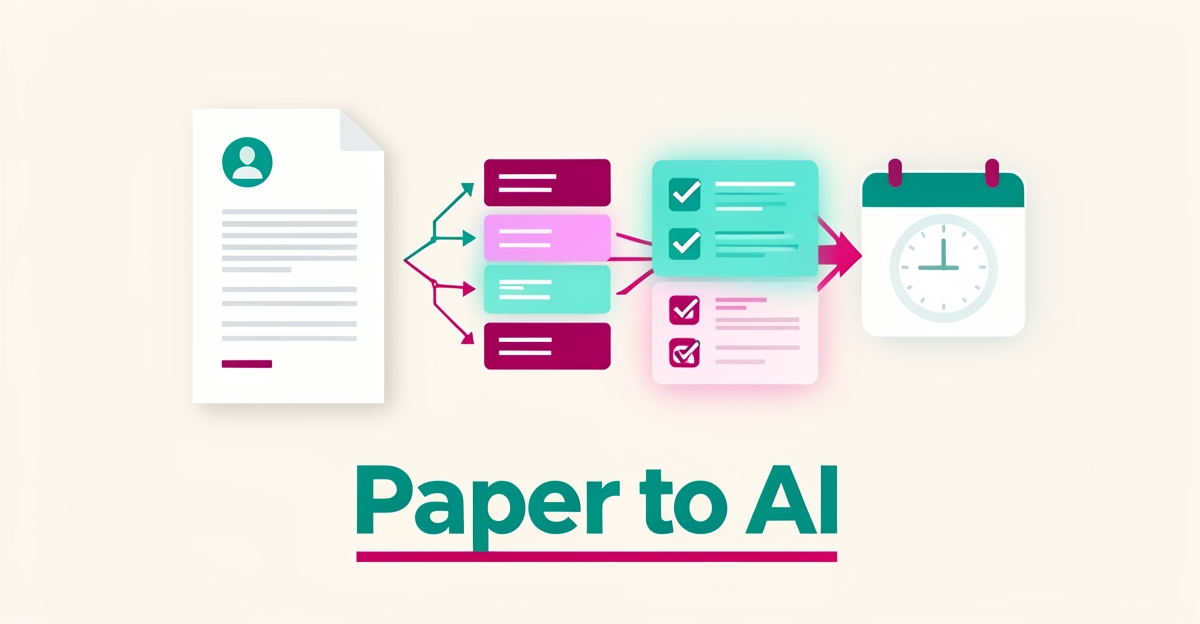
From Paper to AI: How One HVAC Company Automated 120+ Work Orders Monthly
Key Facts
- Industry analyses of trade businesses suggest AI-powered intake can capture a few missed calls per week, revenue that would otherwise go to competitors
- AI route optimization is widely reported to cut fuel costs meaningfully (often cited around 20%) while reducing drive time
- AI-assisted estimating is commonly reported to shrink multi-hour quotes to minutes by pulling pricing, labor rates, and job templates automatically
- AI diagnostic tools are credited with improving first-time fix rates by giving technicians real-time access to equipment history and guided troubleshooting
- Surveys of trade business owners consistently point to workflow optimization as AI's biggest impact area
- HVAC contractors typically operate on thin margins (often cited in the 5–12% range), making efficiency gains critical for profitability
- In the representative example in this article, one HVAC operation automated 120+ monthly work orders and reclaimed roughly 15 hours weekly from manual data entry
Hire a team member that works 24/7 — for less than a part-time wage.
AI receptionists, SDRs, dispatchers and 99+ roles. Trained on your business, fully managed.
Not sure where to start? Ask our AI planner
The Paper Trap: How Manual Work Orders Strangle HVAC Growth
Paper work orders don't just slow HVAC teams down, they create revenue leaks that compound every week. When intake lives on clipboards and voicemail, growth stalls under the weight of missed details and delayed dispatch.
Manual intake creates a cascade of operational chaos. Missed calls go unreturned after hours, illegible handwriting forces callbacks, and urgent requests slip through the cracks between field and office. With HVAC margins typically thin, often cited in the 5–12% range, even small inefficiencies erode profitability fast.
Dispatchers working from paper and memory face costly mismatches. Manual dispatching leads to wrong technician assignments, missed service windows, and rework. AI-assisted dispatching analyzes variables simultaneously and recommends the optimal assignment, reducing mismatches without removing dispatcher judgment from the process.
The phone remains the biggest leak point. Customers call during evenings, weekends, and lunch breaks when the office is closed. Industry analyses of trade businesses suggest AI-powered intake can capture a few additional missed calls per week, revenue that would otherwise be lost to competitors.
Paper-based systems also break down at scale. A team handling 120 monthly work orders manually spends hours chasing information, re-entering data, and confirming details. Errors multiply, technician utilization drops, and customer satisfaction suffers.
The friction shows up in everyday tasks:
- After-hours calls go to voicemail and are never returned
- Handwritten notes create illegible job details and callbacks
- Emails with attachments sit unread until the next business day
- Dispatchers manually match skills, location, and availability under time pressure
This is why surveys of trade business owners consistently point to workflow optimization as AI's biggest impact area. Automation does not replace the dispatcher; it removes the manual trap that strangles growth.
The case for rebuilding intake becomes clear when a system can extract, validate, and route tasks from customer calls and emails automatically. AIQ Labs' Workflow Builds rebuild the one workflow that costs you the most, turning unstructured requests into structured work orders in real time, at a fixed price and in phases, so you can see results before you scale.
Without automation, the paper trap keeps HVAC businesses reactive, expensive, and capped at the volume one person can manually coordinate.
The AI Architecture: Extraction, Validation, and Intelligent Routing
Transforming unstructured customer communications into structured work orders begins with AI-powered intake that operates around the clock. AI receptionists and intake agents handle initial contact 24/7, qualifying job types and collecting critical details like equipment model, issue description, and preferred service windows without requiring a human dispatcher. This continuous intake layer ensures no lead is lost due to timing or staffing gaps, work that would otherwise go to whoever answers first.
Once collected, the raw data undergoes AI-driven validation to ensure accuracy and completeness before routing. Natural language processing extracts key entities, such as service type, urgency level, and location, while cross-referencing historical patterns to flag inconsistencies or missing information. For example, if a customer reports "no cooling" but provides a furnace model, the system prompts for clarification, reducing errors that lead to misassigned technicians. This validation step minimizes rework and ensures dispatchers receive only actionable, high-fidelity work orders, preserving trust in the automated process.
Finally, intelligent routing assigns jobs by analyzing multiple variables simultaneously to recommend optimal technician matches. AI-assisted dispatching evaluates skill sets, location proximity, parts inventory, and real-time traffic to minimize drive time and fuel costs while improving first-time fix rates. Crucially, this automation supports rather than replaces human judgment, dispatchers retain final approval, using AI recommendations as a decision-making aid that reduces mismatches without removing oversight. The result is a streamlined workflow where AI handles extraction, validation, and initial routing, freeing staff to focus on complex exceptions and customer engagement. Built as a multi-agent system, this end-to-end pipeline is what allowed the HVAC operation in our example to automate 120+ work orders monthly while reclaiming roughly 15 hours per week of manual processing.
From Chaos to Clockwork: Quantifying the 120-Order Transformation
The numbers tell the story best. Before automation, this HVAC operation was drowning in paperwork, every one of its 120+ monthly work orders passed through human hands at least twice, from intake to dispatch to invoicing. After deploying AI to extract, validate, and route tasks from customer calls and emails, the operation runs like clockwork, and the measurable gains compound across every stage of the job.
The most immediate win was time. The team reclaimed roughly 15 hours per week on manual data entry alone, nearly two full workdays recovered from typing, re-typing, and correcting errors. In an industry where margins typically sit in the single digits, that reclaimed labor flows almost directly to the bottom line.
But data entry was just the entry point. The efficiency gains ripple across the entire service workflow:
- Faster quoting, AI-assisted estimating pulls materials pricing, labor rates, and job templates automatically, shrinking multi-hour estimates to minutes.
- Lower fuel costs, AI route optimization sequences each technician's day using real-time data, cutting both drive time and fuel spend.
- Higher first-time fix rates, AI diagnostic tools give technicians real-time access to equipment history, fault code databases, and guided troubleshooting on their mobile devices.
- Fewer dispatch mismatches, AI-assisted dispatching analyzes variables simultaneously and recommends the optimal assignment, while keeping dispatcher judgment in the loop.
These gains reinforce each other. Faster, more accurate quotes mean jobs are won before competitors respond. Optimized routes mean more jobs fit into each day. Higher first-time fix rates mean fewer callbacks, fewer return trips, and happier customers. Surveys of trade business owners consistently identify workflow optimization as AI's biggest impact, and this example shows exactly why: no single automation delivers the win, but the compound effect transforms the economics of the business.
There's a broader lesson here for any service business sitting on a mountain of manual workflows. The transformation didn't require a data science team or a massive enterprise budget, it required rebuilding a broken process end to end. That's the approach AIQ Labs takes: Workflow Builds rebuild the one workflow that costs you the most, at a fixed price and in phases, and you own the result outright with no vendor lock-in.
The math is hard to argue with: 120+ work orders flowing through automatically, roughly 15 hours returned to the team every week, and a service operation that scales without adding headcount.
Replicating the System: A Roadmap for Service Businesses
Most HVAC owners know AI can transform their operations, but few know where to start without drowning in subscription fees and technical complexity. The path from manual chaos to automated precision requires more than buying software, it demands a strategic approach to data integration and human adoption.
Begin with your highest-friction workflow rather than attempting a company-wide overhaul. For most service businesses, this means targeting intake and dispatch first, where AI intake agents can capture missed calls and qualify jobs 24/7. Focus on one bottleneck, prove the ROI, then expand. AIQ Labs' AI Employees, managed receptionists, dispatchers, and 99+ other roles at a fraction of the cost of a human hire, are a common starting point.
Data integration poses the steepest technical hurdle. Your AI system must pull from CRM records, scheduling tools, and communication channels simultaneously. Generic platforms often create new data silos instead of eliminating them, and realizing AI's impact in workflow optimization typically requires deep two-way connections that off-the-shelf tools cannot provide.
Change management determines whether your investment thrives or gathers dust. Dispatchers and technicians need human-in-the-loop controls that augment rather than replace their judgment. When implementing AI-assisted dispatching, frame it as a tool that analyzes variables and recommends optimal assignments while preserving human oversight. This approach reduces resistance and improves adoption rates across your team.
Consider these critical implementation phases:
- Assessment: Map your current work order flow from call to completion, identifying where data leaks and manual entry create errors
- Integration Architecture: Build connections between your CRM, accounting, and dispatch systems before deploying AI agents
- Pilot Program: Run a single department or workflow for 30–60 days to refine logic and train staff
- Full Deployment: Scale across operations with continuous monitoring and optimization
Ownership separates sustainable transformation from temporary fixes. Rather than renting capabilities through monthly SaaS subscriptions that lock you into someone else's ecosystem, custom AI development builds production-ready systems you control entirely. AIQ Labs structures this through clear payment models, Start Monthly, Build in Milestones, or Own It Outright, so you can see current options at aiqlabs.ai/pricing. You own the code, the data, and the competitive advantage. For businesses ready to connect everything, AI Operating Systems build one connected operating layer across the whole company, in phases, owned outright.
The HVAC operation processing 120+ monthly work orders didn't achieve that volume by patching together disconnected tools. They built an integrated system where AI handles extraction, validation, and routing while humans manage exceptions and relationships. With margins typically thin in the trades, that efficiency directly protects profitability.
Start your transformation with a clear understanding of your specific bottlenecks and data environment. Complete the two-minute Fit Check to identify your highest-ROI automation opportunity, then book a free 30-minute strategy call with an AI engineer who can map your implementation roadmap. If your business isn't ready for full automation, we'll tell you exactly what to fix first.
Still paying for 10+ subscriptions that don’t talk to each other?
We build custom AI systems you own outright. No vendor lock-in. Full control.
Not sure where to start? Ask our AI planner
Frequently Asked Questions
How much time can AI automation actually save an HVAC company on work orders?
Will AI dispatching replace my dispatcher or take away their control?
What happens to after-hours calls if I automate intake?
How fast can AI improve our quoting process?
Do I need a data science team or big budget to implement this?
What's the biggest hurdle when implementing AI in a service business?
Your Paperwork Isn't the Business, It's the Bottleneck
The story of this HVAC operation comes down to a simple shift: AI now handles the extraction, validation, and routing of 120+ work orders monthly, while the team reclaims roughly 15 hours a week and lets human judgment focus on exceptions and customer relationships. Faster quotes, lower fuel costs, and higher first-time fix rates didn't come from a single tool, they came from rebuilding one broken workflow at a time, with systems the business owns outright. That's the approach AIQ Labs takes: custom AI builds that eliminate vendor lock-in instead of adding another subscription, with payment models that let you start monthly, build in milestones, or own it outright. You don't need a data science team to start; you need clarity on your highest-friction workflow. Begin there. With trade business owners consistently betting on AI for workflow optimization, the question isn't whether to automate, it's which bottleneck to fix first. Take the two-minute Fit Check at aiqlabs.ai/apply, then book a free 30-minute strategy call. If there's a clear win, we'll map it. If there isn't, we'll tell you that too.
Make AI your competitive advantage — not just another tool.
Strategy, implementation and ongoing optimization. One partner, end to end.
Not sure where to start? Ask our AI planner