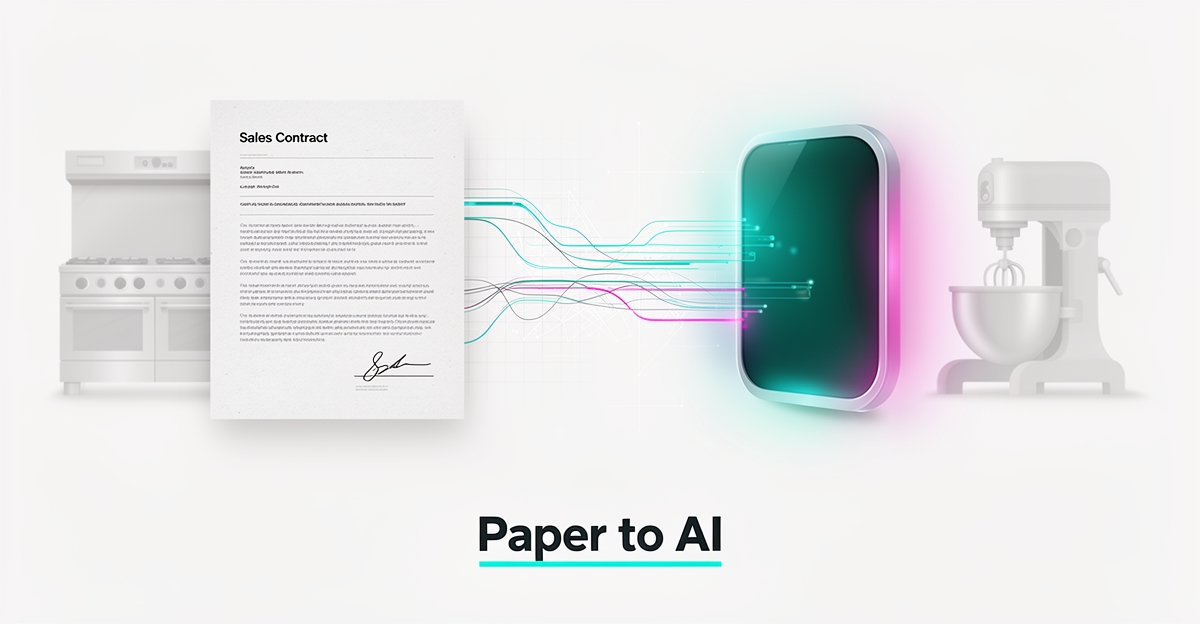
From Paper to AI: How Restaurant Equipment Distributors Can Digitize Sales Contracts
Key Facts
- Industry surveys in recent years have consistently found that a majority of contracts across distribution sectors remain paper-based or manually processed, creating inefficiencies and increased risk
- Manual contract reviews typically take several days, with complex agreements stretching to weeks
- AI-powered contract management can reduce review time substantially — often by as much as 90% — turning days into hours
- Many restaurants and their suppliers still rely on manual contract processes, leading to errors and inefficiencies
- AI can generate standardized contracts in minutes based on equipment type, delivery schedules, and payment terms
- Manual contract delays directly impact cash flow and cause distributors to miss time-sensitive restaurant opening opportunities
- AI contract systems reduce human error while automatically flagging compliance risks and warranty obligations
Hire a team member that works 24/7 — for less than a part-time wage.
AI receptionists, SDRs, dispatchers and 99+ roles. Trained on your business, fully managed.
Not sure where to start? Ask our AI planner
The Paper Contract Bottleneck in Equipment Distribution
The restaurant equipment distribution industry operates on complex sales contracts that govern everything from equipment specifications to delivery timelines and payment terms. Yet despite the critical nature of these agreements, a large share of contracts in the broader distribution sector is still paper-based or managed through email redlines, creating systemic inefficiencies that ripple through the entire sales cycle. This reliance on manual processes isn't just inefficient — it's actively hindering operational agility in an industry where timing and precision directly impact restaurant openings and ongoing operations.
The consequences of manual contracting are particularly acute for distributors managing long-term equipment agreements. Manual review cycles typically consume several days per contract, and when factoring in coordination across legal, sales, and operations teams — especially for customized equipment configurations or seasonal delivery schedules — the process can stretch to weeks. These delays create bottlenecks that affect cash flow, strain supplier relationships, and leave distributors vulnerable to compliance risks when terms aren't properly tracked or enforced.
Specific pain points emerge when handling the intricate details inherent in equipment distribution contracts. Teams must manually verify equipment type specifications against inventory availability, align delivery schedules with restaurant construction timelines, and negotiate payment terms that balance distributor cash flow needs with operator budget constraints. Each of these elements requires cross-referencing multiple documents, tracking version changes, and ensuring all stakeholders approve modifications — steps that multiply error risks when performed manually. A single overlooked clause regarding installation responsibilities or warranty terms can lead to costly disputes months after equipment delivery.
The cumulative effect of these manual processes extends beyond administrative frustration. Distributors report that contract-related delays directly impact their ability to capitalize on time-sensitive opportunities, such as securing equipment for new restaurant concepts during peak opening seasons. When sales teams spend days chasing signatures or clarifying terms instead of pursuing new business, the opportunity cost becomes measurable in lost revenue and delayed market responsiveness. For an industry where equipment lead times already dictate operational planning, adding unnecessary contract review time creates a competitive disadvantage that accumulates over each sales cycle.
How AI Transforms Contract Generation, Review and Storage
Restaurant equipment distributors are still moving contracts through email, redlines and paper files while delivery schedules and payment terms shift daily. That friction creates delays, errors and compliance exposure across long-cycle sales.
Manual workflows remain common across the industry. Benchmark surveys of contracting practices in recent years have consistently found that most contracts are still paper-based or manually routed, and review cycles of several days — stretching to weeks for complex agreements — are the norm rather than the exception.
AI changes the generation step first. Instead of starting from a blank template, AI can generate standardized contracts based on equipment type, delivery schedule and payment terms. The system learns your standard clauses, pricing matrices and risk thresholds, then assembles a first draft in minutes rather than hours.
Review and extraction become automated rather than manual. AI-powered contract management can reduce contract review time dramatically — in many deployments by as much as 90% — freeing staff to focus on strategic initiatives. Models extract key obligations, dates, warranties and service terms, flag deviations from policy, and surface real-time insights and recommendations for negotiation.
Storage and compliance are built into the workflow. Once executed, contracts are digitized, indexed and linked to orders, delivery notes and payment records. That creates an auditable trail and makes renewal, termination and performance monitoring accessible without digging through folders.
For distributors, the practical impact shows up in three areas:
- Faster turnaround from quote to signed agreement, cutting days to hours while maintaining compliance and accuracy
- Consistent application of terms across equipment types, reducing human error and negotiation variance
- Centralized repository for contracts, delivery schedules and payment terms with searchable extraction
Manual processes remain common on the restaurant side too, with industry analyses finding that a majority of operators still manage contracts manually — a source of errors and inefficiencies that flows straight back to their distributors. AIQ Labs applies AI-powered document automation to digitize sales contracts, with automated review, extraction and analysis that maintains compliance and accuracy. This kind of contract workflow is a natural fit for AI Workflow Builds, where the single costliest workflow in your business gets rebuilt end to end.
The result is standardized contract generation that scales with sales volume, automated review and extraction that protects margins, and a single source of truth for the entire contract lifecycle.
Proven Benefits and Risk Reduction for Distributors
Restaurant equipment distributors face mounting pressure to modernize contract processes as industry data reveals significant inefficiencies in current practices. A majority of contracts across the distribution sector remain paper-based or manually processed, creating bottlenecks that slow operations and increase exposure to risk. Review cycles of several days — and weeks for complex agreements — directly impact cash flow and supplier relationships.
AI-powered contract management transforms this landscape by cutting review time dramatically, in many cases turning multi-day processes into matters of hours. This acceleration isn't just about speed; it enables distributors to respond faster to market opportunities while maintaining rigorous compliance standards. Manual systems, by contrast, leave teams relying on error-prone processes that compromise accuracy and increase legal exposure.
The benefits extend well beyond time savings. AI-driven solutions deliver measurable improvements across critical operational areas:
- Enhanced compliance through automated clause checking and risk flagging
- Higher accuracy rates by eliminating manual data entry errors
- Real-time insights that strengthen negotiation leverage with suppliers
- Stronger supplier relationships built on transparency and faster execution
- Reduced administrative burden allowing teams to focus on strategic initiatives
For distributors still managing contracts through spreadsheets and filing cabinets, the contrast is stark. Manual methods struggle with version control, miss critical renewal dates, and create audit trails that are difficult to verify. AI systems provide centralized, searchable repositories with automated alerts for key dates and obligations — turning contract management from a reactive chore into a proactive strategic advantage.
AIQ Labs integrates these capabilities into broader transformation strategies, helping distributors connect contract automation with inventory, billing, and supplier management systems — the kind of connected operating layer delivered through AI Operating Systems. The result is not just faster contracts, but a foundation for smarter, more resilient operations in an industry where equipment reliability directly impacts service quality. As contract complexity grows with evolving supply chain demands, digitization becomes less about convenience and more about competitive necessity.
Implementation Roadmap from Assessment to Adoption
Many restaurant equipment distributors still rely on paper-based sales contracts, creating bottlenecks in sales cycles and increasing compliance risks. With manual reviews typically taking several days — and complex agreements far longer — distributors face delays that impact cash flow and customer satisfaction. AI-powered contract management offers a path to dramatically reduce review time while ensuring accuracy and regulatory alignment. Industry analyses consistently show that manual contract processes remain widespread across the restaurant supply chain, highlighting a clear need for modernization.
To begin implementation, distributors should first assess their current contract workflows, identifying pain points such as delayed approvals, missing clauses, or inconsistent terminology across equipment types. This evaluation should map out the full contract lifecycle — from creation and negotiation to execution, renewal, and storage — while noting integration points with CRM, ERP, and accounting systems. Involving sales, legal, and operations teams early ensures the solution addresses real-world challenges and gains cross-functional buy-in. AIQ Labs supports this phase with a readiness assessment and roadmap design tailored to SMB constraints, starting with a two-minute Fit Check.
Next, evaluate AI-powered contract management approaches based on their ability to automate clause extraction, enforce compliance rules, and integrate with existing tools via APIs. Look for solutions that support equipment-specific templates, dynamic payment terms, and audit trails for regulated industries. Once selected, phase the rollout — starting with a pilot on high-volume equipment contracts — before scaling across product lines. Training should focus on role-specific workflows, emphasizing how AI reduces manual review while preserving human oversight for complex negotiations. Finally, establish performance metrics such as average contract turnaround time, error rates, and compliance audit results to monitor adoption and continuously refine the system. AIQ Labs builds these systems in milestones with fixed pricing per phase, so you pay for working software at each step rather than a long speculative project — and you own the system outright when it's done.
From Bottleneck to Competitive Edge
Paper contracts are still costing restaurant equipment distributors time, cash flow and compliance peace of mind. Manual review cycles of several days — and weeks for complex deals — create delays that ripple into missed openings, strained supplier relationships and higher error risk. AI changes the equation by generating standardized agreements from equipment type, delivery schedule and payment terms, automating review and extraction, and creating a searchable, auditable source of truth linked to orders and payments. The result is faster quote-to-signed turnaround, consistent terms across product lines and fewer manual errors. For distributors ready to modernize, the practical next step is to map your current contract lifecycle, identify the highest-volume equipment agreements, and pilot automation where delays hurt most. AIQ Labs helps SMBs assess readiness and build owned AI systems that fit existing CRM and ERP workflows. Start the Fit Check at https://aiqlabs.ai/apply for a free 30-minute strategy call to map your biggest bottleneck and see if there is a clear win.
Make AI your competitive advantage — not just another tool.
Strategy, implementation and ongoing optimization. One partner, end to end.
Not sure where to start? Ask our AI planner