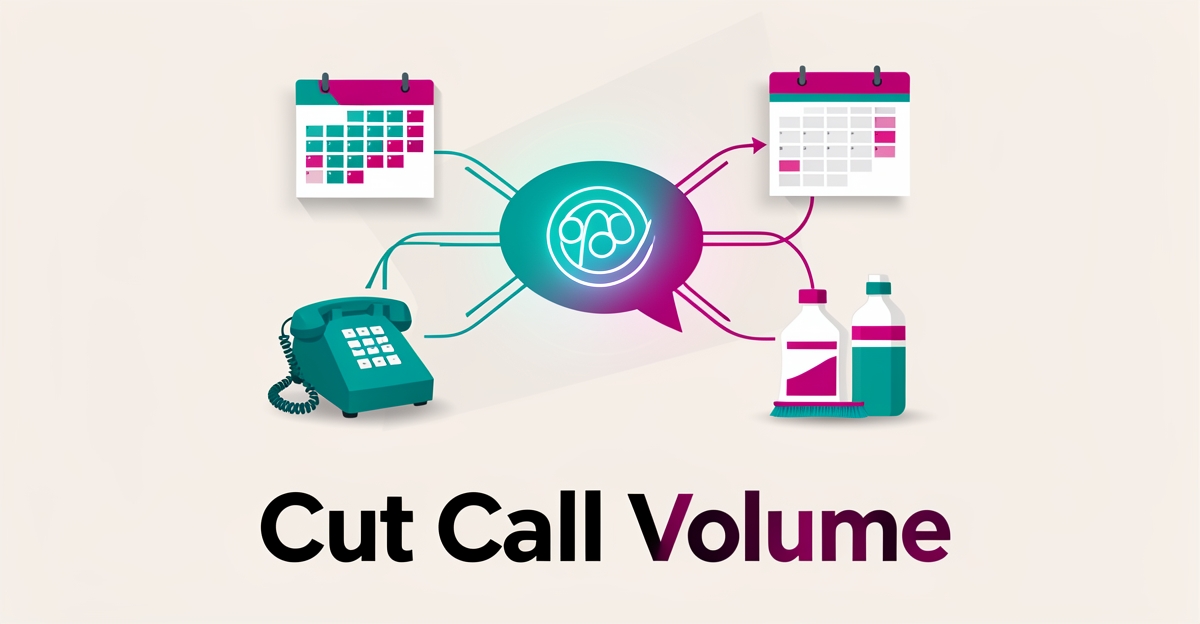
How a Janitorial Service Can Cut Call Volume by 40% with an AI Receptionist
Key Facts
- The U.S. janitorial services market is a large and growing sector, with industry analyses tracking continued expansion through 2026.
- Labor costs in the janitorial sector continue to climb year over year, squeezing margins for small operators.
- Automated customer communication typically shrinks response times from hours to minutes, according to industry adoption research.
- A majority of commercial cleaning operations now use at least one automated workflow system, per recent industry analysis.
- AI adoption in janitorial and facility cleaning has grown sharply since 2022, with small local operations still lagging larger firms.
- Small cleaning businesses typically see ROI within a few months of deploying basic automation.
Hire a team member that works 24/7 — for less than a part-time wage.
AI receptionists, SDRs, dispatchers and 99+ roles. Trained on your business, fully managed.
Not sure where to start? Ask our AI planner
The Phone Problem: Why Janitorial Offices Are Drowning in Calls
The U.S. janitorial services market continues to grow, yet many owners spend their days acting as switchboard operators instead of running cleaning crews. When the phone rings with another quote request or schedule change, someone has to answer it, and that someone is usually the person who should be managing operations.
The math behind this daily grind is getting harder to ignore. Labor costs in the sector keep climbing, and paying skilled staff to answer repetitive questions about pricing or availability is an expensive use of payroll. Every hour your office manager spends on routine calls is an hour not spent on quality control or business development.
Here is where the bottleneck really hurts. Industry adoption research suggests automated customer communication can shrink response times from hours down to minutes. That gap often represents the difference between winning a contract and losing it to a competitor who answered first.
The calls flooding a typical janitorial office follow predictable patterns:
- Requests for quotes and service pricing
- Scheduling or rescheduling cleaning appointments
- Questions about service areas and availability
- Status updates on existing work orders
- After-hours inquiries that go to voicemail
Each of these interruptions pulls focus from quality control, staff management, and business development. For small operators, the problem is especially acute: large facility management companies have adopted AI tools at much higher rates than small local operations, leaving smaller businesses competing with one hand tied behind their backs.
The industry is waking up to this reality. Recent industry analysis suggests a majority of commercial cleaning operations now use at least one automated workflow system, with adoption growing sharply since 2022. Early adopters commonly report meaningful reductions in operational costs by letting technology handle routine communications.
This is where an AI receptionist changes the equation. AIQ Labs builds AI employees that answer calls around the clock, schedule service appointments, and route urgent requests without human intervention. Instead of interrupting a site supervisor to confirm Tuesday's cleaning time, the system handles it instantly while your team stays focused on delivering the service that keeps clients renewing.
What an AI Receptionist Actually Does for a Cleaning Business
An AI receptionist for a janitorial service isn't just a chatbot on a website, it's a full-function team member that handles real workflows end-to-end. It answers calls 24/7, books service appointments directly into scheduling tools, routes dispatch requests to the right technician, and integrates with platforms like Google Calendar or Jobber. Unlike basic automation, this AI employee learns your processes, communicates naturally over phone or chat, and never misses a call due to lunch breaks or shift changes.
For cleaning businesses overwhelmed by administrative noise, this shift delivers measurable relief. Automated customer communication typically cuts response times from hours to minutes, ensuring inquiries are addressed before they escalate or require follow-up calls. This speed alone reduces unnecessary back-and-forth, freeing staff from constant phone monitoring and letting them focus on cleaning operations instead of administrative triage.
The impact on call volume is significant. Industry analyses of AI-adopting cleaning companies show automated scheduling is among the most commonly implemented tools, and adopters commonly report fewer scheduling conflicts and better staff utilization, meaning fewer missed appointments, less double-booking, and more efficient deployment of teams across client sites. When scheduling runs smoothly, inbound calls about rescheduling, delays, or confusion drop dramatically.
By embedding the AI receptionist into core workflows, not bolting it onto broken processes, janitorial services turn routine inquiries into automated actions. The result isn't just fewer calls; it's a cleaner, more responsive operation where human staff spend less time on hold and more time delivering quality service. AIQ Labs helps businesses deploy these AI employees with full integration and ongoing management, so the technology works for you, not the other way around.
The Payoff: Where the 40% Call Reduction Shows Up in Your Numbers
Reducing call volume by 40% isn't just an operational convenience, it translates directly into measurable financial gains that reshape your bottom line. When administrative staff stop fielding routine inquiries and scheduling calls, the savings compound across multiple areas of your business.
The most immediate impact appears in administrative overhead. Industry research on cleaning operations suggests companies implementing automation commonly report meaningful reductions in administrative costs. For a mid-sized janitorial operation, automating client scheduling, staff coordination, and communication workflows can translate to tens of thousands of dollars in annual savings versus maintaining dedicated administrative personnel for those tasks.
The return on investment tends to arrive faster than most business technology deployments. Small cleaning businesses implementing basic automated scheduling and customer communication systems typically see positive ROI within a few months, according to data on AI adoption in janitorial services. This rapid payback period makes AI receptionists one of the most accessible entry points for cleaning businesses exploring automation.
Beyond direct cost savings, the financial impact extends to revenue protection and growth:
- Improved client retention through automated feedback collection and faster response systems
- Each retained commercial client represents significant annual recurring revenue, often the difference between a flat and a growing year
- Response times drop from hours to minutes, preventing prospect loss to competitors who answer first
- Consistent follow-up and communication reduce contract cancellations and improve renewal negotiations
The retention economics deserve particular attention. When a single commercial client generates tens of thousands of dollars annually, even retaining a couple of additional clients per year through improved communication can cover the cost of an AI receptionist several times over. This is where the long-term value shows up, not just in cost reduction, but in revenue preservation.
Perhaps the most undervalued benefit comes from redirected staff capacity. When your office manager or operations coordinator stops spending 15-20 hours weekly on routine phone tasks, that time shifts to quality control, client relationship building, and proactive service improvements. Facility services teams using freed-up time for structured quality control commonly report fewer client complaints and stronger contract renewal outcomes compared to manual inspection processes.
This creates a compounding effect: better service quality drives retention, retention stabilizes revenue, and stable revenue funds growth. The 40% call reduction isn't the end goal, it's the mechanism that unlocks these downstream financial benefits. Your team stops reacting to phone interruptions and starts proactively managing the client experience, which is where janitorial businesses differentiate themselves in a competitive market.
How to Implement an AI Receptionist Without the Usual Headaches
The difference between a janitorial business that transforms its phone line and one that wastes money on AI comes down to implementation discipline. The technology works, the rollout is where most owners stumble.
The fastest path to ROI starts with scheduling and customer communication automation. Small cleaning businesses implementing these basics typically see returns within a few months, making them the ideal entry point before expanding into broader operational AI.
But there's a critical prerequisite most vendors skip: AI only creates value when it fixes broken workflows, not when it's layered on top of them. As workflow experts note, businesses don't lose time because they lack AI tools, they lose it because processes still move through disconnected systems and inboxes. Before deploying an AI receptionist, map exactly how a call becomes a scheduled job in your operation today. Fix the gaps first, then automate.
Once live, plan for the human side of the transition. Adoption research in the cleaning sector suggests technician rollout typically requires several weeks of consistent reinforcement, and many cleaning companies face some staff resistance during rollout. Budget for that adjustment period rather than expecting instant adoption.
Data preparation runs on a similar clock. Companies transitioning from paper or basic digital systems typically need one to three months to clean and standardize historical data, client preferences, service specs, location details, before AI can use it effectively.
A realistic rollout sequence looks like this:
- Document your current call-to-booking workflow and eliminate redundancies
- Choose a single-provider solution, single-platform setups typically implement faster than multi-vendor stacks
- Run data cleanup in parallel with configuration, not after
- Reinforce new processes with staff for several weeks
- Track response times and booking accuracy before expanding scope
The final hurdle is the one most janitorial owners can't solve alone: many small cleaning businesses cite lack of dedicated IT support as their primary implementation barrier. This is precisely where managed AI employees change the equation. Rather than hiring technical staff or wrestling with configuration yourself, a managed approach means the AI receptionist is built, trained on your specific services, integrated with your scheduling tools, and continuously optimized, the same way you'd hire a human receptionist, minus the management overhead. AIQ Labs structures these deployments so the technical burden stays with the provider, not the business owner.
Done right, implementation isn't a months-long IT project. It's a structured handoff that starts paying for itself within a single quarter.
Your Next Step: Map the Bottleneck Before You Buy Anything
Before investing in any solution, take a hard look at where your team's time is actually going. For janitorial services, the front desk often becomes a bottleneck handling repetitive inquiries about quotes, scheduling, and dispatch, tasks that pull staff away from cleaning operations and drive up administrative costs. Industry research shows cleaning companies commonly report meaningful reductions in administrative overhead through automation, proving that targeting these repeatable interactions delivers measurable relief. Start by auditing your call types and volumes over a two-week period to see exactly which requests are eating up hours each day.
Identify which inquiries follow predictable patterns: Are customers asking the same pricing questions? Do scheduling calls eat up morning hours? Is dispatch coordination creating delays? Once you've mapped these repeatable tasks, you'll know exactly where an AI receptionist can step in to handle quotes, booking, and routing without human intervention. This approach ensures you're fixing the workflow, not just adding technology to a broken process, a critical distinction highlighted by industry experts who note AI creates the most value when it fixes existing workflows rather than being bolted onto broken processes.
Pilot one AI receptionist role focused on your highest-volume, repeatable inquiry type before scaling. AIQ Labs' AI Employees run on the Start Monthly model, build, training on your business, tool integrations, monitoring, and improvements for a flat monthly cost that typically runs around 80% less than a human hire, with no surprise fees or complex contracts. Take the first step with the two-minute Fit Check, then book a free 30-minute strategy call to map your bottleneck and see if an AI receptionist is the right fit for your operation. There's no obligation, just clarity on where AI can actually reduce your call volume by 40% or more.
Still paying for 10+ subscriptions that don’t talk to each other?
We build custom AI systems you own outright. No vendor lock-in. Full control.
Not sure where to start? Ask our AI planner
Frequently Asked Questions
Will an AI receptionist actually cut my call volume for a janitorial business?
How much can an AI receptionist save on admin costs?
Is AI realistic for small local cleaning companies or just big firms?
What types of calls does an AI receptionist handle best?
Will my technicians resist using an AI receptionist?
How quickly do janitorial businesses see ROI from AI call automation?
Stop Answering Phones, Start Growing Contracts
The 40% call reduction isn't a tech metric, it's reclaimed time for operations, quality control, and client retention. Janitorial businesses are already seeing the shift: automated customer communication shrinks response times from hours to minutes, while automated scheduling cuts conflicts and lifts staff utilization. That speed protects revenue, every retained commercial client matters, and frees your team from repetitive quote, rescheduling, and dispatch inquiries. The payoff compounds when AI is embedded into the workflows it's meant to fix, not layered on top of broken processes. Map your highest-volume repeatable calls first, clean up the call-to-booking flow, then pilot an AI receptionist for scheduling and routing before scaling. If you want clarity on where the bottleneck is and whether an AI employee fits your operation, start the two-minute Fit Check at aiqlabs.ai/apply, then book a free 30-minute strategy call to map it together. You can also reach the team at [email protected] with any questions.
Make AI your competitive advantage — not just another tool.
Strategy, implementation and ongoing optimization. One partner, end to end.
Not sure where to start? Ask our AI planner