How a Residential Remodeling Business Can Use AI to Reduce Project Overruns
Key Facts
- Construction needed 540,000 extra workers in 2023 to meet basic demand.
- AI researchers identified 354 potential use-cases for construction efficiency.
- Literature reviews found 173 specific barriers to AI adoption in construction.
- Robotics software can cost millions, pricing out many smaller companies.
- AI employees cost $599-$1,500 monthly versus $4,000-$7,000 for humans.
- AIQ Labs runs 70+ production agents daily across its own SaaS products.
- AI Workflow Fix services start at $2,000 to target single broken processes.
What if you could hire a team member that works 24/7 for $599/month?
AI Receptionists, SDRs, Dispatchers, and 99+ roles. Fully trained. Fully managed. Zero sick days.
The Digitization Paradox: Why Remodelers Struggle
Residential remodelers face a cruel irony: the technology that could save their margins is the very thing keeping them awake at night. While AI possesses the proven potential to forecast resource constraints and eliminate cost overruns before they happen, the construction industry remains stubbornly analog.
This resistance isn’t just stubbornness; it’s a rational response to high stakes and thin margins. Remodelers are currently drowning in a crisis that makes digital transformation feel like a luxury they can’t afford. The core of this paradox lies in three compounding factors: deep-seated skepticism of "black box" algorithms, severe data scarcity, and prohibitive implementation costs.
The primary barrier to AI adoption in remodeling is not a lack of interest, but a critical lack of trust in opaque predictions. Unlike manufacturing, where every widget is identical, every residential remodel is unique. This variability makes historical data less reliable, leading many operators to reject AI recommendations that lack clear, explainable logic.
When an algorithm predicts a delay, a remodeler needs to know why. Without transparent reasoning, these tools are dismissed as "black boxes" that add complexity without delivering clarity. This skepticism is compounded by the fact that most remodeling firms lack the structured data infrastructure required to train accurate predictive models.
- The Transparency Problem: Operators reject tools that don’t explain the "why" behind a prediction.
- The Data Gap: Unique project sites make historical data less transferable than in manufacturing.
- The Cost Barrier: High-end robotics and software are often priced out of reach for SMBs.
The struggle to digitize is exacerbated by a severe workforce shortage that leaves no bandwidth for innovation. The industry was forced to recruit an additional 540,000 workers on top of normal hiring needs in 2023 to meet basic demand according to PlanHub.
This shortage creates a vicious cycle. When crews are stretched thin, the priority shifts exclusively to immediate physical completion. Administrative tasks and long-term strategic planning are deprioritized, leading to the very inefficiencies and overruns that AI could prevent. Remodelers are too busy fighting fires to build the fire extinguisher.
- 540,000 Worker Gap: The industry needed this many additional recruits in 2023 alone according to PlanHub.
- Focus on Immediate Work: Labor shortages force companies to ignore long-term tech adoption.
- Talent Scarcity: There is a severe lack of AI engineers who also understand construction workflows.
The solution isn’t to force remodelers into expensive, complex enterprise systems. It requires accessible, transparent AI solutions that fit within the reality of an SMB’s budget and workforce. The goal is to move beyond theoretical "black box" predictions and toward actionable, explainable insights that integrate seamlessly into existing workflows.
By leveraging custom-built systems rather than generic software, remodelers can gain true ownership of their data and insights. This approach addresses the trust deficit by providing clear visibility into project health, while managed AI employees handle the administrative burden that current labor shortages exacerbate.
The path forward requires a shift from viewing AI as a replacement to viewing it as a force multiplier. By starting with small, high-ROI workflows, remodelers can build trust in the technology while simultaneously addressing the labor gap that threatens their operational stability.
This strategic pivot sets the stage for understanding exactly how real-time analytics can transform project control, moving from reactive firefighting to proactive precision.
The Predictive Solution: Beyond the 'Black Box'
Project overruns are rarely caused by a single catastrophic event. Instead, they accumulate through small, invisible inefficiencies in timeline monitoring, material tracking, and labor allocation. Most traditional project management tools fail to catch these drifts until it is too late to correct them profitably.
AI transforms this reactive model into a proactive shield against budget erosion. By analyzing historical data and real-time variables, AI predicts potential delays before they impact the bottom line. This shift from hindsight to foresight is the key to consistent profitability in residential remodeling.
The biggest barrier to AI adoption in construction is the "black box" fear. Project managers hesitate to trust algorithms that deliver predictions without explaining the "why" behind them. This lack of transparency creates resistance, even when the technology could prevent costly errors.
You need explainable AI insights that provide clear, actionable context. Instead of a generic warning, a transparent system shows exactly which material delay or labor hour deviation is causing the risk. This clarity allows project managers to make informed decisions rather than guessing at solutions.
According to industry research, a major barrier to adoption is a lack of trust in solutions that do not explain why a certain prediction was made according to PlanHub. To overcome this, AI systems must integrate seamlessly with existing data sources to provide contextual visibility into project health.
- Clear Data Sources: Dashboards must show exactly where data originates.
- Actionable Warnings: Alerts should specify the risk factor (e.g., "Lumber delivery delayed 3 days").
- Historical Context: Compare current performance against similar past projects.
- Human-in-the-Loop: AI suggests, but humans decide, maintaining control and trust.
Effective prediction requires monitoring three specific pillars: timelines, materials, and labor. AI excels at analyzing vast datasets to optimize decision-making in these areas, specifically enhancing accuracy in predicting project timelines as reported by PlanHub.
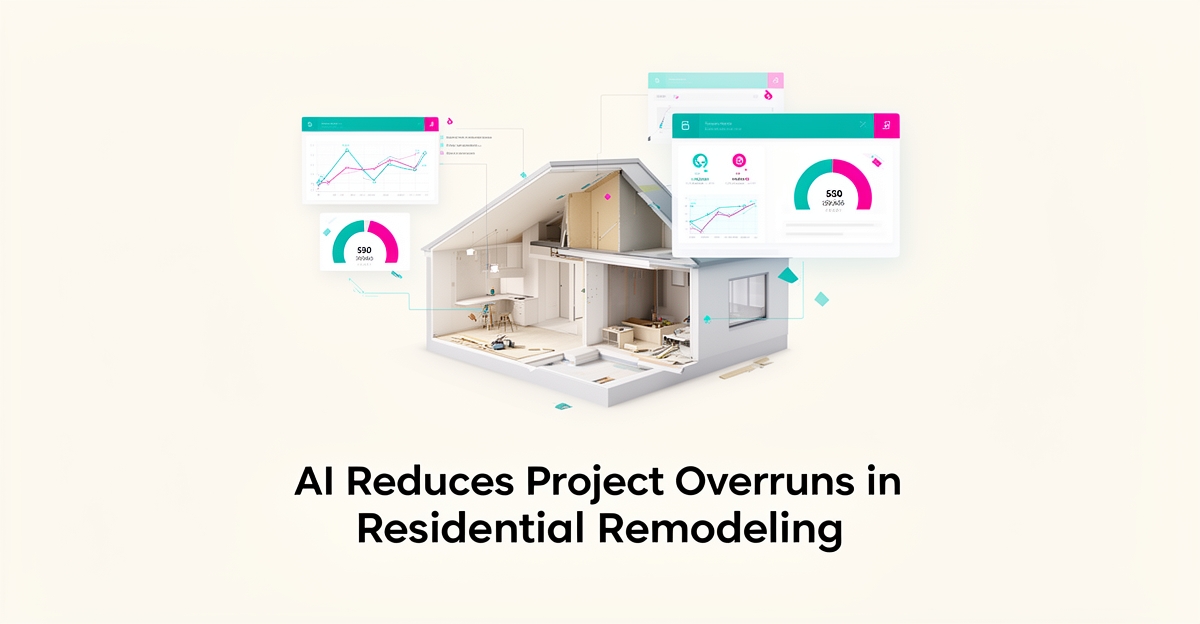
Real-time analytics dashboards provide early warnings that allow for immediate course correction. Rather than waiting for a weekly report to discover a budget bleed, project managers see issues as they emerge. This immediate visibility turns potential crises into manageable adjustments.
A systematic review of 85 research articles identified "operational efficiency" as a key benefit of AI in construction according to IAARC. By focusing on these three areas, remodelers can significantly reduce the operational drag that leads to overruns.
- Timeline Monitoring: AI adjusts schedules dynamically based on weather, supplier delays, and crew availability.
- Material Usage Tracking: Predictive models forecast waste and reorder needs, preventing work stoppages.
- Labor Hour Prediction: AI compares actual hours against estimates, flagging inefficiencies in real-time.
Generic off-the-shelf software often fails to capture the nuances of residential remodeling. Every project is unique, contributing to data scarcity challenges that hinder broad AI adoption research from PlanHub. Custom-built AI systems solve this by adapting to your specific workflows and data structures.
AIQ Labs delivers production-ready custom systems that eliminate vendor lock-in. By building tailored dashboards, you ensure the AI understands your specific business logic. This approach guarantees that the insights provided are not just statistically accurate, but operationally relevant to your daily operations.
Experts note that small mistakes in data can lead to costly or critical errors on a project as reported by PlanHub. Custom development mitigates this risk by ensuring data integrity and alignment with your unique operational standards.
Adopting predictive AI is not about replacing project managers; it is about empowering them with superior information. By moving beyond the black box, you create a culture of transparency and precision. This foundation allows for the next step in optimization: leveraging AI Employees to handle the administrative load.
Implementation Strategy: AI Employees and Custom Dashboards
Residential remodelers often fall victim to the "black box" trust deficit, where opaque algorithms fail to explain why a project is drifting off-track. According to industry analysis, this lack of transparency is a primary barrier preventing construction firms from adopting predictive tools that could save them from costly overruns PlanHub. To overcome this, remodelers must move beyond theoretical AI concepts and deploy visible, actionable systems that provide clear visibility into project health.
AIQ Labs solves this by combining custom-built analytics with managed AI workforce solutions. This dual approach ensures that predictions are not only accurate but also explainable, allowing project managers to trust and act on data rather than guessing. By integrating these tools, remodelers can transform reactive firefighting into proactive control, ensuring every project stays within budget and timeline.
The core of this strategy relies on two specific AIQ Labs offerings designed to address labor shortages and data opacity.
1. Deploy "AI Employees" to Eliminate Administrative Drift
Labor shortages are crippling the construction sector, with the industry needing an additional 540,000 workers in 2023 alone PlanHub. Instead of competing for scarce human talent, remodelers can deploy AI Employees for roles like Dispatchers and Service Coordinators. These agents handle scheduling, material ordering, and client communication 24/7 at a fraction of the cost of human hires.
AI Employees integrate directly with your existing CRM and project management tools, ensuring no detail is missed. This reduces administrative burden on your human staff, allowing them to focus on skilled labor rather than paperwork.
Key benefits of AI Employees include: * 24/7 Availability: Never miss a client call or emergency dispatch request. * Cost Efficiency: Costs range from $599–$1,500/month, significantly lower than human salaries. * Zero Administrative Drift: Automated follow-ups ensure invoices and change orders are processed immediately. * Scalability: Add more "staff" instantly during peak seasons without hiring delays.
2. Build Custom Dashboards for Transparent Predictive Analytics
While AI Employees handle the workflow, custom dashboards provide the intelligence. Research highlights that AI can analyze vast datasets to optimize decision-making and reduce delays, but only if the data is integrated correctly PlanHub. AIQ Labs builds production-ready dashboards that consolidate data from accounting, scheduling, and inventory systems into a single source of truth.
These dashboards do not just report history; they predict the future. By monitoring real-time material usage and labor hours, the system flags potential overruns before they impact the bottom line. This transparency directly addresses the industry’s skepticism of "black box" algorithms by showing the exact data points driving each prediction.
The Combined Impact
When AI Employees execute the tasks and dashboards monitor the progress, remodelers gain complete control. A systematic review of AI in construction identified operational efficiency as the top benefit, with 354 potential use-cases for improving project outcomes IAARC. By implementing these solutions, you shift from guessing project health to knowing it with precision.
This integrated strategy allows you to scale operations without the risk of vendor lock-in, as you own the custom code and systems outright. In the next section, we will explore how to launch this transformation through a low-risk pilot program.
Phased Adoption: From Workflow Fix to Transformation
The construction industry remains one of the least digitized sectors, with organizations frequently stuck in the "pilots" stage of AI maturity. Most businesses struggle to scale past initial experiments due to high implementation costs and a lack of trust in opaque "black box" algorithms. This skepticism creates a significant barrier, preventing remodelers from realizing the full potential of predictive analytics to stop overruns before they happen.
To overcome these hurdles, AIQ Labs recommends a low-risk, high-impact entry point: the AI Transformation Partner model. Instead of attempting a risky, enterprise-wide overhaul, businesses should begin with a Discovery Workshop or AI Workflow Fix. This approach allows you to prove ROI on a single, critical workflow before investing in complex, company-wide systems.
Why Start Small?
- Mitigates Risk: A $2,000+ AI Workflow Fix targets one broken process, limiting financial exposure while delivering immediate value.
- Builds Trust: Transparent, explainable outputs help overcome industry skepticism about AI decision-making.
- Proves ROI: Success on a single workflow (e.g., invoice processing) provides the data needed to justify scaling.
- Lowers Barrier to Entry: Tiered pricing makes enterprise-grade AI accessible to SMBs without massive upfront capital.
The Eight-Step Pragmatic Guideline
Research from the International Association for Automation and Robotics in Construction highlights an eight-step pragmatic guideline for successful AI implementation. This framework emphasizes readiness assessment, use-case identification, and continuous monitoring. By starting with a focused workflow, remodelers can systematically move through these steps without overwhelming their teams or data infrastructure.
For example, a mid-sized architecture firm utilized a phased engagement to automate practice-wide operations. They began by integrating project management and accounting systems to automate scheduling and dispatch. This initial success built internal confidence, paving the way for broader transformation.
Scaling from Fix to Transformation
Once the initial workflow is optimized, the path to transformation becomes clear. AIQ Labs supports this progression through three integrated pillars:
- AI Development Services: Build custom, owned systems like real-time dashboards that track material usage and labor hours.
- AI Employees: Deploy managed AI staff for roles like Dispatchers or Project Manager Assistants to handle 24/7 administrative tasks.
- AI Transformation Consulting: Leverage strategic advisory to scale AI across departments, establishing governance and continuous improvement.
This phased strategy ensures that AI becomes a sustainable competitive advantage rather than a fleeting experiment. By addressing immediate pain points first, you create a foundation for long-term operational excellence.
Ready to stop overruns before they start? Contact AIQ Labs today to schedule your free AI Audit & Strategy Session and discover how a single workflow fix can transform your remodeling business.
Conclusion: Building a Sustainable Competitive Advantage
AI has evolved from a futuristic concept into a critical survival mechanism for residential remodelers facing project overruns. It is no longer just a tool for efficiency but a strategic advantage that transforms how businesses predict and prevent budget leaks. By moving beyond simple "exploration" phases, remodelers can secure true ownership of their operational data.
The construction industry remains one of the least digitized sectors, with 173 specific challenges to AI adoption identified in recent academic reviews according to IAARC research. However, the cost of inaction is far higher. With a 540,000 worker shortage impacting the industry as reported by PlanHub, relying solely on human labor to catch errors is unsustainable.
To thrive, remodelers must shift from pilots to transformation using a partner that delivers production-tested expertise. This approach eliminates the "black box" skepticism that hinders adoption by providing explainable, transparent insights.
Key Strategies for Transformation
- Deploy Custom Dashboards: Move beyond generic software to build true ownership systems that integrate seamlessly with existing project management tools.
- Hire AI Employees: Replace administrative bottlenecks with managed AI workforce solutions that handle scheduling and coordination 24/7.
- Adopt Phased Consulting: Start with a Discovery Workshop to identify high-ROI workflows before scaling to complex systems.
The barrier to entry is often perceived as high, with robotics costing millions according to industry analysis from PlanHub. However, AIQ Labs democratizes this power through tiered services. For instance, a Department Automation package ranges from $5,000–$15,000, offering a manageable entry point for SMBs. Meanwhile, AI Employees start at just $599/month, providing a cost-effective alternative to human hires who cost $4,000–$7,000 monthly.
Consider an electrical services client who utilized AIQ Labs to rebuild their dispatch automation. By automating scheduling and lead capture, they eliminated the manual data entry that typically leads to project overruns. This wasn’t a theoretical prototype; it was a live, revenue-generating system built on the same infrastructure AIQ Labs uses for its own SaaS products.
Why Partnership Matters
Most businesses get stuck at the "Pilots" stage of the AI maturity curve. They experiment with tools but fail to integrate them into their core operating model. AIQ Labs serves as an AI Transformation Partner to help you move to the "Transformation" stage, where AI becomes embedded in your daily operations.
Unlike vendors who deliver point solutions, we commit to end-to-end partnership. This includes:
- Custom Development: Building systems you own, with no vendor lock-in.
- Strategic Consulting: Providing roadmap design and ROI modeling.
- Ongoing Optimization: Ensuring your AI evolves with your business.
By choosing a partner that builds, trains, and manages your AI, you gain sustainable competitive advantages. You are not just buying software; you are acquiring a capability that scales with you.
The choice is clear: remain reactive to unexpected costs or become proactive with predictive intelligence. AIQ Labs provides the architecture, engineering, and strategic guidance to make that shift seamless.
Ready to transform your business? Contact AIQ Labs today to discover how we can architect your competitive advantage and eliminate project overruns for good.
Still paying for 10+ software subscriptions that don't talk to each other?
We build custom AI systems you own. No vendor lock-in. Full control. Starting at $2,000.
Frequently Asked Questions
Is AI actually worth it for small residential remodeling businesses, or is it just for big contractors?
I don't trust 'black box' AI predictions. How do I know if the data is accurate?
Can I start with just one small task instead of rebuilding my whole business?
How does AI help when we are so short-staffed right now?
Won't custom AI be too expensive compared to off-the-shelf software?
What if I don't have a lot of historical data to train the AI?
From Black Box to Building Block: Owning Your Project Intelligence
The digitization paradox in residential remodeling stems from a critical lack of trust in opaque predictions, severe data scarcity, and prohibitive costs. However, the solution isn't more generic software—it is transparent, explainable intelligence. AIQ Labs addresses these barriers by deploying custom-built, real-time analytics dashboards that monitor project timelines, material usage, and labor hours to predict overruns before they impact the bottom line. Unlike 'black box' tools, our systems provide the clear reasoning remodelers need to trust automated insights. By moving beyond the pilot stage with our AI Transformation Consulting, you can replace disconnected tools with a unified, owned digital asset. Whether through targeted workflow fixes or comprehensive business AI systems, we help you eliminate the guesswork from unique project sites. Stop letting thin margins and workforce shortages dictate your profitability. Schedule a Free AI Audit & Strategy Session today to discover how AIQ Labs can architect your competitive advantage.
Ready to make AI your competitive advantage—not just another tool?
Strategic consulting + implementation + ongoing optimization. One partner. Complete AI transformation.