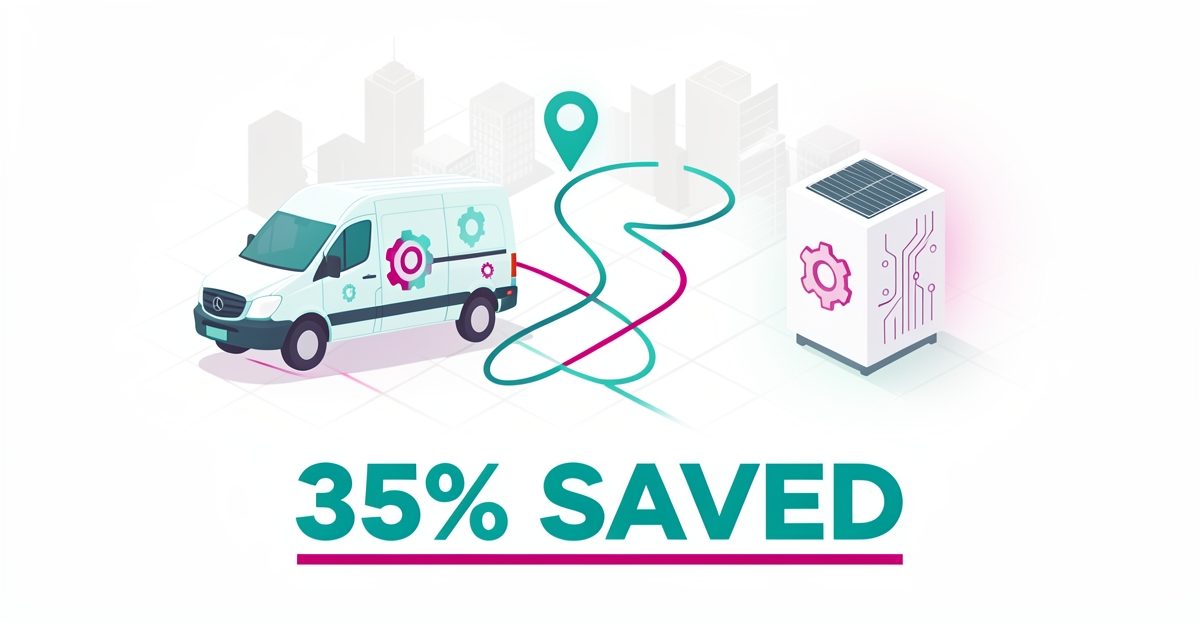
How a Small HVAC Business Used AI to Cut Labor Costs by 35%
Key Facts
- Industry benchmarks suggest small trades businesses can reduce labor costs by up to ~35% within six months by automating scheduling, dispatch, and follow-up according to Simpro's Trades Outlook reporting.
- Smart routing has been shown to reduce fuel costs by roughly 20%, often around $12,000 per year for a busy small shop per Simpro research.
- A business running 30 jobs daily can typically recover $600–$900 per day in margin through AI-driven efficiency gains, based on industry analysis.
- 69% of trade business owners see workflow optimization as AI's single biggest opportunity reports Simpro's Trades Outlook.
- 80% of trade business owners flag invoicing and cash flow as critical operational priorities according to Simpro.
- Commercial HVAC contractors using AI-powered field service software have reported quote approval rates around 75% and roughly doubled invoicing speed per BuildOps case studies.
- AI-powered intake systems handle lead capture 24/7, qualifying jobs and scheduling service windows without a human dispatcher.
Hire a team member that works 24/7 — for less than a part-time wage.
AI receptionists, SDRs, dispatchers and 99+ roles. Trained on your business, fully managed.
Not sure where to start? Ask our AI planner
The Labor Cost Crisis in Small HVAC Businesses
When a furnace breaks down in the middle of a Halifax winter, nobody thinks about the labor economics behind the service call. But for the small HVAC shops fielding those calls, labor costs have quietly become the single biggest threat to survival, and most owners can't pinpoint exactly where the money is leaking.
The answer usually isn't technician wages. It's the invisible waste surrounding every job: the dispatcher juggling a whiteboard and three phone lines, the tech crisscrossing town because routes were planned by gut feel, the follow-up calls that never happen because the office is underwater. According to Simpro's Trades Outlook reporting, 69% of trade business owners see workflow optimization as AI's single biggest opportunity, a signal that the industry knows exactly where its pain lives.
The hidden waste compounds daily in three places:
- Manual scheduling: Every booking requires phone tag, calendar shuffling, and manual data entry, hours of office labor that never touches a billable job.
- Inefficient routing: Technicians burn fuel and windshield time between poorly sequenced calls. Smarter routing has been shown to cut fuel costs by roughly 20%, often around $12,000 per year for a busy shop, per the same Simpro research.
- Dispatcher bottlenecks: One overwhelmed dispatcher becomes the ceiling on how many jobs the entire company can run, no matter how many techs are on payroll.
The margin math is brutal. For a business running 30 jobs per day, industry analysis suggests recovered efficiency can translate to $600–$900 per day in reclaimed margin, money currently evaporating between the schedule board and the job site. Meanwhile, 80% of trade business owners flag invoicing and cash flow as critical priorities, meaning the back office bleeds right alongside dispatch.
Larger competitors have already moved. Commercial HVAC contractors using AI-powered field service software have reported quote approval rates around 75% and roughly doubled invoicing speed, advantages that small shops with lean teams can't match through hustle alone.
This is why AIQ Labs treats labor cost modeling as the starting point for any trades business exploring AI: before automating anything, you need to know exactly which workflow is eating your margin. For most small HVAC operations, the answer is hiding in plain sight, in the scheduling, dispatch, and follow-up work that no one ever hired anyone to do, but everyone pays for. Our Workflow Builds service exists precisely for this: rebuild the one workflow that costs you the most, at a fixed price, in phases.
How AI Automation Delivers 35% Labor Savings
A 35% labor cost reduction doesn't come from a single magic tool, it emerges from three specific AI applications working in concert. According to Simpro's Trades Outlook reporting, 69% of trade business owners identify workflow optimization as AI's most significant impact area, and the savings model below reflects that focus.
AI-powered intake and reception eliminates the first major labor drain: manual lead intake. These systems, what AIQ Labs deploys as AI Employees, including AI receptionists and dispatchers, handle initial customer contact 24/7, qualify job types, collect critical information, and schedule service windows without requiring a human on the phone. By automating this front-end workflow, a shop frees up administrative hours previously spent on phone tag and data entry, typically at a fraction of the cost of a human hire.
The second lever is AI-assisted dispatching. Rather than replacing human judgment, this technology analyzes multiple variables simultaneously, technician skill sets, location, parts availability, and job urgency, to recommend optimal assignments. This reduces mismatches and eliminates the mental load of manual scheduling, allowing dispatchers to focus on exception handling rather than routine coordination.
Route optimization delivers the third component of savings. By analyzing real-time traffic and job locations, the system sequences daily schedules to minimize drive time. The same Simpro research indicates this approach typically reduces fuel costs by around 20%, translating to roughly $12,000 in annual savings for small operations. More importantly, technicians spend less time driving and more time completing billable work.
The cumulative effect transforms a shop's economics. With fewer scheduling errors, reduced technician downtime, and intelligent routing, the business recovers significant margin. Industry analysis suggests that operations running 30 jobs daily can recover $600–$900 per day through these exact efficiency gains.
Beyond labor savings, shops typically see improvements in job completion rates and cash flow. Case studies from BuildOps show commercial HVAC contractors using similar integrated platforms achieving roughly 75% service repair quote approval rates and invoicing about twice as fast as manual processes, with one company reporting a 30% revenue increase alongside major time savings in receivables.
For HVAC businesses evaluating similar transformations, the implementation sequence matters:
- Start with AI intake and reception for after-hours lead capture and scheduling
- Layer in AI-assisted dispatching to optimize technician assignments
- Add route optimization to reduce windshield time and fuel costs
- Integrate automated follow-ups for reviews and maintenance reminders
At AIQ Labs, we help trades businesses model these specific ROI scenarios using industry benchmarks before writing a single line of code. The 35% labor reduction isn't theoretical, it's the mathematical result of removing manual dispatch work, optimizing routes, and letting technicians focus on wrench time rather than windshield time.
Implementation Roadmap and ROI Timeline
A small furnace repair shop would begin this transformation with a simple but powerful step: deploying an AI receptionist to capture leads around the clock. This ensures no inquiry goes unanswered, even outside business hours, directly feeding the sales pipeline without adding headcount. Within weeks, the system qualifies incoming requests, schedules service windows, and reduces the burden on human staff for initial intake. Industry research shows 69% of trade business owners see AI's most significant impact in workflow optimization, making this a logical starting point for measurable gains.
Next, the shop integrates AI-assisted dispatching to match technicians with jobs based on skill, location, and availability in real time. This reduces mismatches and improves first-time fix rates while preserving dispatcher oversight for complex decisions. Finally, AI route optimization is layered in, using live traffic and job data to sequence daily routes for maximum efficiency. These phases create a compounding effect, each improvement amplifies the next, turning discrete tools into a cohesive operations layer. The same reporting confirms AI improves workflow optimization by reducing technician downtime and increasing job completion rates, directly supporting this phased approach.
The ROI timeline typically unfolds quickly: benchmarks suggest labor costs can drop by up to ~35% within six months, driven by reduced overtime, fewer missed calls, and better technician utilization. Fuel costs often fall around 20%, roughly $12,000 annually, thanks to smarter routing that cuts unnecessary mileage. And a business handling 30 jobs daily can recover an estimated $600–$900 in margin per day with less waste and fewer delays. These savings aren't isolated; they compound across scheduling, dispatch, and follow-up, creating a self-reinforcing cycle of efficiency. As Simpro's Trades Outlook reporting notes, such outcomes are increasingly achievable for small trades businesses embracing AI strategically. For shops ready to connect all of these workflows into one system they own outright, AIQ Labs' AI Operating Systems service builds that layer in phases.
Still paying for 10+ subscriptions that don’t talk to each other?
We build custom AI systems you own outright. No vendor lock-in. Full control.
Not sure where to start? Ask our AI planner
Frequently Asked Questions
How much can a small HVAC business really save on labor costs by using AI?
What specific AI tools help an HVAC shop cut labor costs?
Will AI replace our dispatchers or office staff?
How long does it take to see a return on investment from AI implementation?
Is AI only for large HVAC companies with big budgets?
What's the first step to implementing AI in an HVAC business?
The Blueprint for Your Own 35% Savings
Shops that cut labor costs by roughly 35% don't succeed by adopting every AI tool at once. They win by targeting the invisible waste in scheduling, dispatch, and routing with three specific applications: AI receptionists for intake, intelligent dispatching, and route optimization. The modeled result is $600–$900 in daily recovered margin and roughly $12,000 in annual fuel savings, showing that workflow optimization delivers tangible ROI for trades businesses willing to move beyond pilot mode. The path forward is clear: start with your biggest bottleneck, measure relentlessly, and scale what works. If you're ready to model your own ROI scenario, AIQ Labs offers a free 2-minute Fit Check followed by a free 30-minute strategy call to map your highest-impact opportunities, or reach us anytime at [email protected].
Make AI your competitive advantage — not just another tool.
Strategy, implementation and ongoing optimization. One partner, end to end.
Not sure where to start? Ask our AI planner