How AI Can Automate Client Onboarding for Cleaning Services
Key Facts
- Cleaning businesses that redesign their onboarding workflow typically reclaim 30+ hours per month of administrative time
- Slow, disjointed onboarding directly affects retention, clients who get a confusing first impression often show churn signals within weeks
- Poor agreement management is widely estimated to cost the global economy trillions in lost value, and shows up locally as missed details and delayed starts
- AI only creates value when it fixes the workflow, not just automates broken steps, a principle echoed across the agreement-management industry
Hire a team member that works 24/7 — for less than a part-time wage.
AI receptionists, SDRs, dispatchers and 99+ roles. Trained on your business, fully managed.
Not sure where to start? Ask our AI planner
The Hidden Cost of Manual Client Onboarding in Cleaning Services
Every new cleaning client triggers a familiar scramble: phone calls to collect property details, email chains to confirm scope, hours spent drafting service agreements from scratch. Each step seems small, but together they consume entire afternoons that could be spent growing the business.
The administrative burden adds up faster than most owners realize. Cleaning businesses that redesign their onboarding workflow typically reclaim 30+ hours per month, time previously lost to paperwork, follow-ups, and manual data entry. That is nearly a full working week spent every month on tasks that generate no revenue.
The costs extend beyond lost hours. Manual processes create inconsistent experiences: one client receives a detailed walkthrough of what to expect, another gets a rushed summary. Service agreements drafted by hand vary in terms, scope, and clarity. This inconsistency creates friction that quietly erodes client trust before the first cleaning even happens.
The stakes are higher than they appear. Onboarding research has long shown that a confusing or rushed first experience is a reliable early churn signal, clients who feel lost in the first days of a relationship are far more likely to walk away. When your onboarding takes days of back-and-forth instead of minutes, you are starting every client relationship at a disadvantage.
The problem is not unique to cleaning services. Poor agreement management is widely estimated to cost the global economy trillions in lost value, and it shows up locally as missed details, delayed starts, and clients who churn because expectations were never properly set.
Here is the trap many owners fall into: buying software to patch a broken process. As agreement-industry leaders have put it, AI only creates value when it fixes the workflow. Layering technology on top of a flawed process simply automates the flaws. The right sequence is to redesign the process first, then build the right mix of integrations, rules, and AI around that design.
The hidden cost of manual onboarding, then, is threefold:
- Lost time: 30+ hours monthly consumed by paperwork and follow-up
- Lost consistency: agreements and expectation-setting that vary client to client
- Lost clients: churn driven by slow, confusing first impressions
The workflow that deserves attention first is rarely the flashiest, it is the one with the highest combination of frequency, friction, failure cost, and cross-system dependency. For most cleaning businesses, client onboarding checks every box. AIQ Labs approaches this through AI Workflow Builds: rebuild the entire onboarding journey end-to-end, client detail collection, agreement delivery, and expectation-setting, as a single automated system, rather than bolting tools onto a process that was broken to begin with.
Why Workflow Redesign Must Come Before AI Automation
Many cleaning services rush to automate client onboarding with AI, only to find they've digitized broken steps rather than fixed them. True value comes not from adding AI to existing chaos, but from redesigning the workflow first so AI can solve real problems.
The principle is simple: AI only creates value when it fixes the workflow. Businesses with fragmented onboarding, where client details get lost between emails, agreements sit unsigned, and expectations aren't clarified, waste time even with AI tools. Automation amplifies inefficiency when the underlying process lacks structure.
The priority isn't automating the flashiest task, but targeting where effort hurts most. A practical prioritization model combines four factors: how often a task happens (frequency), how frustrating it is (friction), what errors cost (failure cost), and how many handoffs occur. Multiplying those together identifies the workflows where redesign yields the highest return before AI touches them.
For example, a cleaning business that redesigns its client intake process can typically reclaim 30+ hours monthly by eliminating redundant data entry and clarifying service scope upfront. Only after establishing this structured flow, collecting details once, triggering agreements automatically, and setting clear expectations, can AI consistently apply policy checks, personalize welcome messages, and ensure nothing falls through the cracks.
AI works best when humans own judgment and machines handle repetition. In onboarding, that means AI sends agreements, tracks signatures, and flags missing info, but only after the workflow defines exactly what details matter, when agreements go out, and who approves exceptions. Without this foundation, AI becomes another layer of confusion rather than a solution.
Start by mapping your current onboarding steps: Where do clients repeat information? Where do delays happen? Which steps cause the most errors or handoffs? Redesign those points first, simplify forms, clarify ownership, and set clear triggers. Only then layer in AI to automate the repeatable, enforce consistency, and free your team for higher-value client conversations. This sequence, redesign before automation, is what transforms AI from a costly experiment into a reliable engine for scaling client relationships.
How AI Transforms Each Stage of Cleaning Client Onboarding
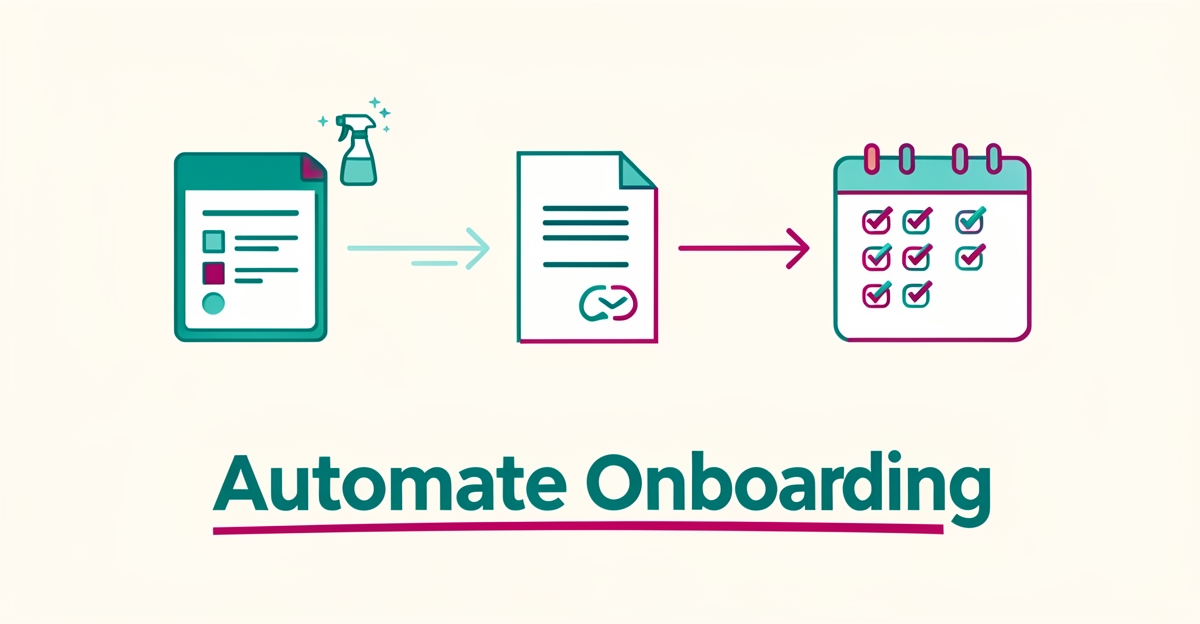
AI is reshaping how cleaning services welcome new clients, turning a traditionally manual process into a personalized, efficient experience. By automating client onboarding, businesses can streamline the collection of client details, generate service agreements, and set clear expectations, cutting down paperwork and ensuring consistency. And because AI only creates value when it fixes the workflow, its real power emerges when applied to well-structured processes like onboarding.
Intelligent intake forms adapt in real time based on the service type selected, whether residential, commercial, or move-in/move-out cleaning, asking only relevant questions and meaningfully reducing completion time. These dynamic forms eliminate redundant fields and guide clients through a seamless entry point, minimizing friction from the first interaction. Automated service agreement generation then pulls client-specific data to produce customized contracts while applying consistent policy checks, ensuring every agreement meets company standards without manual review. AI also acts as a stress tester for the process itself: a well-built onboarding system scales reliably under varying client needs, and the automation surfaces weak points quickly.
Personalized welcome sequences follow, delivering tailored messages that outline service scope, scheduling preferences, and preparation tips, helping clients feel informed and confident from day one. Smart scheduling systems learn from past behavior, such as preferred times or frequency of service, to propose optimal slots and reduce back-and-forth communication. Together, these AI-driven stages reclaim significant operational time; businesses that redesign onboarding workflows typically report recovering 30+ hours per month, with similar client-facing automations in other service industries saving 40+ hours monthly.
- Intake forms that adapt to service type and client needs
- Automated agreements with embedded policy validation
- Welcome sequences that set clear, personalized expectations
- Scheduling that learns and optimizes based on client behavior
This end-to-end intelligence doesn't just save time, it builds trust, reduces errors, and creates a foundation for long-term client satisfaction. AIQ Labs designs these systems so the business owns them outright, ensuring full control over customization and future evolution without vendor lock-in.
Building Your AI-Powered Onboarding System: Implementation Roadmap
AI can transform client onboarding for cleaning services by eliminating manual bottlenecks and ensuring consistent, personalized experiences from the first interaction. Many businesses still spend excessive time on repetitive tasks like data entry, agreement distribution, and follow-up scheduling, steps that AI can handle reliably while freeing staff for higher-value work. By focusing on workflow redesign before automation, companies avoid layering technology onto broken processes and instead create systems that deliver measurable efficiency gains.
Start by identifying the onboarding workflow with the highest combination of frequency, friction, failure cost, and cross-system dependency, this prioritization ensures efforts target the most impactful areas first. Redesign the process before automating it; that is what unlocks real value. Once the ideal flow is mapped, build a custom AI system that integrates with existing tools like CRM, scheduling, and payment platforms to automate repeatable tasks such as collecting client details, generating service agreements, and setting expectations.
AI-powered onboarding can reclaim significant time, cleaning businesses typically report recovering 30+ hours per month after workflow redesign, and similar client-facing automations in other service industries have saved 40+ hours monthly. These gains come not just from speed, but from reducing errors in data handling and ensuring every client receives the same compliant, professional experience. AI excels at applying consistent policy checks and helping teams move faster without losing control over critical judgments, especially in agreement management where human oversight remains essential.
To implement, follow a phased approach: first redesign the onboarding process, then layer in AI for automatable steps like document routing, reminder sequencing, and data validation. Maintain human-in-the-loop controls for exceptions or complex decisions, ensuring the system augments rather than replaces staff judgment. Measure ROI through time saved, labor cost recovery, reduced errors, and increased capacity, metrics that directly reflect improved operational health.
How you engage depends on your situation. If onboarding is your single biggest cost, an AI Workflow Build rebuilds it end-to-end at a fixed price, in phases. If admin is bleeding time across the whole business, AI Employees can handle intake, scheduling, and follow-up around the clock at a fraction of the cost of a human hire. And when you want one connected layer across sales, operations, and admin, AI Operating Systems is built in phases and owned outright. Payment models, Start Monthly, Build in Milestones, or Own It Outright, let you scale at your own pace. Real numbers and cost structures are provided in writing after a free strategy call, so you know exactly what you're committing to before anything starts.
Turn Onboarding from a Cost Center into Your Competitive Edge
Cleaning services routinely lose 30+ hours each month to manual client onboarding, time swallowed by repetitive paperwork, inconsistent agreements, and delayed starts that quietly erode trust before the first clean. The real issue isn't a lack of tools, but a workflow built on friction: clients repeating details, agreements varying by hand, and expectations left unclear. AI only creates value when it fixes the workflow, meaning the smartest move isn't bolting on technology, but first redesigning the onboarding journey to eliminate redundancy, standardize expectations, and clarify handoffs. Once that foundation is solid, AI can collect details, generate compliant agreements, personalize welcome messages, and optimize scheduling, freeing your team to focus on service quality and growth. The payoff isn't just time saved; it's consistent, professional experiences that build client confidence from day one and reduce churn rooted in poor first impressions. If you're ready to stop losing hours to admin and start turning onboarding into a streamlined, trust-building process, the next step is simple: take the two-minute Fit Check, then book a free 30-minute strategy call to see where the real opportunity lies.
Make AI your competitive advantage — not just another tool.
Strategy, implementation and ongoing optimization. One partner, end to end.
Not sure where to start? Ask our AI planner