How AI Can Automate Client Quotes for Plaster Repair Work
Key Facts
- Most quoting work, damage classification, material takeoffs, labor math, is repetitive and well suited to automation
- Businesses that automate routine administrative work typically report meaningful reductions in error rates and hours saved per worker
- AI quote generation can produce accurate estimates in minutes instead of hours when connected to live inventory and pricing
- Quote accuracy directly protects margins: underquoted jobs erode profit, overquoted bids lose clients
- Integration with existing CRM, inventory, and scheduling systems is what turns a demo into a daily tool
- Validation in parallel with manual quotes builds estimator trust before full rollout
Hire a team member that works 24/7 — for less than a part-time wage.
AI receptionists, SDRs, dispatchers and 99+ roles. Trained on your business, fully managed.
Not sure where to start? Ask our AI planner
The Hidden Costs of Manual Quoting in Plaster Repair
Many plaster repair businesses still rely on manual quoting methods that consume hours per job and leave room for costly mistakes. This traditional approach requires estimators to manually calculate material quantities, labor hours, and pricing, tasks that are not only time-consuming but also highly susceptible to human error. Most of this work is repetitive and partially or fully automatable, which is exactly why it represents such a significant inefficiency in current quoting practices.
The hidden costs of manual quoting extend beyond just labor time. Each error in material estimation or labor calculation can lead to underquoted jobs that erode profit margins or overquoted bids that lose clients. Studies of workflow automation consistently suggest that automating repetitive administrative work dramatically reduces error rates, a critical improvement for plaster repair businesses where quote accuracy directly impacts project profitability and client trust. Automating routine tasks also frees a substantial share of estimator time, which can be redirected toward client relationships and project execution.
- Manual quoting often takes hours per job, limiting the number of estimates a business can handle daily.
- Inconsistent calculations between estimators create pricing variability that confuses clients and complicates job planning.
- Time spent on manual calculations diverts skilled workers from higher-value activities like site assessments and client consultations.
- Lack of standardized processes makes it difficult to scale operations or train new estimators effectively.
- Delayed quote turnaround times can cause businesses to lose competitive bids to faster-responding competitors.
AIQ Labs addresses these inefficiencies by building custom quote-generation systems that integrate with existing inventory and pricing models, eliminating manual calculations while ensuring accuracy. By automating the repetitive aspects of quoting, plaster repair businesses can turn a bottleneck into a streamlined, reliable process, and typically see meaningful operational cost savings as a result. For a broader view of how we approach builds like this, see our workflow build process.
How AI Quote Generation Works for Plaster Repair
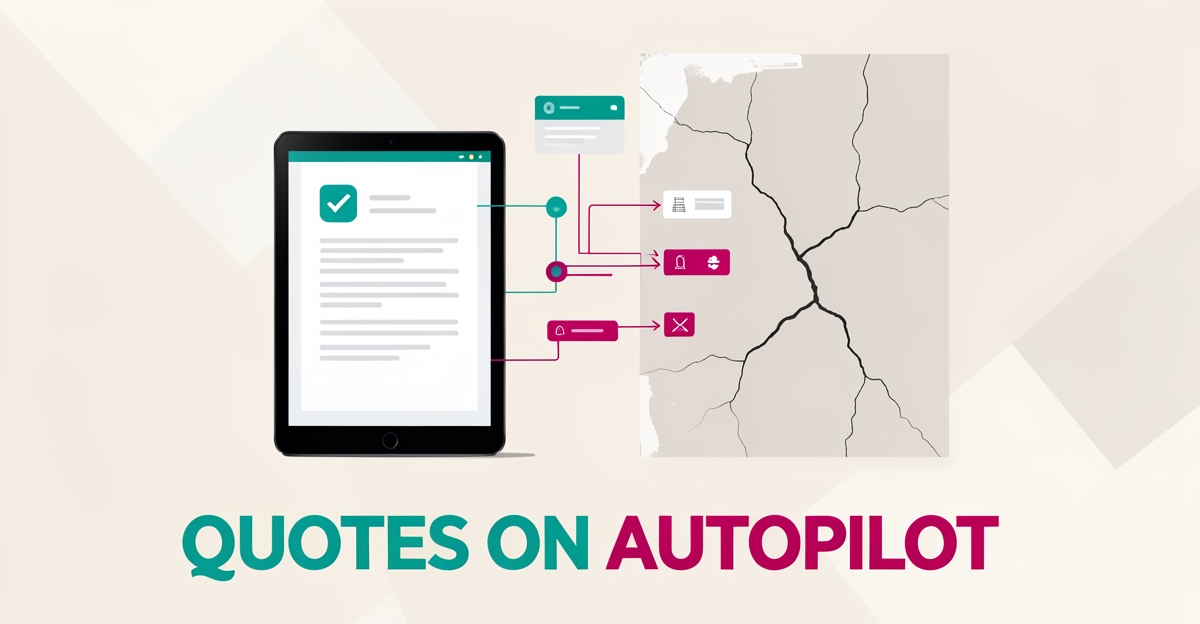
AI-powered quote generation transforms how plaster repair businesses create accurate, customized estimates by combining damage assessment, material calculation, and labor estimation into a seamless workflow. These systems analyze input data, such as photos of damaged surfaces or client descriptions, to classify the type and severity of plaster issues, then determine the appropriate repair approach based on established industry standards. By integrating with existing inventory and pricing models, the AI ensures that material quantities and costs reflect real-time availability and market rates, eliminating guesswork and reducing the risk of underquoting or overquoting.
The process begins with damage assessment, where computer vision or natural language processing identifies cracks, holes, water damage, or texture inconsistencies from uploaded images or textual inputs. Next, material calculation engines compute the exact volume of plaster, bonding agents, and finishing compounds needed, factoring in surface area, repair depth, and waste allowances. Labor estimation follows, using historical data and complexity multipliers to predict hours required for preparation, application, drying, and finishing, adjusted for regional wage rates and crew efficiency. Because these are repetitive, rule-driven calculations, automating them typically produces a significant drop in error rates and a marked improvement in quote reliability.
These AI-driven quoting tools integrate directly with CRM platforms, accounting software, and scheduling systems through API connections, enabling automatic data synchronization across departments. For example, when a quote is generated, the system can update inventory levels, schedule labor crews, and trigger follow-up emails without manual intervention. This seamless integration delivers real productivity gains in the first year of deployment, allowing estimators to focus on client consultations and project oversight rather than manual calculations. AIQ Labs builds these systems to work within existing business infrastructures, ensuring adoption is smooth and scalable.
By automating the core components of quoting, damage analysis, material takeoffs, and labor forecasting, plaster repair companies can generate accurate, professional estimates in minutes instead of hours. The system continuously learns from past quotes and outcomes, refining its recommendations over time to better match actual project costs and timelines. This adaptive capability not only enhances accuracy but also builds trust with clients who receive consistent, transparent pricing. As AI adoption accelerates across the trades as of late 2026, businesses that leverage AI for quoting gain a competitive edge through faster response times, fewer costly errors, and improved operational efficiency.
The Business Case: ROI and Efficiency Gains
For plaster repair businesses, adopting AI-powered quoting systems delivers measurable financial returns. The return comes from three compounding sources: hours saved per estimate, fewer costly quoting errors, and faster turnaround that wins more bids. Businesses that automate core administrative workflows typically report strong first-year productivity gains, with payback timelines that shorten as quote volume grows. These benefits are consistently realized across service industries where accurate, timely quoting directly impacts revenue.
Beyond direct cost savings, AI quoting reduces errors that erode profitability. Automating repetitive administrative tasks, material quantity calculations, labor hours, market-based pricing, cuts the mistake rate sharply, a critical advantage in plaster repair where a single bad estimate can wipe out a job's margin. Once properly deployed, teams tend to trust automation outputs for accuracy, minimizing costly rework and client disputes. For trades businesses, this precision translates to fewer budget overruns and stronger client trust in estimates.
The efficiency gains free skilled estimators to focus on higher-value activities. Automating routine tasks can save each worker a meaningful share of their time, often equivalent to hundreds of hours annually. In plaster repair, this means estimators spend less time on manual calculations and more on complex damage assessments, client consultations, and project planning. AIQ Labs builds quote-generation systems that integrate with existing inventory and pricing models, ensuring these productivity improvements are realized without disrupting established workflows. The result is a streamlined quoting process that scales with business growth while maintaining accuracy and profitability.
Implementing AI Quoting in Your Plaster Repair Business
Adopting AI quoting starts with mapping the manual steps that slow you down today, not buying software. Plaster repair businesses that automate quotes first clarify their workflow, then build integration around inventory and pricing they already trust.
Start by auditing your current quoting process. Identify every repetitive calculation, from damage assessment to material quantity estimation and labor hour calculations. Document where data lives, spreadsheets, inventory systems, CRM notes, and where errors typically appear. This baseline reveals the real time cost and helps you define success metrics.
Define the quote structure the AI must produce. A reliable system needs clear inputs for damage type classification, material requirements based on severity, labor estimates by square footage and complexity, and pricing tied to current inventory and market rates. Standardizing this structure ensures consistent outputs and makes integration possible.
Design reusable prompt templates that turn field inputs into structured quotes. Templates guide the model to analyze damage, recommend a repair approach, calculate materials, and generate labor estimates with pricing. Building a decision brief generator that includes problem identification, options with tradeoffs, recommendation, risks, and next steps raises quote quality beyond simple calculations.
Integration with existing systems is the difference between a demo and a daily tool. The AI should pull live material costs from inventory, check labor availability, and write back to your CRM for client history. Businesses that keep their pricing models and inventory in place avoid rework and maintain control. AIQ Labs builds quote-generation systems that integrate with existing inventory and pricing models for seamless adoption, preserving ownership of data and workflows.
Validate before you scale. Cross-reference AI calculations with manual estimates, verify material quantities against industry standards, and check labor estimates against historical data. Because error rates for repetitive administrative work drop sharply after automation, quality checks build trust quickly.
Roll out in phases and monitor impact. Track accuracy of generated quotes, time saved versus manual processes, and client satisfaction. Strong and growing demand for workflow automation across industries reflects the ROI businesses see as they automate core operations.
A practical implementation plan looks like this:
- Map and document the current quoting workflow and data sources
- Standardize quote components and build prompt templates for damage, materials, labor, and pricing
- Integrate AI with inventory, pricing, scheduling, and CRM systems
- Run parallel validation with manual quotes and refine models
- Deploy gradually with monitoring for accuracy, time savings, and adoption
When the system is built as a production-ready, owned asset rather than a subscription widget, teams gain sustainable competitive advantage and can scale quoting without adding headcount. If you want to scope the highest-ROI version of this for your business, start with our fit check.
Still paying for 10+ subscriptions that don’t talk to each other?
We build custom AI systems you own outright. No vendor lock-in. Full control.
Not sure where to start? Ask our AI planner
Frequently Asked Questions
How much time can AI quote generation actually save a plaster repair business?
Will AI-generated quotes be accurate enough, or will I end up underquoting jobs?
Do I need to replace my existing inventory, pricing, or CRM systems to use AI quoting?
What kind of ROI can I expect from automating my quoting process?
How do I get started with AI quoting without a big technical project?
Can AI handle different types of plaster damage, like cracks versus water damage?
Turn Quoting From Bottleneck Into Competitive Edge
Manual quoting is costing plaster repair businesses time, margin, and bids. Hours spent on calculations, inconsistent estimates between estimators, and delayed turnaround create hidden costs that compound as you scale. AI quote generation changes that by automating damage assessment, material takeoffs, and labor forecasting while integrating with the inventory and pricing models you already trust. The result is accurate, professional estimates in minutes, fewer costly errors, and estimators freed to focus on site assessments and client relationships. The business case is clear: automating repetitive quoting work sharply reduces error rates and delivers real productivity gains in the first year. To move forward, audit your current quoting steps, standardize the quote components you need, and validate AI outputs in parallel with manual estimates before scaling. AIQ Labs builds quote-generation systems that integrate with existing inventory and pricing models for seamless adoption. Start the Fit Check at https://aiqlabs.ai/apply for a free 30-minute strategy call to map your biggest quoting bottleneck and identify high-ROI automation opportunities, or chat live with an AI Transformation Agent at https://aiqlabs.ai/chat.
Make AI your competitive advantage — not just another tool.
Strategy, implementation and ongoing optimization. One partner, end to end.
Not sure where to start? Ask our AI planner