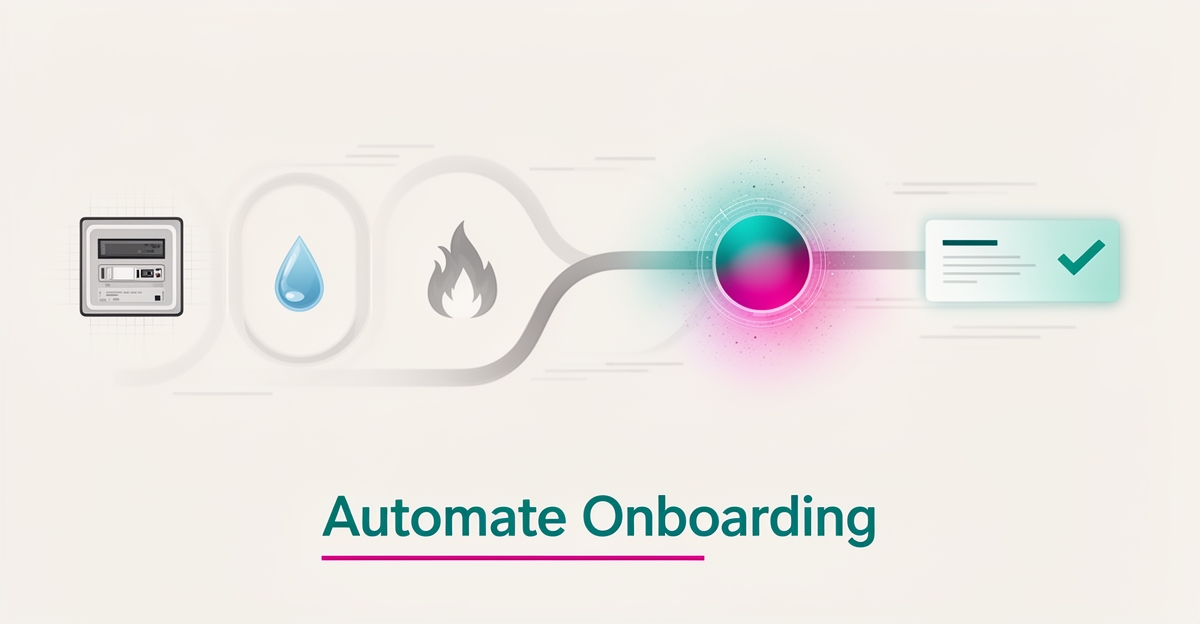
How AI Can Automate Customer Onboarding for Utility Service Providers
Key Facts
- Manual onboarding typically means days or weeks of activation delays, repeated information requests, and avoidable data-entry errors
- Automated data collection and validation typically reduces processing time and error rates compared to manual methods
- AI agents are proactive, autonomously planning and taking actions to achieve goals, unlike reactive assistants, as IBM defines the technology
- AI isn't magic, it's a strategy requiring planning, data readiness, and system integration
- AIQ Labs has deployed 200+ multi-agent systems and runs 4 live SaaS products daily
Hire a team member that works 24/7 — for less than a part-time wage.
AI receptionists, SDRs, dispatchers and 99+ roles. Trained on your business, fully managed.
Not sure where to start? Ask our AI planner
The Hidden Cost of Slow Utility Onboarding
The utility onboarding experience often begins with frustration before service even starts. Manual processes force customers to wait days or weeks for activation while navigating confusing paperwork and repeated information requests. This delay isn't just inconvenient, it directly erodes trust and satisfaction from the very first interaction.
Poorly implemented technology makes this worse. When automated systems fail to resolve a customer's problem on the first try, customers who already feel stuck in bureaucratic limbo lose confidence fast. For utilities, a slow or clumsy onboarding creates a critical first impression that service will be difficult to access and manage.
The operational toll is equally severe. Manual onboarding consumes valuable staff time on repetitive data entry and verification tasks, increasing labor costs while introducing avoidable errors. These inefficiencies cascade into delayed activations, which typically hurt long-term customer retention, especially in markets where switching barriers are low.
Beyond activation delays, slow onboarding triggers hidden costs through increased support inquiries and complaint resolution. Customers left waiting for service frequently contact call centers for status updates, driving up volume and straining resources that could be better spent on proactive service delivery. Each inquiry represents both a direct cost and an opportunity cost, time spent troubleshooting onboarding issues is time not spent building relationships or identifying upsell opportunities.
Utilities that persist with manual onboarding also risk regulatory scrutiny in regions where timely service connection is mandated. Prolonged activation periods can trigger penalties or damage reputations with oversight bodies, adding compliance risks to the financial and reputational costs of inefficiency. The cumulative effect transforms what should be a straightforward service initiation into a multi-faceted operational burden.
AI-powered onboarding directly addresses these pain points by automating data collection, validation, and organization, reducing manual effort while accelerating time-to-service. When implemented thoughtfully, this technology doesn't just speed up activation; it creates a foundation for personalized engagement from day one. For utility providers, the hidden cost of slow onboarding isn't just measured in delayed revenue, it's seen in every frustrated call, every eroded trust signal, and every operational hour wasted on preventable delays. Addressing this gap isn't merely about efficiency; it's about restoring confidence in the utility-customer relationship at its most critical moment.
How AI Transforms Data Collection and Validation in Onboarding
Every new utility customer account begins with a mountain of paperwork: addresses, meter details, usage history, payment information, service preferences. When that data is gathered by hand, errors slip in, follow-up calls pile up, and customers wait days for service that should take minutes.
AI changes the equation by automating three core tasks, collection, validation, and organization. Intelligent systems can pull customer information from multiple channels, cross-check it against existing records, and structure it into a clean, unified profile without human intervention. This matters because data quality is the foundation of everything else: without accurate, structured customer data, no downstream automation, billing, compliance, or communication, can work reliably.
The payoff shows up in onboarding performance. Providers that automate collection and validation typically see faster activation times, fewer correction cycles, and lower support volume. Clean, validated data also enables something manual processes rarely can: personalized service plans built around each household's actual usage patterns and preferences.
There's a critical distinction utilities should understand before deploying these tools. As IBM explains, AI assistants are reactive, performing tasks at your request. AI agents are primarily proactive, autonomously planning and taking actions to achieve a defined goal using the tools and permissions available to them. In onboarding, that means an AI agent doesn't just wait for a customer to submit a form, it flags a missing document, requests verification, and updates the account record on its own.
When evaluating what AI should handle in data collection and validation, utilities benefit most from automating:
- Extracting customer details from applications, emails, and uploaded documents
- Cross-referencing new records against existing account and billing systems
- Flagging inconsistencies or missing information before they cause delays
- Organizing validated data into profiles that support personalized service plans
The caveat is that AI isn't magic, it's a strategy. Success depends on planning, data readiness, and integration with existing systems. That's why providers like AIQ Labs build custom AI systems that handle compliance, billing, and communication as unified, fully owned infrastructure rather than bolt-on tools. The providers who treat data validation as a proactive, automated workflow, not a manual afterthought, will onboard faster and retain more of the customers they win.
Implementation Roadmap: From Pilot to Scalable AI Onboarding
Utility providers seeking to modernize customer onboarding can follow a clear, phased approach. Starting with goal-setting ensures AI initiatives align with business outcomes like faster activation and reduced manual effort. Because onboarding sits at the top of the customer relationship, it's typically the highest-impact first target for utilities struggling with slow, error-prone processes.
Next, data readiness becomes critical, AI systems depend on accurate, accessible customer information to validate identities, assess service needs, and trigger compliant billing setup. Before deployment, providers should audit data sources, cleanse inconsistencies, and establish integration points with CRM, billing, and legacy systems. Poor data quality remains a top barrier to AI effectiveness, so investing in data hygiene upfront prevents downstream failures. This step also supports the development of AI Employees, managed AI staff that handle onboarding tasks like document verification and status updates while securely interacting with internal tools.
Change management prepares teams for new workflows where AI handles routine tasks like document verification and welcome communications, freeing staff for complex issue resolution. Training programs should clarify roles, address concerns about job displacement, and demonstrate how AI augments rather than replaces human expertise. Organizational buy-in is achievable when leaders frame AI as a strategic enabler, not a disruptive force.
Deployment follows a phased rollout: begin with a pilot focused on one onboarding sub-process, such as address verification or rate plan selection. Use AI Employees or custom systems to handle repetitive tasks while maintaining human oversight for exceptions. Monitor key metrics like processing time, error rates, and customer satisfaction, then refine before expanding to additional workflows. This incremental approach reduces risk, builds confidence, and allows utilities to scale AI ownership without vendor lock-in, core to AIQ Labs' model of delivering production-ready systems clients fully control. For utilities that want to start smaller, a single AI Workflow Build can rebuild the one onboarding step that costs the most, at a fixed price. Those ready to connect onboarding, billing, and communication end-to-end can move toward a full AI Operating System, built in phases and owned outright. By anchoring each step in measurable outcomes and proven frameworks, providers transform onboarding from a trust-eroding bottleneck into a competitive advantage.
Still paying for 10+ subscriptions that don’t talk to each other?
We build custom AI systems you own outright. No vendor lock-in. Full control.
Not sure where to start? Ask our AI planner
Frequently Asked Questions
Why is utility customer onboarding so slow and frustrating right now?
Can AI actually make onboarding faster for utilities, or is it just hype?
What's the difference between an AI assistant and an AI agent for onboarding?
Won't customers just get frustrated if the AI doesn't work?
Is the utility industry really investing in AI for onboarding?
What data does AI need to automate onboarding safely?
The First Impression You Can't Afford to Get Wrong
Slow onboarding costs utilities far more than delayed revenue, it erodes trust at the exact moment it matters most. As this article has shown, AI can transform that first impression by automating data collection, validation, and organization, turning a bureaucratic bottleneck into a foundation for personalized service. But success isn't automatic. The providers seeing real results start with clear goals, clean data, and a phased rollout, piloting one workflow, measuring outcomes, and scaling with confidence. The question is no longer whether to modernize onboarding, but how to do it without adding vendor lock-in or fragile bolt-on tools. That's the gap AIQ Labs closes: custom-built, production-ready systems your utility fully owns, handling compliance, billing, and communication as unified infrastructure, backed by 200+ multi-agent systems deployed and 4 live SaaS products we run daily. If you're ready to identify where automation delivers the fastest win for your onboarding process, take the two-minute Fit Check at aiqlabs.ai/apply and book a free 30-minute strategy call, a real working session with an AI engineer, and if there's no clear win, we'll tell you that too.
Make AI your competitive advantage — not just another tool.
Strategy, implementation and ongoing optimization. One partner, end to end.
Not sure where to start? Ask our AI planner