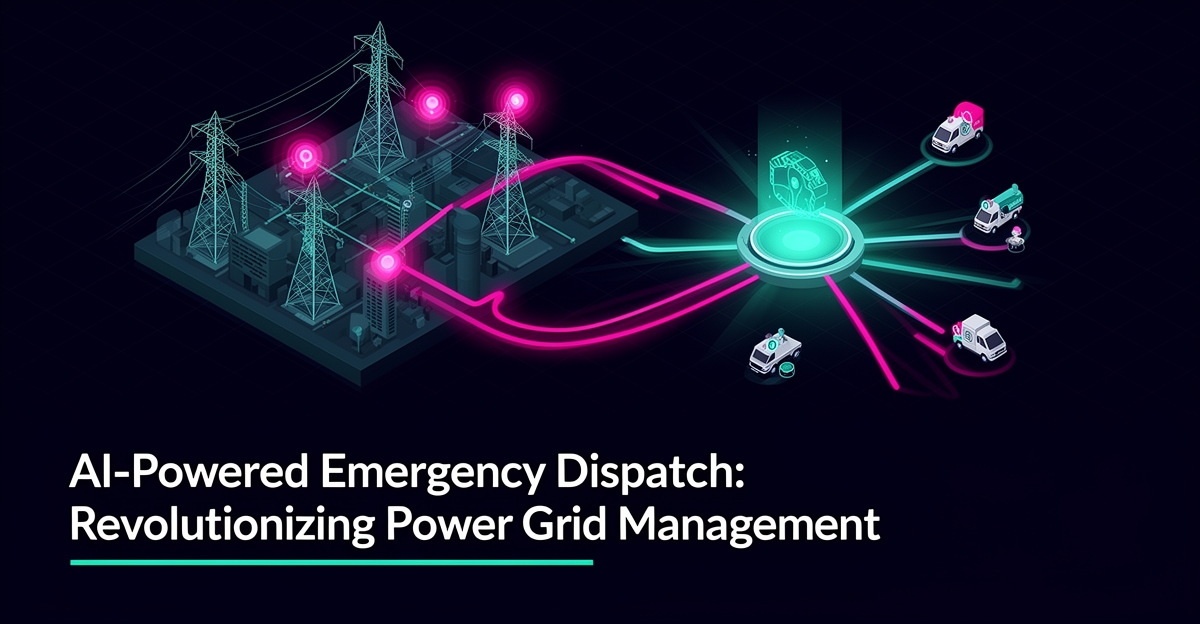
How AI Can Automate Emergency Response Dispatching for Power Outages
Key Facts
- AI workloads and data centers are adding significant strain to the grid, and industry analysts warn that outage risks will grow as demand accelerates through the end of the decade.
- Traditional power flow analysis for energization requests can take weeks, while AI-assisted approaches can produce engineering recommendations in a fraction of that time.
- Emergency call volumes can spike several times above normal levels during storm events, overwhelming human operators and sending calls to voicemail.
- Rapid, consistent triage classification is widely associated with faster emergency response and fewer misallocated resources.
- Major utilities, including Southern California Edison, have begun piloting AI-driven digital twin technology to model distribution networks in real time.
- AIQ Labs has deployed 200+ multi-agent systems and runs four live SaaS products daily, this is operational software, not slideware.
Hire a team member that works 24/7 — for less than a part-time wage.
AI receptionists, SDRs, dispatchers and 99+ roles. Trained on your business, fully managed.
Not sure where to start? Ask our AI planner
The Growing Crisis in Power Outage Response
The grid is under pressure like never before. AI workloads and data centers are consuming electricity at unprecedented rates, creating operational challenges that existing infrastructure struggles to meet. Industry analysts warn that this added strain could meaningfully increase outage risks by the end of the decade.
The picture for utilities is stark. Electricity demand keeps climbing, while customers expect reliability and fast answers. Traditional power flow analysis can take weeks for energization requests, leaving customers waiting during critical situations, and leaving dispatch teams reacting instead of planning.
Utilities are responding with AI-driven solutions. Southern California Edison, for example, has partnered with ThinkLabs to pilot physics-informed AI digital twins that model distribution networks in real time, compressing analysis cycles that previously took days into minutes.
Yet grid management is only half the battle. When outages occur, dispatch operations face their own crisis:
- Call volumes can spike several times above normal levels during storm events, overwhelming human operators
- Manual dispatch processes introduce delays when every minute counts for customer restoration
- After-hours and weekend coverage gaps leave emergencies unaddressed during off-peak times
- Inconsistent triage decisions lead to misallocated resources and extended downtime
Other field service industries already show what's possible. AI-powered emergency call systems in sectors like roofing capture jobs that would otherwise vanish to voicemail, with a single captured emergency often covering the system's monthly cost. These platforms operate continuously, triage calls by urgency, and book appointments directly into scheduling systems without human intervention.
For utilities and field service organizations, the implications are clear. Manual dispatch methods cannot scale to meet modern grid demands. The combination of rising outage risks and customer expectations for rapid response creates an operational gap that traditional approaches cannot bridge.
AIQ Labs works with utilities and field service companies to deploy AI dispatch agents that address these challenges directly. Our systems monitor outage alerts around the clock, assess technician availability and location, and route qualified personnel automatically based on load requirements and generator availability. The result is faster restoration times and more efficient resource utilization during critical events. This is exactly the kind of high-cost workflow we rebuild through AI Workflow Builds, one broken process, fixed at a set price.
The grid of tomorrow demands response capabilities that match its complexity. As system stress becomes the norm rather than the exception, utilities that cling to manual dispatch processes risk falling behind permanently.
How AI Transforms Emergency Dispatch for Utilities
Power outages don't wait for business hours, and utilities can't afford manual triage when grid stress is rising. AI-powered dispatch is changing how outages are detected, prioritized, and resolved in real time.
AI systems ingest real-time grid telemetry, weather feeds, and customer reports to spot anomalies before they cascade. Where traditional power flow analysis can take weeks, AI-assisted approaches compress that analysis into minutes, enabling instant outage detection and impact assessment instead of delayed manual review.
Predictive analytics adds a second layer of protection. Models learn from large volumes of power flow scenarios to forecast where failures are likely and how load will shift, allowing dispatchers to act on validated options rather than assumptions.
Automated triage replaces call-center bottlenecks with consistent, 24/7 handling. For utilities, this translates to:
- Instant classification of outage severity from sensor alerts and customer calls
- Location-based technician matching by proximity, skills, and current workload
- Generator availability checks and load prioritization before dispatch
- Automatic escalation and mitigation guidance for critical events
The transformation is already visible in utility partnerships. Southern California Edison has partnered with ThinkLabs AI to implement physics-informed AI digital twins that model distribution and sub-transmission networks, an approach utility executives describe as a key enabler for grid digitalization and more efficient operations.
This is where AIQ Labs comes in. We deploy AI dispatch agents that work 24/7 to ensure rapid, efficient response during critical events, automating alert detection and dispatching qualified technicians based on location, load, and generator availability. For utilities that want dispatch, customer communication, and field coordination running on one connected layer, our AI Operating Systems offering builds it in phases, and you own it outright.
The shift from reactive to proactive dispatch reduces restoration time, balances workloads, and improves customer trust. With service interruptions increasing on the U.S. grid, automated, data-driven dispatch is becoming essential infrastructure.
Implementing AI Dispatch: From Pilot to Full Operations
Implementing AI dispatch for power outages begins with defining urgency tiers that align with utility response priorities. AI systems can be configured to categorize outages based on factors like customer impact, critical infrastructure involvement, and restoration complexity, mirroring triage models proven in emergency services, where rapid classification is widely associated with faster response. These tiers trigger automated workflows that match technician availability, location, and equipment readiness, such as generator access or specialized vehicle deployment, ensuring the right resource is dispatched without manual intervention.
Integration with existing operational systems is critical for seamless execution. AI dispatch platforms must connect to SCADA for real-time grid status, outage management systems for fault location, and CRM databases for customer and crew information, enabling end-to-end automation from detection to deployment. This connectivity allows AI agents to continuously monitor grid conditions and initiate responses the moment an outage is detected, even during off-hours or storm events.
Escalation protocols ensure human oversight remains embedded in the process. When AI encounters scenarios beyond its authority, such as widespread transmission failures or safety hazards, it automatically alerts on-call supervisors with contextual data, including outage scope, affected critical facilities, and recommended actions. This hybrid approach maintains safety and compliance while leveraging AI's ability to handle routine cases at scale. Testing with realistic outage scenarios, including simulated storms and cyber-physical disruptions, validates system performance before full deployment. Drawing from field service automation models where AI captures emergency calls that would otherwise go to voicemail, utilities can refine triage logic and communication scripts using real-world data, ensuring the system adapts to evolving outage patterns and crew availability. The pilot-to-operations transition hinges on iterative refinement, clear KPIs like mean time to dispatch, and stakeholder training to build trust in automated decision-making. AIQ Labs supports this journey end to end, from defining operational rules to optimizing AI agents for grid-specific workflows, built in milestones so you can verify value at every phase.
Still paying for 10+ subscriptions that don’t talk to each other?
We build custom AI systems you own outright. No vendor lock-in. Full control.
Not sure where to start? Ask our AI planner
Frequently Asked Questions
How does AI improve emergency dispatch for power outages compared to traditional methods?
Can AI dispatch systems operate 24/7 during storms and off-hours when human teams are overwhelmed?
How quickly can AI analyze grid data to detect and respond to outages?
What risks are associated with relying solely on manual dispatch during grid emergencies?
How does AI ensure the right technician is dispatched for a power outage?
Is there proof that AI-powered emergency dispatch works in real-world utility operations?
Powering the Future: AI as the Backbone of Resilient Utility Response
As grid stress rises from growing AI workloads and extreme weather, utilities can no longer rely on manual dispatch methods that struggle to keep pace with storm-driven call volume spikes. AI-powered emergency response transforms how utilities detect, prioritize, and resolve power failures, processing grid data in minutes instead of days, triaging calls 24/7, and automatically dispatching qualified technicians based on location, load, and generator availability. This shift reduces restoration times, balances workloads, and improves customer trust when every minute counts. For utilities ready to move beyond reactive responses, the path forward begins with a clear assessment of current bottlenecks. Take the two-minute Fit Check, a free, no-obligation evaluation, to identify high-ROI automation opportunities and map a strategic implementation plan tailored to your operations. If there isn't a clear win, we'll say so. It's a real working session with an AI engineer, not a sales pitch.
Make AI your competitive advantage — not just another tool.
Strategy, implementation and ongoing optimization. One partner, end to end.
Not sure where to start? Ask our AI planner