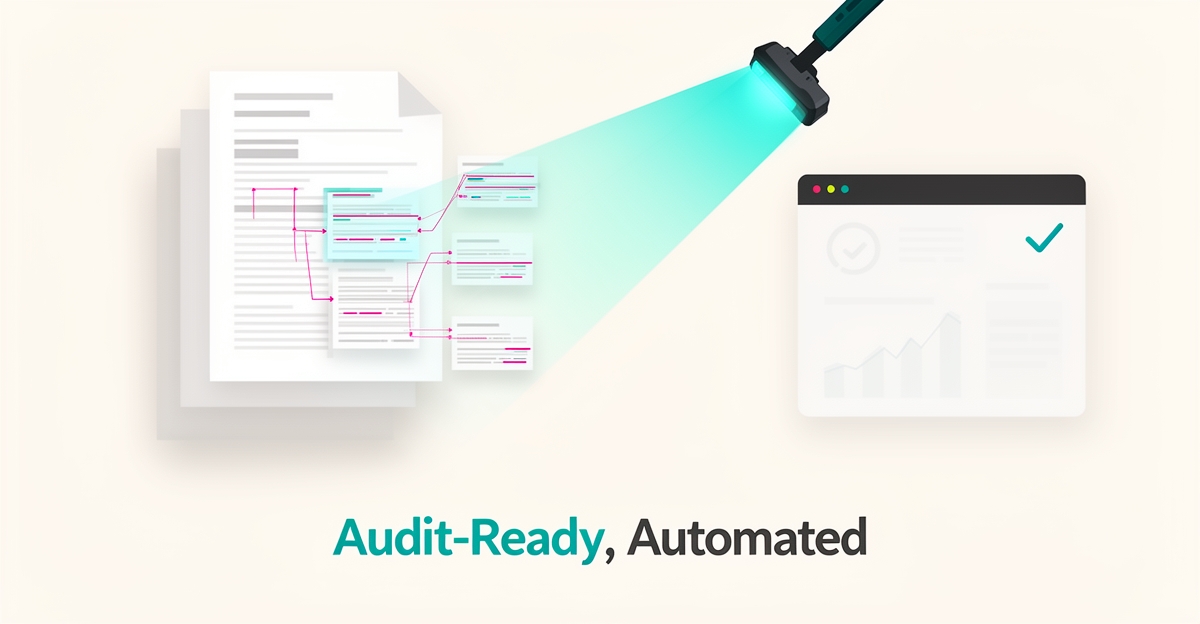
How AI Can Automate Land Lease Reporting for Financial and Regulatory Audits
Key Facts
- AI typically cuts lease abstraction time from 4-8 hours to under 15 minutes, a roughly 90% speed improvement over manual methods.
- Manual lease abstraction commonly carries error rates around 10%, while AI typically achieves 95-98% accuracy, reaching 99%+ with human review.
- The global Lease Management AI market was estimated at $1.38 billion in 2024 and is projected to reach $9.37 billion by 2033.
- AI lease abstraction can reduce processing costs by 70-90%, dropping per-lease expenses from $100-$300 to under $15.
- AI is being embedded into financial workflows rapidly, outpacing governance structures designed to ensure safety.
- ASC 842 and IFRS 16 require all leases over 12 months on balance sheets, accelerating demand for automated lease abstraction.
- While most commercial real estate firms have started AI pilots, only a small fraction have achieved all their program goals.
Hire a team member that works 24/7 — for less than a part-time wage.
AI receptionists, SDRs, dispatchers and 99+ roles. Trained on your business, fully managed.
Not sure where to start? Ask our AI planner
The Compliance Burden: Why Manual Land Lease Reporting Fails Modern Audits
Manual lease files are collapsing under audit pressure that didn't exist a decade ago. Land lease managers now face a compliance burden where a single missed clause can trigger restatements, penalties, and investor scrutiny.
Regulatory mandates like ASC 842 and IFRS 16 require all leases longer than 12 months to appear on balance sheets, which has accelerated the demand for automated lease abstraction. The rule change turned lease administration from a back-office task into a financial reporting control point.
The operational reality is still manual. Real estate asset managers commonly spend 4-8 hours manually abstracting a single commercial lease. That process relies on trained reviewers reading dense contracts and rekeying data into spreadsheets. Manual extraction introduces error rates that can reach 10% or higher, creating significant risk during financial and regulatory audits.
That risk compounds at scale. Portfolios with hundreds of land leases generate thousands of data points for occupancy, rent escalations, renewal options, and compliance tracking. Auditors now expect traceable, consistent lease data with clear lineage from source document to report. Spreadsheets and email chains cannot provide that.
The pressure is intensifying as the market grows. The global Lease Management AI market was estimated at USD 1.38 billion in 2024 and is projected to grow at a CAGR of roughly 22% through 2033, driven by increasing complexity of real estate portfolios and stricter regulatory requirements. Industry research notes automation of lease administration tasks is a primary growth driver, reducing human error and operational costs.
Manual workflows also create governance gaps. Finance teams operate on the principle that if you cannot trace it, you cannot trust it, yet black box outputs and untracked changes are emerging risks in finance. AI is being embedded into financial workflows faster than governance structures can adapt.
Land lease reporting fails modern audits for three core reasons:
- Abstraction time: 4-8 hours per lease with no real-time visibility into portfolio changes
- Error exposure: Manual first-pass accuracy of 85-92% leaves material errors in abstracts
- Audit readiness: Disconnected sources prevent instant reports on lease occupancy, revenue, and compliance
These constraints explain why lease abstraction is identified as the single highest-impact use case for AI in real estate operations. Organizations need real-time reports on lease occupancy, revenue, and compliance that are essential for audits and investor reviews. AIQ Labs rebuilds the workflows that cost the most — for lease-heavy teams, that usually starts with abstraction and reporting. Learn more on the AI Workflow Builds page, or go bigger with a connected AI Operating System that ties lease data into one layer you own outright.
Without automation, the compliance burden will only grow as portfolios expand and standards tighten.
How AI Transforms Lease Data Extraction and Real-Time Reporting
The traditional process of lease abstraction has long been a bottleneck for financial and regulatory reporting, consuming significant manual effort and introducing avoidable errors. Modern AI systems now transform this workflow by combining advanced OCR with retrieval-augmented generation (RAG) pipelines to extract structured data from complex lease documents in minutes rather than hours.
AI-powered lease abstraction typically reduces processing time from 4-8 hours per lease to under 15 minutes while achieving field-level accuracy rates between 95-98%. This improvement enables real-time reporting on critical metrics like occupancy, revenue recognition, and compliance with standards such as ASC 842 and IFRS 16. For audit-ready results, pairing AI extraction with human review pushes accuracy to 99%+, ensuring data integrity for investor disclosures and regulatory examinations.
- Extracts 30+ lease data fields including rent schedules, escalation clauses, and renewal options
- Reduces processing costs by 70-90% compared to manual methods
- Enables continuous monitoring of lease portfolios for proactive compliance management
These capabilities directly support AIQ Labs' approach to building custom AI analytics that consolidates lease data from disparate sources into unified, actionable reports. By automating the foundational data extraction layer, organizations can shift focus from manual abstraction to strategic analysis of portfolio performance and risk exposure — turning lease management from a cost center into a source of operational insight. The result is not just faster reporting, but more reliable, audit-ready intelligence that scales with portfolio complexity.
Building Audit-Ready AI: Governance, Traceability, and the Black Box Problem
The integration of AI into financial workflows is accelerating, but this pace introduces new risks when systems lack transparency. As AI handles increasingly complex lease data extraction and reporting, the inability to trace how conclusions are reached — commonly referred to as the "black box" problem — undermines the very foundation of financial trust. Auditors operate on a simple principle: if you cannot trace it, you cannot trust it, a mantra that remains critical in the age of AI. Without governance frameworks that enforce traceability, even highly accurate AI outputs become liabilities during regulatory scrutiny.
To address this, audit-ready AI systems must incorporate complete audit trails, Chain of Thought reasoning, and human-in-the-loop validation. These mechanisms ensure that every data point — from lease occupancy figures to revenue calculations — can be traced back to its source document and the logical steps used to derive it. For example, modern AI platforms leveraging multimodal analysis and retrieval-augmented generation not only reduce lease abstraction time from hours to minutes but also provide explicit reasoning paths that auditors can review. This level of transparency transforms AI from an opaque tool into a verifiable component of the financial reporting chain.
Human oversight remains essential, particularly for high-stakes decisions involving compliance with standards like ASC 842 and IFRS 16. The most effective workflows combine AI's speed and consistency with expert review, achieving accuracy rates of 99%+ when AI extraction is paired with human quality assurance. This hybrid approach satisfies both efficiency demands and governance requirements, ensuring that AI-generated lease data is not only fast and cost-effective but also defensible in audit environments. By embedding these controls, organizations can harness AI's potential without compromising the integrity of their financial reporting.
Implementing Custom AI Analytics for Land Lease Portfolios
Implementing custom AI analytics for land lease portfolios requires a structured, phased approach that aligns technology deployment with business objectives. The process begins with discovery and architecture, where AIQ Labs analyzes existing lease data sources, CRM and accounting systems, and reporting workflows to identify integration points and define KPIs for occupancy, revenue, and compliance tracking. This foundational phase ensures the AI system is designed to pull structured and unstructured data from leases, property management tools, and financial platforms into a unified data layer.
During development and integration, custom AI agents are built to automate lease abstraction, rent roll calculations, and compliance validation against standards like ASC 842 and IFRS 16. These agents use multi-agent frameworks to extract 30+ data fields per lease — including escalation clauses, renewal options, and payment schedules — with field-level accuracy typically in the 95-98% range, consistent with recent benchmark studies. The system integrates directly with existing business tools via API connections, enabling real-time data synchronization and eliminating manual entry that traditionally consumes hours per lease. Deployment follows with user training, dashboard configuration, and performance monitoring setup, ensuring stakeholders can access actionable insights through custom financial and KPI dashboards tailored to audit and investor reporting needs.
Optimization and scale represent an ongoing phase where the AI system is refined based on usage patterns, new lease additions, and evolving regulatory requirements. Continuous monitoring tracks processing speed, accuracy improvements, and cost savings — with AI typically reducing abstraction time by up to 90% and lowering per-lease costs from $100-$300 manually to under $15 with automation. AIQ Labs builds in milestones, so you pay for working phases rather than a monolithic project, and when the build is done you own the platform outright — full control over customization, data governance, and future enhancements, with no vendor lock-in. AI lease abstraction benchmarks confirm that combining AI extraction with human quality assurance achieves 99%+ accuracy, making it ideal for regulated reporting environments. Market research shows the lease management AI sector is projected to grow at a CAGR of roughly 22%, reaching $9.37 billion by 2033, underscoring the urgency for firms to modernize their reporting infrastructure. Industry analysis identifies lease abstraction as the highest-impact AI use case in real estate, directly addressing the manual bottlenecks that delay audit readiness. Governance experts emphasize that traceable AI outputs are essential for financial trust, reinforcing the need for auditable automation in lease reporting. Workflow automation principles support the use of scheduled AI agents to continuously monitor lease data streams, ensuring reports reflect real-time occupancy and revenue changes without manual intervention. Owning the analytics infrastructure outright enables long-term adaptation to evolving audit standards and portfolio complexities.
Still paying for 10+ subscriptions that don’t talk to each other?
We build custom AI systems you own outright. No vendor lock-in. Full control.
Not sure where to start? Ask our AI planner
Frequently Asked Questions
How accurate is AI at extracting data from land leases compared to manual abstraction?
Can AI really reduce lease abstraction time from hours to minutes?
Will AI-generated lease reports pass financial and regulatory audits?
What data fields can AI extract from land lease documents?
How much does AI lease abstraction cost compared to manual processing?
What happens if the AI makes a mistake on a critical lease term?
From Manual Burden to Audit-Ready Intelligence
AI transforms land lease reporting from a slow, error-prone burden into a strategic advantage — cutting abstraction time from hours to minutes, boosting accuracy to 99%+ with human review, and delivering the traceable, real-time data auditors demand. By automating the foundational data extraction layer, organizations shift focus from chasing documents to proactive compliance monitoring and portfolio insights. The result is faster, defensible reporting that scales with complexity while reducing costs by up to 90%. To see how this applies to your lease portfolio, start with the free two-minute Fit Check — it leads to a no-obligation 30-minute strategy call where an AI engineer maps your biggest bottlenecks and identifies where AI can deliver immediate value.
Make AI your competitive advantage — not just another tool.
Strategy, implementation and ongoing optimization. One partner, end to end.
Not sure where to start? Ask our AI planner