How AI Can Automate Medical Record Entry in Implant Dentistry Clinics
Key Facts
- Industry reports on dental automation suggest AI-powered tools can cut administrative time significantly, by some estimates up to 40%.
- A majority of dental practices have adopted or plan to adopt AI and automation tools as of 2026 per industry surveys.
- Most dentists who have implemented AI report positive outcomes in industry data.
- Analyses of AI-assisted documentation suggest error reductions of 95-98% versus manual entry in medical settings per Practice EHR.
- AI-powered X-ray analysis can help detect subtle signs of caries and periodontal disease per Planmeca.
Hire a team member that works 24/7 — for less than a part-time wage.
AI receptionists, SDRs, dispatchers and 99+ roles. Trained on your business, fully managed.
Not sure where to start? Ask our AI planner
The Administrative Burden in Implant Dentistry: Why Manual Record Entry Is Failing Clinics
Manual record entry is quietly draining implant dentistry clinics of time, accuracy, and staff morale every single day.
Implant cases generate a high volume of complex documentation, intake forms, radiographs, surgical notes, and post-op instructions that must be captured accurately and shared across teams. When staff transcribe this data by hand, the workflow becomes a bottleneck that delays treatment planning and pulls clinicians away from patient care.
Administrative burden compounds quickly in this specialty. Industry research on dental practice automation suggests AI-powered tools can reduce administrative time by up to 40%. That time is typically lost to repetitive data entry, chart reconciliation, and chasing missing information between visits.
Error rates rise alongside the workload. Manual transcription introduces inconsistencies in patient histories, medication lists, and imaging references, which can compromise safety and compliance. In medical documentation, analyses of AI-assisted documentation suggest errors can be reduced by 95-98% compared with manual entry. For implant dentistry, where precise measurements and medical histories drive surgical decisions, those errors carry outsized risk.
Staff burnout follows the friction. Clinicians and coordinators report fatigue from repetitive typing, double-checking charts, and re-entering data across platforms. The result is slower turnaround, missed details, and reduced capacity to focus on patient communication and care quality.
The market is already shifting. Dental automation trends indicate a majority of dental practices have adopted or plan to adopt AI and automation tools as of 2026, with most dentists who implemented AI reporting positive outcomes. Investment in practice management and automation software continues to grow year over year.
Clinics feel the pain points most acutely in daily operations:
- Time consumption from retyping notes, X-ray details, and consent forms across systems
- Error-prone handoffs between front desk, hygienists, and surgeons
- Staff burnout from repetitive administrative tasks that add no clinical value
- Delayed record completion that postpones treatment planning and billing
This is where AI document processing and management changes the equation. AI can extract and organize patient data from intake forms, X-rays, and clinical notes, reducing transcription time and minimizing errors while interfacing with common dental software platforms. AIQ Labs builds custom systems tailored to these workflows, from targeted Workflow Builds that rebuild the one record-entry workflow that costs you the most, to full AI Operating Systems that connect your whole practice, so clinics can automate record entry without replacing their existing tools.
When administrative burden is removed, teams regain capacity for what matters: accurate planning, clear patient communication, and consistent, high-quality implant care.
How AI-Powered Document Processing Solves Record Entry Challenges in Dental Practices
Every implant dentistry clinic runs on paperwork, intake forms, referral letters, radiographs, and clinical notes, that someone must manually transcribe into the practice management system before the patient ever sits in the chair. AI-powered document processing changes that equation by extracting and organizing patient data automatically, turning hours of clerical work into a background task.
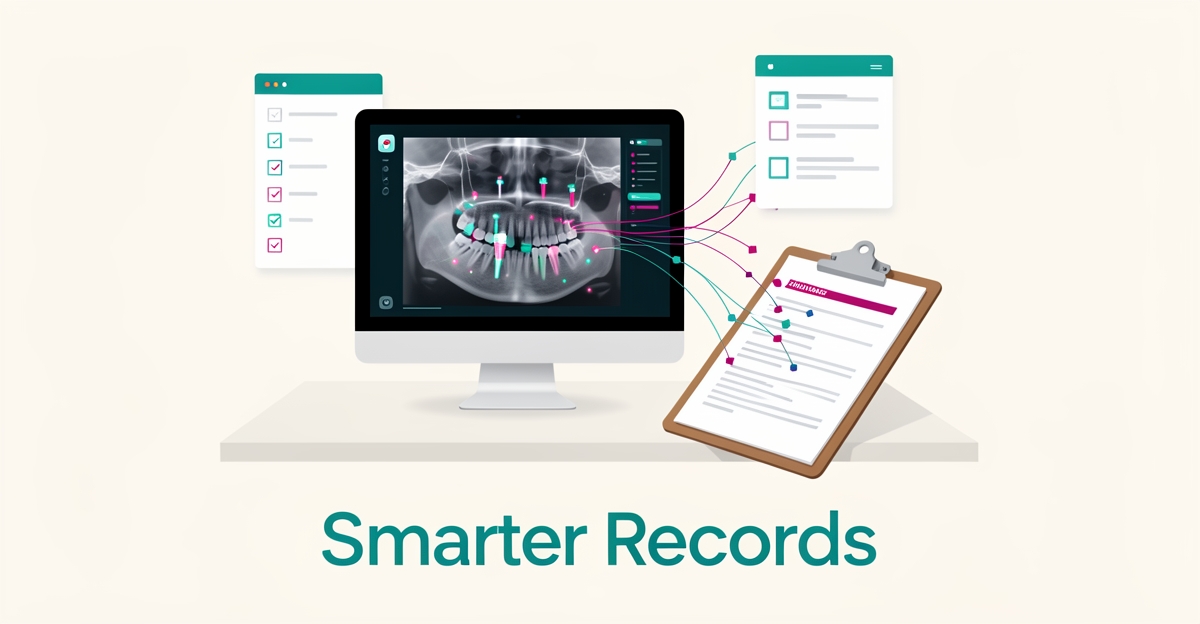
The technology behind this combines natural language processing (NLP) and computer vision. NLP reads unstructured text from intake forms and clinical notes, identifying fields like medical history, allergies, and implant site details, then maps them into structured records. Computer vision handles the imaging side: AI-powered X-ray analysis can help detect subtle signs of developing caries and periodontal disease, supporting faster, more consistent diagnostics than manual review alone.
The accuracy gains are significant. According to analyses of medical documentation, AI-assisted scanning can reduce documentation errors by 95-98% compared to manual entry, a critical margin when implant treatment plans depend on complete, precise patient records. AI systems also excel at analyzing large volumes of data, identifying patterns, and surfacing insights that inform treatment decisions.
The efficiency impact is just as compelling. Industry data suggests AI-powered tools can cut administrative time by up to 40%, and most dentists who implemented AI report positive outcomes. For record entry specifically, that means staff spend less time typing and more time on patient care and case coordination.
A well-designed AI document processing workflow for an implant clinic typically handles:
- Extracting patient demographics, medical history, and consent details from intake forms
- Transcribing and structuring clinical notes into standardized implant records
- Organizing and tagging radiographs and CBCT images alongside the relevant patient file
- Flagging incomplete or inconsistent entries for human review before they reach the chart
That last point matters. AI adoption in dentistry raises legitimate concerns about data security, patient privacy, and potential bias in AI decision-making, which is why experts in dental AI emphasize human-in-the-loop controls and careful implementation. The best systems validate every action before it commits to the record and escalate ambiguous cases to staff.
This is where custom development becomes essential. Generic software rarely integrates cleanly with the specific practice management system a clinic already uses. AIQ Labs builds custom AI document processing systems that connect directly to existing dental software platforms via API, so extracted data flows straight into the patient chart without manual re-entry. Because clients own the systems outright, clinics can adapt them as workflows evolve rather than being locked into a vendor's roadmap.
With a majority of dental practices adopting or planning to adopt AI and automation tools as of 2026, automated record entry is shifting from competitive advantage to baseline expectation. Clinics that implement it thoughtfully, balancing automation with oversight, position themselves to capture the efficiency gains while protecting the data integrity that implant dentistry demands.
Implementing AI Record Automation: A Step-by-Step Guide for Implant Dentistry Clinics
Implementing AI record automation in implant dentistry clinics begins with a thorough assessment of current workflows to identify bottlenecks in data entry from intake forms, imaging, and clinical notes. AIQ Labs starts this process with a discovery phase that maps existing systems, evaluates data readiness, and designs a solution architecture tailored to the clinic's practice management software. This ensures the AI system integrates without disrupting daily operations, laying the foundation for measurable efficiency gains.
The implementation follows a phased approach through AIQ Labs' Build in Milestones model, allowing clinics to automate one workflow at a time, such as extracting patient data from digital X-rays or structuring clinical notes from voice dictation, at a fixed price per phase, while retaining full ownership of each completed milestone. Clinics can pause or adjust the engagement after any milestone, minimizing risk while building toward broader automation. This method aligns with industry findings that AI-powered tools can meaningfully reduce administrative time and documentation errors, directly addressing common pain points in implant dentistry where precision and record integrity are critical.
Staff training and change management are embedded throughout deployment, with AIQ Labs providing role-specific guidance to ensure team members understand how to interact with the new system, validate outputs, and escalate exceptions when needed. Ongoing optimization continues post-launch, refining AI models based on real-world performance and expanding capabilities, such as linking extracted data to treatment planning modules or automating insurance verification, so the system evolves with the clinic's needs. Clinics that want administrative coverage without waiting for a build can also start with AI Employees for front-desk and coordination roles, then graduate to owned systems. By focusing on owned infrastructure and transparent progress, implant dentistry practices can achieve sustainable AI adoption without vendor lock-in or unexpected costs. Industry research shows that a majority of dental practices plan to adopt AI and automation tools as of 2026, reflecting growing recognition of its value in streamlining operations while maintaining high standards of patient care. Analyses indicate AI-driven documentation can reduce errors substantially, a critical advantage in implant dentistry where accurate records impact surgical outcomes and long-term success. Planmeca's work further supports that AI tools improve both speed and consistency in handling complex dental data, making them well suited to the detailed record-keeping required in implant procedures. Clinics ready to begin can start the two-minute Fit Check to assess their automation readiness and identify high-impact entry points for AI record automation.
Still paying for 10+ subscriptions that don’t talk to each other?
We build custom AI systems you own outright. No vendor lock-in. Full control.
Not sure where to start? Ask our AI planner
Frequently Asked Questions
Can AI really cut down the time we spend on manual record entry in implant dentistry?
How much more accurate is AI documentation compared to manual entry?
Will AI replace our existing dental practice management software?
Is it safe to use AI with patient records given privacy concerns?
How many dental practices are actually adopting AI for admin tasks?
What does an AI-powered record entry workflow look like for an implant clinic?
From Paperwork to Precision: AI's Role in Elevating Implant Dentistry
The administrative burden of manual record entry in implant dentistry clinics isn't just an inconvenience, it's a silent drain on time, accuracy, and team morale. As this article has shown, AI-powered document processing transforms this reality by automating data extraction from intake forms, clinical notes, and imaging, meaningfully reducing transcription time and documentation errors. These gains directly support safer treatment planning, faster turnaround, and more focus on patient care, without requiring clinics to abandon their existing systems. AIQ Labs builds custom AI solutions that integrate with current dental software, giving clinics full ownership and control over their automation journey, whether through a single Workflow Build or a complete AI Operating System. For practices ready to reclaim clinical capacity and reduce burnout, the next step is clear: assess where AI can make the biggest impact. Start the two-minute Fit Check to explore your automation readiness and discover how owned, tailored AI systems can strengthen your clinic's foundation for long-term efficiency and growth.
Make AI your competitive advantage — not just another tool.
Strategy, implementation and ongoing optimization. One partner, end to end.
Not sure where to start? Ask our AI planner