How AI Can Automate Parking Spot Assignments for High-Traffic Events
Key Facts
- AI systems can monitor and manage thousands of parking spaces consistently, while a single human attendant can typically only track a few dozen to a hundred spaces at a time.
- Manual payment and ticketing processes are prone to human error and cash-handling losses that AI-automated systems largely eliminate.
- AI-powered parking management enables predictive occupancy analytics and dynamic pricing based on real-time demand.
- The efficiency gap between AI and manual operations widens as facility size increases, AI maintains consistent performance while manual processes require proportional staff increases.
- AI systems offer predictable long-term cost structures with economies of scale, reducing labor requirements in parking management.
- As of late 2026, most large organizations use some form of AI in daily operations, and event logistics is one of the fastest-growing automation categories.
Hire a team member that works 24/7 — for less than a part-time wage.
AI receptionists, SDRs, dispatchers and 99+ roles. Trained on your business, fully managed.
Not sure where to start? Ask our AI planner
The Hidden Costs of Manual Parking Operations
High-traffic events expose every weakness in a manual parking operation. Attendants with clipboards and hand signals can only process vehicles as fast as they can walk and talk. When thousands of guests arrive within the same 60-minute window, the result is predictable: long queues on access roads, frustrated attendees missing the start of the event, and attendants making snap assignments that leave prime lots half-empty while overflow lots jam.
The costs go beyond congestion. Manual operations carry labor costs, wages, training, scheduling, and overtime for event days, that scale linearly with facility size. Human error in payment handling and ticketing creates revenue leakage that's difficult to audit after the fact. And because attendants can't see the whole facility at once, operators fly blind: they don't know occupancy levels until the lot is already gridlocked.
Perhaps the biggest hidden cost is opportunity cost. Every minute a guest spends circling for a spot is a minute they're not buying concessions, browsing vendors, or enjoying the event. For venues that host repeated high-traffic events, a poor parking experience compounds into lower repeat attendance.
How AI Transforms Parking Spot Assignment
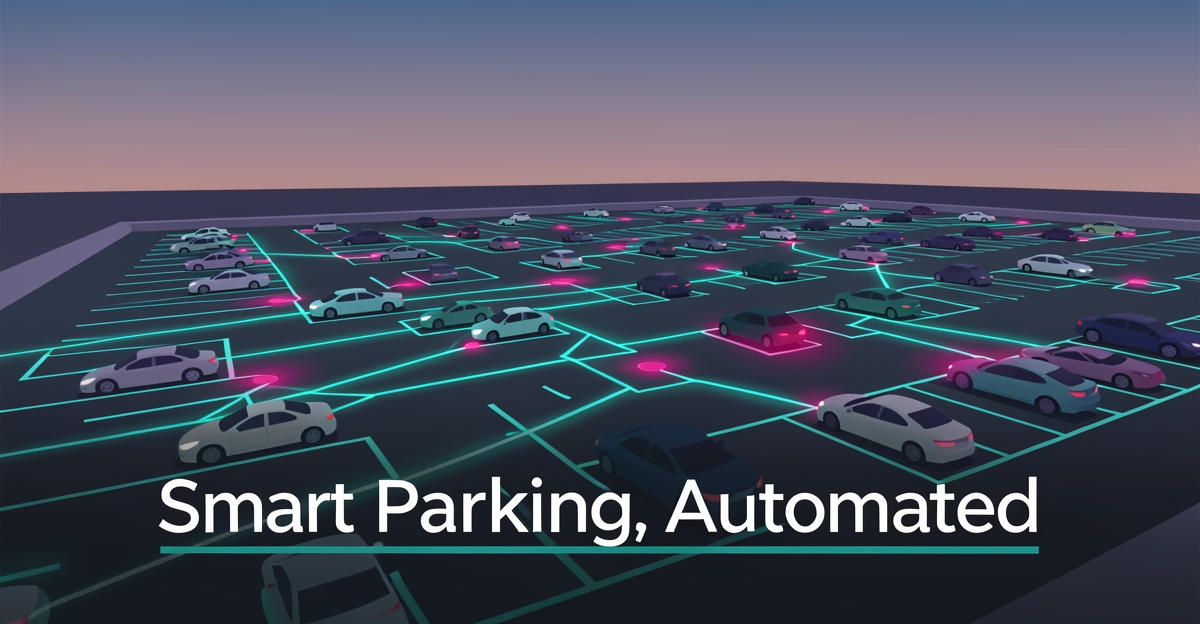
AI-driven parking assignment replaces guesswork with continuous, real-time optimization. Instead of directing each car individually, the system maintains a live model of every lot, aisle, and space, then assigns each arriving vehicle the spot that minimizes total congestion rather than just the nearest opening.
A typical AI parking stack for events combines several capabilities:
- Real-time occupancy sensing. Cameras with computer vision, IoT single-space sensors, or license plate recognition feed a live occupancy map of the entire facility.
- Predictive analytics. Machine learning models forecast arrival surges based on ticket scans, pre-registration data, and historical event patterns, so lots are staffed and staged before the wave hits.
- Dynamic assignment. As each vehicle arrives, the system assigns a specific spot, balancing distance to the venue, vehicle size, accessibility needs, and traffic flow across all lots simultaneously.
- Automated guidance and payment. Digital signage, app-based directions, and automated payment remove the bottlenecks where attendants traditionally slow things down.
The key difference is scale. A human attendant can realistically track a few dozen to a hundred spaces. An AI system tracks every space, every arrival, and every exit at once, and its performance doesn't degrade at 2,000 spaces the way a manual team's does. That consistency is what makes AI assignment viable for stadium events, festivals, and conference-scale venues.
Implementing AI Parking Systems: A Strategic Roadmap
You don't automate event parking in one leap. A phased approach keeps costs predictable and proves value at each stage:
- Map the current workflow. Document exactly how vehicles arrive, get assigned, pay, and exit. Identify where the delays and revenue losses actually happen, this is usually where the biggest ROI hides.
- Start with sensing and visibility. Before any automation, get a live occupancy picture. Even simple camera-plus-vision monitoring gives operators data they've never had before.
- Automate assignment. Once you can see the facility, let the system assign spots dynamically instead of relying on attendant judgment.
- Automate payment and access. License plate recognition and app-based payment remove the transaction bottleneck entirely.
- Add prediction. Feed historical and live event data into models that stage lots and staff before surges arrive.
Implementation does require upfront investment in sensors, cameras, software, and integration with existing infrastructure, along with ongoing maintenance. But those costs are offset by reduced labor demands, recovered revenue leakage, and a guest experience that keeps attendees coming back. The operators who struggle are the ones who try to boil the ocean on day one; the ones who succeed fix the single most expensive workflow first and expand from there.
Building Custom AI Parking Solutions with AIQ Labs
Off-the-shelf parking software solves generic problems. Event venues have specific constraints, multiple lot owners, accessibility requirements, VIP staging, weather contingencies, that generic tools handle poorly. AIQ Labs builds custom automation around your actual operation, not a template.
AIQ Labs offers three ways in, depending on where you are:
- AI Employees (/ai-employees): managed AI staff, dispatchers, receptionists, guest-service agents, and 99+ other roles, that handle the communication and coordination work around your parking operation at a fraction of the cost of a human hire.
- AI Workflow Builds (/workflow-builds): we rebuild the one workflow that costs you the most, like parking assignment for event days, at a fixed price, in phases.
- AI Operating Systems (/ai-operating-systems): one connected operating layer across your whole venue, built in phases and owned outright by you.
With 200+ multi-agent systems deployed and four live SaaS products running daily, AIQ Labs knows what it takes to make automation work in the real world. Payment is straightforward: start monthly, build in milestones, or own it outright, no fake prices, no surprises. Start with the 2-minute Fit Check to see if your operation is a match.
Still paying for 10+ subscriptions that don’t talk to each other?
We build custom AI systems you own outright. No vendor lock-in. Full control.
Not sure where to start? Ask our AI planner
Frequently Asked Questions
How does AI improve parking spot assignment for large events compared to manual methods?
What are the main cost differences between AI-powered parking systems and traditional manual parking management?
Can AI parking systems handle payment processing more accurately than human attendants?
What technologies do AI-powered parking management systems typically use to monitor space availability?
How should a venue start implementing AI parking automation?
What are the key challenges when implementing an AI-powered parking system for events?
Turning Parking Chaos into Seamless Guest Experiences
AI-powered parking spot assignment transforms a common pain point at high-traffic events into a streamlined, guest-centric operation. By analyzing event layouts, vehicle dimensions, and arrival patterns in real time, AI eliminates congestion, reduces wait times, and enhances satisfaction, directly impacting event success and repeat attendance. AI systems manage thousands of spaces with consistent performance where manual methods falter, offering predictable scalability and long-term efficiency. For venue operators and event planners seeking smarter logistics, the path forward begins with identifying your single biggest workflow bottleneck. AIQ Labs helps businesses assess where AI-driven automation delivers measurable ROI, starting with a free strategy call to map your biggest opportunities. Take the first step toward owning a custom AI solution that works as hard as you do: schedule your free 30-minute strategy call to see how AI can optimize your operations, not just your parking lots.
Make AI your competitive advantage — not just another tool.
Strategy, implementation and ongoing optimization. One partner, end to end.
Not sure where to start? Ask our AI planner