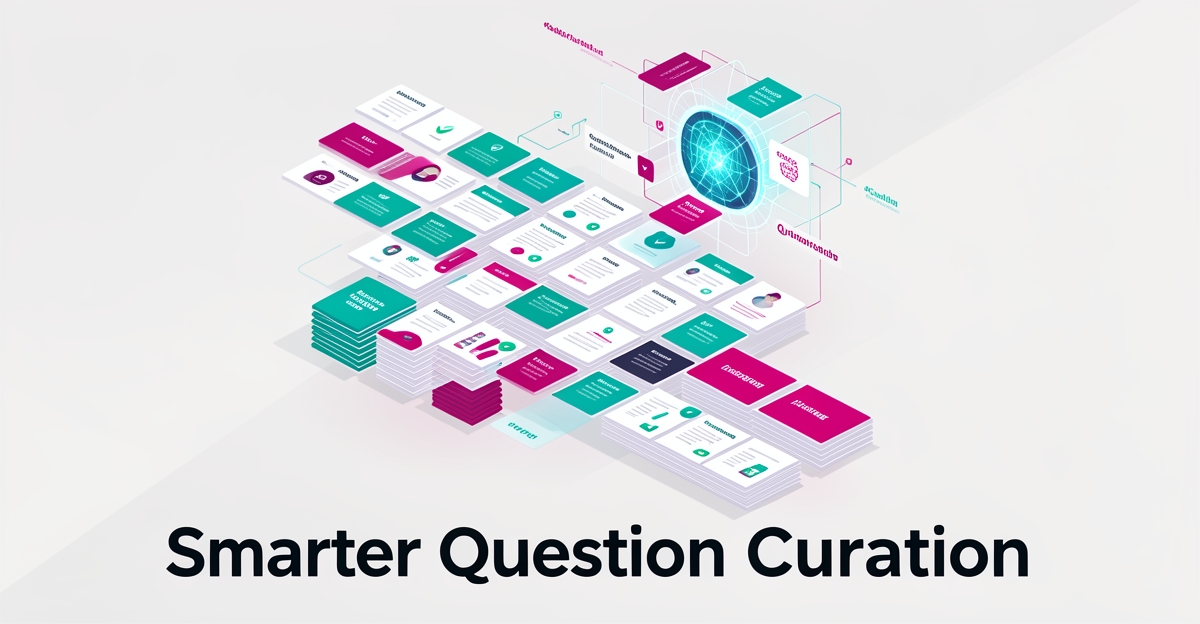
How AI Can Automate Standardized Test Question Bank Curation for Test Prep Firms
Key Facts
- Manual question bank curation is time-consuming and prone to human error, especially during fatigue-driven review sessions
- AI can improve curation accuracy by reducing the likelihood of human error, according to industry research on automated testing
- AI can increase curation efficiency by automating review, tagging, and question selection
- As of late 2026, a large share of AI engineers report encountering harmful biases in generative AI models, making human oversight essential
- Quality checking must be treated as an ongoing job, not a one-off task, curation is never "done"
Hire a team member that works 24/7 — for less than a part-time wage.
AI receptionists, SDRs, dispatchers and 99+ roles. Trained on your business, fully managed.
Not sure where to start? Ask our AI planner
The Hidden Cost of Manual Question Bank Curation
Ask any test prep operations manager what consumes their team's calendar, and the answer is rarely teaching, it's the question bank. Behind every polished practice exam sits thousands of past questions that someone must manually review, verify, update, and retire, one by one.
The scale of this problem is easy to underestimate. A firm tracking even a handful of standardized exams accumulates tens of thousands of items over time, each one subject to curriculum changes, format revisions, and shifting exam blueprints. Manual review cycles stretch for weeks, and by the time reviewers finish a pass, the earliest questions they approved may already be stale.
The costs compound in ways that show up directly on the P&L:
- Reviewer hours spent re-reading questions that were verified just months earlier
- Human error slipping through fatigue-driven review sessions, since manual curation is prone to human error by its very nature
- Stale content reaching students, eroding trust in the brand's core promise of accuracy
- Rising payroll costs, as AI-driven approaches can reduce the need for large teams of human reviewers
Manual curation's fundamental trade-off is well documented: it offers human judgment and expertise, but it is time-consuming and prone to human error. AI-driven curation, by contrast, improves accuracy, increases efficiency, and reduces costs, though it introduces its own considerations around bias and data security that firms must manage deliberately.
The stale-content problem deserves particular attention. Standardized tests evolve constantly, and a question bank that was accurate last season can quietly mislead students this season. As one industry discussion puts it, treating quality checking as a one-off task is misleading, it must be an ongoing job. For test prep firms, that means curation is never "done," and the labor never stops.
This is where purpose-built AI systems change the economics. Machine learning models can analyze large datasets and identify relevant questions, continuously flagging outdated items, duplicate content, and misaligned difficulty levels without waiting for a quarterly review cycle. Teams like AIQ Labs build these custom curation systems so that content remains accurate and up-to-date automatically, letting human experts focus on judgment calls rather than repetitive verification.
The hidden cost of manual curation isn't just the reviewer payroll, it's the opportunity cost of expertise spent on work machines do better, faster, and without fatigue.
How AI-Driven Curation Works: From Exam Archives to Adaptive Practice Sets
AI-driven test question curation transforms how test prep firms build and maintain their question banks by turning static archives into dynamic, adaptive learning resources. Machine learning models scan vast datasets of past exam questions, automatically identifying high-quality items that align with curriculum standards and learning objectives. These systems analyze patterns in question structure, topic coverage, and historical performance to surface the most relevant and effective practice materials.
Using natural language processing and semantic analysis, AI tags each question by subject, subtopic, cognitive level, and estimated difficulty with remarkable precision. This granular metadata enables intelligent assembly of practice sets that evolve based on individual student performance data. As learners interact with the system, the AI continuously refines question selection, prioritizing areas needing reinforcement while avoiding over-exposure to mastered concepts.
The process begins with ingesting legacy question banks, which AI cleans, deduplicates, and enriches with contextual metadata. Advanced models then assess question quality by evaluating clarity, distractor effectiveness, and alignment with scoring rubrics. High-performing items are flagged for reuse, while outdated or ambiguous questions are either revised or retired, ensuring the bank remains current and pedagogically sound.
- AI can analyze large datasets and identify relevant questions, according to industry research on automated testing
- AI can improve the accuracy of test curation by reducing the likelihood of human error, as demonstrated in automated testing environments
- AI can increase the efficiency of test curation by automating the process and reducing the time required to review and select questions
By integrating student response patterns, time-on-task, and error analysis, the system generates adaptive practice sets that target knowledge gaps in real time. This creates a feedback loop where each interaction improves the precision of future question selection, making preparation increasingly personalized and effective. For test prep firms, this means scalable content curation that maintains quality while reducing manual overhead, allowing educators to focus on instruction rather than question vetting.
AIQ Labs applies this same intelligent automation expertise to help organizations transform their content workflows, ensuring accuracy, relevance, and continuous improvement at scale. The result is a living question bank that grows smarter with every use, delivering better outcomes for both learners and the institutions that serve them.
The Payoff: Accuracy, Speed, and Lower Curation Costs
The difference between a question bank that merely exists and one that actually drives student outcomes comes down to curation quality, and that's where the economics shift dramatically. Test prep firms managing thousands of items know that every hour spent manually reviewing questions is an hour not spent on instruction or strategy.
Industry research shows that AI-driven curation improves accuracy by reducing the likelihood of human error while simultaneously increasing efficiency through automation. The same analysis confirms that firms can reduce costs associated with test curation by decreasing the need for large teams of human reviewers. When you multiply those savings across tens of thousands of items and multiple exam lines, the scale of potential savings becomes clear.
- Reduced human error through consistent algorithmic evaluation of question quality, difficulty calibration, and alignment standards
- Faster review cycles that compress weeks of manual selection into hours of automated curation
- Lower curation costs by minimizing the reviewer headcount needed to maintain bank freshness and relevance
- Continuous improvement as models learn from student performance data and expert feedback loops
The contrast is stark: manual curation relies on human judgment and expertise but remains time-consuming and prone to inconsistency, while AI-driven approaches deliver improved accuracy, increased efficiency, and reduced costs, though they require careful attention to bias mitigation and security. AIQ Labs builds custom curation systems that address these challenges directly, embedding validation layers and human-in-the-loop controls so test prep firms capture the speed and savings without compromising the pedagogical rigor their reputation depends on.
Guardrails: Bias, Security, and Context in AI Curation
AI systems for test question bank curation face real risks that can undermine their effectiveness if left unchecked. Training-data bias remains a critical concern, as of late 2026, a large share of AI engineers report having encountered harmful biases in generative AI models, which could lead to skewed question selection or unfair representation in practice sets. Cyber vulnerabilities also pose a threat, as AI-driven curation systems handling sensitive educational data could be targeted by attacks aiming to compromise question integrity or leak proprietary content. Additionally, AI may struggle to grasp the contextual nuance of certain questions, such as those requiring cultural sensitivity or interdisciplinary understanding, potentially resulting in inaccurate or inappropriate curation outcomes.
To mitigate these risks, robust guardrails are essential. Human-in-the-loop validation layers serve as a critical safeguard, ensuring that AI-generated question banks are reviewed for bias, accuracy, and contextual relevance before deployment. These validation steps allow subject matter experts to catch nuances AI might miss, such as subtle linguistic cues or evolving educational standards, while also providing oversight to detect and correct biased patterns introduced during training. Security protocols, including regular audits and access controls, further protect the integrity of the curation process against cyber threats. By combining AI efficiency with human expertise, test prep firms can maintain high-quality, fair, and secure question banks that truly support student learning. AIQ Labs integrates these validation layers into its custom AI systems, ensuring that automation enhances, not replaces, professional judgment in educational content curation.
Implementing AI Curation in Your Test Prep Firm: A 5-Step Roadmap
Implementing AI curation in your test prep firm starts with clear goals. Define what you want to achieve, whether it's reducing manual review time, improving question relevance, or personalizing practice sets based on student performance. The demand for efficient, scalable curation is proven: manual review is the bottleneck in nearly every large question bank operation, and AI can significantly cut the time and effort required to maintain it.
Next, design the solution and interface around your team's workflow. Map how educators and content managers will interact with the AI, reviewing suggestions, tagging gaps, or approving curated sets. Prioritize usability so the tool enhances, not disrupts, existing processes. Consider whether a custom build aligns with your long-term control needs or if a managed service offers faster entry. AIQ Labs supports both paths through flexible payment models, Start Monthly, Build in Milestones, or Own It Outright, so you keep ownership and integration with your current systems.
Then, train the model on your existing question bank. Feed it historical exams, metadata, and performance data so it learns patterns in difficulty, topic distribution, and student struggle points. This step is critical, AI improves accuracy by reducing human error in curation, but only when trained on high-quality, representative data. Well-trained models increase efficiency and lower costs by automating repetitive selection tasks.
Validate the output with real users before full rollout. Have teachers and tutors use the AI-curated sets in live sessions, gathering feedback on relevance, clarity, and alignment with learning objectives. Watch for signs of bias or contextual gaps, AI may miss nuances if training data lacks diversity. Experts warn that biased data can skew results, making human oversight essential during testing.
Finally, deploy and monitor continuously. Track metrics like time saved per curation cycle, student engagement with practice sets, and improvement in mock test scores. Set up regular retraining cycles to keep the model current with new exam trends. AI curation isn't a one-time setup, it's an ongoing partnership between your expertise and intelligent automation, delivering lasting value when managed with care. Consistent monitoring turns AI tools into reliable, evolving assets for test prep excellence. If you want a read on whether your firm is a fit, start with the 2-minute Fit Check and take a free 30-minute strategy call.
Still paying for 10+ subscriptions that don’t talk to each other?
We build custom AI systems you own outright. No vendor lock-in. Full control.
Not sure where to start? Ask our AI planner
Frequently Asked Questions
How does AI actually improve the accuracy of test question curation compared to manual review?
Can AI really reduce the time and cost of maintaining a test question bank, or is it just hype?
What are the real risks of using AI for test question curation, and how can test prep firms protect against them?
How does AI-powered curation create adaptive practice sets that actually help students improve?
Is AI question curation a one-time setup, or does it require ongoing maintenance to stay effective?
How should a test prep firm get started with AI-driven curation?
Key Takeaways
From Manual Grind to Intelligent Curation: The AI Edge for Test Prep
The hidden cost of manual question bank curation, reviewer fatigue, stale content, and rising payroll, directly impacts test prep firms' bottom lines and brand trust. AI-driven systems change the economics: they cut review cycles from weeks to hours, reduce human error, and keep banks continuously current without growing headcount. The firms that win aren't the ones automating everything at once, they're the ones rebuilding the single costliest workflow first, with human-in-the-loop guardrails for bias, security, and context built in from day one. AIQ Labs has deployed 200+ multi-agent systems and runs four live SaaS products daily, so the approach is proven in production, not just in theory. If curation is eating your team's calendar, the cost of waiting compounds every semester. Take the 2-minute Fit Check at aiqlabs.ai/apply and book your free 30-minute strategy call.
Make AI your competitive advantage — not just another tool.
Strategy, implementation and ongoing optimization. One partner, end to end.
Not sure where to start? Ask our AI planner