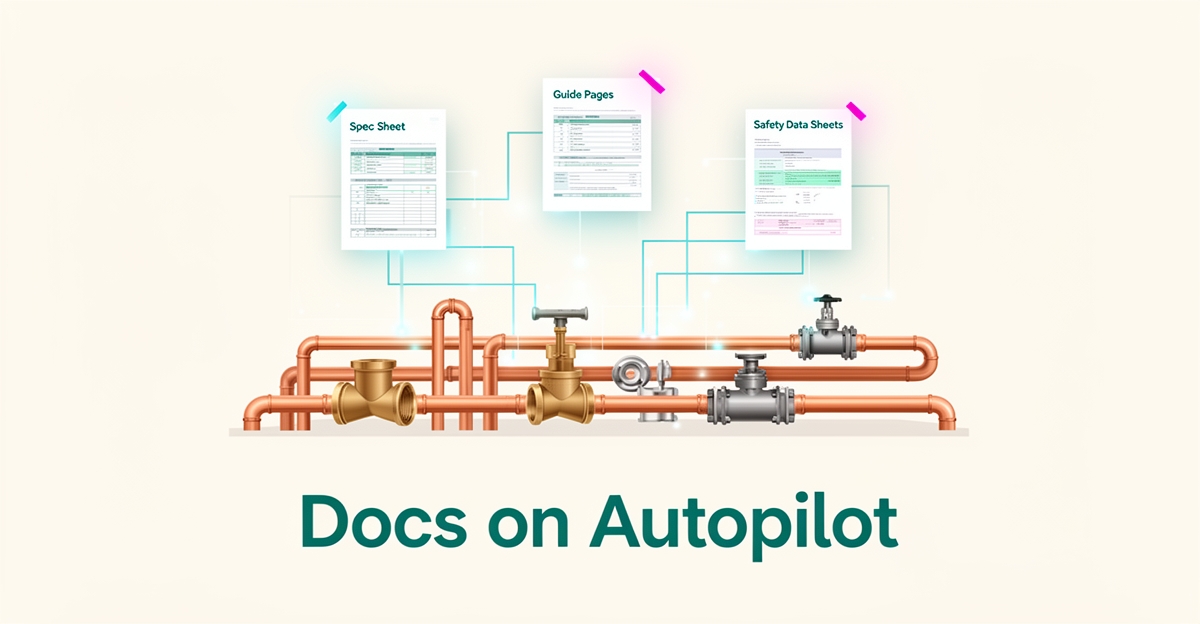
How AI Can Automate Technical Documentation for Plumbing Supply Products
Key Facts
- Automation reduces human intervention by predetermining decision criteria, improving quality, accuracy, and precision across documentation workflows
- AI agents can monitor product databases and regulatory feeds in real time to trigger documentation revisions as changes occur
- Mature workflow platforms offer hundreds of integrations, connecting ERP, inventory, and documentation systems without custom code
- AIQ Labs has deployed 200+ multi-agent systems and runs 4 live SaaS products daily, so the approach is proven in production—not theoretical
- AI enables plumbing companies to handle repetitive data-heavy tasks, freeing experts for engineering and customer engagement
Hire a team member that works 24/7 — for less than a part-time wage.
AI receptionists, SDRs, dispatchers and 99+ roles. Trained on your business, fully managed.
Not sure where to start? Ask our AI planner
The Hidden Cost of Manual Documentation in Plumbing Supply Chains
Manual documentation in plumbing supply chains creates a silent drain on resources that grows with product complexity. Updating installation guides, safety data sheets, and product specs across thousands of SKUs requires constant human intervention, turning what should be a straightforward update into a labor-intensive bottleneck. This process is not only slow but inherently error-prone, as repetitive data entry across vast inventories increases the likelihood of inconsistencies that can compromise safety and compliance. Automation directly addresses these quality, accuracy, and precision gaps by predetermining decision criteria and reducing manual touchpoints.
The scale of this inefficiency becomes critical when considering regulatory frequency and product lifecycle demands. Plumbing supply companies face evolving safety standards, material regulations, and installation code updates that require timely documentation revisions. Without automation, each change necessitates manual edits across dozens of documents per SKU—a task that scales linearly with product count and update frequency. AI excels at handling repetitive, data-heavy tasks like updating thousands of product pages, freeing human experts to focus on complex engineering and customer engagement rather than administrative overhead.
This operational burden extends beyond inefficiency—it introduces tangible compliance risks. Outdated safety data sheets or installation guides can lead to liability issues, failed inspections, or unsafe product use, particularly when regulations change mid-cycle. Manual systems lack the agility to synchronize updates across ERP systems, customer portals, and field support teams in real time. Internal tool platforms that integrate with dozens of databases demonstrate how synchronized data flows are essential for maintaining accuracy across complex inventories, a capability manual processes simply cannot match at scale. The result is a growing gap between what is documented and what is actually compliant—a gap that widens with every product update and regulatory shift.
How AI Agents Generate and Update Documentation in Real Time
Product data changes constantly, and manual updates to specs, installation guides and SDS create lag, errors and compliance risk. AI agents close that gap by watching source systems and triggering documentation revisions the moment a change occurs.
Agentic workflows monitor product databases and regulatory feeds in real time. When a SKU revision, material update or new safety regulation is published, the system applies predetermined decision criteria to reduce human intervention and improve quality, accuracy and precision. This approach delivers labor savings and consistency improvements at scale.
Workflow platforms provide the connective tissue. Modern automation platforms offer native AI capabilities with hundreds of integrations, while production-ready agentic workflow tools orchestrate multi-step documentation pipelines reliably. The broader automation ecosystem—spanning tens of thousands of open-source projects—means the building blocks for custom documentation pipelines are mature and widely available.
Internal tooling makes the data usable. Low-code internal tool platforms connect to a wide range of databases for building dashboards that manage complex plumbing supply inventories. This depth of connectivity is essential for seamless data synchronization between ERP, inventory and documentation portals.
The real-time loop works as follows:
- Change detection agents poll product databases, ERP systems and regulatory feeds for updates
- Validation agents confirm the change scope and required document types, such as specs, installation guides or SDS
- Generation agents regenerate documents with updated values, compliance language and version history
- Publishing agents push revisions to customer portals, internal knowledge bases and partner systems automatically
This architecture mirrors how AI automates estimates and invoicing by selecting inputs and producing professional documents in seconds. The same logic applies to technical documentation so data delivered to customers is always current.
AI is a complement to human expertise, not a replacement. Industry analysis consistently emphasizes that AI enhances skilled work with data-driven insights, freeing experts to focus on engineering challenges and strategic decisions while every piece of paperwork handles itself.
For plumbing supply companies, the outcome is instant, accurate revisions to specs and SDS without manual intervention. AIQ Labs builds internal knowledge systems that maintain up-to-date, compliant documentation across product lines, ensuring customer communications stay accurate as products and regulations evolve. If you want to start with a single high-cost workflow instead of a full system, an AI Workflow Build targets exactly the one process that drains the most hours.
Building and Scaling an Internal AI Documentation System with AIQ Labs
Plumbing supply businesses face mounting pressure to keep technical documentation accurate and compliant as product lines expand and regulations evolve. Manual updates to installation guides, safety data sheets, and product specs create bottlenecks that slow customer support and increase error risk. An internal AI documentation system solves this by automating generation and synchronization directly from ERP and inventory data, ensuring every customer-facing document reflects the latest specifications without manual intervention.
AIQ Labs enables this through three entry points—AI Employees for managed AI staff that handle documentation and support tasks at roughly 80% less cost than a human hire, AI Workflow Builds for rebuilding the one workflow that costs the most at a fixed price, and AI Operating Systems for a single connected operating layer built in phases and owned outright. Starting with needs discovery, the team maps which product lines require automated documentation and identifies regulatory triggers that should initiate updates. This phase defines an AI approach that fits the business's operational reality, avoiding over-engineering while ensuring coverage across critical SKUs.
Design focuses on creating intuitive internal tools for managing documentation workflows and clear, brand-aligned customer-facing outputs. Interfaces are tailored to how plumbing supply teams interact with product data—whether through inventory managers updating SKUs or support teams retrieving installation guides—ensuring generated specs are easy to read, navigate, and act upon. This design clarity reduces training time and increases adoption across departments, turning documentation from a chore into a seamless operational function.
Development involves configuring AI agents to understand product specifications, safety regulations, and installation requirements using proven technologies like multi-agent workflow orchestration and retrieval-augmented generation. These agents are trained on the company's specific data structures, enabling them to interpret changes in product databases and instantly regenerate affected documentation. Integration with ERP and CRM systems via API ensures that when a product spec changes—such as a new material compliance requirement or updated pressure rating—the AI automatically triggers documentation updates without human prompting.
Ongoing optimization maintains system performance, security, and reliability as the business scales. This includes monitoring data synchronization accuracy, validating that generated documents meet quality and compliance standards, and refining agents based on feedback from support teams and customers. As new products are added or regulations shift, the system adapts continuously, preserving accuracy while eliminating the administrative burden of manual updates. For plumbing supply companies, this means faster response to market changes, reduced risk of outdated safety information, and the ability to scale documentation efforts without proportional increases in staff—turning a cost center into a competitive advantage. With 200+ multi-agent systems deployed and 4 live SaaS products the company runs daily, AIQ Labs builds systems it operates itself—not slideware.
Still paying for 10+ subscriptions that don’t talk to each other?
We build custom AI systems you own outright. No vendor lock-in. Full control.
Not sure where to start? Ask our AI planner
Frequently Asked Questions
How does AI actually keep installation guides and SDS up to date without manual edits?
Will AI replace the people who currently manage our technical documentation?
What technology stack is proven for automating plumbing supply documentation?
Is automation mature enough to handle compliance and safety data sheets reliably?
How long does it take to build an internal AI documentation system?
What's the easiest way to start without a huge upfront commitment?
Turning Documentation from Burden to Business Advantage
AI-powered documentation automation transforms a costly, error-prone chore into a strategic asset for plumbing supply companies. By replacing manual updates with real-time, agent-driven workflows, businesses eliminate compliance risks, reduce administrative overhead, and free skilled teams to focus on engineering and customer engagement—not paperwork. The result is faster response to market changes, consistent accuracy across thousands of SKUs, and scalable operations without proportional staff growth. For companies ready to stop chasing documentation updates and start leveraging them as a competitive edge, the path forward begins with clarity. Take the 2-minute Fit Check at aiqlabs.ai/apply and schedule a free 30-minute strategy call to explore how AIQ Labs can build an owned, internal knowledge system that keeps your specs, guides, and safety sheets perpetually current—so every piece of paperwork handles itself. Questions first? Reach the team at [email protected].
Make AI your competitive advantage — not just another tool.
Strategy, implementation and ongoing optimization. One partner, end to end.
Not sure where to start? Ask our AI planner