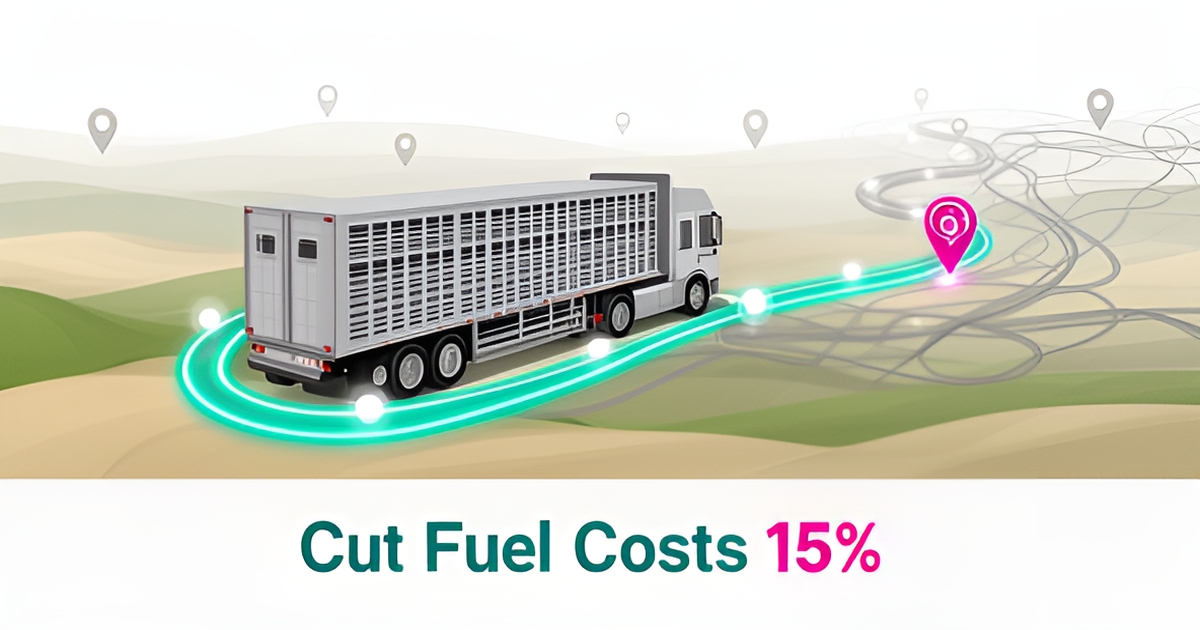
How AI Can Cut Fuel Costs by 15% in Livestock Hauling Operations
Key Facts
- AI route optimization typically cuts fuel costs by around 15% for livestock haulers through compounding efficiencies like terrain avoidance and real-time rerouting according to Metronome Labs
- Fleets commonly waste 5-10% of their annual operating budget on preventable fuel inefficiencies, costing $25,000-$50,000 yearly for a 50-truck operation per industry research
- AI can reduce suboptimal routing waste from 8-12% extra miles to just 2-3% by evaluating large numbers of variables simultaneously per Metronome Labs analysis
- Fuel price optimization can capture roughly $0.15 per gallon in savings across fill-ups, with station spreads often exceeding $0.30/gallon per Metronome Labs breakdown
- Idling reduction of 45 minutes per truck daily can save roughly 3,000 gallons annually for a 20-truck fleet, worth about $12,000 in fuel per Metronome Labs data
- Predictive congestion avoidance can save 30 minutes in heavy traffic per vehicle per day, reducing fuel burn by an estimated 2,500 gallons yearly per Metronome Labs analysis
- Terrain-aware routing improving fleet MPG by 0.1 can save roughly 5,300 gallons (about $21,200) annually for a 20-truck fleet per Metronome Labs breakdown
Hire a team member that works 24/7 — for less than a part-time wage.
AI receptionists, SDRs, dispatchers and 99+ roles. Trained on your business, fully managed.
Not sure where to start? Ask our AI planner
The Hidden Fuel Drain in Livestock Hauling: Why Traditional Methods Fail
Livestock haulers lose money on fuel long before the engine starts—wasting resources on preventable inefficiencies that manual planning and basic GPS simply cannot fix. Traditional methods treat fuel management as a backward-looking exercise, documenting waste after it occurs rather than preventing it in real time. Industry research indicates fleets commonly waste between 5% and 10% of their annual operating budget on preventable fuel inefficiencies—translating to $25,000 to $50,000 lost annually for a mid-sized 50-truck operation spending $500,000 on diesel.
These losses stem from four interconnected blind spots: excessive idling during loading/unloading waits, inefficient routing that ignores terrain and traffic, poor load sequencing that creates unnecessary miles, and static planning that fails to adapt to changing conditions. Detailed analysis shows traditional routing adds 8-12% extra miles due to suboptimal stop sequencing alone—a figure AI-driven systems can reduce to just 2-3% by evaluating large numbers of variables simultaneously. Meanwhile, human planners can effectively process only 5-10 variables at once, while AI analyzes hundreds including real-time traffic, weather, fuel pricing, hours-of-service constraints, and vehicle-specific fuel consumption patterns.
The compounding effect of these inefficiencies is especially costly in livestock hauling, where weight shifts, time-sensitive deliveries, and animal welfare constraints create uniquely complex routing challenges. Basic GPS navigation answers only the simplest question—what's fastest from Point A to Point B right now—while ignoring the multi-stop sequencing, terrain avoidance, and fuel price optimization that collectively drive savings. Further evidence suggests AI route optimization can cut fuel costs by 20-30% through adaptability: continuously learning from historical data, monitoring execution in real-time, and updating routes mid-operation without manual intervention. For livestock operators, this means transforming fuel from an uncontrollable expense into a recoverable margin—one hill, idle minute, or inefficient sequence at a time. AIQ Labs builds custom systems that expose these hidden drains and turn them into measurable savings.
How AI Route Optimization Delivers Measurable Fuel Savings in Livestock Transport
AI route optimization doesn't just find shorter paths — it rewrites the economics of livestock hauling by processing hundreds of variables simultaneously. Where human planners juggle five to ten factors, AI systems evaluate real-time traffic, weather patterns, terrain gradients, fuel pricing differentials, hours-of-service limits, and predictive congestion models across an entire fleet at once.
The compounding effect is measurable. Metronome Labs breaks down the roughly 15% fuel savings into five distinct efficiencies: multi-stop sequencing that eliminates 120,000 excess miles annually for a 20-truck fleet, fuel price optimization capturing $0.15 per gallon across fill-ups, terrain-aware routing improving fleet MPG by 0.1, idling reduction of 45 minutes per truck daily, and predictive congestion avoidance saving 30 minutes in heavy traffic per vehicle per day. Together, these factors can add up to $173,200 in direct fuel savings against a $1.33 million baseline.
- Multi-stop optimization reduces suboptimal sequencing waste from 8-12% to 2-3% of total miles
- Fuel price intelligence exploits station spreads that often exceed $0.30 per gallon
- Terrain-aware routing avoids climbs where a 12-mile longer flat route burns less diesel
- Hours-of-service compliance baked into every route prevents costly violations and re-routing
UPS proved the model at scale — its ORION system cuts 100 million delivery miles annually while continuously learning from every completed route. The same principle applies to livestock operations where animal welfare windows, weight distribution, and facility readiness add constraint layers that static routing cannot handle. Research confirms that fleet-wide coordination — optimizing all trucks simultaneously rather than individually — enables load consolidation and delivery sequencing impossible for standalone GPS units.
AIQ Labs builds custom AI systems that ingest historical trip data, live traffic feeds, and terrain maps to design routes that respect both biology and balance sheets. The result: fuel efficiency gains that compound across every mile, every load, every day.
From Data to Dollars: Implementing AIQ Labs' Custom AI System for Livestock Haulers
Most AI implementations fail because they force businesses to abandon the tools they already use. AIQ Labs takes a different approach: we build custom AI systems that integrate directly with your existing CRM, dispatch software, and telematics platforms, creating a unified operational intelligence layer that learns from every delivery. Unlike generic routing software that relies on static algorithms, our systems process hundreds of variables simultaneously—traffic patterns, terrain, weather, delivery windows, and vehicle capacity—to design routes that minimize fuel consumption without disrupting your workflow.
The implementation process begins with a deep analysis of your historical delivery data. According to industry research, AI algorithms can process hundreds of variables at once while human planners effectively handle only 5-10. This capability gap explains why traditional routing methods leave 8-12% extra miles on the table due to suboptimal sequencing, while AI can reduce that waste to just 2-3%. Our systems continuously learn from each completed delivery, creating a feedback loop that improves route efficiency over time rather than remaining static.
For livestock haulers, this means the AI accounts for animal welfare constraints, weight distribution, and time-sensitive delivery windows while optimizing for fuel efficiency. The system automatically reroutes around congestion, avoids terrain that increases fuel burn, and sequences stops to minimize total miles. Real-time adjustments happen without dispatcher intervention, though centralized dashboards provide full visibility when human oversight is needed.
If you want to start smaller, an AI Workflow Build targets the single most expensive workflow in your operation—often dispatch or route planning—rebuilt at a fixed price in phases. For haulers who want AI handling routine coordination end to end, AI Employees can cover roles like dispatch coordinators and scheduling staff at roughly 80% less than a human hire. And for operations ready to connect routing, dispatch, telematics, and billing into one layer, AI Operating Systems deliver a connected operating layer built in phases and owned outright.
AIQ Labs structures these implementations through three flexible payment models designed for SMB budgets:
- Start Monthly — Setup plus a flat monthly plan that costs less than a part-time hire, with build, training, integrations, monitoring, and improvements included. Pause or adjust anytime.
- Build in Milestones — Split the project into phases, approve and pay for each as it ships, and stop anytime while keeping everything built so far.
- Own It Outright — Full ownership of the code, agents, and data with one project price or a monthly Build Partnership, eliminating vendor lock-in entirely.
This approach delivers enterprise-grade optimization without the enterprise price tag or operational disruption. A recent analysis found that AI route optimization can reduce fuel costs by roughly 15% through compounding efficiencies: shorter routes, smarter fuel purchasing, terrain avoidance, reduced idling, and congestion avoidance. For a 20-truck fleet spending $1.33 million annually on fuel, that translates to as much as $173,200 in direct savings—savings that begin accumulating as soon as the system goes live.
Because clients own the systems we build, there are no ongoing subscription fees or platform dependencies. The AI becomes a permanent operational asset that continues improving as it processes more of your delivery data, ensuring the fuel cost reduction isn't a one-time gain but a sustained competitive advantage. AIQ Labs has deployed 200+ multi-agent systems and runs four live SaaS products daily—so the approach is proven in production, not just in theory.
Still paying for 10+ subscriptions that don’t talk to each other?
We build custom AI systems you own outright. No vendor lock-in. Full control.
Not sure where to start? Ask our AI planner
Frequently Asked Questions
How does AI route optimization actually reduce fuel costs in livestock hauling?
What's the difference between AI routing and the GPS system I already use?
How much can a mid-sized livestock hauling fleet realistically save?
Will AI routing work with the animal welfare constraints and delivery windows we deal with?
How long does it take to see ROI from AI route optimization?
What happens to our existing dispatch software and telematics systems?
Stop Paying the Fuel Tax: Turn Route Waste Into Working Capital
The math is no longer theoretical: AI route optimization can cut fuel costs by roughly 15% through compounding efficiencies—smarter sequencing, terrain avoidance, and real-time adjustments—that manual planning cannot replicate. For livestock haulers, this means transforming your largest variable expense into recoverable margin while respecting animal welfare constraints and delivery windows. Industry analysis confirms these systems process hundreds of variables simultaneously, turning as much as $173,200 in annual savings for a 20-truck fleet from projection into operational reality. AIQ Labs builds custom systems that integrate with your existing dispatch and telematics tools, ensuring you own the asset outright rather than renting another subscription. Ready to see what your operation is leaving on the table? Start the two-minute Fit Check to identify your highest-ROI automation opportunity, or book a free 30-minute strategy call to map your implementation. If there isn't a clear win, we'll tell you—no obligation, just clarity.
Make AI your competitive advantage — not just another tool.
Strategy, implementation and ongoing optimization. One partner, end to end.
Not sure where to start? Ask our AI planner