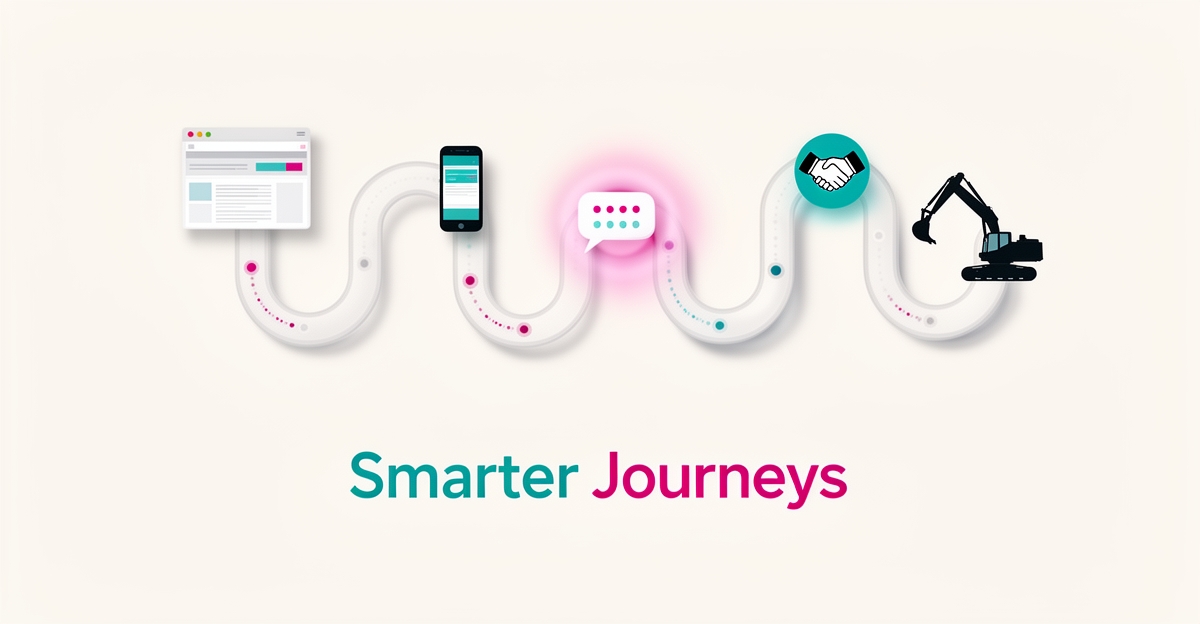
How AI Can Improve Customer Journey Mapping in Equipment Sales
Key Facts
- AI can track customer interactions across multiple channels—such as websites, social media, and mobile apps—providing a unified view of the journey according to research
- The '10-20-70 rule' states that 70% of the effort in successful AI transformation should focus on people and processes, not just technology as noted by Miro
- AI-driven predictive analytics can forecast future customer behavior based on past interactions to anticipate next steps and proactively optimize touchpoints per industry analysis
- Traditional journey maps often rely on assumptions and anecdotal evidence, becoming outdated the moment they're finished per Miro research
- AI enables micro-segmentation by creating highly specific customer groups based on actual behavior rather than broad personas per behavioral data research
- Dedicated journey mapping tools can run into the thousands of dollars per month at the enterprise tier—a significant investment for static outputs per industry analysis
- AI automates the tedious tasks of data collection, analysis, and map creation, freeing teams to focus on strategy and problem-solving per automation research
Hire a team member that works 24/7 — for less than a part-time wage.
AI receptionists, SDRs, dispatchers and 99+ roles. Trained on your business, fully managed.
Not sure where to start? Ask our AI planner
Why Static Journey Maps Fail Equipment Sales Teams
Picture this: your sales team spends three weeks building a detailed customer journey map, prints it out, pins it to the wall—and it's obsolete before the first quarterly review. That's the reality for most equipment sales teams relying on traditional mapping methods.
The core problem is that conventional journey maps are built on assumptions rather than evidence. As research from Miro notes, teams "spend weeks crafting detailed maps, only for them to become outdated the moment they're finished," and these maps "often rely on assumptions and anecdotal evidence." In equipment sales—where a single deal can stretch across months and involve procurement managers, operations leads, and finance stakeholders—guesswork compounds quickly.
Static maps fail in three predictable ways:
- They capture a moment, not a movement. A map created in January can't reflect the shifting priorities, budget changes, or new stakeholders that emerge by June in a long decision cycle.
- They miss hidden friction points. Manual mapping depends on what sales reps remember or assume, not on where customers actually drop off or experience frustration across touchpoints.
- They treat all buyers the same. Broad personas replace the granular, behavior-based understanding needed when multiple decision-makers each follow their own path to a purchase.
The manual process itself is part of the failure. Traditional mapping requires time-consuming data collection and sorting, and the resulting insight is only as good as human recall and anecdote. Research on AI-powered journey mapping shows that AI can track customer interactions across websites, social media, and other channels to reveal the entire journey—something no workshop sticky-note session can replicate. Without that unified view, friction points in complex equipment sales cycles simply go undetected until a deal stalls or a customer quietly walks away.
There's also a cost dimension teams often overlook. Dedicated journey mapping tools can carry significant price tags at the enterprise tier—industry analysis notes that top plans from vendors like Custellence and TheyDo can run from roughly $2,000 per month into the tens of thousands per year—a steep investment for a static output that requires constant manual updating to stay relevant.
This is where the shift to AI-driven journey optimization becomes practical rather than theoretical. AIQ Labs builds systems that analyze every customer interaction from initial inquiry through service completion, surfacing friction points in real time and suggesting process improvements—turning the journey map from a dusty artifact into a living tool that drives satisfaction and repeat business. The lesson from failed AI initiatives applies here too: the 10-20-70 rule reminds us that 70% of the effort belongs on people and processes, not just technology.
How AI Creates Dynamic, Data-Driven Journey Maps
AI is transforming customer journey mapping from a static exercise into a dynamic, continuously updated strategic asset. By unifying data from every touchpoint—website visits, sales calls, service interactions—AI creates a real-time view of the customer experience that evolves with each new interaction. This shift allows equipment sellers to move beyond assumptions and base decisions on actual behavior patterns.
Machine learning algorithms analyze vast datasets to uncover hidden correlations and identify friction points where customers struggle or disengage. Natural language processing interprets sentiment from support tickets, chat logs, and feedback surveys to gauge emotional responses at each stage. Predictive analytics then forecasts future actions, such as when a customer might be ready for an upgrade or at risk of churning, enabling proactive engagement. These technologies work together to transform journey mapping into a living document that adapts as customer behavior changes.
- AI tracks customer interactions across multiple channels—such as websites, social media, and mobile apps—providing a unified view of the journey
- AI analyzes customer data to identify pain points, such as where customers drop off or experience frustration
- AI-driven predictive analytics forecasts future customer behavior based on past interactions
This data-driven approach enables micro-segmentation, moving beyond broad personas to create highly specific customer groups based on actual behavior. AI can predict the "next best action" for each segment, allowing for personalized outreach that feels uniquely tailored. For equipment sales—where journeys are often complex and involve multiple stakeholders—this level of insight helps optimize long sales cycles and improve post-sale service. AIQ Labs implements these capabilities through AI Workflow Builds that unify touchpoint data in a single system, and for teams ready to go further, an AI Operating System that connects journey insight to quoting, service, and follow-up—turning customer experience into a proactive, strategic advantage.
Implementing AI Journey Mapping: From Insight to Action in Equipment Sales
AI-powered journey mapping turns the equipment sales funnel from a static diagram into a living system that learns from every inquiry, quote, and service call. For complex, high-value purchases with multiple stakeholders, that real-time visibility is the difference between guessing and acting.
Equipment buyers move through five essential stages — Awareness, Interest, Evaluation, Decision, and Retention — and AI tracks movement across all of them without manual stitching. According to channel tracking analysis, AI can track customer interactions across websites, social media, and mobile apps to reveal the entire journey, and behavioral data research shows AI can personalize each step by analyzing individual preferences and behaviors.
Implementation works best as a disciplined framework, not a tool rollout. AIQ Labs deploys AI systems that analyze every interaction and suggest process improvements, leading to higher satisfaction and repeat business, with validation built into each step.
A practical 6-step deployment looks like this:
- Define goals and key questions to frame the map around drop-offs, not assumptions.
- Consolidate quantitative and qualitative data from CRM, web analytics, support tickets, and service records into a single source of truth.
- Let AI analyze and identify patterns to surface stages, touchpoints, sentiment shifts, and drop-off points.
- Visualize the journey on a collaborative canvas like Miro, which offers a wide range of integrations for pulling data into the mapping process.
- Validate AI findings with domain expertise, cluster insights, and assign actions to reduce friction.
- Continuously iterate as new data arrives to keep the map current and predictive.
On the visualization side, Miro's AI guidance explains how AI can instantly cluster sticky notes by keyword to find patterns or summarize long research threads—useful for the validation and clustering steps above.
The 10-20-70 rule reminds teams that 70% of the effort should focus on people and processes, not just technology. AI transformation research warns that initiatives fail when technology is prioritized over adoption, and cross-functional validation is what turns data into decisions.
Predictive analytics then shifts the team from reactive to proactive. AI can forecast future customer behavior based on past interactions, anticipate the next steps in the journey, and proactively optimize touchpoints. That capability is critical for post-sale retention in equipment sales, where upgrade timing and service completion drive repeat business.
Automation completes the loop. AI automates the tedious tasks of data collection, analysis, and map creation, freeing sales and service leaders to focus on strategy and problem-solving. The map stays a living, breathing entity that not only shows where customers have been but predicts where they're going next.
Still paying for 10+ subscriptions that don’t talk to each other?
We build custom AI systems you own outright. No vendor lock-in. Full control.
Not sure where to start? Ask our AI planner
Frequently Asked Questions
Why do traditional customer journey maps fail for equipment sales teams?
How does AI create dynamic, data-driven customer journey maps?
What are the five essential stages of the customer journey in equipment sales that AI can track?
What is the 10-20-70 rule and why is it important for AI journey mapping implementation?
Can AI predict when an equipment customer is ready for an upgrade or at risk of churning?
What are the key steps to implement AI-powered journey mapping in equipment sales?
Turn Your Journey Map from Artifact to Advantage
Static journey maps built on assumptions drain time and miss critical friction points in complex equipment sales cycles. AI transforms this process into a living system that tracks real-time behavior across touchpoints, identifies hidden drop-offs, predicts future actions, and enables micro-segmentation for personalized engagement—turning guesswork into data-driven strategy. By focusing 70% of effort on people and process (as the 10-20-70 rule emphasizes), equipment sellers can deploy AI journey mapping that continuously evolves with each customer interaction, driving satisfaction, repeat business, and competitive advantage. To see how this applies to your specific sales cycle, start with a free two-minute Fit Check at https://aiqlabs.ai/apply, followed by a no-obligation 30-minute strategy call to map your biggest bottleneck and uncover high-ROI AI opportunities.
Make AI your competitive advantage — not just another tool.
Strategy, implementation and ongoing optimization. One partner, end to end.
Not sure where to start? Ask our AI planner