How AI Can Personalize Support for Students with Different Learning Needs
Key Facts
- Most K-12 teachers report little to no professional learning on using AI in the classroom, making training the first bottleneck to solve
- Education stakeholders broadly agree that essential learning skills must remain a focus of public education, with AI serving, not replacing, those goals
- Educators who use AI as a classroom learning assistant typically reclaim several hours per week from routine administrative work
- AI is not a replacement for education, but a tool to enhance it, a principle that should guide every deployment
- AI-personalized learning plans work best when they adapt as student needs shift, rather than locking learners into static groupings
Hire a team member that works 24/7 — for less than a part-time wage.
AI receptionists, SDRs, dispatchers and 99+ roles. Trained on your business, fully managed.
Not sure where to start? Ask our AI planner
The One-Size-Fits-All Problem: Why Student Support Breaks Down
Every classroom holds a different mix of needs, yet support systems are built for the average student.
Traditional models ask teachers to stretch individualized plans, administrative work, and feedback loops across an entire class without the capacity to personalize at scale. The result is delayed interventions, generic communication, and learners who slip through the cracks.
The capacity gap is not about intent. Educators are managing administrative tasks that could be automated while also trying to provide the real-time feedback students value. AI can deliver that feedback in the moment, but in most institutions the capability rarely reaches the classroom floor.
Training is a critical bottleneck. As of late 2026, most K-12 teachers still report receiving little or no professional learning about using artificial intelligence in the classroom. Without literacy and practice, even promising tools remain underused, and the gap between what is possible and what is practiced widens.
One-size-fits-all support breaks down in predictable ways:
- Individualized plans become paperwork instead of live guidance
- Feedback is batched weekly rather than delivered in the moment
- Communication to families is generic and reactive
- Teachers absorb repetitive tracking, leaving less time for instruction
The pressure is compounded by a shared conviction that fundamentals matter. Education stakeholders overwhelmingly agree that essential learning skills, literacy, numeracy, research, critical thinking, need to remain the focus of public education. Personalization should protect those skills, not replace them.
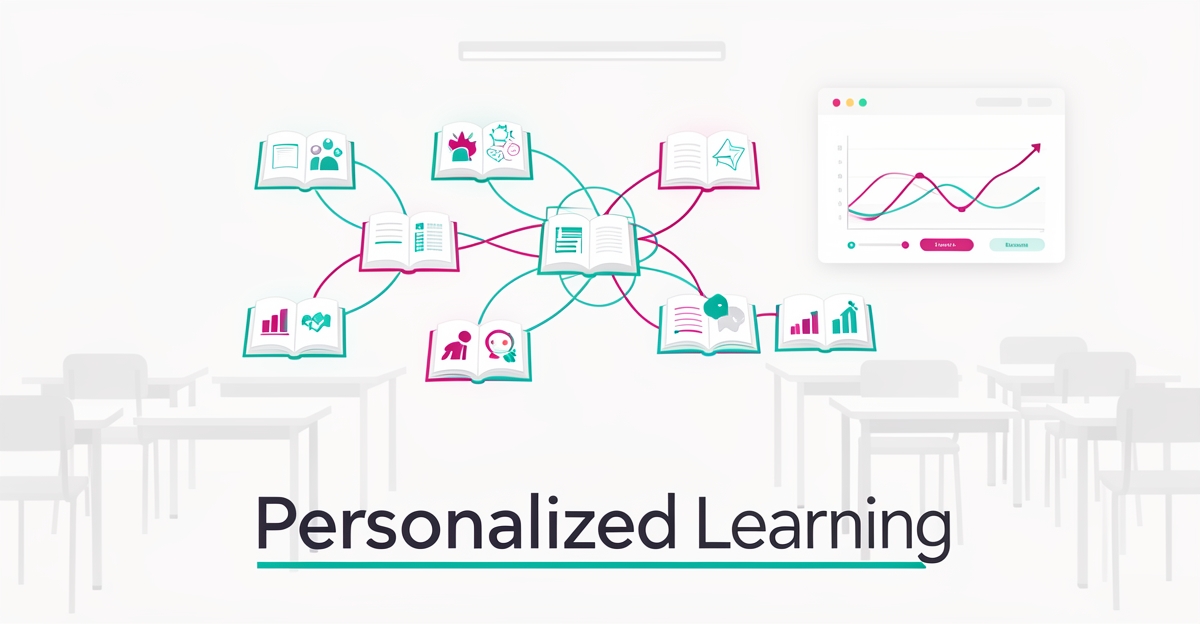
This is where a student-centered care model changes the equation. By analyzing behavior and learning patterns, AI can map each learner's trajectory and trigger timely, relevant interventions and communication. AI-personalized learning plans can adapt as needs shift, rather than locking students into static groupings.
In practice, that means support moves from reactive to anticipatory. Instead of waiting for a summative assessment, the system flags early signals, suggests scaffolds, and keeps families informed with context, not just scores. For institutions exploring AI Customer Journey Optimization, the classroom is a journey with distinct touchpoints where timely, personalized outreach sustains engagement.
AIQ Labs approaches this through adaptive, student-centered care models that treat support as a continuous conversation, not a batch process. When personalization is built into the workflow, educators regain capacity for the human work only they can do, while learners receive the right help at the right time.
How AI Delivers Personalized Learning Plans and Real-Time Feedback
Every student learns differently, yet traditional classrooms treat them as if they don't. AI is changing that equation by analyzing how each student engages with material and adapting instruction to fit their unique patterns, pace, and needs.
At its core, AI personalization works through continuous analysis. These systems track student behavior, where they struggle, how quickly they progress, what formats they respond to, and use those insights to build individualized learning plans tailored to each learner. That gives educators a structured starting point rather than a one-size-fits-all curriculum.
Real-time feedback is the second pillar. Instead of waiting days for a graded assignment, students receive immediate responses that help them correct misunderstandings while the material is still fresh. Students at institutions like UC Berkeley have embraced this approach, using AI as a learning partner that offers instant guidance alongside traditional instruction. The philosophy behind that model matters: AI is not a replacement for education, but a tool to enhance it.
The third capability is often overlooked but arguably the most transformative for educators: automating administrative tasks. When AI handles routine paperwork and tracking, teachers reclaim time for the human work of teaching. Classroom implementations typically suggest educators can save several hours a week when AI acts as a learning assistant, time that can be redirected toward students with the greatest needs.
What effective AI-powered personalization typically looks like:
- Learning plans generated from observed student behavior, not assumptions
- Real-time feedback that catches misconceptions the moment they form
- Automated administrative workflows that free educator time
- Ongoing analysis that adjusts support as student needs evolve
The caveat is critical: AI-generated content must be critically evaluated to ensure it aligns with pedagogical goals. And because most teachers have had little formal AI training, that evaluation skill has to be built deliberately before these tools deliver their full value.
This is where thoughtful implementation matters. Adaptive, student-centered systems only work when the AI behind them is designed around real learner data and clear educational objectives, principles that guide how we approach student-focused AI systems at AIQ Labs. The goal is never to automate education itself, but to give both students and educators a smarter, more responsive foundation for learning.
The Human-in-the-Loop Requirement: Oversight Makes or Breaks AI Personalization
The most dangerous AI in education isn't the one that makes mistakes, it's the one that operates without a teacher watching. When institutions deploy personalization algorithms without pedagogical oversight, they risk automating inequality rather than eliminating it.
The solution lies in maintaining what researchers call "active oversight." In technical fields where AI delegation is most advanced, quality holds only when humans continuously supervise delegated work. The same principle translates directly to classrooms: AI can grade papers, suggest resources, and adapt curricula, but only when educators review outputs, adjust parameters, and intervene when the algorithm misunderstands a student's actual needs.
This oversight requirement becomes clearer when we consider what actually matters in education. Education stakeholders overwhelmingly agree that essential learning skills, literacy, numeracy, research, and critical thinking, must remain the focus of public education. AI should serve these goals, not replace them with efficiency metrics or engagement scores.
Yet a significant gap threatens this balance. Most K-12 teachers still report receiving no meaningful professional learning about AI in the classroom. Without AI literacy, educators cannot distinguish between a helpful personalization suggestion and a biased algorithmic recommendation. They cannot catch when the system prioritizes test scores over genuine understanding, or when it misinterprets a student's struggle as disengagement.
Effective human-in-the-loop AI requires specific competencies:
- Critical evaluation of AI-generated content against pedagogical objectives
- Recognition of algorithmic bias and data limitations
- Strategic intervention when automated personalization misses contextual nuance
- Maintenance of student agency within adaptive learning pathways
As the UC Berkeley learning-partner framework puts it, "AI is not a replacement for education, but a tool to enhance it." This philosophy drives how AIQ Labs approaches adaptive, student-centered care models, building systems where machine intelligence handles pattern recognition and administrative load, while human educators retain authority over learning objectives and student welfare.
The goal isn't to remove humans from the loop, but to elevate their role within it. When teachers understand AI capabilities and limitations, they transform from passive consumers of algorithmic output into active directors of personalized learning experiences. This shift, from automation to augmentation, determines whether AI narrows or widens educational equity.
Implementing AI Personalization: A Practical Roadmap for Education Providers
Knowing where to start is often the hardest part of AI adoption in education. A clear, phased roadmap turns a vague ambition, "personalize support for every learner", into a sequence of decisions an institution can actually execute.
Step 1: Define your objectives. Before evaluating any tool, articulate precisely what personalization should accomplish: adaptive learning plans, real-time feedback, or automated administrative relief. AI-personalized learning plans only deliver value when tied to measurable outcomes like completion rates or mastery of core skills.
Step 2: Assess readiness honestly. Readiness is as much human as technical. With most teachers still reporting little or no AI training, staff development is not optional, it is the foundation. Map your current data infrastructure, communication channels, and team capability before choosing architecture.
Step 3: Choose the right system architecture. Effective personalization requires systems that can analyze student behavior, trigger interventions, and adapt communication across the student journey, not isolated chatbots. This is the approach AIQ Labs takes when building admissions, course-building, and student communication systems for education providers, architecting them as unified, adaptive platforms the institution owns outright rather than renting from a vendor. If you want to start smaller, a single AI Workflow Build can rebuild the one process that costs you the most, then expand from there.
Step 4: Train staff and build AI literacy. Educators need to understand both what the system does and where its limits are. The same principle applies across industries: even teams that integrate AI into most of their work maintain active human oversight of delegated tasks. Human judgment stays in the loop.
Step 5: Evaluate AI-generated content against pedagogical goals. This step never ends. Every generated lesson, message, or learning plan should be checked for alignment with learning objectives and for bias or inaccuracy. Education stakeholders broadly agree that essential skills, literacy, numeracy, research, critical thinking, must remain the focus of education, and AI should serve that focus, not dilute it.
A practical checklist for implementation:
- Define measurable objectives tied to student outcomes, not technology features.
- Audit data infrastructure and staff AI literacy before selecting tools.
- Choose architecture that connects admissions, instruction, and communication into one adaptive system.
- Invest in role-specific staff training with human-in-the-loop controls.
- Review AI-generated content continuously against pedagogical standards.
As the UC Berkeley perspective puts it, "AI is not a replacement for education, but a tool to enhance it." Institutions that follow a disciplined roadmap, and own the systems they deploy, are the ones positioned to make that enhancement stick.
Still paying for 10+ subscriptions that don’t talk to each other?
We build custom AI systems you own outright. No vendor lock-in. Full control.
Not sure where to start? Ask our AI planner
Frequently Asked Questions
How much time can teachers actually save by using AI as a classroom learning assistant?
Is AI meant to replace teachers in personalized learning?
Why is teacher training such a critical bottleneck for AI adoption in schools?
How does human oversight actually work when AI personalizes learning plans?
What does AI-powered personalization look like in practice for students?
Where should an education provider start when implementing AI personalization?
Where Technology Meets the Human Touch in Learning
Personalizing student support with AI isn't about replacing educators, it's about giving them back the time and insights to do what only humans can do: inspire, mentor, and adapt in real time. This article showed how AI can analyze learning patterns, deliver immediate feedback, and automate routine tasks, but its true value emerges when educators remain in the loop, using these tools to spot needs earlier and intervene more effectively. For education providers looking to move beyond one-size-fits-all support, the path forward starts with clear objectives, honest readiness assessments, and systems designed for continuous human oversight. When AI handles the pattern recognition and paperwork, teachers can focus on the nuanced work of guiding each learner's journey. To explore how adaptive, student-centered care models can work in your institution, built on owned infrastructure and aligned with your pedagogical goals, start with our 2-minute Fit Check, then book a free 30-minute strategy call to map your highest-impact opportunities. Schedule your 30-minute strategy session to see where AI can strengthen, not replace, the human core of education.
Make AI your competitive advantage — not just another tool.
Strategy, implementation and ongoing optimization. One partner, end to end.
Not sure where to start? Ask our AI planner