Back to Blog

How AI Can Predict Equipment Failures Before They Happen in Small Engines

AI Data Analytics & Business Intelligence > Predictive Analytics & Forecasting16 min read

How AI Can Predict Equipment Failures Before They Happen in Small Engines

Key Facts

  • AI-driven predictive maintenance reduces overall maintenance costs by 18% to 31% compared to traditional methods.
  • Predictive systems can estimate maintenance dates 2–3 weeks in advance, preventing catastrophic failures.
  • Unplanned downtime costs average hundreds of thousands of dollars per hour in industrial settings.
  • A forecasted 17% capacity shortfall in MRO services makes independent predictive capabilities critical.
  • Complex sensor data is too intricate for rule-based systems to identify subtle failure patterns effectively.
  • Gradient Boosting Models enable continuous learning, improving prediction accuracy as more operational data is processed.
  • Predictive strategies avoid unnecessary servicing of healthy equipment, optimizing labor and extending asset life.
AI Employees

What if you could hire a team member that works 24/7 for $599/month?

AI Receptionists, SDRs, Dispatchers, and 99+ roles. Fully trained. Fully managed. Zero sick days.

The Hidden Cost of Reactive Maintenance

Unplanned equipment failure isn’t just an inconvenience; it is a silent profit killer for small engine operators. While traditional reactive maintenance waits for breakdowns, the true cost lies in the catastrophic downtime that follows.

According to IBM, unplanned downtime in industrial settings can cost hundreds of thousands of dollars per hour. For small businesses, these losses often exceed tens of millions annually when scaled across fleets.

Most small businesses operate on a "run-to-failure" model, assuming they can fix engines only after they break. This approach ignores the hidden expenses of emergency repairs and lost productivity.

When an engine fails unexpectedly, the costs extend beyond the repair bill:

  • Emergency Service Premiums: Urgent repairs often cost 20-50% more than scheduled service.
  • Operational Downtime: Idle equipment means zero revenue generation during critical periods.
  • Secondary Damage: A small issue can cascade into major component failure if ignored.
  • Reputation Loss: Missed deadlines due to equipment failure damage client trust.

The industry is rapidly moving away from scheduled preventive maintenance toward Predictive Maintenance (PdM). This strategy performs maintenance "just in time" based on real-time data, avoiding the unnecessary servicing of healthy equipment.

As reported by Loveleen Narang’s research in the Journal of AI & ML, PdM represents a significant evolution from traditional methods by utilizing data-driven insights rather than rigid schedules.

AI-driven systems can estimate maintenance dates 2–3 weeks in advance by analyzing subtle patterns in operational data. Machine learning models process complex variables that rule-based systems miss, identifying failure risks long before they become critical.

Key data points analyzed include:

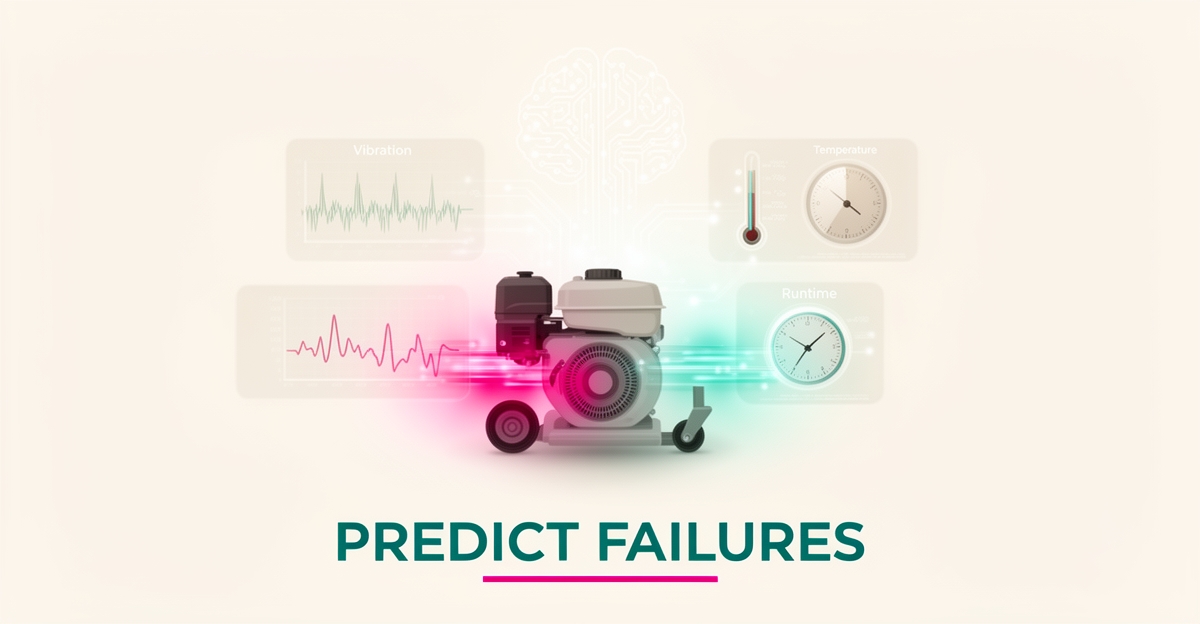
  1. Temperature Fluctuations: Unexpected heat spikes indicate friction or cooling failures.
  2. Vibration Patterns: Irregular vibrations signal mechanical wear or imbalance.
  3. Runtime Efficiency: Deviations in fuel consumption or power output.
  4. Pressure Metrics: Changes in lubrication or fuel line pressure.

Implementing predictive intelligence fundamentally changes the cost structure of equipment management. By identifying issues early, operators can schedule repairs during low-impact windows, eliminating emergency premiums.

Research from IBM confirms that predictive maintenance reduces overall maintenance costs by 18% to 31% compared to traditional methods. This savings comes from extended equipment life and optimized labor allocation.

For small engine operators, this shift offers a sustainable competitive advantage by ensuring maximum fleet availability. Instead of reacting to crises, businesses can proactively manage their assets with data-driven confidence.

This foundation of cost savings sets the stage for understanding the specific technologies, such as LSTM networks and Gradient Boosting, that make these predictions possible.

How Machine Learning Detects Subtle Failure Patterns

Traditional rule-based systems fail because they rely on static thresholds that cannot interpret the chaotic reality of engine operation.

Sensor data from temperature, vibration, and pressure sensors is too complex for simple rule-based systems to effectively identify subtle patterns preceding failure.

A rule-based system might trigger an alarm only when temperature exceeds 200°F, missing the gradual thermal drift that indicates an impending bearing failure weeks in advance.

Machine learning models, however, analyze high-dimensional data to find non-linear relationships that human engineers or simple scripts would overlook.

By processing continuous streams of operational data, ML algorithms detect minute deviations from normal behavior long before a catastrophic breakdown occurs.

This capability transforms maintenance from a reactive guess into a precise science, allowing businesses to schedule repairs during planned downtime rather than emergency outages.

Machine learning approaches to engine monitoring generally fall into three distinct categories, each serving a specific diagnostic purpose.

Remaining Useful Life (RUL) estimation predicts the exact time or runtime remaining before a component fails, enabling precise scheduling.

Anomaly Detection identifies deviations from normal behavior without necessarily knowing the specific failure mode, catching unknown issues early.

Failure Mode Classification categorizes the specific type of fault (e.g., fuel line clog vs. valve misfire) to guide the correct repair procedure.

These tasks require different algorithmic approaches because the nature of the data and the desired output vary significantly.

  • Remaining Useful Life (RUL): Predicts time-to-failure using sequence models like LSTMs or Transformers to analyze temporal trends.
  • Anomaly Detection: Uses unsupervised methods like Isolation Forests to flag unusual sensor readings that deviate from historical baselines.
  • Failure Mode Classification: Employs supervised models like Random Forests to categorize specific faults based on labeled historical failure data.

The volume and velocity of data generated by small engines necessitate advanced architectures like Long Short-Term Memory (LSTM) networks or Gradient Boosting Models.

LSTMs are particularly effective because they retain memory of past states, allowing them to understand that a current temperature spike is significant only if preceded by a specific vibration pattern.

According to industry research, data-driven ML methods are considered accurate, efficient, and cost-effective because they do not require detailed prior knowledge of physical degradation processes.

This is crucial for small engines where physical modeling is difficult due to varying load conditions and environmental factors.

A hybrid "Trans-LSTM" model can further enhance accuracy by combining Transformer capabilities to capture long-term dependencies with LSTM temporal filtering.

Consider a small engine in a agricultural pump that experiences gradual thermal drift over three weeks.

A rule-based system ignores this because the temperature never hits the "danger" threshold of 200°F.

However, an ML model trained on historical failure data recognizes this drift as a precursor to coolant pump seal failure.

The model flags the anomaly, triggering a work order 2–3 weeks in advance of the actual failure.

This early warning prevents a mid-season breakdown that could cost thousands in lost crop revenue and emergency repair fees.

By shifting from preventive to predictive maintenance, operators avoid the unnecessary servicing of healthy equipment while ensuring critical assets remain available.

This proactive approach reduces overall maintenance costs by 18% to 31% compared to traditional reactive methods.

AIQ Labs builds custom predictive systems that enable this level of precision, leveraging advanced architectures to turn raw sensor data into actionable business intelligence.

The Business Case: Cost Reduction and Availability

The Business Case: Cost Reduction and Availability

For small engine operators, a single unexpected breakdown can trigger a cascade of missed jobs, emergency rental fees, and damaged client trust. Traditional reactive maintenance is no longer a viable strategy in an era where fleet availability directly dictates revenue. By shifting to AI-driven Predictive Maintenance (PdM), businesses transform from chasing failures to preventing them, securing a competitive advantage through reliability.

The financial argument for predictive systems is robust and measurable. Industry data confirms that implementing predictive strategies reduces overall maintenance costs by 18% to 31% compared to traditional methods. This significant savings stems from avoiding unnecessary servicing of healthy equipment and preventing catastrophic failures that require expensive emergency repairs.

  • Cut maintenance costs by up to 31% through proactive intervention
  • Avoid unplanned downtime that costs hundreds of thousands per hour in severe cases
  • Secure maintenance slots early before capacity shortfalls hit the industry
  • Extend asset lifespan by addressing issues before they cause secondary damage

The efficiency gains are not just theoretical; they are embedded in modern operational workflows. In sectors prioritizing fleet availability, operators are adopting data-driven practices to secure maintenance slots early and improve efficiency. With a forecasted 17% capacity shortfall in MRO services over the next decade, having your own predictive capability ensures you are not dependent on external repair shop availability.

AI systems achieve this by analyzing real-time operational data—specifically temperature, vibration, pressure, and runtime—to identify subtle patterns preceding failure. While rule-based systems miss these nuances, machine learning models detect anomalies weeks before a breakdown occurs. Research indicates that AI-driven systems can estimate maintenance dates 2–3 weeks in advance, providing ample time to schedule repairs without disrupting operations.

Consider a landscape services company using AI to monitor mowing engines. Instead of following a rigid calendar, the AI analyzes engine RPM and oil pressure trends. When it detects a deviation from normal behavior, it automatically triggers a work order and checks inventory for necessary parts. This shifts the business from emergency repairs to scheduled, efficient maintenance, ensuring every engine is ready when the job starts.

This approach eliminates the guesswork of preventive maintenance. By focusing on condition-based maintenance, businesses only repair components when data indicates necessity. This precision reduces the "unnecessary servicing of healthy equipment" that plagues traditional fleets, ensuring every dollar spent on maintenance directly contributes to asset longevity and availability.

The technology relies on advanced architectures like Gradient Boosting Models and LSTM networks to process complex sensor data. These systems learn continuously, improving prediction accuracy as more data is processed. For SMBs, this means the system becomes smarter and more reliable over time, delivering sustainable competitive advantages without constant manual oversight.

Ultimately, the goal is not just fixing engines but optimizing total fleet availability. By integrating predictive AI with automated workflow systems, businesses create a closed-loop maintenance environment. This seamless integration ensures that predictions translate instantly into action, reducing manual data entry and operational errors.

As the industry moves toward data-driven decision-making, the gap between proactive and reactive operators will widen. Adopting AI-driven maintenance is no longer optional for serious businesses. It is the essential step toward eliminating operational inefficiencies and protecting your bottom line.

Ready to stop guessing and start predicting? AIQ Labs builds custom predictive systems that enable proactive maintenance and prevent costly breakdowns.

Implementing Custom Predictive Systems with AIQ Labs

Traditional maintenance schedules often result in unnecessary servicing of healthy equipment, wasting time and resources on machines that are still functioning optimally. AIQ Labs solves this by building custom predictive systems that shift your operation from reactive guesswork to proactive precision.

Our approach leverages advanced machine learning to analyze real-time engine telemetry, identifying subtle failure patterns long before they cause costly downtime. By integrating sensor data with historical records, we create owned, automated maintenance workflows that eliminate guesswork and maximize fleet availability.

Most small engine operators rely on fixed maintenance intervals, which frequently leads to either premature part replacement or unexpected breakdowns. AI-driven predictive maintenance (PdM) analyzes variables like temperature, vibration, and runtime to predict failures with high accuracy.

According to industry data, predictive maintenance reduces overall maintenance costs by 18% to 31% compared to traditional methods according to IBM. This efficiency stems from performing maintenance "just in time" based on actual equipment condition rather than arbitrary calendars.

AIQ Labs architects these systems to fit seamlessly into your existing operations. We don’t just provide data; we build the intelligent infrastructure that acts on it.

  • Real-Time Monitoring: Continuous analysis of engine RPM, oil pressure, and fuel flow.
  • Failure Prediction: Early warning systems that detect anomalies before catastrophic failure.
  • Automated Workflows: Automatic generation of service tickets when thresholds are breached.
  • Cost Optimization: Elimination of unnecessary scheduled servicing for healthy units.

AIQ Labs specializes in engineering production-ready AI systems that businesses own outright. For small engine operators, this means deploying models that estimate Remaining Useful Life (RUL) with remarkable precision.

Research indicates that AI-driven systems can estimate maintenance dates 2–3 weeks in advance as reported by technical implementations. This window allows operators to schedule repairs during off-hours, ensuring maximum uptime for critical assets.

We utilize advanced architectures, such as Gradient Boosting Models and Long Short-Term Memory (LSTM) networks, to interpret complex sensor data. These models learn from your specific engine behaviors, improving prediction accuracy over time as more data is processed.

The true power of AI lies in automation. AIQ Labs connects predictive insights directly to your operational tools, creating a closed-loop maintenance system. When our AI detects a potential failure risk, it doesn’t just send an alert—it triggers action.

This integration transforms isolated data points into streamlined operational efficiency. For example, a predicted failure can automatically check inventory for replacement parts, schedule a technician via your dispatch software, and generate an invoice before the client even knows there is an issue.

  • Seamless Integration: Connects with CRM, accounting, and dispatch systems.
  • Proactive Scheduling: Books repairs automatically based on predictive alerts.
  • Inventory Management: Ensures parts are available before arrival.
  • Zero Manual Entry: Eliminates administrative bottlenecks in the service process.

By choosing AIQ Labs, you gain a single accountable partner that delivers end-to-end AI transformation. Our systems are designed for true ownership, ensuring you control your data and your competitive advantage.

Ready to stop reacting to breakdowns and start predicting them? Contact AIQ Labs today to architect your custom predictive maintenance solution.

Next Steps: Transitioning to AI-Driven Reliability

Moving from speculative exploration to concrete implementation is where small engine operators separate themselves from the competition. Most businesses stall at the pilot stage, experimenting with tools without achieving scalable results. The key to breaking through this barrier is adopting a structured partnership model that prioritizes production-ready systems over theoretical prototypes.

At AIQ Labs, we help SMBs bypass the "pilot purgatory" by integrating custom AI directly into existing workflows. Instead of relying on fragile rule-based systems, we deploy machine learning models that analyze real-time operational data to predict failures with precision. This shift transforms maintenance from a reactive cost center into a proactive competitive advantage.

Traditional maintenance either waits for breakdowns or services equipment on rigid schedules, often resulting in unnecessary downtime. Predictive maintenance changes this dynamic by identifying subtle patterns preceding failure that rule-based systems miss. By analyzing variables like temperature, vibration, and runtime, AI can estimate maintenance needs 2–3 weeks in advance.

This approach eliminates the guesswork of preventive maintenance, ensuring you only service equipment when data indicates necessity. The result is a significant reduction in unplanned downtime and operational costs. According to industry analysis, predictive maintenance reduces overall maintenance costs by 18% to 31% compared to traditional methods.

To achieve this level of reliability, you must integrate multiple data sources. Our custom systems combine:

  • Real-time IoT sensor data (temperature, pressure, vibration)
  • Historical maintenance records and repair logs
  • External factors like weather conditions and usage patterns

This multi-source integration allows our models to detect anomalies that isolated data points cannot reveal. By creating a unified view of equipment health, we enable condition-based automation that triggers work orders only when needed.

Building a predictive maintenance ecosystem requires more than off-the-shelf software; it demands custom engineering tailored to your specific engine types and operational constraints. AIQ Labs leverages advanced architectures, such as Gradient Boosting Models and LSTM networks, to interpret complex sensor data accurately.

We don’t just build the model; we integrate it into your daily operations. When an AI model predicts a potential failure, it can automatically trigger a work order, check inventory for parts, and schedule a technician. This closed-loop automation removes manual bottlenecks and ensures zero missed maintenance windows.

Consider a field services company that implemented our custom AI workflow. By automating the dispatch and scheduling process based on predictive alerts, they eliminated 20+ hours of weekly manual data entry. This efficiency gain allowed them to scale operations without adding headcount, directly impacting their bottom line.

Transitioning to AI-driven reliability is a journey that requires strategic planning and technical expertise. AIQ Labs serves as your AI Transformation Partner, guiding you from initial assessment through full implementation and ongoing optimization. We ensure that your AI systems are not just tools, but owned assets that grow with your business.

Our structured engagement model includes:

  • Discovery & Architecture: Assessing your current data infrastructure and identifying high-value automation targets.
  • Custom Development: Building production-ready ML models using advanced frameworks like LangGraph.
  • Integration & Deployment: Seamlessly connecting AI insights with your existing CRM and maintenance software.
  • Continuous Optimization: Refining models as more data becomes available to improve prediction accuracy.

Don’t let equipment failures dictate your operational limits. Partner with AIQ Labs to build a resilient, data-driven maintenance strategy that keeps your engines running and your business growing.

AI Development

Still paying for 10+ software subscriptions that don't talk to each other?

We build custom AI systems you own. No vendor lock-in. Full control. Starting at $2,000.

Frequently Asked Questions

How does AI predict engine failures before they actually happen?
AI models analyze real-time operational data like temperature, vibration, and runtime to identify subtle patterns that rule-based systems miss. By detecting these anomalies, ML systems can estimate maintenance needs 2–3 weeks in advance, allowing you to schedule repairs before a breakdown occurs.
Is predictive maintenance actually cheaper than traditional scheduled maintenance?
Yes, research confirms that predictive maintenance reduces overall maintenance costs by 18% to 31% compared to traditional methods. This savings comes from avoiding unnecessary servicing of healthy equipment and preventing costly emergency repairs caused by sudden failures.
What specific data points does the AI monitor to detect issues?
The system monitors key variables including engine RPM, lubricant oil pressure, fuel pressure, temperature fluctuations, and vibration patterns. It also integrates external factors like weather and historical maintenance records to improve prediction accuracy.
Why can't simple rule-based systems detect these failures instead of using AI?
Sensor data is too complex for simple rule-based systems to effectively identify subtle patterns preceding failure. AI models, such as LSTMs or Gradient Boosting, can analyze high-dimensional data to find non-linear relationships that static thresholds ignore.
How soon can AI predict when an engine part will fail?
AI-driven systems can estimate maintenance dates 2–3 weeks in advance. This early warning window allows operators to secure parts and schedule technicians during low-impact periods, avoiding the high costs of unplanned downtime.
Does implementing this system require replacing all my existing equipment?
No, you don't need to replace your engines. The system integrates with existing IoT sensors and historical records to build a custom predictive model. AIQ Labs builds these as owned, automated workflows that connect to your current data sources without requiring new hardware.

Stop Chasing Breakdowns: Turn Predictive Data Into Profit

Unplanned equipment failure is a silent profit killer, driving up costs through emergency service premiums, operational downtime, and reputational damage. By shifting from reactive 'run-to-failure' models to Predictive Maintenance (PdM), small engine operators can leverage machine learning to detect failure risks 2–3 weeks in advance. This data-driven approach eliminates unnecessary servicing and prevents costly secondary damage, ensuring your fleet remains productive and profitable. AIQ Labs specializes in building custom AI solutions that turn this predictive capability into reality. We don’t just offer advice; we engineer production-ready systems that analyze engine usage, temperature, and runtime to enable proactive maintenance. As a full-service AI transformation partner, we help SMBs eliminate operational inefficiencies without the complexity or vendor lock-in. Stop waiting for breakdowns to dictate your schedule. Contact AIQ Labs today to discover how we can architect a predictive maintenance strategy that delivers measurable ROI and sustainable competitive advantage for your business.

AI Transformation Partner

Ready to make AI your competitive advantage—not just another tool?

Strategic consulting + implementation + ongoing optimization. One partner. Complete AI transformation.

Join The Newsletter

Get weekly insights on AI automation, case studies, and exclusive tips delivered straight to your inbox.

Ready to Increase Your ROI & Save Time?

Book a free 15-minute AI strategy call. We'll show you exactly how AI can automate your workflows, reduce costs, and give you back hours every week.

P.S. Still skeptical? Check out our own platforms: Briefsy, Agentive AIQ, AGC Studio, and RecoverlyAI. We build what we preach.