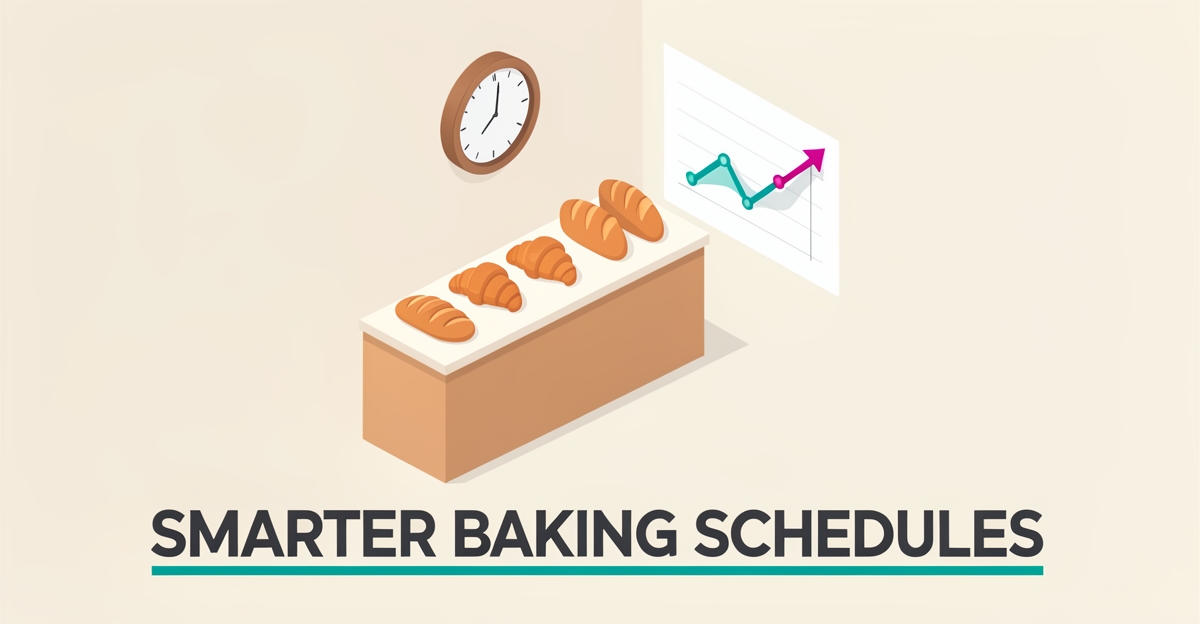
How AI Can Predict Peak Hours and Optimize Baking Schedules for Your Cafe
Key Facts
- AI forecasting models typically reduce planning time significantly compared with manual scheduling, since they generate prep plans automatically from your own data
- Demand forecasting models improve accuracy over time by continuously learning from each day's actual sales
- Weather, local events, and seasonality are the variables that most often shift cafe demand hour by hour
- Overproduction and underproduction are the two most expensive failure modes of manual baking schedules
- AIQ Labs has deployed 200+ multi-agent systems and runs 4 live SaaS products daily
- Cafes can start with one workflow, like baking prep, rebuilt at a fixed price, then scale in phases
Hire a team member that works 24/7 — for less than a part-time wage.
AI receptionists, SDRs, dispatchers and 99+ roles. Trained on your business, fully managed.
Not sure where to start? Ask our AI planner
The Hidden Cost of Guesswork: Why Manual Baking Schedules Fail Cafes
Cafes lose money every morning before the first customer orders. When baking schedules rely on intuition, the result is predictable: trays of unsold pastries and empty cases during the rush.
Manual planning treats every day the same. Owners extrapolate from memory, not data, and the system breaks under variability. Human planners are limited by speed and volume, when demand shifts, the schedule can't keep up.
The hidden cost shows up as waste, overtime, and missed revenue. Overproduction fills the trash bin while underproduction forces sell-outs. Every discarded tray is margin you already paid for in ingredients, labor, and oven time.
Traditional schedules also cannot adapt in real time. A sudden rainstorm, a local event, or a supplier delay requires a full manual rework. AI systems process large amounts of information continuously, making adjustments far beyond what human planners can manage during high-pressure times.
For bakeries, the failure points are specific and expensive:
- Overbaking popular items on slow mornings, creating food waste and lost margin
- Underbaking during unpredictable spikes, leading to stockouts and lost sales
- Static labor plans that leave staff idle or overwhelmed depending on the day
- No visibility into how weather, events, or seasonality shift demand hour by hour
Manual planning delivers control and a personal touch, whereas AI-driven scheduling offers speed, scalability, and data-driven insight. The personal touch does not compensate for missed revenue during peak hours and the cost of discarded product.
AI analyzes historical sales, weather, and events to predict peak hours and adjust baking schedules. AIQ Labs builds predictive systems tailored to bakery operations, replacing intuition with continuous learning so your prep plan improves with every day of data. If you want to start with the one workflow that costs you the most, AI Workflow Builds rebuild it at a fixed price, in phases.
The shift is from reactive firefighting to proactive preparation. Businesses that stay with guesswork pay for it in spoilage, overtime, and frustrated customers.
How AI Forecasts Demand: Turning Sales, Weather, and Events into Precise Predictions
AI transforms demand forecasting by analyzing multiple data streams simultaneously to predict peak hours. Unlike traditional time-based approaches that assume consistent daily patterns, AI models process historical sales, weather conditions, local events, and seasonal trends to generate dynamic forecasts that adapt to changing conditions. This comprehensive analysis enables cafes to anticipate demand fluctuations hours or even days in advance, moving beyond guesswork to data-driven scheduling decisions.
These models identify subtle correlations that human schedulers might miss, such as how a light rain on a Tuesday afternoon lifts pastry sales, or how a local farmers' market boosts morning foot traffic. The technology processes large datasets in seconds, revealing patterns that would take analysts hours to uncover manually. As IBM notes in its overview of artificial intelligence, AI systems are built precisely for this kind of learning, problem-solving, and autonomous decision-making.
The predictive capability extends well beyond simple trend analysis. AI systems can pinpoint when demand will spike during specific hours, identify which menu items will see increased demand based on weather conditions, and even anticipate how events like concerts or sports games will alter customer behavior patterns. This granular forecasting allows cafes to adjust baking schedules with precision, producing more croissants when rainy weather drives indoor demand or scaling back sourdough production when outdoor festivals divert foot traffic.
- Historical sales data analysis identifies recurring daily and weekly patterns
- Weather pattern integration forecasts how conditions affect foot traffic and product preferences
- Local event processing anticipates demand spikes from concerts, markets, or sports games
- Seasonal trend detection adjusts for holidays, school schedules, and tourism fluctuations
AIQ Labs builds custom predictive models that integrate these data streams specifically for bakery operations, continuously refining forecasts as new data flows in. The system learns from each prediction cycle, improving accuracy over time while adapting to evolving customer preferences and local conditions. This creates a self-optimizing scheduling system that becomes more valuable with every day of operation, turning historical data into a competitive advantage for cafes navigating unpredictable demand cycles.
From Prediction to Action: Implementing AI-Driven Baking Schedules in Your Cafe
Turning demand forecasts into operational reality requires a structured approach to implementation. Cafes begin by gathering comprehensive historical data, past sales records, customer traffic patterns, weather conditions, and local events, to build the foundation for accurate predictions. Once this data is integrated into a unified system that machine learning models can learn from, the manual spreadsheet reconciliation disappears.
Next, custom predictive models are deployed to analyze patterns and forecast peak hours. These models continuously learn from new data, enabling dynamic adjustments to baking schedules based on predicted customer traffic, weather impacts, and special events. Real-time monitoring then allows for instant schedule modifications when conditions change, such as unexpected weather shifts or local events driving foot traffic. The payoff is less overproduction during slow periods and fewer stockouts during rushes.
To sustain long-term effectiveness, cafes establish continuous validation and retraining protocols. This involves regularly monitoring model performance against actual sales, retraining with fresh data, and validating predictions to maintain accuracy as customer behaviors evolve. AIQ Labs supports this implementation cycle through phased builds, starting with the baking-prep workflow at a fixed price, then expanding toward a fuller AI Operating System that connects forecasting, inventory, and scheduling into one layer you own outright. The result is a self-optimizing schedule that reduces waste, increases productivity, and aligns baking output with predicted demand, without requiring proportional staffing increases. If you'd rather hand the whole thing to a managed service, AI Employees can run the day-to-day at a fraction of the cost of an additional hire.
Still paying for 10+ subscriptions that don’t talk to each other?
We build custom AI systems you own outright. No vendor lock-in. Full control.
Not sure where to start? Ask our AI planner
Frequently Asked Questions
How does AI improve baking schedules compared to manual planning?
What data does AI use to predict peak hours for cafes?
Can AI really reduce food waste in bakeries?
Is AI scheduling only for large cafe chains, or can small cafes benefit too?
How long does it take to see results after implementing AI for baking schedules?
What if I don't have technical expertise to manage an AI system?
From Guesswork to Precision Baking
The cost of manual baking schedules shows up every morning in waste, sell-outs, and exhausted staff. AI changes that by turning historical sales, weather, local events and seasonality into hour-by-hour peak forecasts, allowing you to bake more of what will sell and less of what won't. The result is fewer discarded trays, fewer empty cases during rushes, and labor plans that match real demand instead of memory. AIQ Labs builds predictive systems tailored to bakery operations, deployed in phases, at a fixed price, and owned outright once built. The next step is practical: audit your sales and traffic data, identify the variables that move demand in your location, and test a forecast-driven schedule for one product line. If you're ready to move from reactive firefighting to proactive preparation, take the 2-minute Fit Check at https://aiqlabs.ai/apply, then book a free 30-minute strategy call to map your biggest bottleneck and see if a tailored forecasting system is a clear win for your cafe.
Make AI your competitive advantage — not just another tool.
Strategy, implementation and ongoing optimization. One partner, end to end.
Not sure where to start? Ask our AI planner