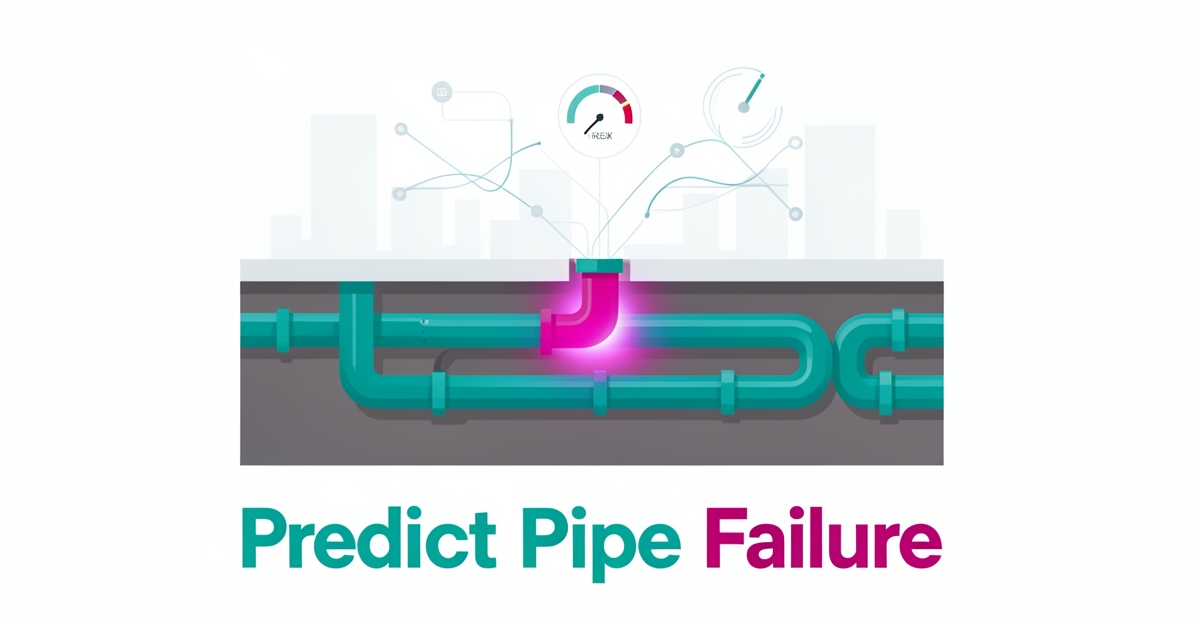
How AI Can Predict Pipe Failure Before It Happens, A Guide for Sewer Repair Companies
Key Facts
- Emergency pipe repairs typically cost several times more than planned work, according to infrastructure analysis
- Industry research indicates roughly 61% of maintenance work orders are still reactive, happening only after equipment fails
- Government agencies using AI predictive maintenance have reported significantly fewer unplanned failures and longer asset lifespans
- An estimated 240,000 water mains break annually in the U.S., wasting roughly 2.1 trillion gallons of water, according to infrastructure analysis
- A majority of organizations applying AI to maintenance report measurable value within six months, according to maintenance workflow research
- One U.S. city used AI acoustic sensors to find 50 hidden leaks, reportedly saving 167 million gallons of water annually
- Predictive maintenance can reduce maintenance costs substantially, industry studies cite figures up to 40%, while cutting downtime
Hire a team member that works 24/7 — for less than a part-time wage.
AI receptionists, SDRs, dispatchers and 99+ roles. Trained on your business, fully managed.
Not sure where to start? Ask our AI planner
The Reactive Sewer Repair Cycle Is Costing You
Every break-fix repair job feels like a win on the invoice, but the model underneath is quietly bleeding margin. When crews are dispatched after a collapse instead of before one, the company absorbs overtime, rushed mobilization, and damage that has already spread. Infrastructure analysis consistently puts emergency repairs at roughly four times the cost of planned interventions, and the scramble never stops.
The numbers confirm this isn't an occasional problem. Industry research indicates that roughly 61% of work orders are still reactive, with only about 39% preventative, meaning most maintenance teams spend their day responding to failures rather than preventing them. At the infrastructure level, the scale is staggering: an estimated 240,000 water mains break in the U.S. every year, wasting roughly 2.1 trillion gallons in the process.
The deeper issue is that most operators aren't actually running a maintenance strategy. Calendar-based routines, send a crew every three months, inspect what's visible, fix what's already failed, amount to damage control after the damage has already happened. A pipe doesn't fail because it hit a date on the schedule. It fails because soil shifted, corrosion advanced, or load changed, and nobody was watching the signals.
For sewer repair companies, the reactive cycle creates three compounding costs:
- Unpredictable revenue and staffing, with emergency calls crowding out planned, profitable work
- Premium pricing on labor, excavation, and equipment because every job is urgent
- Customer churn, as property owners and municipalities lose patience with repeated failures and surprise bills
The contrast with a forecastable model is stark. Reactive maintenance treats breakdowns "like weather: unpredictable, unavoidable," while predictive maintenance treats them "like forecasts: visible, preventable, manageable." Maintenance workflow research also notes that teams commonly spend three or more hours daily on manual data entry, so the information needed to anticipate failures often exists but never gets analyzed.
That's the shift this guide maps: from unpredictable failures to forecastable risk. By analyzing soil data, weather patterns, and historical repair records, custom AI models can rank pipes by failure likelihood, letting companies schedule inspections on their terms instead of answering emergency calls on the pipe's. If you want to see how this kind of prediction-to-dispatch workflow could run inside your operation, AIQ Labs' AI Workflow Builds rebuild the one workflow that costs you the most, at a fixed price and in phases. The question is no longer whether a failure will happen, but which asset will fail first and when.
How AI Turns Soil, Weather and Repair History Into Failure Forecasts
For sewer repair companies, the shift from reactive fixes to proactive interventions begins with data. By analyzing soil composition, weather patterns, and historical repair records, AI systems can identify which pipes are most likely to fail, turning guesswork into precision forecasting. This approach moves beyond age-based replacement schedules to condition-based interventions, targeting resources where they matter most.
The predictive maintenance loop starts with machine telemetry from sensors embedded in or near pipelines, capturing real-time signals like vibration, pressure fluctuations, and acoustic anomalies. These data streams flow into monitoring systems where they are cleaned and aligned over time, creating a baseline for normal operation. Historical context, such as past repair logs, failure incidents, and environmental conditions, teaches the AI what early-stage degradation looks like, enabling pattern detection that spots subtle changes humans would miss. Industry research emphasizes that predictive maintenance works best when AI, sensors, and operations are designed as one cohesive loop, ensuring alerts lead to timely interventions.
Soil, climate, and land-use data further refine risk rankings, especially in regions with shifting ground or extreme weather. A widely cited example comes from Tucson, where an ML model analyzed over 12 years of pipe break records alongside soil type, temperature fluctuations, precipitation, and land-use patterns. The model assigned individualized risk scores to each pipe segment, revealing that failure likelihood correlates more strongly with environmental stressors than age alone. This risk-based approach allows sewer companies to prioritize inspections and repairs in high-vulnerability zones, preventing bursts before they occur. In another case, a U.S. Southeast city used acoustic sensors combined with machine learning to monitor 70 miles of at-risk pipe. The AI flagged 50 hidden leaks, including two streams leaking at approximately 10 gallons per minute, enabling repairs that reportedly saved an estimated 167 million gallons of water annually. These examples demonstrate how AI identifies degradation weeks before failure, giving crews time to act.
When deployed effectively, this closed-loop system delivers measurable outcomes: government agencies using AI predictive maintenance have reported around 50% fewer unplanned failures and roughly 30% longer asset lifespans. By catching issues early, sewer repair companies can reduce emergency dispatches, optimize crew schedules, and extend the service life of critical infrastructure, all while lowering long-term maintenance costs. The result is not just fewer breaks, but smarter, more resilient operations grounded in data-driven foresight.
From Prediction to Proactive Dispatch: A Practical Implementation Roadmap
Turning AI insights into real-world action requires more than just a predictive model, it demands a seamless workflow that connects data to dispatch. As practitioners in the field put it, "prediction without action is just reporting," and the true value emerges when AI, sensors, and operations function as a single loop. For sewer repair companies, this means moving beyond alerts to automated work orders that trigger proactive inspections before failure occurs.
The implementation begins with clear business goals: reducing emergency calls, extending asset lifespans, or cutting maintenance costs. Companies should start by instrumenting critical zones, such as high-risk pipe segments identified through historical break data, with sensors that capture soil moisture, temperature, vibration, and flow rates. These real-time signals must then be unified with existing SCADA systems, GIS maps, and work order databases to create a single source of truth for the AI model.
Labeling historical failure events is essential for training accurate models. By tagging past repairs, leaks, and breaks in maintenance logs, companies teach the AI what degradation patterns look like before a pipe bursts. Once trained, models must be validated using unseen data to ensure they generalize well, measuring precision, recall, and F1-score to confirm reliability. Only then should insights flow into the CMMS, where automated alerts generate prioritized work orders, schedule preventive inspections, and align repairs with planned service windows.
AIQ Labs supports this transition in phases. You can start monthly with a focused pilot, build in milestones as the model proves itself, and eventually own the system outright, no vendor lock-in, no subscription treadmill. The result is a closed-loop system where prediction drives action, reducing reactive work orders, which industry research suggests still make up roughly 61% of all maintenance tasks, and shifting toward a proactive, cost-saving maintenance strategy. When you're ready to connect prediction to a full operating layer across inspections, dispatch, and reporting, AIQ Labs' AI Operating Systems are built in phases and owned outright by you.
Why Custom AI Beats Off-the-Shelf for Pipe Failure Prediction
The difference between a sewer repair company that drowns in emergency calls and one that runs a calm, profitable inspection schedule often comes down to how its AI is built. Off-the-shelf tools promise prediction, but generic software trained on someone else's data rarely understands the soil conditions, weather patterns, and repair history that actually determine where your pipes will fail.
It helps to start with the three maintenance models. Reactive maintenance treats breakdowns like weather, unpredictable and something you deal with when it hits, and emergency repairs can cost roughly four times more than planned work. Preventive maintenance schedules crews on a calendar, which brings predictable costs but often replaces pipe that didn't need it while missing pipe that did. Predictive maintenance, by contrast, treats failures like forecasts: visible, preventable, and manageable before they cost you. The results back this up, government agencies deploying AI predictive maintenance report around 50% fewer unplanned failures and roughly 30% longer asset lifespans, and Tucson's machine learning model, which ingests more than 12 years of break records alongside soil, climate, and land-use data, shows what's possible when a model is trained on infrastructure-specific data rather than generic inputs.
This is where custom AI pulls ahead of off-the-shelf. A purpose-built model learns from your repair records, your service territory, and your inspection outcomes, the historical context that teaches the system what degradation actually looks like in your network. Experts emphasize that predictive maintenance isn't a dashboard feature but a data discipline: sensors, historical logs, and response workflows have to connect as one loop. Generic vendors stop at the alert. Custom systems carry prediction through to action.
That action layer matters as much as the model. As one practitioner puts it, "prediction without action is just reporting." For a sewer repair company, the loop looks like this:
- The model ranks pipes by failure risk using soil, weather, and repair history data.
- High-risk findings convert automatically into scheduled inspections instead of emergency dispatches.
- An AI dispatcher or service coordinator books crews, routes calls, and manages work orders around the clock.
- Every completed inspection feeds back into the model, sharpening future predictions.
The payoff is measurable. A majority of organizations applying AI to maintenance report measurable value within six months, and predictive approaches can cut maintenance costs by up to 40% while reducing downtime by as much as half, according to industry studies.
Ownership is the final differentiator. When you rent a subscription tool, your prediction engine, and your data, live on someone else's platform. AIQ Labs builds custom AI models trained on industry-specific data that clients own outright, with no vendor lock-in, and pairs them with managed AI employees, dispatchers, service coordinators, and 99+ other roles, who handle dispatch and inspection scheduling at a fraction of the cost of a human hire. The result isn't just smarter forecasts; it's fewer 2 a.m. emergency calls and a calendar full of planned, profitable work.
Still paying for 10+ subscriptions that don’t talk to each other?
We build custom AI systems you own outright. No vendor lock-in. Full control.
Not sure where to start? Ask our AI planner
Frequently Asked Questions
Is predictive maintenance really cheaper than just fixing pipes when they break?
What data does AI actually need to predict pipe failures?
Can AI find leaks before they become major breaks?
How much downtime and cost can sewer companies actually save?
Is off-the-shelf software good enough for pipe failure prediction?
How do we start without a huge upfront project?
From Emergency Calls to Predictable Profit
The reactive sewer repair cycle, where industry research suggests roughly 61% of work orders are still reactive, drains margins through emergency dispatches, inflated labor costs, and customer frustration. By shifting to AI-driven predictive maintenance that analyzes soil, weather, and repair history, companies can turn guesswork into foresight, cutting emergency calls, extending asset lifespans, and reducing maintenance costs. AIQ Labs builds custom AI models trained on your specific infrastructure data, ensuring you own the system outright, with seamless integration into your workflows, from prediction to automated dispatch. The result isn't just fewer 2 a.m. failures, but a calendar full of planned, profitable work and stronger client trust. Ready to see how predictive maintenance can transform your operations? Start with a free 2-minute Fit Check to identify your highest-ROI automation opportunity, no obligation, just clarity. Start the Fit Check
Make AI your competitive advantage — not just another tool.
Strategy, implementation and ongoing optimization. One partner, end to end.
Not sure where to start? Ask our AI planner