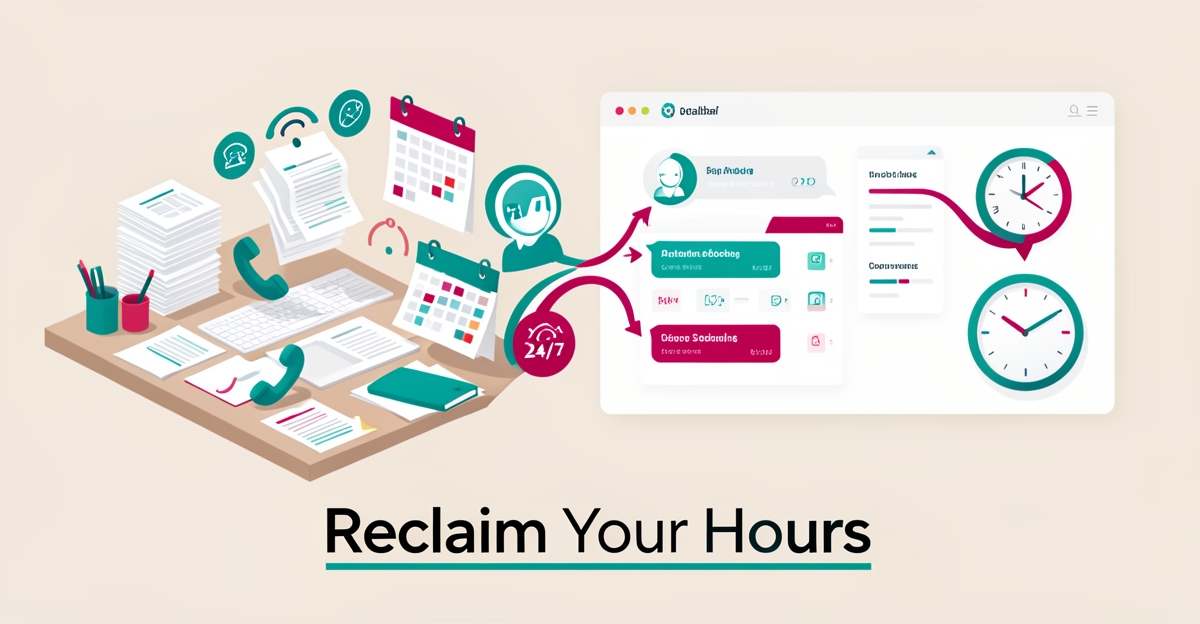
How AI Can Reduce Administrative Burden in Hoarding Cleanup Operations
Key Facts
- A large share of calls to on-site cleanup crews go unanswered, and every missed call is a lead that often goes to a competitor
- After-hours emergency callers frequently never call back if the first attempt goes unanswered
- Manual scheduling typically consumes 20 hours or more per week in administrative overhead for small cleanup operations
- AI Employees typically cost around 80% less than an equivalent human hire while covering phones 24/7
- Repetitive data entry consumes a significant portion of many workers' weeks, time automation can recover
- AIQ Labs has deployed 200+ multi-agent systems and runs 4 live SaaS products daily
Hire a team member that works 24/7 — for less than a part-time wage.
AI receptionists, SDRs, dispatchers and 99+ roles. Trained on your business, fully managed.
Not sure where to start? Ask our AI planner
The Hidden Administrative Tax on Hoarding Cleanup Businesses
The administrative workload in hoarding cleanup operations creates a silent drain on resources that directly impacts both profitability and client care. Staff spend valuable time on repetitive tasks instead of focusing on the sensitive, hands-on work that defines their service. This imbalance not only increases operational costs but also risks missing critical opportunities when clients need help most.
When crews are on site, phones go unanswered. Each missed call is a potential job, often one that goes straight to a competitor. After-hours emergency callers are even less forgiving: if nobody picks up the first time, many never call back. For a business built on showing up in vulnerable moments, that's a revenue leak that compounds weekly.
Meanwhile, manual scheduling typically consumes 20 hours or more per week in administrative overhead, time that could be redirected toward job site work or team development. This burden pulls staff away from emotionally charged client situations where their presence and expertise are most needed. The constant interruption of phone calls and scheduling conflicts disrupts workflow and increases stress on teams already dealing with high-pressure environments.
- Unanswered calls during site visits
- After-hours emergency call drop-off
- Time lost to manual scheduling
- Staff distraction from client-facing work
- Increased operational inefficiency
AIQ Labs addresses this challenge through AI Employees that handle reception, lead qualification, and scheduling 24/7, at roughly 80% less cost than a human hire, ensuring no call goes unanswered and every lead is properly tracked. By automating these repetitive administrative functions, teams can reclaim time for the nuanced, compassionate work that requires human judgment, particularly vital in hoarding cleanup scenarios where sensitivity and timing are critical. This shift not only recaptures lost revenue but also improves response reliability during emergencies when clients are most vulnerable.
Where AI Actually Helps: Calls, Scheduling, Notes, and Data Entry
Hoarding cleanup teams lose revenue before the first truck rolls. Missed calls, manual scheduling, and repetitive documentation eat hours that should go to on-site work.
Calls are the biggest leak. When crews are elbow-deep in a job, phones ring out, and callers in distress rarely leave voicemail. A 24/7 AI receptionist answers and qualifies every call, routes emergencies, and books directly into the calendar. It never sleeps, never gets pulled onto a job site, and never lets a lead sit in an inbox overnight.
Scheduling overhead compounds the problem. Manual scheduling alone typically eats 20 hours or more per week in admin time for a small operation. Automated scheduling cuts that burden by confirming appointments, sending reminders, and updating job status without staff touch. AI Employees integrate with the calendars and CRMs you already use, so a booked call becomes a booked job without anyone retyping anything.
Documentation and data entry are the quiet cost centers. Repetitive data entry consumes a significant portion of many workers' weeks, hours spent retyping client details, job notes, and invoices that automation can capture the first time. For hoarding cleanup, that means client intake forms, job notes, and compliance records are logged cleanly without pulling an estimator off a site visit.
Note-taking and job documentation benefit from the same automation. AI tools can transcribe calls, summarize client conversations, and log site conditions into the CRM immediately after contact. AIQ Labs builds these automations as part of Workflow Builds, targeting the single workflow that costs your business the most and rebuilding it at a fixed price.
Highest-ROI automation targets for hoarding cleanup operations include:
- 24/7 AI receptionist that answers, qualifies, and books every call, at roughly 80% less cost than a human hire
- Automated scheduling and calendar coordination that eliminates the weekly hours lost to manual booking
- AI note-taking for client intake, site assessments, and job documentation with real-time CRM sync
- Data entry automation for leads, invoices, and compliance records
The result is fewer missed opportunities, cleaner records, and crews focused on the work only people can do.
Deploying AI Without Losing the Human Touch
Hoarding cleanup work is personal, urgent, and often emotionally charged. AI can lift the administrative weight, but it must not replace the human judgment clients rely on in vulnerable moments.
The risks are real. AI tools can miss nuance in conversation, and privacy is a legitimate concern when clients are sharing details about their homes and lives. In hoarding cleanup, a missed nuance in intake notes or a mishandled after-hours call can erode trust and delay care. AI works best as a tool that handles well-defined tasks, not open-ended human judgment.
The practical approach is role separation. AI handles repetitive, low-stakes admin work while people stay on sensitive client interactions. AIQ Labs designs automations that free up human staff to focus on high-value cleanup work, data entry, client note-taking, and job status updates, without exposing confidential conversations to unsupervised processing.
Keep humans in the loop where empathy and discretion matter most:
- Intake and crisis calls route to a human after AI qualification, preserving tone and trust
- AI drafts notes and updates job status, staff reviews and approves before filing
- Scheduling and reminders run 24/7, with escalation paths for complex or distressed clients
This hybrid model protects both efficiency and relationships. An AI receptionist can capture leads and book appointments around the clock, while trained staff handle the sensitive conversations that follow. The AI never pretends to be something it isn't, callers know how they'll be routed, and your team decides what stays human.
Security must be built in from the start. For confidential client data, Zero Trust security principles provide a clear framework. Verify explicitly with strong authentication and continuous verification for every AI and human access point. Use least privilege access so AI tools only surface information each user is authorized to see. Assume breach and build monitoring, audit trails, and rapid response into AI interactions.
Training and change management complete the picture. Staff need clear escalation rules, transparent logging of AI-generated notes, and regular review of edge cases where context was missed. When AI is positioned as an assistant for admin tasks and never as a replacement for human care, teams adopt faster and clients feel safer.
The result is a system where AI reduces administrative burden and humans retain control of trust.
Your Implementation Roadmap: From First Call to Full Automation
Administrative drag is the silent profit leak in hoarding cleanup. Every missed call, retyped note, and manual calendar update pulls crews away from high-value work and leaves revenue on the table.
A practical rollout starts with clarity, then builds capability in layers you can control.
Begin with the two-minute Fit Check, followed by a free 30-minute strategy call to map current call handling and identify high-ROI automation opportunities. This no-obligation working session assesses your intake flow, scheduling bottlenecks, and CRM usage so the build targets the right pain first. From there, AIQ Labs offers three entry points that fit how you want to engage: Start Monthly with an ongoing AI Employee, Build in Milestones with a fixed-price Workflow Build, or Own It Outright with a full AI Operating System built in phases and owned by you. Details on all three are on the pricing page, no fake prices, no invented numbers.
Once priorities are set, deploy an AI receptionist or employee trained on your processes. The system is built and trained on your business, integrates with your tools, and goes live with a dedicated phone number and email address. It answers calls 24/7, qualifies leads, and books appointments, closing the gap that forms whenever your crew is on site or off the clock.
Integration follows, connecting Google Calendar, Calendly, and your CRM so call notes, job status updates, and client details sync without re-entry. This creates seamless workflow automation where the phone rings, the AI answers, and the calendar fills itself.
Security and adoption are built in from day one.
- Establish Zero Trust security protocols with explicit verification, least privilege access, and breach-assumption monitoring for sensitive client data
- Train staff on escalation paths so the team knows when to take over complex or emotionally sensitive hoarding situations
- Monitor performance and refine the system using real call data to improve accuracy and tone
Data entry and note-taking also improve with AI. Intake forms, job notes, and compliance records get captured once, at the source, instead of being retyped from paper into a CRM at the end of a long day. That reliability matters when documenting job details, compliance notes, and client communications.
With the right roadmap, automation moves from experiment to operating system. Start small with one workflow, prove value, then expand across intake, dispatch, and documentation so your human team focuses on the cleanup work only people can do.
Still paying for 10+ subscriptions that don’t talk to each other?
We build custom AI systems you own outright. No vendor lock-in. Full control.
Not sure where to start? Ask our AI planner
Frequently Asked Questions
Will an AI receptionist really pick up calls when my crew is on site?
How much time does manual scheduling actually waste in hoarding cleanup?
Is AI accurate enough for client intake forms and compliance notes?
What about after-hours emergency calls? Do clients ever come back?
Can AI handle sensitive hoarding situations without losing important details?
How much can AI reduce reception and admin costs?
Reclaiming the Work That Matters Most
Hoarding cleanup teams carry a weight that goes beyond clutter, they carry trust, urgency, and the quiet responsibility of showing up when people are at their most vulnerable. The administrative drag of missed calls, manual scheduling, and repetitive documentation doesn't just cost revenue; it pulls focus from the human moments that define this work. AI doesn't replace that presence. It protects it. By handling 24/7 reception, qualifying leads, syncing calendars, and capturing notes the moment they're spoken, AI employees give crews back the 20 hours a week lost to scheduling alone, and make sure after-hours callers aren't lost for good. The path forward isn't a leap; it's a layered rollout starting with the two-minute Fit Check at aiqlabs.ai/apply and a free 30-minute strategy call to map your biggest bottleneck. Whether you Start Monthly, Build in Milestones, or Own It Outright, the system is trained on your processes and managed like staff. No obligation, just clarity on what's possible when admin stops running the show. Questions along the way? Reach the team at [email protected].
Make AI your competitive advantage — not just another tool.
Strategy, implementation and ongoing optimization. One partner, end to end.
Not sure where to start? Ask our AI planner