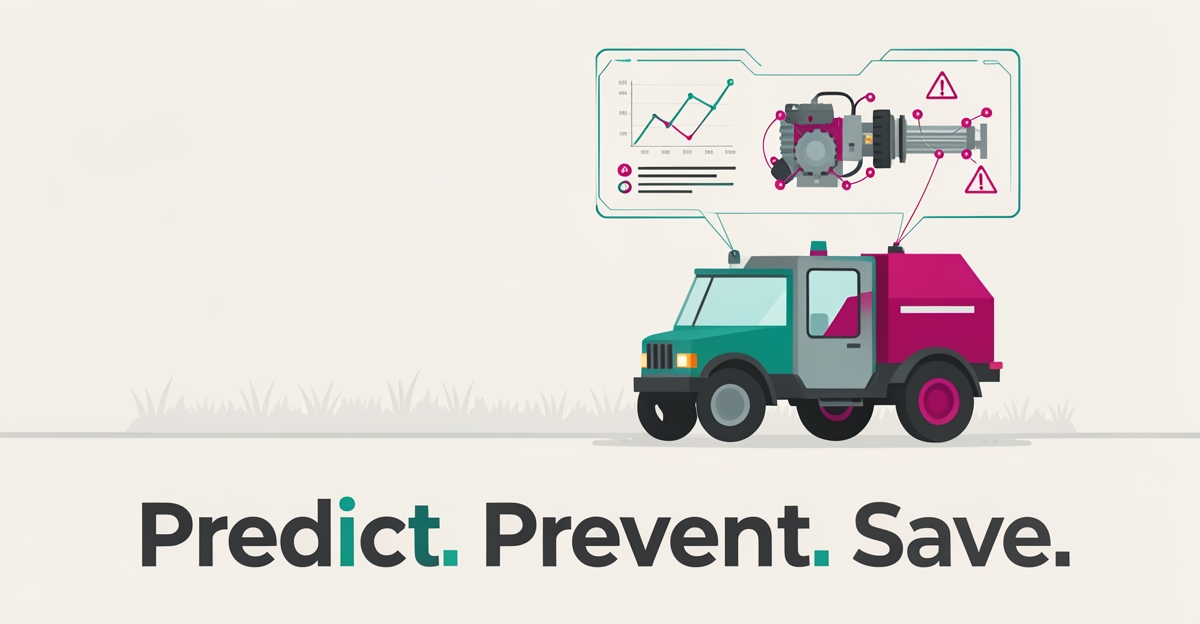
How AI Can Reduce Costs in Equipment Maintenance for Weed Control Services
Key Facts
- Industry reports on AI-powered predictive maintenance commonly cite failure prediction accuracy around 95% with days-to-weeks of advance warning according to predictive maintenance research
- Organizations using AI predictive maintenance report up to 85% less downtime and maintenance costs reduced by 30% or more per industry research
- Reactive repairs typically cost several times more than planned predictive repairs, one widely cited comparison puts reactive failures at $15K+ versus roughly $3.5K per predictive repair based on predictive maintenance data
- Industrial operations research has documented hundreds of hours of annual production loss per plant, with downtime losses running into the millions per industrial operations research
- A large majority of companies surveyed consider their maintenance processes inefficient and unable to prevent unexpected equipment failure per industry analysis
- A majority of companies cite aging equipment as a critical downtime factor per maintenance best practice research
- AI can extend equipment lifespan by detecting wear patterns early through continuous sensor data analysis per maintenance transformation experts
Hire a team member that works 24/7 — for less than a part-time wage.
AI receptionists, SDRs, dispatchers and 99+ roles. Trained on your business, fully managed.
Not sure where to start? Ask our AI planner
The Cost of Reactive Maintenance in Weed Control
Seasonal weed control runs on tight windows. When a sprayer, mower or application rig fails mid-route, the cost is not just a repair bill, it is missed acres, crew idle time and customers waiting.
Reactive maintenance dominates field service fleets. Equipment is run until it breaks, then fixed under pressure. Industry analysis finds that a large majority of companies consider their maintenance processes inefficient and unable to prevent unexpected equipment failure. That inefficiency shows up as unplanned downtime during peak growth periods.
The financial gap between reactive and predictive is stark. Predictive maintenance data commonly puts the average cost per reactive failure at $15K+ versus roughly $3.5K per repair with predictive. Preventive sits in the middle, often over-servicing healthy assets while still missing sudden failures.
Scale magnifies the risk. Research on industrial operations has documented hundreds of hours of production lost per plant per year, with downtime losses running into the millions. For weed control operators, those hours translate directly into lost service days that cannot be recovered once the season passes.
A reactive approach creates compounding problems across the fleet:
- Emergency repairs cost more than planned work and strain parts inventory
- Crew downtime spreads to other routes and delays scheduled applications
- Aging equipment increases failure frequency, with a majority of companies citing it as a critical downtime factor
The seasonal nature of weed control makes this especially painful. Breakdowns cluster in spring and summer when demand peaks and rental replacements are scarce. Reactive fixes also shorten asset life, because wear patterns go undetected until catastrophic failure.
The financial angle matters here too. By predicting equipment wear and automating maintenance schedules, AI helps prevent costly breakdowns and extends tool life. Integrating maintenance logs and service records with predictive models turns historical data into forward-looking action, and maintenance data becomes a financial control point rather than an afterthought.
AIQ Labs approaches this through AI Workflow Builds, rebuilding the one workflow that costs the most, for many fleets, that is maintenance scheduling and downtime recovery. The shift from firefighting to foresight is where downtime becomes a controllable cost instead of a seasonal gamble.
Without visibility, operators cannot prioritize the right assets at the right time. With it, maintenance moves from a cost center to a competitive advantage during the windows that matter most.
How AI Predictive Maintenance Prevents Breaks Before They Happen
AI is transforming equipment maintenance from a reactive expense into a proactive advantage for weed control services. By continuously analyzing sensor data, AI systems can detect early signs of wear and predict failures before they disrupt operations. This shift allows teams to address issues during scheduled downtime rather than facing emergency repairs in the field.
Industry research suggests that AI-powered predictive maintenance can achieve failure prediction accuracy around 95%, with advance warning measured in days to weeks. This lead time enables service teams to plan interventions strategically, avoiding costly breakdowns during peak weed control seasons. As a result, organizations report up to 85% less downtime and maintenance costs reduced by 30% or more.
The process begins with IoT sensors collecting real-time data on vibration, temperature, and equipment performance. Machine learning algorithms then analyze this stream to identify subtle degradation patterns invisible to manual inspections. When anomalies are detected, the system automatically generates prioritized work orders, assigns the most qualified technician based on skills and availability, and reserves necessary parts, all before a failure occurs.
- Auto priority based on failure risk level and asset criticality
- Smart assignment matching the best technician by skills, repair history, and availability
- Parts auto-reserve checking inventory and triggering reorders automatically
- Deadline scheduling set before the predicted failure window
For weed control providers operating specialized equipment like precision sprayers and boom mowers, this level of automation prevents missed service windows and protects revenue during critical periods. AIQ Labs supports this transformation by connecting predictive maintenance capabilities with financial tracking, so maintenance decisions align with broader cost optimization goals. The result is a maintenance strategy that not only prevents breakdowns but also extends equipment lifespan and improves operational predictability.
From Data to Action: Building an AI Maintenance System That Works
The difference between AI that delivers results and AI that becomes expensive shelf-ware often comes down to one thing: the operational foundation beneath it. Before any algorithm can predict a single equipment failure, a weed control business needs clean data, defined metrics, and clear ownership of what happens after a prediction is made.
Start by establishing a baseline. According to maintenance best practice research, this means gathering asset histories, repair frequency, downtime records, replacement part costs, and technician response times, plus calculating the actual cost of one hour of downtime during peak season. Without this baseline, there's no way to measure whether AI is improving anything.
From there, define objectives using SMART metrics, Specific, Measurable, Achievable, Relevant, and Time-bound. Industry guidance on measuring AI impact recommends goals like reducing downtime by 20% or cutting maintenance costs by 15%, tracked through dashboards that visualize predictions against real outcomes. Key metrics worth tracking include:
- Mean Time Between Failures (MTBF) and Mean Time To Repair (MTTR)
- Prediction accuracy and false positive rates
- Cost per repair compared to your reactive baseline
- Equipment availability during critical service windows
Integration is where many implementations stumble. Research on AI readiness warns that AI cannot compensate for fragmented systems or conflicting sources of truth, it simply exposes weaknesses that already exist. Predictive maintenance platforms need to connect with your existing ERP, CMMS, and scheduling tools so that a sensor alert flows automatically into a work order, a parts reservation, and a technician assignment. This is precisely where AIQ Labs builds value for field service businesses: AI Operating Systems that connect maintenance tracking into one operating layer the fleet owns outright, rather than adding another disconnected dashboard.
Perhaps the most overlooked requirement is prediction-to-action ownership. As maintenance transformation experts put it, data doesn't repair machines, value is created only when a prediction becomes an action that is owned and completed. Someone (or something) must be accountable for converting every alert into a scheduled intervention before the failure window closes.
This is where AI Employees change the equation for smaller operations. Rather than relying on a busy office manager to monitor alerts, an AI Dispatcher or Service Coordinator can own the follow-through, generating work orders, assigning technicians based on skills and availability, and confirming completion. AIQ Labs delivers managed AI Employees on a flat monthly plan, typically around 80% less than a human hire, giving weed control businesses a dedicated digital team member that ensures no prediction ever dies in an inbox.
The organizations that succeed with AI maintenance aren't the ones with the most sophisticated algorithms. They're the ones that build the data discipline, integration, and accountability structures first, then let AI amplify what already works.
A Practical Implementation Roadmap for Service Fleets
Implementing AI-powered maintenance doesn't require a complete operational overhaul on day one. The most successful rollouts start small, prove value on a single high-cost asset, and scale from there.
The first step is establishing a data baseline. Before any sensors or algorithms come into play, weed control operators need documented asset histories covering repair frequency, downtime hours, parts costs, and technician response times. According to equipment maintenance research, calculating the cost of a single hour of downtime is essential for designing a viable strategy. This baseline becomes the benchmark against which every AI-driven improvement is measured.
Next, define objectives and select metrics that are Specific, Measurable, Achievable, Relevant, and Time-bound. Rather than a vague goal like "reduce breakdowns," target concrete outcomes such as cutting maintenance costs by 15% or improving equipment availability by 10%, as recommended by maintenance performance experts. The critical question to answer first is simple: where is downtime costing the most money today? One critical asset, one recurring problem, one measurable outcome, then scale.
With priorities set, the technical rollout follows a clear sequence:
- Deploy IoT sensors on priority equipment to capture vibration, temperature, and performance data around the clock.
- Activate machine learning analytics that detect anomalies and degradation trends, trained on your historical maintenance logs.
- Configure automated alerts delivered via email, SMS, or mobile with recommended actions and priority levels.
- Enable auto-generated work orders that assign the right technician, reserve parts, and set deadlines before the predicted failure window.
- Integrate with existing systems, ERP, CMMS, and scheduling tools, so data flows seamlessly across the operation.
This integration step is where many implementations stall. Industry analysis warns that AI cannot compensate for fragmented systems or inconsistent data, it simply exposes weaknesses that already exist. For weed control fleets, this means connecting spray rig sensors to the same platform that handles scheduling and invoicing, creating a single source of truth rather than another data silo.
Once live, the focus shifts to measurement and refinement. Track Mean Time Between Failures (MTBF) and Mean Time To Repair (MTTR) as core indicators. Predictive maintenance data commonly reports MTBF improvements around 40% and MTTR reductions around 35%, alongside roughly 30% lower maintenance costs. Dashboards that visualize these metrics against your original baseline make it straightforward to demonstrate ROI and identify the next optimization opportunity.
The key is treating this as a continuous cycle, not a one-time installation. Every completed work order feeds new data back into the model, sharpening future predictions. For weed control businesses managing seasonal equipment fleets, working with a partner like AIQ Labs can compress this roadmap significantly, from initial data assessment through sensor deployment, model training, and ongoing refinement, without requiring in-house AI expertise. With 200+ multi-agent systems deployed and four live SaaS products AIQ Labs runs daily, that experience carries directly into field service work.
Still paying for 10+ subscriptions that don’t talk to each other?
We build custom AI systems you own outright. No vendor lock-in. Full control.
Not sure where to start? Ask our AI planner
Frequently Asked Questions
How much can AI predictive maintenance actually save a weed control fleet?
How accurate are AI failure predictions for sprayers and mowers?
Do we need sensors and clean data before AI will work?
How does AI turn a prediction into a completed repair?
What metrics should we track to prove ROI on AI maintenance?
Can a small weed control business afford to start with AI maintenance?
Turn Downtime Into a Controllable Cost
Seasonal weed control leaves no room for mid-route failures, and reactive maintenance turns a single breakdown into missed acres, idle crews, and lost revenue that can't be recovered once the window closes. AI shifts that dynamic by moving from firefighting to foresight: continuous sensor monitoring, machine learning anomaly detection, and automated work orders that give teams early warning of failures. Industry reports commonly cite up to 85% less downtime and maintenance costs reduced by 30% or more, with planned predictive repairs costing a fraction of reactive failures. Real results depend on a clean operational foundation, integrated ERP/CMMS data, and clear prediction-to-action ownership. Start with one high-cost asset, baseline downtime cost, and prove the outcome before scaling. AIQ Labs helps field service teams build that foundation, whether that's a managed AI Dispatcher through AI Employees, a fixed-price rebuild of your costliest maintenance workflow through AI Workflow Builds, or a connected AI Operating System you own outright. Take the two-minute Fit Check at https://aiqlabs.ai/apply, then book a free 30-minute strategy call at https://aiqlabs.ai/book to map your biggest bottleneck and a viable AI roadmap.
Make AI your competitive advantage — not just another tool.
Strategy, implementation and ongoing optimization. One partner, end to end.
Not sure where to start? Ask our AI planner