How AI Can Reduce Delivery Errors in Last-Mile Packing Operations
Key Facts
- Manual packing verification fails under fatigue and deadline pressure, exactly when error rates climb during peak-volume rushes.
- AI label scanning cross-references every order against the manifest in real time, catching mismatches before items go into the box.
- AIQ Labs has deployed 200+ multi-agent systems and runs 4 live SaaS products daily using its own AI infrastructure.
- AI Employees typically cost around 80% less than a human hire in equivalent roles while working around the clock.
- AIQ Labs builds validation systems in phases with fixed pricing, no open-ended retainers and no vendor lock-in.
Hire a team member that works 24/7 — for less than a part-time wage.
AI receptionists, SDRs, dispatchers and 99+ roles. Trained on your business, fully managed.
Not sure where to start? Ask our AI planner
The Cost of Packing Mistakes in Last-Mile Delivery
A single misread label or incorrect item count can cascade into a failed delivery, a frustrated customer, and a costly return trip. These errors compound rapidly when operations rely on manual verification alone.
Manual packing processes depend on human attention during repetitive, high-volume tasks, a combination that inevitably produces mistakes. Workers scan dozens of labels per hour, cross-reference packing slips, and count items by hand, all while racing delivery cutoffs. Fatigue and distraction turn routine checks into liability. As of late 2026, most order-processing workflows still leave a large share of verification work to manual effort, which is exactly where errors slip through.
The financial impact extends far beyond reshipping fees. Each error triggers customer service contacts, inventory adjustments, and brand damage that compounds across reviews and referrals. And as more operations adopt AI for at least one function, the competitive gap widens for teams still relying on paper-based verification.
Common failure points in last-mile packing include:
- Misread or damaged barcode labels leading to wrong-item shipment
- Incorrect item counts from manual tallying
- Mismatched packing slips and actual box contents
- Missing verification steps during peak-volume rushes
- No real-time flagging of discrepancies before sealing
These breakdowns persist because manual processes lack systematic validation. AIQ Labs builds custom AI systems that validate data before shipment, automating label scanning, verifying order details, and flagging discrepancies in real time. The challenge isn't recognizing the problem; it's implementing a solution that integrates with existing workflows. Many enterprises struggle with AI implementation due to technical complexity, which is why a partner that handles architecture, integration, and ongoing optimization matters as much as the technology itself.
How AI Automates Label Scanning and Order Verification
A single misread label can undo hours of careful picking, and it usually happens at the worst possible moment: right before a box leaves the dock. AI-powered label scanning replaces that fragile human checkpoint with a system that validates every order in real time.
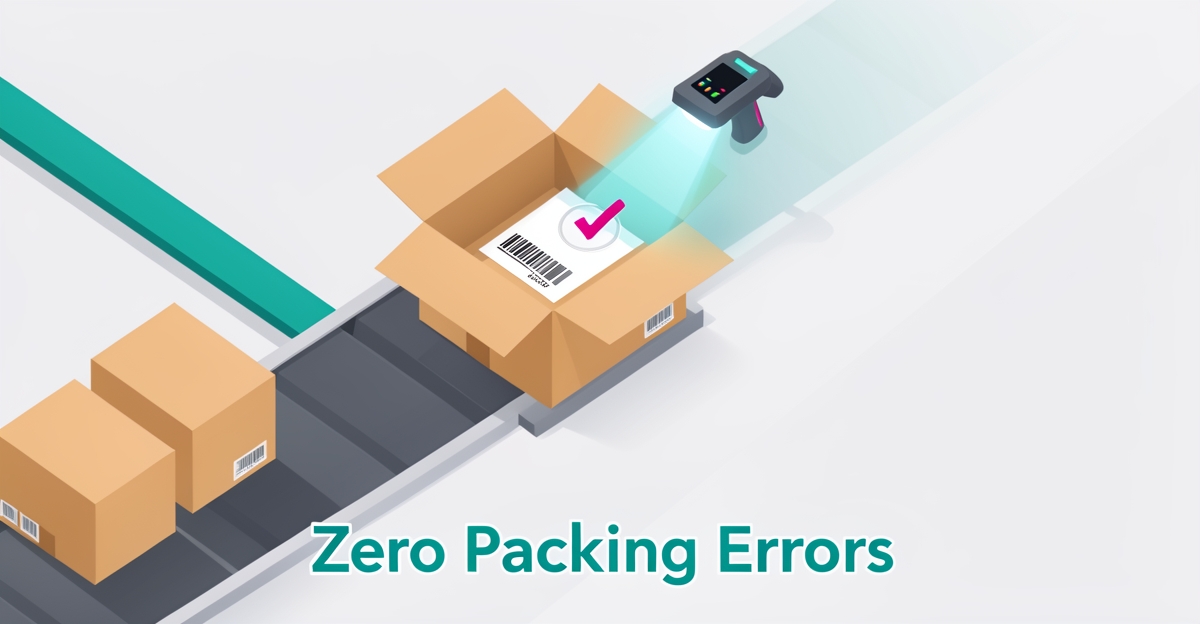
The technology works by combining computer vision with document processing logic. Cameras or handheld scanners capture label data, and AI cross-references it against the order manifest instantly. Instead of trusting a tired worker to catch a mismatch at 4 PM on a Friday, the system flags discrepancies before the first item goes into the box.
This matters more than ever as adoption accelerates. Packing verification is becoming a standard AI use case across logistics operations. The shift is not about replacing workers. It is about removing the repetitive, error-prone checks that humans are worst at maintaining consistently.
Here is what automated verification handles in a modern packing workflow:
- Real-time label validation against order databases to catch mismatches before packing begins
- Item count confirmation using vision systems that detect quantity errors instantly
- Discrepancy flagging that alerts staff to wrong SKUs, damaged goods, or missing components
- Audit trail creation so every verified order has a digital record for customer disputes
The efficiency gains compound quickly. When wrong-item shipments drop, so do the angry emails, reshipment costs, and hours spent on damage control. Support teams stop firefighting and start working on retention instead.
The real power comes from integration. Standalone scanners help, but custom document processing systems that connect directly to your existing warehouse management software eliminate the gaps where errors hide. AIQ Labs builds these systems to fit existing workflows rather than forcing operations to adapt to rigid software, validating data before shipment, not after complaints arrive. If packing verification is the workflow costing you the most, that's exactly what AI Workflow Builds are designed to rebuild at a fixed price.
The barrier to entry is lower than most operations managers expect. Implementation struggles usually reflect poor planning, not flawed technology. Starting with a single workflow like label verification lets teams prove value before scaling. The result is fewer returns, happier customers, and a packing line that finally keeps pace with order volume.
Implementing AI Validation: From Pilot to Full Ownership
Implementing AI validation in last-mile packing operations requires a structured approach that balances technical rigor with practical business constraints. For small and medium businesses, jumping straight into full-scale deployment often leads to stalled pilots and wasted resources. A phased path ensures each step builds confidence, capability, and ownership while avoiding vendor lock-in.
The first phase, discovery, focuses on mapping current packing workflows to pinpoint where errors originate, whether from misread labels, incorrect item counts, or manual data entry bottlenecks. AIQ Labs begins this stage with a detailed process analysis, assessing existing tools like label scanners, inventory systems, and order management platforms to determine integration points. This foundational work identifies high-impact opportunities, such as automating label validation using optical character recognition trained on your specific packaging formats, ensuring the solution targets real pain points rather than hypothetical gains.
In the development phase, the system is built incrementally using the Build in Milestones model. Each milestone delivers a functional component, like a label scanning module that cross-references SKUs with order details in real time, allowing businesses to validate accuracy before moving forward. This approach reduces risk: teams can test the AI's ability to flag discrepancies (e.g., a scanned label showing 2 units when the order calls for 3) and refine thresholds based on actual packing line performance. Crucially, the system is engineered for production readiness from the start, integrating directly with your ERP or WMS via API, so there's no rework when scaling.
Deployment follows with minimal disruption. The AI validation system runs in parallel with manual checks during an initial go-live period, capturing performance data and building trust among warehouse staff. Training is role-specific, packers learn how to respond to AI flags, while supervisors get dashboards showing error reduction trends. Because you own the code and configurations outright, there are no hidden dependencies or platform fees. As volumes grow or new SKUs are added, the system scales through the same modular framework, turning a pilot into a permanent, owned capability that continuously improves packing accuracy without increasing headcount. For a broader connected layer across your whole operation, AI Operating Systems extend the same approach beyond packing. Start with the 2-minute Fit Check to map your packing operation's highest-impact AI opportunity, then book a free 30-minute strategy call.
Still paying for 10+ subscriptions that don’t talk to each other?
We build custom AI systems you own outright. No vendor lock-in. Full control.
Not sure where to start? Ask our AI planner
Frequently Asked Questions
How does AI actually prevent packing errors before boxes ship?
What's the ROI on AI packing validation systems?
Will AI packing systems integrate with our existing warehouse software?
Why do most AI implementations fail in warehouse operations?
Do we need to replace our packing staff with AI?
How long does it take to deploy AI label verification?
Turning Packing Precision into Competitive Advantage
The cost of packing errors goes far beyond reshipping fees, it erodes customer trust, strains support teams, and weakens brand reputation in a market where more competitors are using AI to close operational gaps. By automating label scanning, verifying order details in real time, and flagging discrepancies before shipment, AI transforms last-mile packing from a liability into a streamlined, auditable process that frees staff for higher-value work. The path forward doesn't require overhauling your entire operation; starting with a single workflow like label validation lets you prove value quickly, build internal confidence, and scale on your terms. If you're ready to see where AI can make the biggest impact in your packing line, start with the 2-minute Fit Check, no sales pitch, just clarity on what's possible for your business.
Make AI your competitive advantage — not just another tool.
Strategy, implementation and ongoing optimization. One partner, end to end.
Not sure where to start? Ask our AI planner