How AI Can Reduce Design Rework and Save Countertop Fabricators Thousands of Dollars Annually
Hire a team member that works 24/7 — for less than a part-time wage.
AI receptionists, SDRs, dispatchers and 99+ roles. Trained on your business, fully managed.
Not sure where to start? Ask our AI planner
The Hidden Cost of Design Rework in Countertop Fabrication
A single misread dimension on a client’s email can turn a profitable countertop job into a costly redo. When specs live in scattered PDFs, handwritten notes, and long email threads, small errors slip through and quietly erode margins.
Most rework in fabrication shops does not come from lack of skill. It comes from fragmented information. A client confirms edge profiles in one message, updates sink cutouts in another, and sends final measurements as a PDF attachment. Each document is accurate on its own, but together they create conflicting versions of the truth. Teams then spend hours reconciling details instead of cutting stone.
This is fundamentally a data problem, not a people problem. As industry experts note, successful AI initiatives depend on strong data foundations and automation, not just new tools. When design inputs are unstructured and inconsistent, even the most experienced fabricator is forced into manual interpretation, which increases the risk of error.
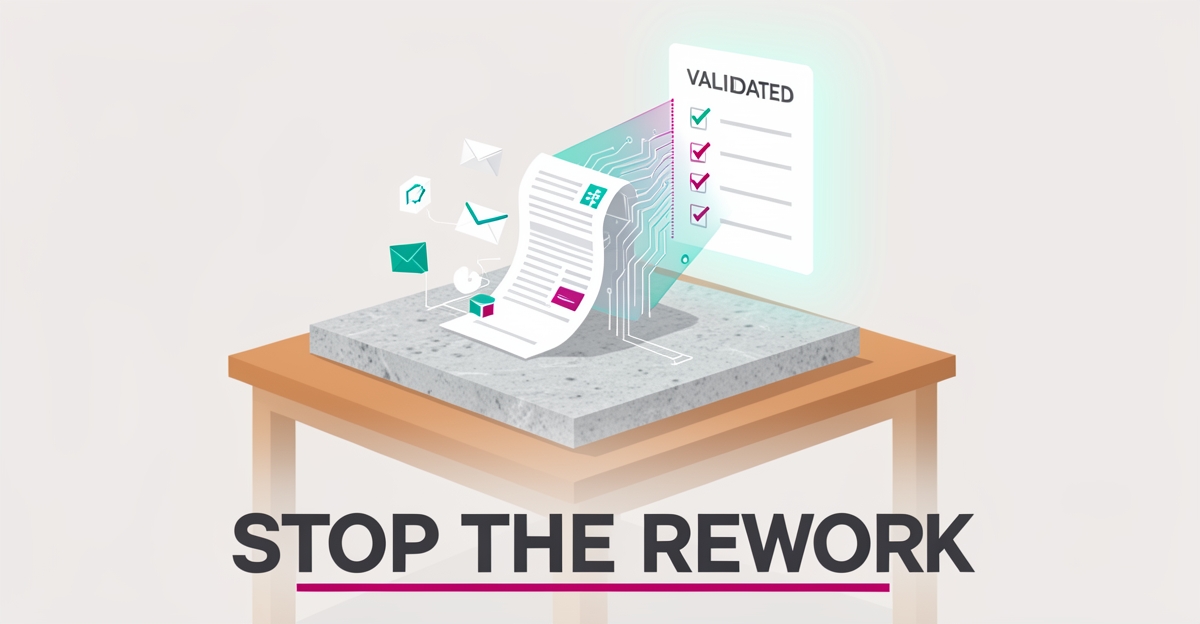
The financial impact compounds quickly. Rework means wasted slab material, additional labor hours, delayed installations, and strained client relationships. For small and mid-sized shops operating on tight margins, a few avoidable mistakes each month can add up to thousands of dollars annually. AI-driven document processing changes this dynamic by extracting and validating specs directly from emails, PDFs, and client notes before production begins.
Instead of relying on memory or manual cross-checking, AI systems can:
- Flag missing dimensions or conflicting measurements
- Compare new revisions against prior versions
- Validate specs against material constraints
- Push structured data directly into design and order systems
The broader lesson from AI transformation research is clear: start with business outcomes, not technology for its own sake. In one widely shared analysis, leaders are urged to map specific pain points to AI solutions and audit data quality before launching major initiatives. For countertop fabricators, that pain point is often design miscommunication.
AIQ Labs approaches this challenge by deploying document processors that integrate directly into existing workflows. By turning unstructured communication into structured, validated data, fabricators reduce guesswork at the source. The result is fewer surprises on the shop floor, tighter coordination between sales and production, and margins that stay intact where they belong. Learn more about AI Workflow Builds → /workflow-builds.
AI Document Processing That Validates Specs Before Production
A single misread measurement on a client email can send a $4,000 slab straight to the scrap pile. For countertop fabricators, the gap between what a client says and what reaches the saw is where thousands of dollars quietly disappear every year.
Most spec information never arrives in a clean format. It comes buried in email threads, scanned PDFs, handwritten notes from a site visit, and text messages with photos of a backsplash sketch. Someone on your team has to manually translate all of that into production-ready details, and every manual translation is a chance for error.
AI document processing changes that equation. Modern systems can extract design specifications directly from unstructured inputs, emails, PDFs, and client notes, then validate them against your production requirements before anything hits the shop floor. When edge profiles conflict between documents, when a sink cutout dimension is missing, or when material quantities don't match the layout, the system flags it automatically. Miscommunication gets caught at the intake stage instead of during fabrication.
The payoff compounds across every job. In documented AI transformation work, Google achieved a 50% reduction in project time by applying Large Language Models to complex migration tasks, evidence that AI-driven document and workflow handling delivers measurable speed gains, not just convenience. For a fabrication shop, that same principle applies to moving specs from inbox to production queue.
The technology only works, however, when the foundation underneath it is solid. As Pedro Martins puts it, "AI Transformation is not just about AI. Behind every successful AI initiative lies a robust foundation in data, automation, and cloud infrastructure." Before deploying spec validation, shops should audit their data quality, accessibility, and governance, your AI can only validate specs against standards your systems actually capture.
Practical implementation follows a familiar pattern drawn from AI-driven software transformation guidance:
- Identify pain points by documenting where spec errors and manual re-entry currently occur in your workflow.
- Build and test a prototype in a controlled environment, run AI extraction on a handful of real client documents before scaling.
- Empower your team by training staff on the new system and incorporating their feedback on flagged inconsistencies.
- Start with business outcomes, not AI capabilities, map each spec-validation feature to a concrete cost you want to eliminate.
This is where AI-driven software transformation differs from buying another standalone tool. The goal is a system where validated specs flow directly into your design and order platforms, eliminating the copy-paste step entirely. AIQ Labs deploys AI document processors that integrate directly into design and order systems, so extracted specs land where production actually happens rather than in another app nobody checks.
Alex Lieberman's observation cuts to the heart of it: "It's not sexy to say, but most of AI transformation has nothing to do with AI." The unglamorous work, clean data pipelines, connected systems, validated inputs, is exactly what prevents the miscommunication that costs fabricators thousands of dollars annually. When your specs are validated before production begins, rework stops being a line item on your P&L.
From Spec Extraction to Integrated Production Workflow
Extracting a spec is only half the battle. If that extracted data never reaches your design software or order system accurately, rework is still guaranteed. The real value emerges when AI document processors become part of the production workflow itself, where a flagged discrepancy in a client email stops a bad slab from ever hitting the saw.
This is where integration matters more than intelligence. An AI system that pulls specs from emails, PDFs, and client notes but then dumps them into a spreadsheet someone must manually re-key has simply moved the bottleneck, not removed it. Modern AI document processors connect directly into the design and order platforms fabricators already use, so validated specs flow straight into production without a human retyping a single dimension. AIQ Labs deploys exactly this kind of system, building document processors that integrate into a shop's existing design and order tools rather than sitting alongside them.
Getting there follows a proven path. An analysis of how to implement AI-driven software transformation recommends starting with business outcomes rather than AI capabilities, mapping specific pain points to potential solutions before touching any technology. For a fabricator, that means documenting where spec errors actually originate: Which client channels cause the most confusion? Where do measurements get lost in translation?
The implementation sequence looks like this:
- Identify pain points by documenting workflows and pinpointing where manual tasks or errors creep in
- Audit your data infrastructure, review quality, accessibility, and governance before any major AI initiative
- Build and test a prototype in a controlled environment, gather feedback, and refine before scaling to more users
- Empower your team by training staff on new systems and encouraging their input so continuous improvement sticks
That second step deserves emphasis. As one AI strategy analysis notes, auditing data quality, accessibility, and governance is essential before any major AI initiative, because AI runs on data. A fabricator whose client notes live in scattered emails and handwritten job tickets needs to consolidate that information first, or the AI will simply automate the chaos.
The payoff for doing this groundwork is real. Google achieved a 50% reduction in project time by applying large language models to code migrations, demonstrating what disciplined AI integration can deliver on document-heavy work. Closer to home, extracting and validating design specs from emails, PDFs, or client notes prevents the miscommunication that drives rework, saving fabricators thousands of dollars annually by catching inconsistencies and missing details before production begins.
Perhaps the most important lesson comes from Alex Lieberman's observation that "most of AI transformation has nothing to do with AI." Behind every successful initiative lies a robust foundation in data, automation, and infrastructure. For countertop fabricators, that means the shops winning with AI aren't the ones chasing the flashiest tools, they're the ones that connected validated spec data directly into the systems that actually cut, polish, and install. Learn more about AI Operating Systems → /ai-operating-systems.
Implementation Roadmap for Countertop Shops
Implementing AI in countertop fabrication starts with a focus on business outcomes, not technology for its own sake. Begin by documenting your current workflow, from initial client contact through design approval to production, and identify where miscommunication or missing details lead to costly rework. AI can extract and validate design specifications from emails, PDFs, or handwritten notes, flagging inconsistencies before they reach the shop floor. This proactive approach prevents errors that often require scrapping materials or re-cutting slabs, directly protecting margins. A recent study found that organizations using AI-driven software transformation achieved up to a 50% reduction in project time by eliminating preventable delays.
Success depends on strong data foundations and change management. Before deploying any AI solution, audit your data quality, ensure design specs, client communications, and shop notes are consistently captured and accessible. Poor data undermines even the most advanced AI, so establish clear protocols for how information flows into your system. Simultaneously, invest in team training and feedback loops; when designers and fabricators understand how AI reduces their rework burden, adoption accelerates. AIQ Labs supports this phase through its AI Employees → /ai-employees service, helping shops build cross-functional readiness and governance frameworks that align AI with operational goals. As one industry expert noted, most of AI transformation has nothing to do with AI, it’s about preparing people and processes to leverage it effectively.
Adopt AI incrementally to minimize disruption and build confidence. Start with a single high-impact workflow, such as automating the extraction of edge profiles, cutout dimensions, or material grades from client emails into your design software. Use AIQ Labs’ Build in Milestones → /pricing model to deploy a custom document processor that integrates with your existing tools, measure its impact on rework rates, then scale to adjacent processes like quote generation or installation scheduling. Continuous improvement is key: monitor performance data, retrain models with new edge cases, and refine governance as your AI maturity grows. This approach ensures AI becomes a sustainable capability, not a one-time project. For countertop shops aiming to reduce costly rework, the path forward is clear, prioritize outcomes, ground AI in clean data, empower your team, and expand success one workflow at a time. To explore how this applies to your specific operations, Start the Fit Check → /apply for a free strategy call that maps your biggest bottlenecks to high-ROI AI opportunities.
Still paying for 10+ subscriptions that don’t talk to each other?
We build custom AI systems you own outright. No vendor lock-in. Full control.
Not sure where to start? Ask our AI planner
Frequently Asked Questions
How exactly does AI prevent design rework in countertop fabrication?
What kind of cost savings can a fabricator actually expect from AI spec validation?
Do we need to replace our current design and order software to use AI document processing?
What happens if our client data is currently scattered across emails, PDFs, and handwritten notes?
How do we implement AI spec validation without disrupting current production?
Is AI document processing really worth the investment for a small or mid-sized fabrication shop?
Make AI your competitive advantage — not just another tool.
Strategy, implementation and ongoing optimization. One partner, end to end.
Not sure where to start? Ask our AI planner